Tech Investor | Linear Capital's Harry Wang: Understanding Technology Matters More Than Technology Itself
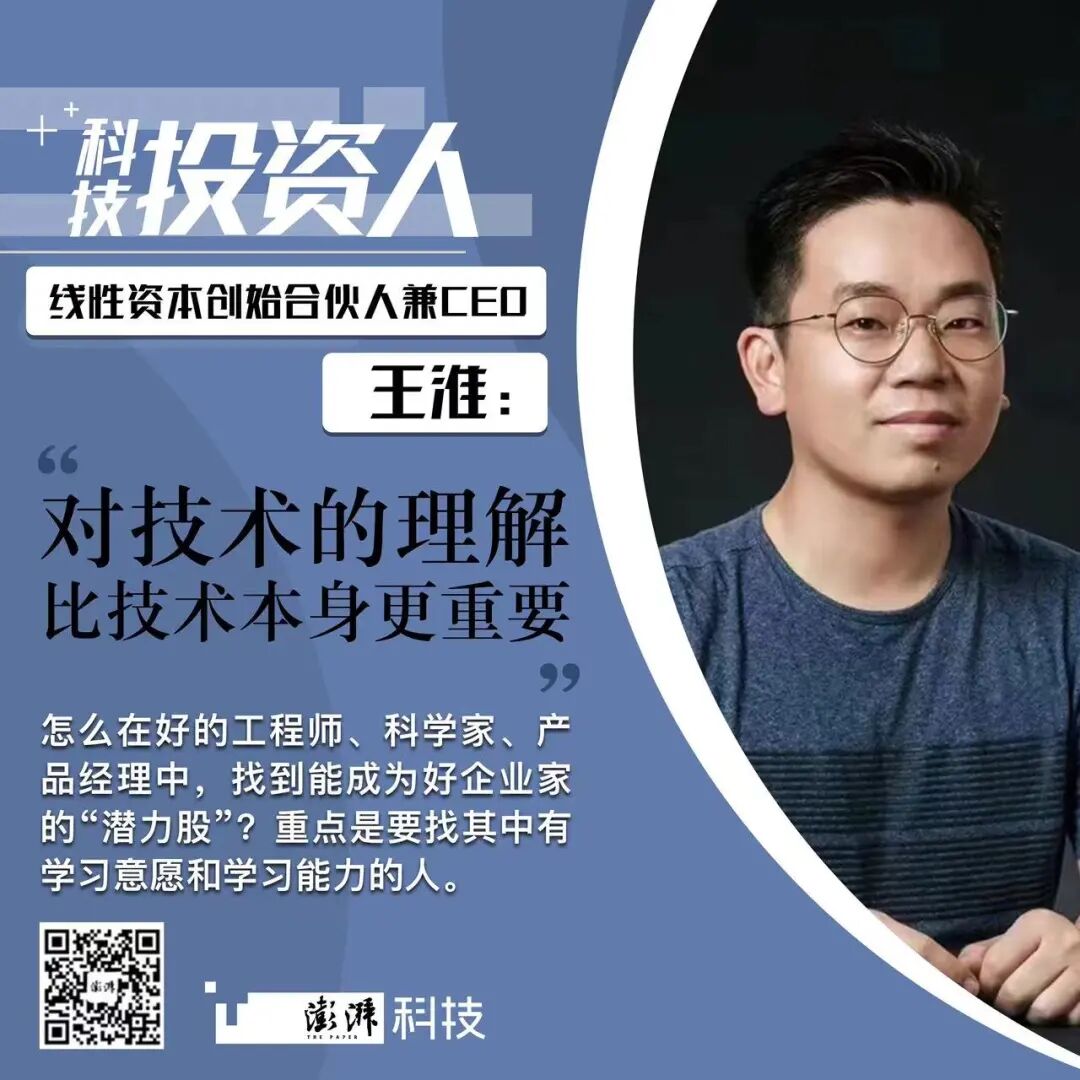
Recently, Harry Wang, founding partner and CEO of Linear Capital, sat down with *Pengpai Tech* to share the fund's perspective on the hot topic of ChatGPT, lessons learned from investing in AI commercialization projects, and how his investment philosophy has evolved over Linear Capital's eight-year history. As the article notes, Linear Capital has always emphasized that "technology is the primary productive force." We pursue and believe in technological innovation, while also maintaining deep respect for the humanities, our customers, business fundamentals, and capital markets.
Recently, Harry Wang, founding partner and CEO of Linear Capital, sat down with Pengpai Tech to share the fund's perspective on the buzz around ChatGPT, lessons learned from investing in AI-powered industrial projects, and how his investment philosophy has evolved over Linear Capital's eight-year history. As the article notes, Linear Capital has always maintained that "technology is the primary productive force." The firm pursues and believes in technological innovation, while keeping a watchful eye on the humanistic, customer, commercial, and capital market dimensions — "starting with technology, but never ending there."
Source: Pengpai Tech | Author: Chengtian Meng
- "ChatGPT is in a state where the infrastructure is extremely expensive, but applications are extremely cheap. So the key isn't whether you can build the application, but whether the application you build can rapidly land and expand in its target market, completing the commercial loop."
- "Because our commercial awareness has changed, we now focus more on understanding the problem the other side wants to solve, and only then discuss the technology. Otherwise, technology becomes pure academic research. That's the importance of problem-oriented tech."
If AI technology is to empower every industry, human understanding of the technology matters more than the technology itself. This may be Harry Wang's deepest realization after ten years in investing. "It's like when a company hires a highly capable employee — whether they can make good use of that employee depends not just on the employee themselves, but on whether the tasks match their strengths, whether the team's organizational structure makes sense, and many other factors," Wang explained to Pengpai Tech.
Before founding Linear Capital, Wang was the second Chinese engineer and first Chinese engineering manager at Facebook's headquarters in the US. He transitioned from engineer to individual angel investor in 2012, and established Linear Capital in 2014, bringing his technical expertise into investment decisions. In his conversation with Pengpai Tech, Wang repeatedly emphasized Linear Capital's unwavering belief that "frontier technology is the primary productive force." Yet beyond championing technological advancement, his sustained reflection on the humanistic, customer, commercial, and capital market dimensions has made his investment journey one that starts with technology, but never ends there.
Linear Capital was founded in 2014 with a focus on data applications, data infrastructure, and frontier technology applications. Notable portfolio companies include Horizon Robotics, Agile Robots, and Sensors Data. In the industry, Linear Capital's brand is as clearly defined as its name suggests: distinctly technical in character. Wang's exceptional track record in identifying early-stage tech companies has earned him repeated placements on ChinaVenture's rankings of "China's Best Early-Stage Investors" and "China's Best AI Industry Investors." Linear Capital itself has been selected multiple times for "China's Most Entrepreneur-Friendly Early-Stage Investment Institutions."
ChatGPT is five to six years away from being a truly usable product
On the currently red-hot topic of ChatGPT, Wang believes that while GPT-4 has demonstrated formidable capabilities, there remains a gap between capability and a genuinely usable product. This requires companies to deeply understand the technology and consider how to use it to replace everyday work. Wang also predicts that some mid-to-low-end mental labor jobs may be displaced by ChatGPT in approximately five to six years.
"Mid-to-low-end mental labor — such as junior-to-mid-level engineers, illustrators, publishing editors — perhaps 80% to 90% of this work could be replaced by ChatGPT within the next one to two years. But whether this ultimately happens depends on many human factors, including legal restrictions and ethical concerns. So I believe the final replacement may take five to six years," Wang explained.
Even at five to six years, this timeline is faster than most people imagine, because ChatGPT applications themselves aren't difficult — the hard part lies in GPT's underlying infrastructure. "ChatGPT is in a state where infrastructure is extremely expensive, but applications are extremely cheap," Wang noted. "So the key isn't whether you can build the application, but whether the application you build can rapidly expand in its target market and form a commercial closed loop."
Wang also mentioned that ChatGPT presents many application opportunities, and China can keep pace and build good products. But on the GPT infrastructure side, development may require substantial state support, introducing structural innovation and forming market-oriented mechanisms that encourage broader participation.
There are also domains where ChatGPT faces relatively difficult transformation, such as today's hardware end. Wang elaborated: "AI is the software, the soul; robots are the hardware, the body. You need the soul's core to make judgments and decide whether something should be done, but when it comes to interacting with the physical world to execute, you still need hardware."
ChatGPT excels at understanding, generating, reasoning, and decision-making, but execution still relies on humans or machines. The machines for execution are currently developing relatively independently, but could integrate with ChatGPT's development in the future. Wang expressed: "If integrated development also matures, then whether mental or physical labor, both could potentially be replaced by machines. The overall benefits of replacement outweigh the drawbacks — we remain full of anticipation for the future."
The last mile of AI product deployment
Similar to ChatGPT, Wang believes that applying AI technology across industries requires human understanding of the technology to matter more than the technology itself. The technology may be advanced and cool, but how to apply it becomes the harder question to answer. This isn't just about finding application scenarios for technology in industries — it also includes whether customers will understand and use the technology.
Agile Robots, a Linear Capital portfolio company, develops robotic system software and hardware with world-leading force control and force sensing technology, enabling robotic arms to predict, adjust, and feedback through force perception within extremely short latency times. "There's absolutely no question about the technological frontier. The difficulty lies in how to apply this technology — this is the company I worry about most," Wang shared. "At the time, we brainstormed several use cases through mind mapping, including glass polishing, surgery, screw tightening, and so on."
Through discussion and experimentation with application scenarios, Agile Robots' products eventually achieved scaled deployment on factory assembly lines for electronic consumer goods and automotive parts, as well as entering medicine and agriculture — including remotely operated surgical robots, intelligent farms, and food processing.
Beyond AI technology finding landing scenarios, embedding technology into the workflows of various industries requires people at every stage to understand the technology — both AI practitioners and industry users. Especially in traditional industries, long-established work habits don't change overnight, so the learning cost and trust cost of introducing new technology are correspondingly higher.
Aikonnong, a digital agriculture company in Linear Capital's portfolio, uses algorithm calibration and model optimization to provide farmers with planting and breeding recommendations — covering what to plant, how to plant it, when to water, fertilize, and apply pesticides, and in what quantities. Through digital-enabled precision management, agricultural production can significantly reduce costs while improving efficiency.
But how to get farmers to actually use this product exceeded Wang's initial expectations. "This was originally an excellent product — farmers could completely DIY their planting and breeding guidance through it. But faced with older farmers, they simply couldn't use the app. Aikonnong's eventual solution was direct B2B service for the B side, but for B2C they chose to partner with distributors, having distributors pass along Aikonnong's guidance to farmers via WeChat," Wang summarized. "In other words, the last mile of this product was achieved through the human service of distributors. This would be unimaginable in the US SaaS industry. Once the post-90s generation of new farmers takes over, this situation will improve significantly."
Wang explained that when an AI product is first developed, it's trained on industry big data. Every enterprise's situation differs somewhat from industry standards, so there's always a one-to-three month adaptation period for initial adopters. Additionally, whether an enterprise's organizational structure and decision-making processes are compatible with AI — even after adopting AI technology, employees continuing business as usual — these were all problems that arose when AI previously tried to penetrate various industries.
"AI technology entering an industry must go through a process of data collection and calibration verification. Only when effective data volume reaches a certain foundation does the AI model become effective, and only as data volume continuously increases does effectiveness keep improving. But during this process, how many people in the industry are willing to share the burden with you? This is a chicken-and-egg problem — many industry people try it briefly and then give up," Wang stated.
To help portfolio companies' technologies be understood by more investors and customers, Linear Capital has invested substantial time and effort in introducing advanced technologies to broader audiences. Wang said, "Our technology judgment is recognized in the industry, but for a company with good technology — can they do good technology productization, product commercialization, and what is their future commercial potential? Linear has done extensive work telling the story of how our portfolio companies' technologies transform industries. We're essentially acting as free financial advisors for our portfolio companies."
Problem-oriented tech
Over Linear Capital's eight years, through various successful and failed investments, Wang's continuous reflection and review have made the firm's investment methodology and values increasingly clear. Wang summarized three ways in which Linear's current thinking differs from before — overall, compared to its early pure emphasis on technological superiority, the firm now stresses more the importance of combining technology with business.
First, greater emphasis on commercial success, because investing is about maximizing technological value through commercial means. Second, greater emphasis on whether technically-backgrounded entrepreneurs are willing to become good business leaders — here, whether the entrepreneur has the willingness to learn is crucial. Third, greater respect for the irrationality of capital markets, emphasizing that when markets are weak, companies must first "survive."
"Because of changed commercial awareness, we now focus more on understanding the problem the other side wants to solve, and only then discuss its technology. We're not requiring entrepreneurs to have a very clearly defined problem they want to solve, but they must be willing to explore this. Otherwise, technology becomes pure academic research. That's the importance of problem-oriented tech," Wang said.
"Second, how to find the 'diamonds in the rough' who can become good entrepreneurs among good engineers, scientists, and product managers — the key is finding those with the willingness and ability to learn," Wang elaborated. "Some people love technology but have no interest in learning to do business. Some prefer working alone and can't handle teamwork. These are all fatal flaws for being an entrepreneur. We didn't care as much about this before — now we care very much."
"Third, we respect capital markets more than before. In the past we emphasized that gold will always shine, that we must be patient for the long term. But if a company can't survive, the future is irrelevant to them. Something we've emphasized greatly over the past three years is 'survive.' So we also pay more attention to companies' commercial operations," Wang summarized. "Because technology must have impact, not just flex its muscles."
"Now that we consider more factors, acting more like a 'proper' investor — will we miss out on some entrepreneurs with real spark? We don't know. That's also what makes investing interesting," Wang said with a smile.
About Linear Capital
We are hiring talent to join our investment team. Multiple positions are currently open. For details, please click here.
Linear Capital is an early-stage investment institution focused on "frontier technology + industry" — that is, frontier technologies including data intelligence, digital new infrastructure, next-generation robotics technology, and new technological transformations in traditional domains (such as biomedicine, materials, energy, etc.), applied across vertical industries to substantially improve industrial efficiency, empower the resolution of pain points, and complete industrial upgrading — achieving excess returns through substantial increases in industrial value. The firm currently manages ten funds with total AUM of approximately $2 billion.
Our investment stage focuses primarily on leading angel to Series A rounds, with typical check sizes of $3 million to $8 million or RMB equivalent.
To date, Linear has made early-stage investments in over 120 entrepreneurial teams including Horizon Robotics, Kujiale, Sensors Data, Tezign, Rokid, Guandata, and Agile Robots. The combined valuation of Linear's portfolio companies is approximately $20 billion.
In the near term, Linear Capital is working to become the premier "Data Intelligence Technology Fund." In the long term, it aims to gradually build itself into the most influential "Frontier Technology Application Fund."