Backed by HSG and Linear Capital, Former Tencent Executive Builds Virtual Concerts Drawing Nearly Ten Million Views

Steve Jobs once said: "The low-bandwidth era transmits information; the high-bandwidth era may transmit emotion."
Author: Shuo Zhang
Editor: Suyun Shi
Steve Jobs once said: "In a low-bandwidth era, what gets transmitted is information. In a high-bandwidth era, what gets transmitted might be emotion."
Over the past few years, the pandemic forced a surge in emotional density within virtual spaces. On one hand, work, life, and entertainment gradually shifted from offline to online. On the other hand, for highly experiential activities like live music performances, the information density conveyed by a flat screen simply wasn't enough. In the view of Chaoyan Zhang, founder and CEO of Bizhen Technology, consumers at an event need rich experiences — watching performances, seeing artists, socializing, free exploration — and the atmosphere and emotional fulfillment this requires can only be delivered through 3D.
Founded in February 2019, Bizhen Technology is a full-chain service platform for creating, publishing, and trading 3D real-time interactive virtual spaces. It aims to provide creators with out-of-the-box virtual space solutions, helping musicians, curators, brands, and other organizers efficiently host various virtual events.
From a scalability perspective, Bizhen Technology has built an S2B2C business model — a three-party system of creators, platform, and consumers, with multiple stakeholders co-creating content. Its flagship product "Bifang City" is a multi-user online 3D real-time interactive space built on cloud rendering, 3D engines, real-time audio and video, motion capture, and lightweight WEB technologies.
On the funding front, in March 2023, Bizhen Technology completed a tens-of-millions RMB angel+ round, with Cathay Capital and Linear Capital as investors. In March 2022, it received angel funding from Linear Capital and HSG.

Top-Tier Technical + Content Hybrid Team, Starting from Virtual Concert Scenarios
Pony Ma once proposed the concepts of "comprehensive reality internet" and "spatial internet," which map onto the characteristics of two generations of the internet. The previous generation's information carriers were primarily text, images, and video; the next generation will be 3D environments. This is driven by improvements in computing networks and bandwidth infrastructure, upgrades in underlying technologies like 5G, big data, and cloud computing, and conceptual innovations around the metaverse, blockchain, and Web3.0.
Among these, virtual reality technology, as an entirely new form of interaction, has evolved into a novel consumer terminal — virtual spaces that enhance user experience.
On the market front, the Ministry of Industry and Information Technology released the "Action Plan for Integrated Development of Virtual Reality and Industry Applications (2022–2026)," which specifies that by 2026, China's overall virtual reality industry scale (including related hardware, software, and applications) will exceed 350 billion RMB, with VR terminal sales surpassing 25 million units, 100 backbone enterprises with strong innovation capabilities and industry influence cultivated, 10 clusters with regional influence that lead VR ecosystem development created, and 10 industry public service platforms established.
Transformation first seeps into industries that heavily emphasize experiential quality and face spatial constraints. Performances and exhibitions have long been concentrated in first-tier cities; consumers who want to experience them up close can only do so through physical displacement. Meanwhile, over the past few years, offline performances became extremely scarce due to pandemic impacts.
This became Bizhen Technology's entry point. "What we want to do is bring the space to the consumer," Chaoyan Zhang told Xiaofanzhuo reporters. Bizhen Technology aims to use reality as a foundation, achieving seamless migration between online and offline, thereby bridging the virtual and physical worlds.
Among various performances and exhibitions, Bizhen Technology first切入 virtual concert scenarios. In Zhang's view, music scenes carry higher emotional density, requiring极致 lighting, stage design, audio-visual effects, and real-time interactivity. If they could crack the music scene, expanding into other domains would come naturally.
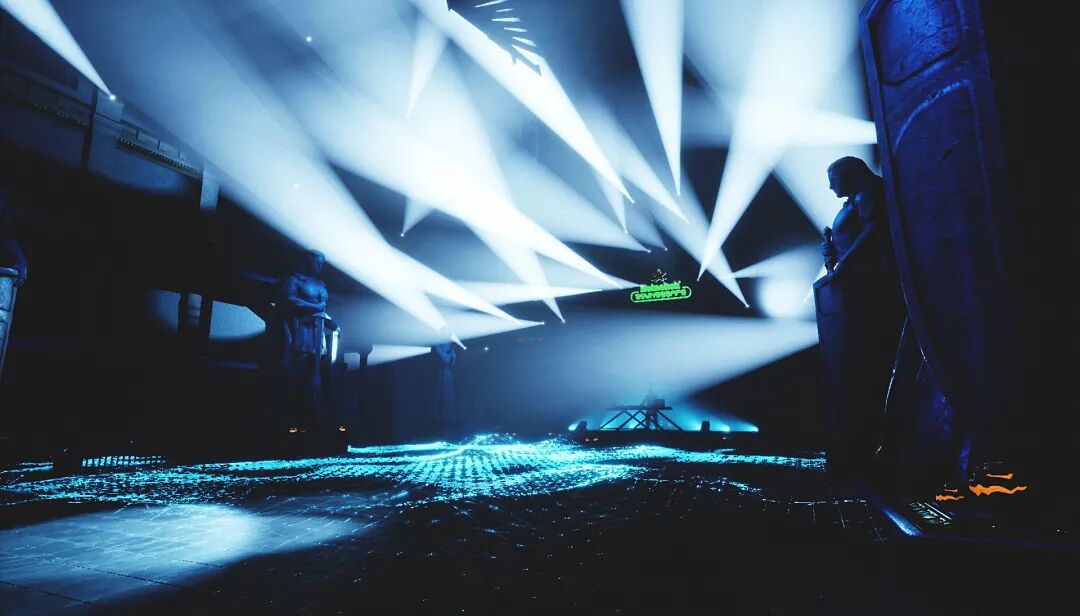
- Virtual concert scenario -
Throughout the virtual concert production process, beyond co-creation, Bizhen Technology's primary role is more like that of a "translator" — bridging "content" and "technology." The virtual concerts built by Bizhen Technology are created by professional lighting designers, architects, modelers, and designers who input data into the virtual space while maintaining their existing workflows, achieving high-fidelity experiences and efficient production.
The concerts leverage cloud rendering and motion capture technology, enabling musicians to real-time restore their voice, movements, expressions, and interactions into the virtual space. The space also supports users in creating personalized avatars, who can join the virtual scene and participate in interactions through a simple link. Access is not limited by platform or terminal, including mobile phones, PCs, tablets, and VR.
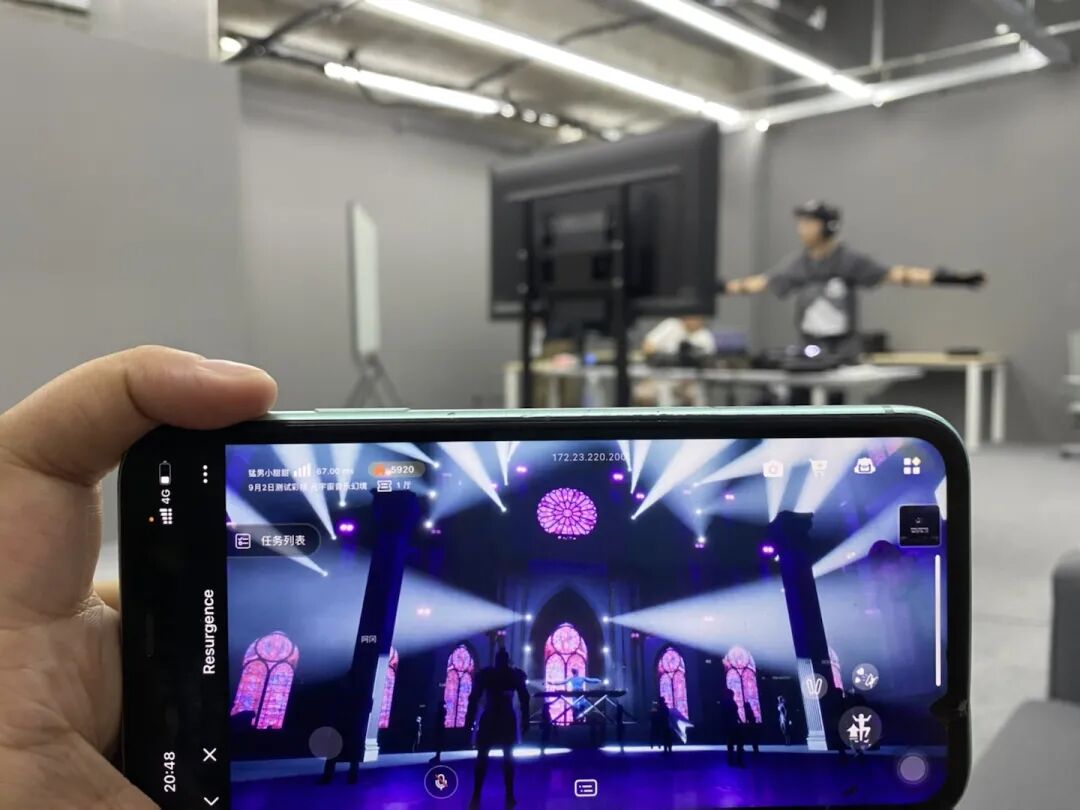
- Motion capture set -
This places high demands on the platform's underlying technology. Chaoyan Zhang and Bizhen Technology's CTO previously worked at Tencent Interactive Entertainment, accumulating deep technical expertise. Before切入 the concert scene, the Bizhen Technology team had developed numerous works in the VR gaming space, with multiple titles winning top prizes at Qualcomm's XR competitions multiple times.
Beyond its Tencent DNA, Bizhen Technology's team includes members from NetEase, Alibaba, and AMD, with an average of over 10 years of graphics rendering and 3D engine experience, over 6 years of XR industry experience, and 20+ related industry solution experiences, possessing solid full-stack technical and product delivery capabilities. Meanwhile, some team members come from content and film industries, including CMC Holdings and Modern Sky. Additionally, its design team hails from the pioneering independent architecture firm Atelier Archmixing, with Class-A qualifications and extensive online and offline design experience in its core team.
To date, Bizhen Technology has hosted multiple large-scale virtual events. In 2022, it launched 6–7 3D virtual events, including three metaverse 3D real-time virtual concerts — the world's first RT3D cloud-rendered 3D real-time virtual concert "New Wulin," and two RESURGENCE WORLD virtual performances co-created with top electronic music label RESURGENCE.
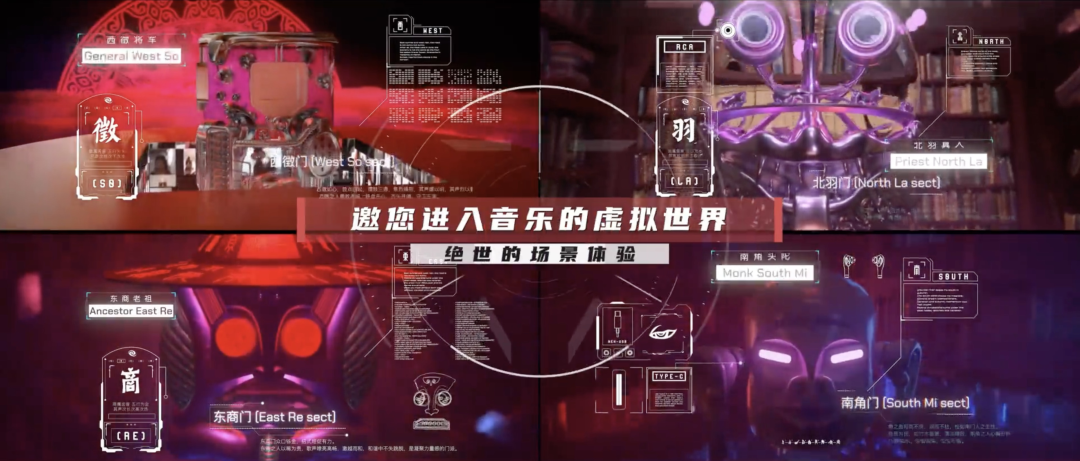
- The world's first RT3D cloud-rendered 3D real-time virtual concert "New Wulin" -
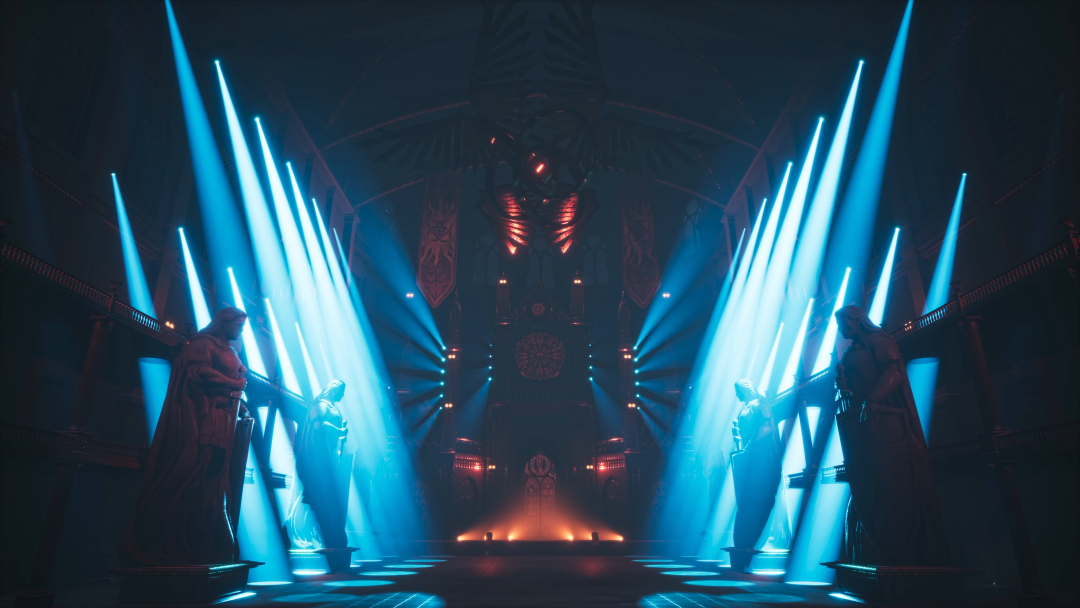
- "RESURGENCE WORLD" virtual performance co-created with RESURGENCE -
All three performances were thousand-person events. After purchasing tickets, users could enter the venue as virtual avatars and buy virtual props, glow sticks, expression costumes, and more. According to statistics, single-event exposure across all platforms reached tens of millions, with live viewership on WeChat Channels surpassing one million.
At the first concert in collaboration with RESURGENCE, Bizhen Technology achieved C-side commercialization for the first time, with limited tickets at various price points selling out instantly. Beyond this, it also sold membership services, 3D virtual wristbands, Bored Ape virtual avatars, and other NFT merchandise within the scene.
But as offline businesses recover, will consumer enthusiasm for virtual concerts gradually wane? Chaoyan Zhang told Xiaofanzhuo reporters that virtual spaces are not temporary substitutes for offline activities during special times; their value is more of a complement, and may even achieve transcendence in the future. "Whether in terms of cost, effects, spatial retention and continuity, or interactive re-creation, virtual spaces demonstrate enormous advantages."
For example, in a concert, singing on a spaceship in outer space, or taking a bow amid exploding flames — effects impossible on real stages — can all be realized in virtual space.
Beyond the concert scenario, Bizhen Technology will expand virtual spaces into more application scenarios, specifically four categories: first, the broader music industry, such as large-scale music festivals, livehouses, and solo concerts; second, the cultural tourism industry, through collaborations with scenic spots; third, the film and television industry; and fourth, exhibition events.

Building the S2B2C Business Model
Becoming the "Amazon + Netflix" of the Virtual Reality Industry
This year, Bizhen Technology has two main development goals. The first is technology: improving technical capabilities to lower the barrier for creators, while scaling up virtual performances to achieve tens of thousands of simultaneous online users with immersive participation. The second is scale, both in terms of creation volume and economic returns.
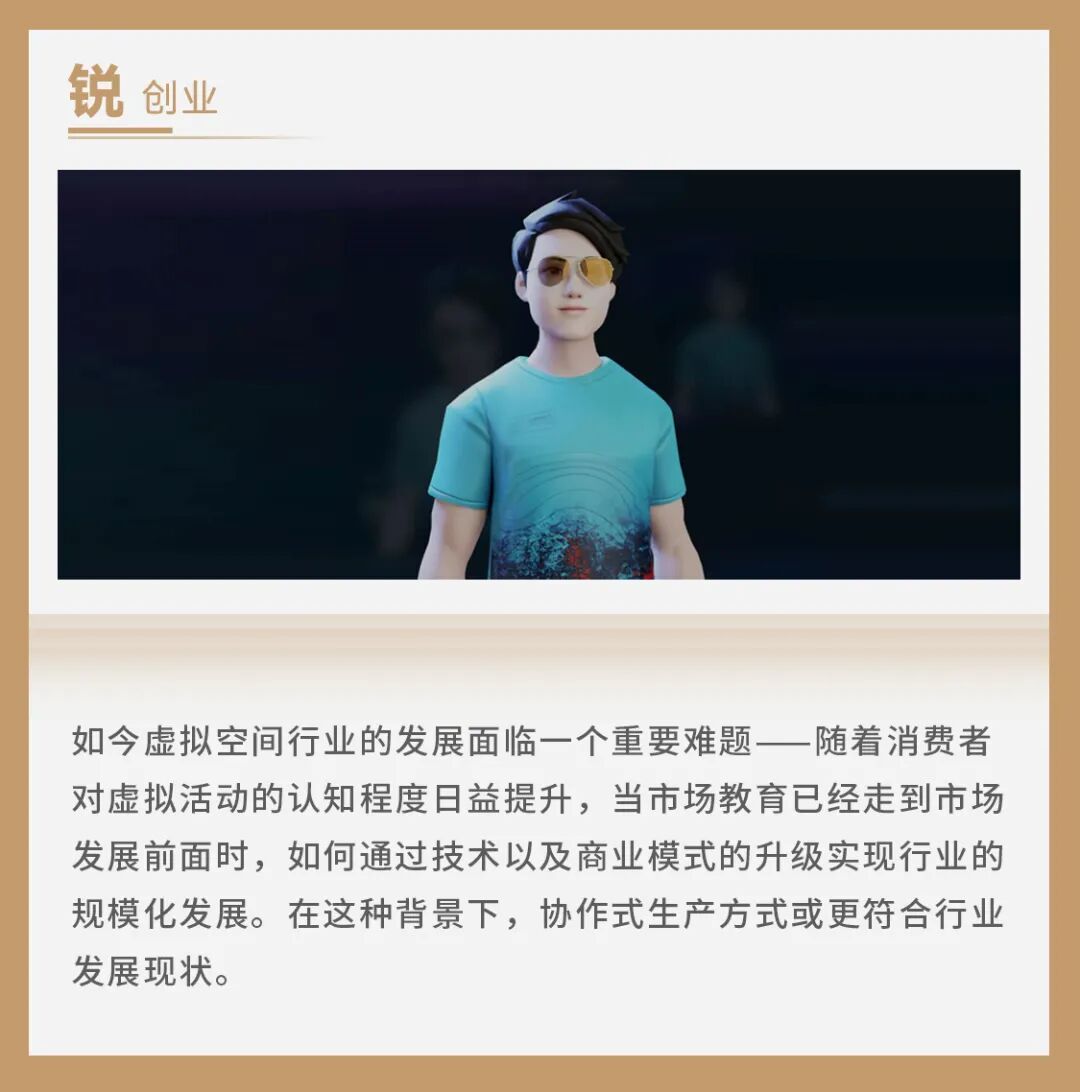
These two goals also address the challenges currently facing the virtual space industry: as consumer awareness of virtual activities grows, and market education outpaces market development, how to achieve industry-scale growth through technological and business model upgrades.
In Chaoyan Zhang's view, collaborative production models better fit the industry's current state. The existence of "technical barriers" keeps the threshold for virtual space content creation high. "Current 3D space production basically relies on professional engines like Unity and Unreal; content creators can hardly participate directly." This requires Bizhen Technology to gradually break through technologically, enabling musicians and artists to complete content production without needing to master specialized technical skills. Until content breakthroughs happen, using business models to influence production methods is the optimal choice.
Thus, Bizhen Technology defines its business model as S2B2C. Here, S stands for professional service providers, including lighting designers, architects, modelers, etc.; B stands for creators, i.e., musicians, curators, brands, labels, or other organizers; C represents the end consumers of various performance events.
Unlike most metaverse and virtual space teams currently adopting a B2B model to solve problems "case by case," the S2B2C model that Bizhen is building emphasizes connecting brands and creators, integrating them with the platform to build a sustainable, cyclical economic ecosystem.
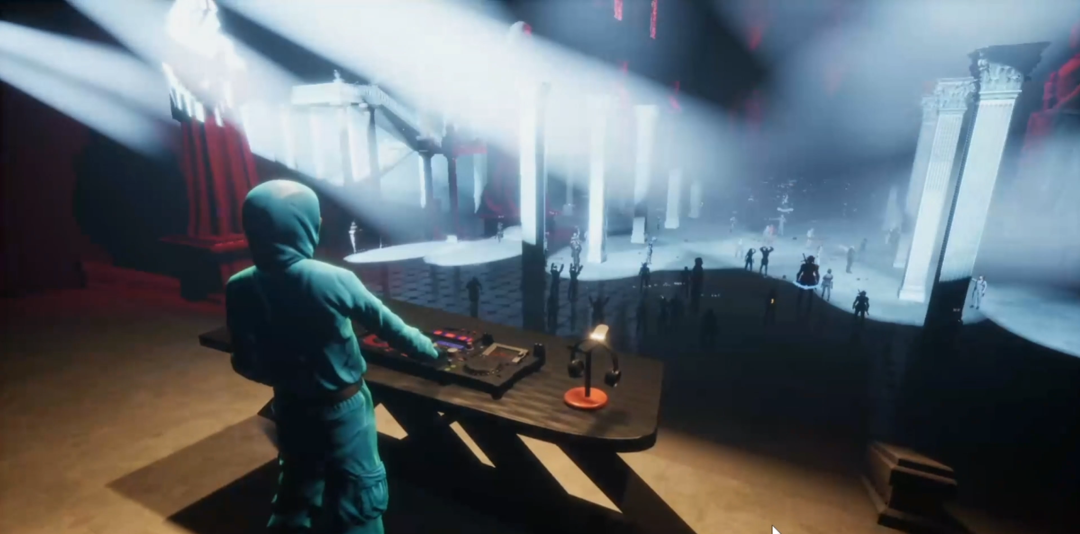
- Performance scene -
Zhang stated that Bizhen Technology's ultimate development goal is to become the "Amazon + Netflix" of the virtual reality industry — to form a virtuous, cyclical economic system like an e-commerce platform, where every participant gets what they want. For example, creators can present their ideal content, consumers can gain better viewing experiences, brands can achieve expected communication effects, and professional service providers can obtain work opportunities and compensation. In the early stages, the company will focus on encouraging content production and providing corresponding support.
For brands of different scales, Bizhen Technology adopts different service strategies. For large domestic clients, it provides full-chain customized services covering technology, product, planning, and operations. Meanwhile, Bizhen Technology also welcomes small and medium creators to join the platform, co-creating virtual spaces or events, enriching online scenarios, and achieving mutually beneficial outcomes.
In Bizhen Technology's definition, each virtual space built for brands is never a "one-off deal." Zhang explained that in Bifang City, every virtual performance, concert, or exhibition belongs to the label's sustainable space. After the event concludes, they can continue using that space as a vertical fan gathering place, hosting meet-and-greets, exchange sessions, and various online activities, maximizing the extended utility of each virtual space and optimizing returns.
Bizhen Technology's "Bifang City" platform provides comprehensive support for creators and brands in virtual spaces, offering consumers a new scene. "Bifang City" will be a city with indigenous inhabitants and GDP, where creators can profit, scene content providers can operate spaces and sell digital goods, and consumers can shape virtual avatars and "live" in the city.

- "Bifang City" platform -
Beyond building its own "Bifang City," Bizhen Technology also constructs "city-level digital spaces" for governments — out-of-the-box virtual space solutions based on cloud rendering, 3D engines, real-time audio and video, and other technologies. These deeply integrate the physical economy with virtual spaces, providing digital economic empowerment across party and youth league building, investment attraction, talent recruitment, cultural tourism, commercial consumption, and agricultural and industrial development.
Going forward, the company will continue to dig deep into the virtual space field, verifying whether data assets, as a fifth factor of production, can truly form an economic system.