"AI + Vertical Industry Applications" Salon Recap: What's Changing in Marketing, Law, and Healthcare?

Since ChatGPT's official launch, the generative AI-driven entrepreneurship wave has continued to spread globally — and after 300 days, the赛道 remains as hot as ever. The long-term value proposition that **generative AI will transform productivity** has become an industry consensus. Yet the road ahead is long. The harder questions behind this revolution are how to **translate technology into real-world deployment, accelerate the development of innovative applications in vertical scenarios, and achieve commercialization**.
Since ChatGPT's official launch, the generative AI startup wave has continued to spread globally, and after 300 days, the track remains red-hot. The long-term value proposition that generative AI will transform productivity has become industry consensus. But the road ahead is long — how to translate technology into real-world deployment, accelerate the deepening of innovative applications across scenarios, and achieve commercialization is the sober reflection behind this revolution.
Amid product transformation and industry restructuring, Microsoft Accelerator and Linear Capital recently co-hosted a closed-door salon, bringing together over 60 investors, founders, technical experts, and industry specialists to share and exchange in-depth perspectives on AI + vertical application deployment from the angles of investment and financing, product innovation, and technology.
The speakers (in order of appearance) came from Microsoft, Linear Capital, Whale, PowerLaw, and Wuxi Technology. Additionally, the event attracted mid-to-senior level executives from major enterprises and institutions including Bosch Group, Danone, Johnson & Johnson, Diageo, Alibaba, SenseTime, CITIC Capital, Shanghai State-owned Capital, and Temasek.
Below is a recap of the speakers' insights from the event:

1. Linear Capital Fully Embraces AIGC
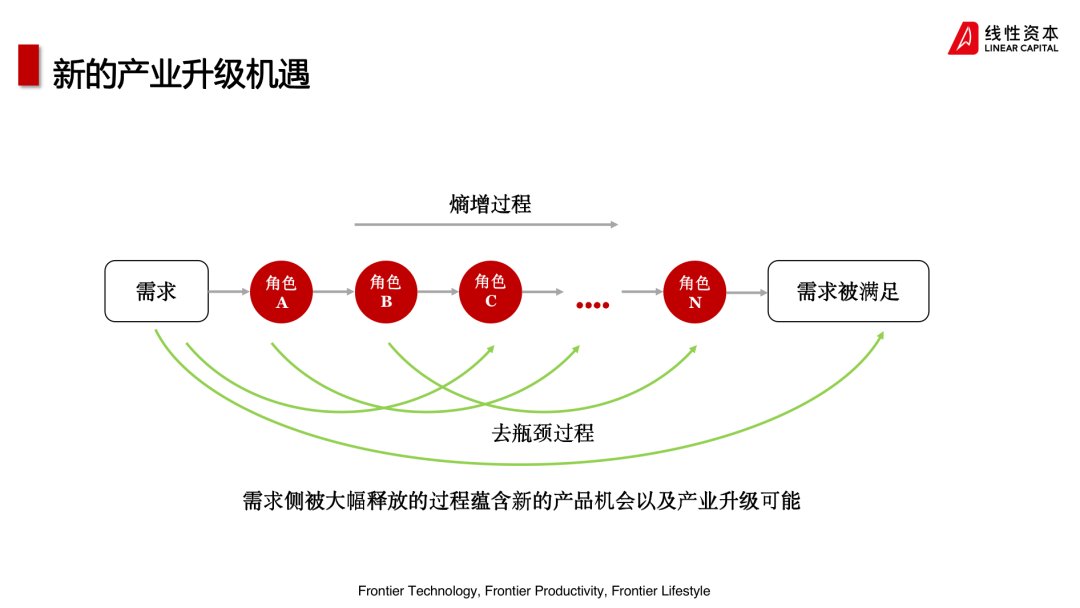
We compare this wave of AI to the Industrial Revolution. It has produced a new production factor called general machine intelligence, abstracting human society's most scarce and least standardizable intellectual activities into scalable productivity supported by computational power. The massive unleashing of such productivity will inevitably drive deep transformation across industries and scenarios. Since early this year, more startups have concentrated on large models and computing platforms, but we believe that over a longer time horizon, new AI application domains will present even greater opportunities.
2. Portfolio Approach: Grounded and Aspirational
The former focuses primarily on solving pain points in vertical scenarios. We see abundant opportunities in the industry where technological innovation driven by data intelligence can create value — this has been a consistent investment theme for us. We have supported numerous AI startups across vertical industries including marketing, design, manufacturing, construction, pharmaceuticals, legal, agriculture, and more. Today's AI capabilities far exceed those of previous small models, and we believe this will unlock substantially greater value. The latter focuses on how today's AI has created entirely new forms of human-computer interaction and information processing. Faced with the potential for dramatically improved efficiency in how we consume and process information, new product forms — even new hardware products — are bound to emerge. Overseas, companies like Rewind and Humane have already appeared in this space, and we believe China has similar opportunities.
3. The AIGC Era Sets a Higher Bar for Startup Teams
Today, the barrier to using AI has been significantly lowered, but leveraging AI to build a commercially viable product remains deeply challenging. First, the team needs profound understanding of the problem they're solving, coupled with strong adaptability to keep pace with technological change — this is what it takes to achieve TPF (Technology-Problem Fit). On the other hand, we have always placed great weight on team resilience. Entrepreneurship is grueling; those who make it to the end are the cockroaches that just won't die.
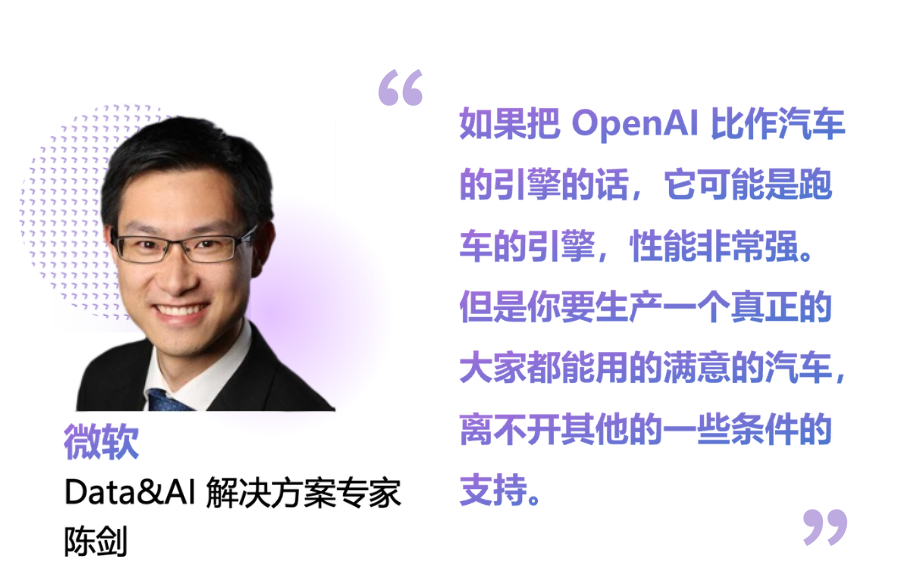
1. OpenAI's Distinctive Advantage — "Chain of Thought" Technology refers to OpenAI's step-by-step reasoning process, demonstrating its analytical approach. This thinking method offers advantages over other large models that deliver results directly, generating more accurate and logically coherent outputs. Additionally, Azure provides OpenAI with enterprise-grade capabilities such as data security, model diversity, customization, content filtering, and access control, ensuring security and compliance for enterprise users.
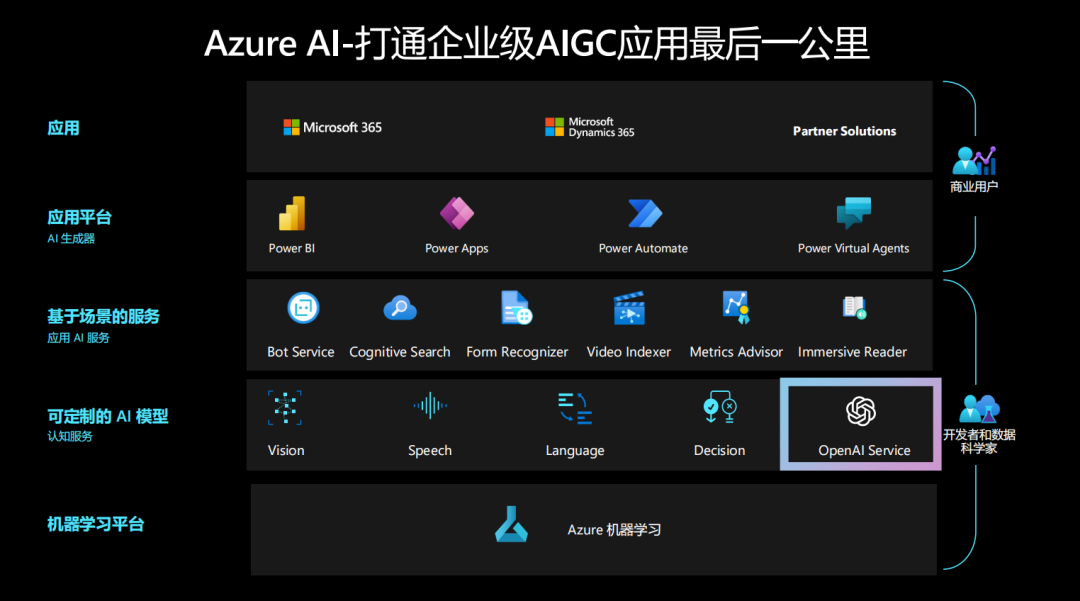
2. Microsoft Integrates OpenAI Services with Its Own Applications, Forming a Complete Toolbox Microsoft bridges the last mile of enterprise AIGC applications by fully integrating OpenAI's capabilities. Using this "long guns plus short artillery" approach, it provides customers with a complete toolbox that maximizes their ability to leverage AIGC without starting development from scratch. For example, Microsoft 365 comes built-in with Microsoft's AIGC functionality, which we call Copilot — you can simply use conversational requests to have it do anything for you.
3. For AIGC Deployment, Microsoft Thinks Across Four Dimensions: Enhancing Brand Influence, Improving Internal Operational Efficiency, Boosting Employee Well-being, and Revolutionizing User Experience Microsoft is helping enterprises identify the optimal integration points for AIGC technology, such as intelligent customer service, employee training, and enterprise private knowledge bases. By fully leveraging large models' powerful semantic understanding and summarization capabilities, these applications can dramatically reduce human resource costs — representing relatively mature and readily deployable AIGC solutions.
4. Large Model Capabilities Are Conversational
This conversation spans five main areas: talking to documents, talking to data, talking to applications, talking to the web, and talking to multimedia. Microsoft's Azure OpenAI is the only platform where OpenAI can be used normally. As long as an enterprise has a Microsoft international account with OpenAI services activated, it can use the API normally.
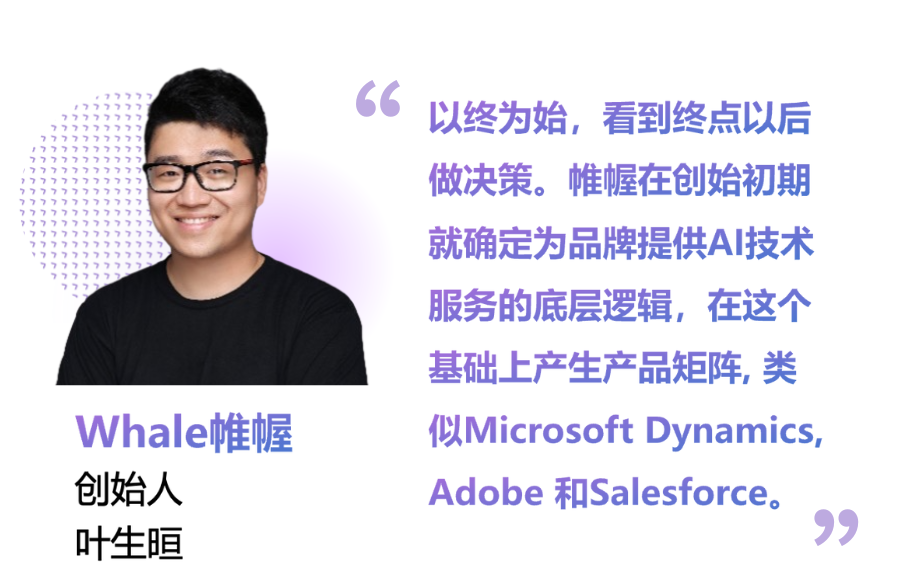
1. From Day One, We Mapped Out the Complete Marketing and Sales Architecture, Built Our Product System on That Foundation, and Executed GTM in Phases
Whale determined from its founding the underlying logic of providing AI technology services to brands, and from there developed its product matrix. We see that this type of company's endgame is inevitably providing customers with a product suite to meet their operational needs (like Microsoft Dynamics, Adobe, or Salesforce). Every product and feature we build starts from the customer and emerges from customer needs. For example, Whale Harbor (Whale's content marketing hub) existed as a product two years ago — it was there in embryonic form on day one of our founding, just called CMS back then. You couldn't build a major product this quickly otherwise. So it's not that we're "adjusting" or "expanding" our product line — we thought through the complete marketing and sales architecture from the start, built a product system on that foundation, and executed GTM in phases.
2. Whale Partners with Many Agencies — We Don't Compete with Them
In this wave of large model entrepreneurship, we believe marketing will be the fastest to land at the application layer, because marketing and sales are closest to the money. In everything we do, we tell clients it's about ROI — every dollar of AI investment we make helps drive attributable conversion. AIGC, or rather AGI, can enable mass customization of content, which precisely matches marketing and sales' demand for personalized content. Content marketing is the touchpoint between brands and consumers: content at the core, connecting people with products. In a flywheel marketing structure, nearly every stage and role across marketing, sales, service, and more has direct consumer touchpoints — advertising, e-commerce, livestreaming, private domains, full-field roles engaging with users almost around the clock — creating virtually unlimited quantities of content needs across unlimited scenarios. But Whale doesn't do agency work, meaning we don't directly provide AIGC image services. Whale's advantage lies in our nationwide customer coverage. We've been in constant dialogue with industry clients, accumulating extensive best practices and know-how. The technology we develop on this foundation will find the best PMF across various vertical industries.
3. For Building Large Models: Data > Computing Resources > Talent > Models
High-quality data will be the scarce resource, especially for Chinese-language large models. Because Chinese is extraordinarily rich — compared to English, its forms of expression are more diverse and complex, and sampling its logic is more difficult. Second is computing resources, the driving force behind model growth, which typically requires very substantial investment. Third is talent — the specialized knowledge for training models is critically important, and very few people can actually do it. Training models is like being a magician and artist, requiring intuition and talent. Finally, models themselves — most models are now publicly available.
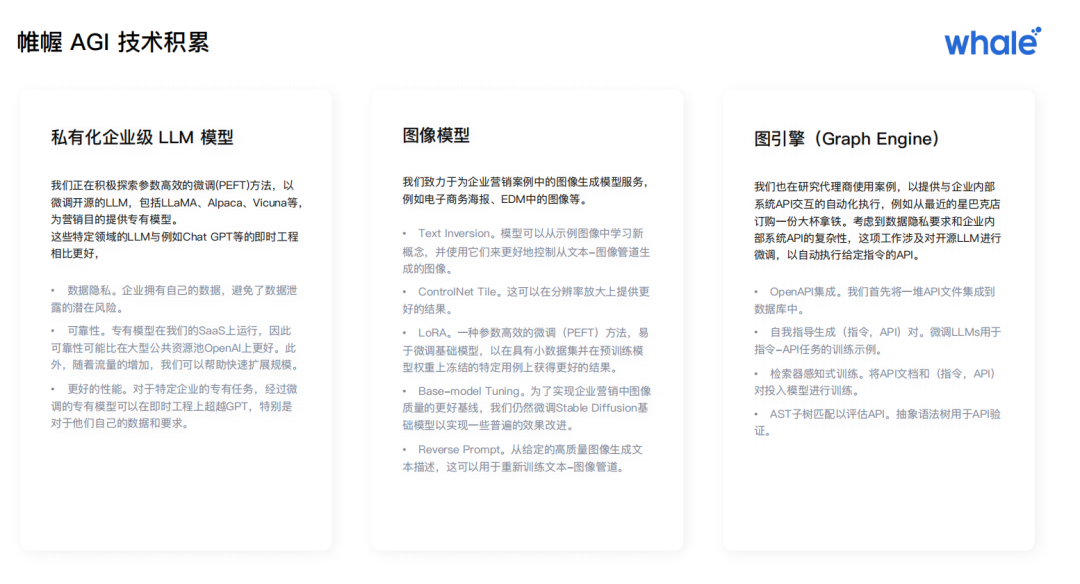
Whale's technical accumulation in AGI has focused on three areas.
First is enterprise private LM models. We are actively exploring parameter-efficient fine-tuning (PEFT) methods to provide proprietary models for marketing purposes.
Second is image models. We are dedicated to serving enterprise marketing use cases with image generation models, such as e-commerce posters and images for EDM. Finally is the Graph Engine. We are also researching agency use cases to provide automated execution that interacts with enterprise internal system APIs.
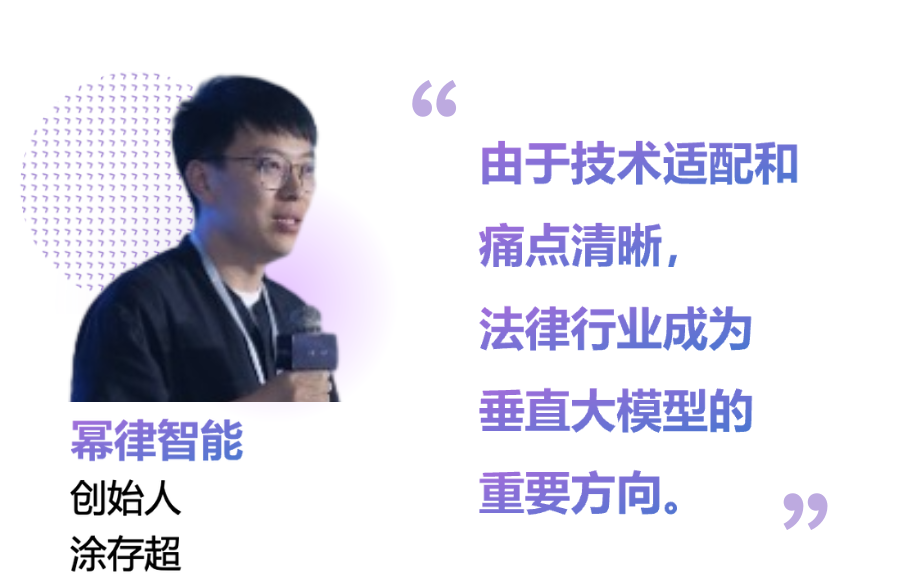
1. Due to Strong Technical Fit and Clear Pain Points, Legal Has Become a Major Direction for Vertical Large Models
Most tasks in legal scenarios involve text input and text output, which aligns highly with current large model capabilities. Overseas, large model applications in the legal track are relatively mature and have entered the integration phase. Although China's legal services market lags far behind the US in size, it is growing rapidly with enormous latent demand. However, the imbalance between the cost of accessing legal services and clients' ability to pay remains the primary contradiction. Large models present a tremendous opportunity to address this core tension.
2. The Core Capabilities for Building Vertical Models Are Large Model Development Capability and High-Quality Data Acquisition Capability
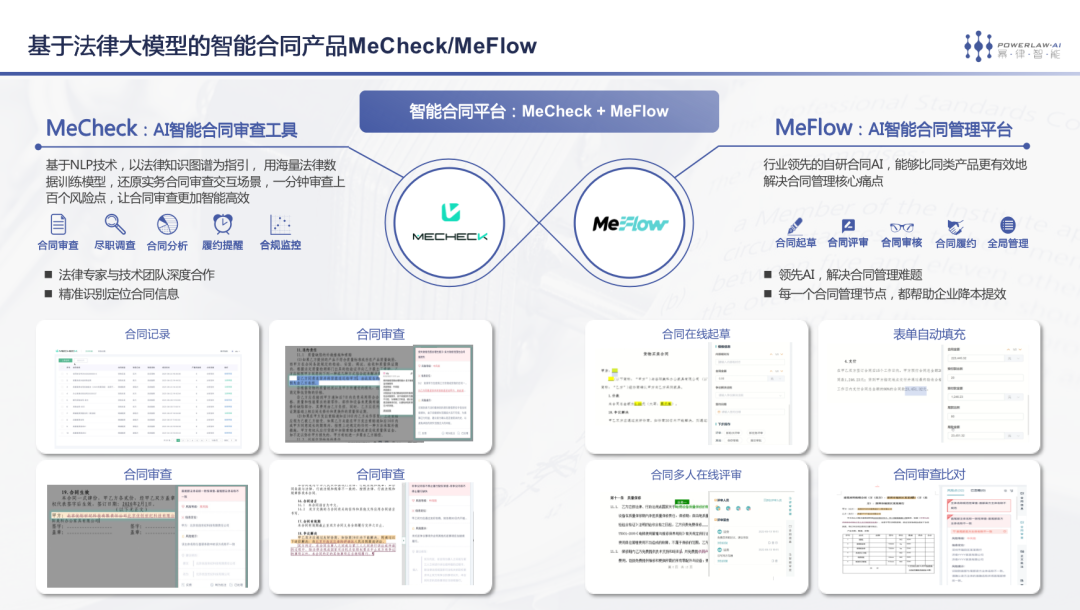
PowerLaw partnered with Zhipu AI to launch PowerLawGLM, China's first self-developed legal large model, with core functions including contract extraction, contract review, contract drafting, and routine legal consultation. Building this large model tests two capabilities: one is large model development capability, which places extremely high demands on the base large model. The other is data sample quality. Because the model primarily serves vertical legal scenarios, it requires training on contract knowledge data, contract text data, annotated data, and user feedback data, building relevant data flywheels to ensure continuously leading model performance.
3. A Major Challenge in the Entrepreneurial Process Is Direction Selection, Requiring Continuous Trial and Error and Learning
This involves understanding the industry, grasping pain points, and selecting customers. Many scenarios in legal face issues of market space, client payment capacity, barriers to entry, and differentiation. Choosing a direction that matches your capabilities and is suitable for long-term deep cultivation is extremely difficult, requiring continuous trial and error and learning. Building a legal large model is not the end goal — the aim is to drive its application in concrete products that solve real problems enterprises face in legal services, making clients willing to pay for the product.

1. Pharmaceuticals Is a High-Frequency Scenario for AI Applications with Long-Term Value
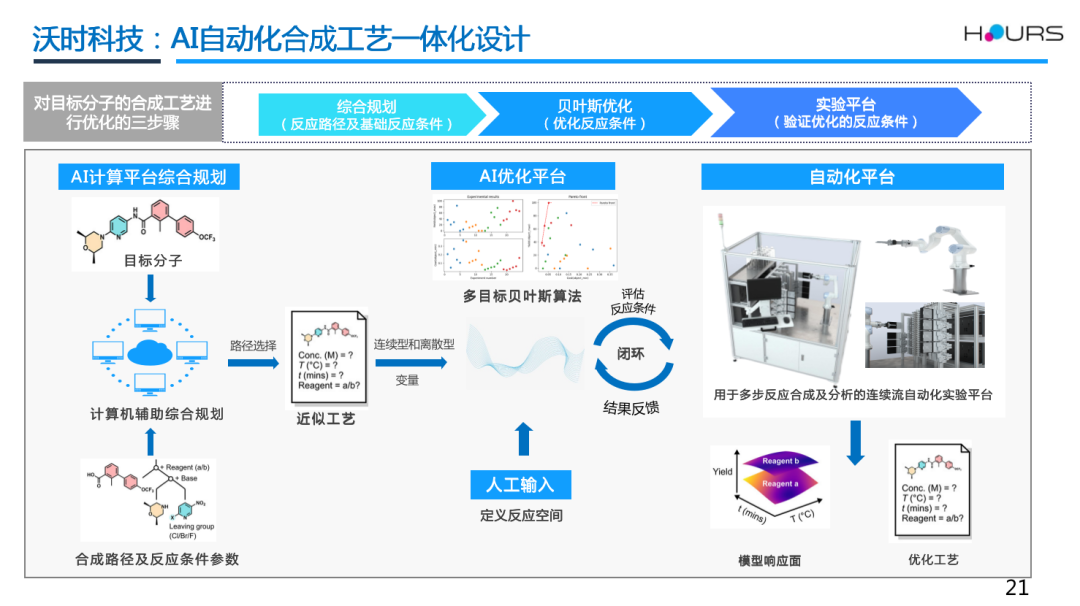
The pharmaceutical industry is one where informatization, intelligence, and automation are generally quite low. Whether from regulatory compliance requirements, refined operations, or domestic substitution, there is a market gap. At the same time, pharmaceutical R&D, including synthesis scenarios, involves very long chains. Facing this market opportunity, Wuxi launched two platform products: an AI computing platform and an automated synthesis platform. We have already used sub-models to conduct experiments in drug structure design, reaction condition optimization, and dosage prediction. Validation has proven that AI models can recommend better reaction conditions, improve yields, and even discover new reaction pathways. Overall, Wuxi Technology combines pharmaceutical AI with automation to improve drug R&D efficiency end-to-end and reduce R&D costs.
2. AI + Pharmaceuticals: A Long Road Ahead
Although the value of AI in the pharmaceutical industry is gradually being recognized and validated, rapid commercialization and deployment remains challenging. Regarding how to advance commercialization and launch standardized software products, we have consistently followed a commercialization-driven R&D approach — from product initiation through development, everything is closely tied to customer needs. Although Wuxi Technology is still a relatively young team, based on our accumulated data, product deployment, and GTM market experience built up over the years, we have already established a deep moat.