Linear Capital Portfolio Company Tezign Founder Fan Ling's Lecture Notes: Creativity Has a Moore's Law Too

**"History is an arrow. It comes from the distant past and flies toward the future. AIGC is that arrow, just released — it may be a once-in-fifty-years technological breakthrough."** **— Fan Ling, Founder and CEO of Tezign**
"History is an arrow. It comes from afar and flies toward the future. AIGC is that arrow, just released — it may be a once-in-fifty-years technological breakthrough." — Fan Ling, Founder and CEO of Tezign
MacPaint was the previous generation's computer drawing tool, the predecessor of Photoshop. The moment it appeared, typesetters — a profession that had existed for over 500 years — vanished from history entirely.
As we enter the AIGC era, what impact will rapidly advancing AI have on human work and life? Will numerous traditional enterprises face collapse? How should innovative companies and professionals respond? In coexisting with AI tools, what boundaries should humans maintain?
Why did the emergence of Photoshop cause graphic designers' workloads to quadruple?
This morning, Professor Fan Ling, Founder and CEO of Tezign and Director of the Tongji University Design AI Lab, joined the Chuangxin (Chaos) app to analyze the evolution of creativity and productivity in the AIGC era.
Tezign, a unicorn enterprise founded in 2015, is dedicated to building digital infrastructure for creative content. It has served over 200 large and medium-sized enterprises including Alibaba, Unilever, Procter & Gamble, L'Oréal, Volvo, and McDonald's, as well as more than 100,000 creators worldwide.
Can creativity truly be computed?
Professor Fan Ling says: "Whether creativity is computable or not isn't a black-and-white matter. When we frame it as opposites, we gradually forget that many interesting things can emerge in between. In that swamp between the two — that's where life is most vibrant."
Below are course notes: (Due to space constraints, this article covers only one-tenth of the course content. Please visit the Chuangxin app for the full course!)
Instructor: Fan Ling, Founder and CEO of Tezign, Director and Professor of the Tongji University Design AI Lab, Doctoral Supervisor Editor: Chuangxin Business Research Team Support: Chuangxin Frontier Course


My Dilemma: How to Integrate Engineering with Art and Design?
I have two full-time jobs. My first is as Director, Professor, and Doctoral Supervisor at the Tongji University Design AI Lab. My second is as Founder and CEO of Tezign, where I work 16 hours a day.
Holding both roles — one focused on technology, the other on creativity and design — I've consistently worked to combine the two. The name "Tezign" reflects this: Tech + Design = Tezign, with the Chinese name Tezan being a phonetic approximation.
I've been conflicted since childhood, always wanting both left and right. I studied engineering but always treated art as a hobby. Over a decade ago, I was doing research and teaching in the US and China; for the past eight years, I've been teaching while building a company. I see my mission as bridging technology and creativity — a pursuit that demands both extensive knowledge and the gritty entrepreneurial spirit of someone willing to get their hands dirty. Both qualities suit my inherently conflicted nature.
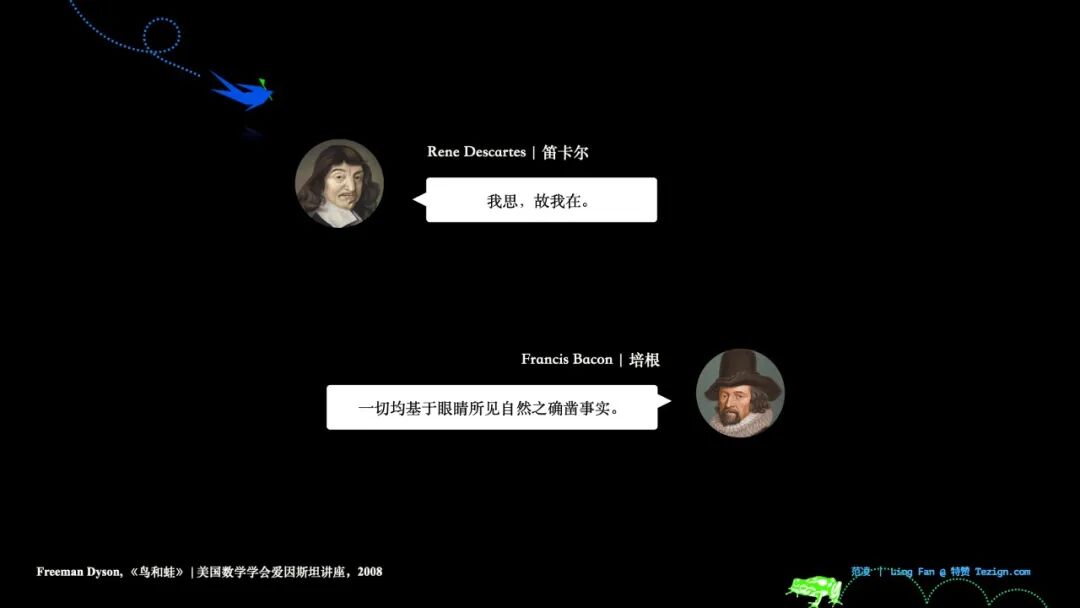
In 2008, I attended a lecture by Freeman Dyson at Princeton. Dyson was a physicist who came close to winning the Nobel Prize but ultimately chose science communication, becoming a renowned popular science writer. This lecture later became a famous essay, "The Bird and the Frog," which argues that modern scientific development requires two types of people: birds and frogs. The former, represented by Descartes, believes "I think, therefore I am" — that everything must first be contemplated. The latter, represented by Bacon, holds that "practice is the sole criterion for testing truth." It is the coexistence and joint development of these two roles that gave rise to modern physics.
Today, I'll borrow these two perspectives to explain the evolution of creative productivity.

How Do We Turn Creativity into Data?
How do we turn creativity into data?
In fact, everyone produces and consumes data. The internet offers various ways to measure this: roughly 5% of data is called structured data, while 95% is called unstructured data.
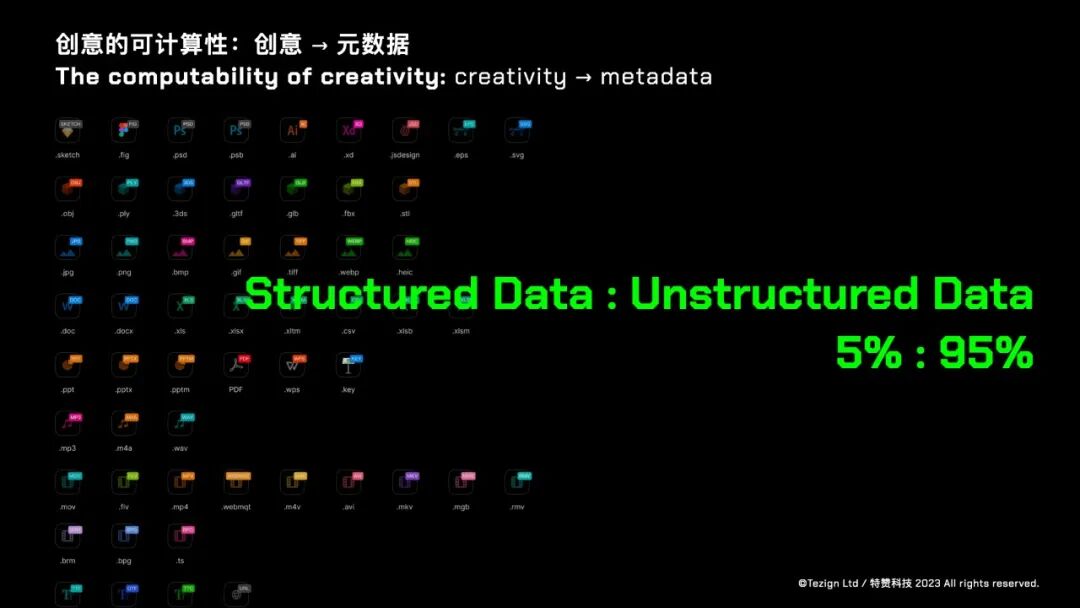
What is structured data? Structured data is anything that can be processed in an Excel spreadsheet — relational data, like 1+1=2. The previous generation of databases handled relational data, solving the problem of recording and computing structured information.
What is unstructured data? Much of what humans create is unstructured: images, text, video, models, interactions, and so on.
If we want machines to "have eyes" and "be able to see," we need an important dataset: ImageNet, which taught machines how to look at images.
In recent years, we've been working to help machines understand unstructured things — or human creativity. We wanted machines with eyes to also have aesthetic sense, so we created DesignNet, teaching machines to understand creativity, design, color, and composition.
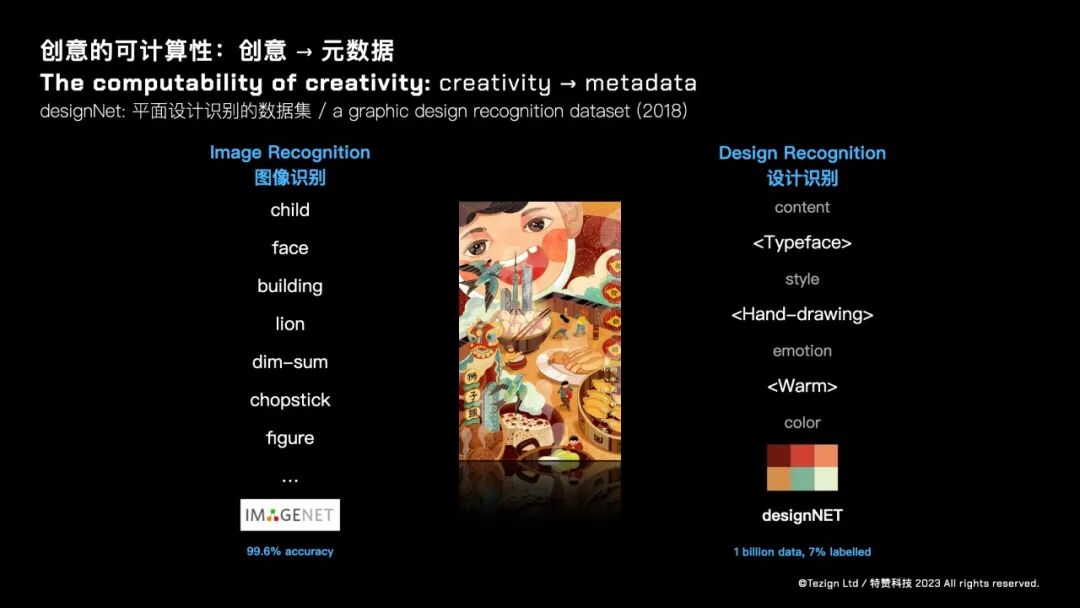
Take this image as an example. On the left is ImageNet, with labels for people, faces, text, food. On the right is DesignNet. The fact is, machines "seeing" doesn't mean they have aesthetic judgment. ImageNet cannot understand an image's style or color combinations; it mainly tags images. After extensive tagging work, ImageNet gained "eyes."
Our next step is to have machines learn creative and design knowledge by reading literature, documents, and books. Datasets are mainly for recognition; knowledge graphs begin establishing connections between recognized elements. It's like machines learning theory before applying it in practice. With both datasets and knowledge graphs, machines have foundational design knowledge and can further understand and create design.
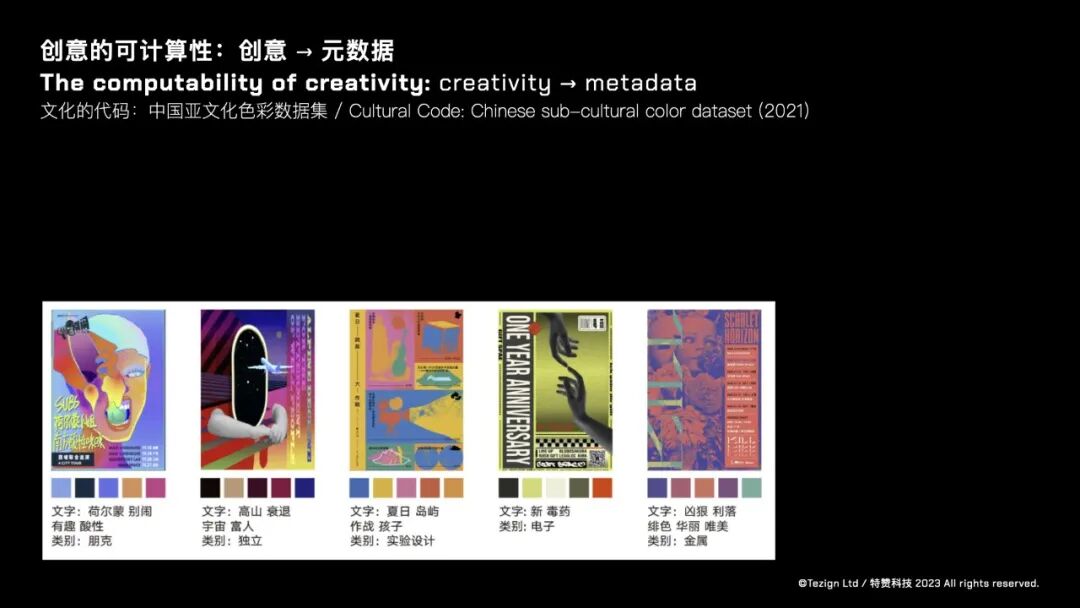
Our company has many young people who change their hair color weekly. They call these colors "subcultural colors" — the color palettes found on rock music posters. Based on our thinking about using AI image recognition, color recognition, and other methods for color identification, cultural research analysis, and establishing logical patterns, we launched a subcultural color dataset research project. With this dataset, machines can help us better understand subcultural color phenomena, and we can apply subcultural colors to anything to make it trendier.
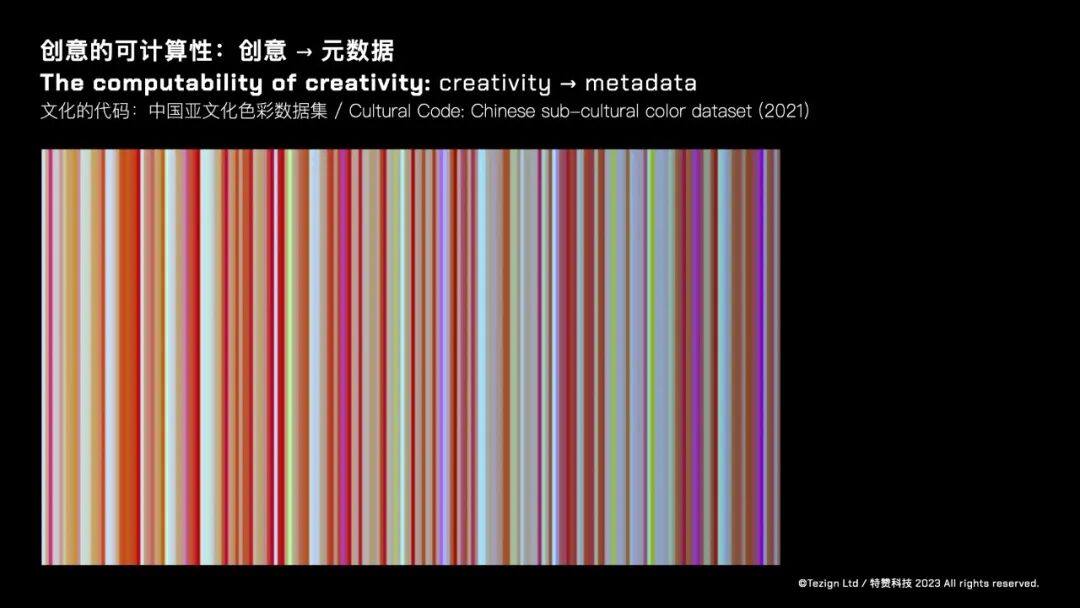
Later, a friend told me that our research process on the subcultural color dataset was essentially cultural analytics. Increasingly, humanities research is adding quantitative wings — for example, Professor Zhiwu Chen uses quantitative methods to study history, and there is also quantitative economics, quantitative urban studies, quantitative sociology, and of course, quantifying our understanding of creativity and design. So the scientification and engineering of humanities is a general trend, while simultaneously, the barriers to AI and computing are lowering, allowing people with humanities backgrounds to use analytical methods from engineering and science.
Due to space constraints, this article covers only one-tenth of the course content. Click the poster below to listen to the full course!

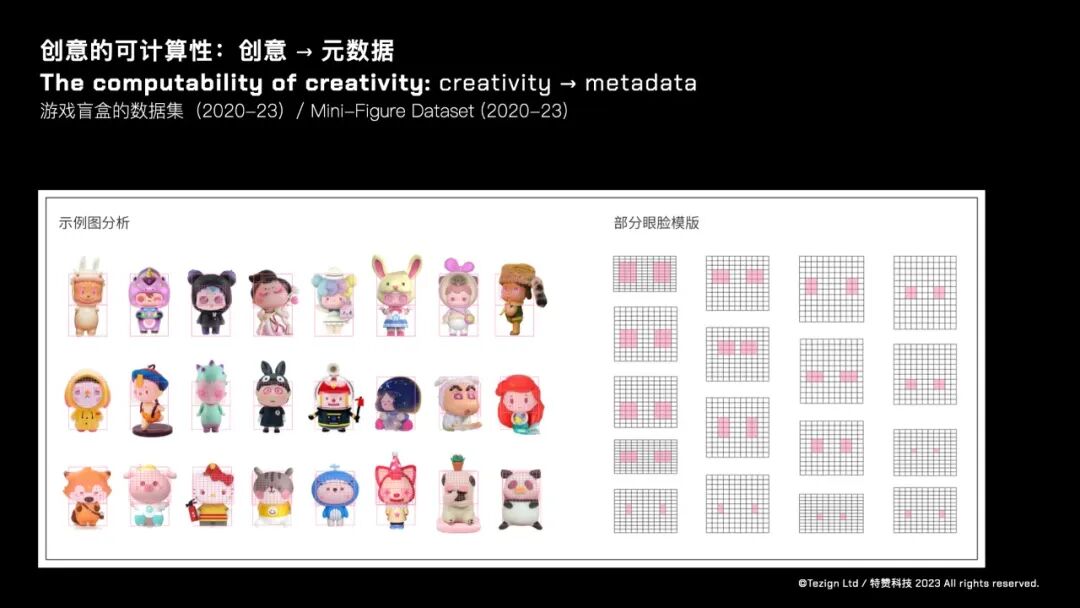
Our employees are particularly eager to turn creativity into data — any trendy cultural phenomenon, they want to analyze culturally. Recently, the company created a type of blind box with different forms, structures, themes, colors, and prices, and also conducted a blind box dataset analysis. We call this entire process the computability of creativity.
[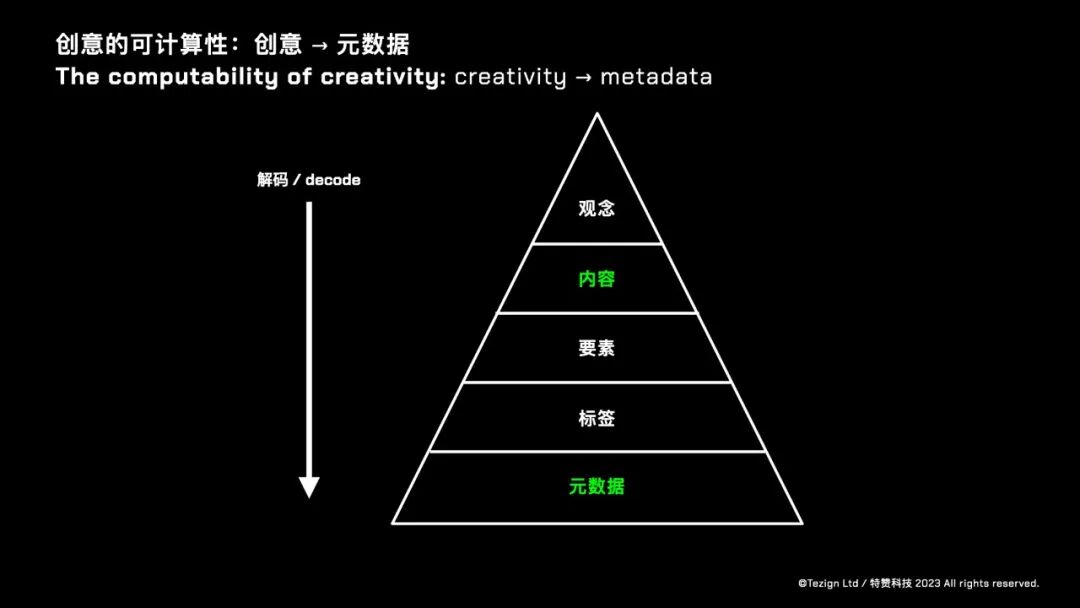
The computational process of creativity takes the shape of a pyramid.
At the top are ideas. Humans have endlessly varied ideas, which find expression through some form of content — images, text, video, models, and so on. When an idea becomes content, some attenuation occurs, but without becoming content, an idea cannot be communicated. It must be anchored in some content form.
Next comes content itself. Content comprises many elements. An image, for instance, might consist of different layers. People need to tag these various elements and translate them into machine-comprehensible language. This is metadata.
The entire process of turning creativity into data — from idea to content to machine-understandable metadata — we call decoding.
We want all decoding to be systematic. It's not enough to design a process or a model; you also need to design a tool that smooths the path from creativity, from idea to content to metadata. This tool is called DAM, Digital Asset Management.
Many friends ask: can creativity really be computed? The way I see it, creativity needs to be computed precisely because we acknowledge that much of it is uncomputable. The more we can compute, the deeper our understanding of what remains uncomputable. As Aristotle said, the more you know, the more you know you don't know.
Due to space constraints, this article covers only one-tenth of the course. Click the poster below to hear the full course!

When people use machines, AI, and new technological means to understand creativity, the goal isn't to reduce creativity to dry metadata, nor does it mean the process of attenuation is correct. The point is to use that attenuation to understand what each step costs — and thereby grasp what lies in the realm of the unknown. The more of creativity we can compute, the more the uncomputable parts will be appreciated. The two aren't locked in a zero-sum opposition; that way, we don't smother possibility.
Just as those who study quantitative history must believe there's also such a thing as biographical history — but when people understand history only as biography, as humanistic narrative, they overlook macro phenomena and end up chasing one story after another. We need balanced perspective to see both sides and understand the limitations of each.
[
How do we generate creativity from metadata?
The path from idea to metadata is subtraction. Generating content from metadata requires addition. This process is called encoding.
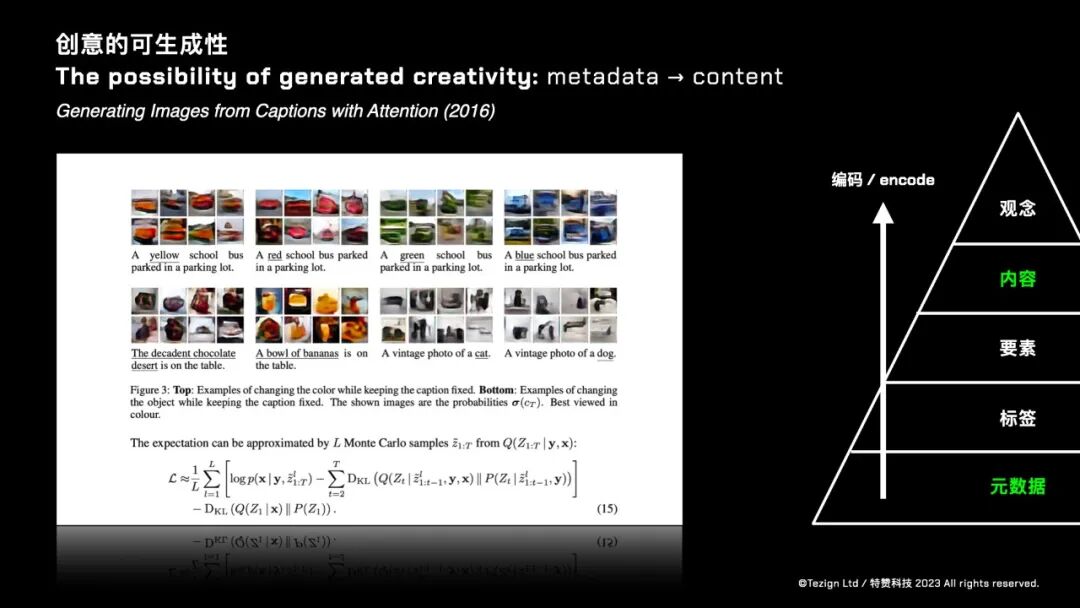
Generation isn't a new concept. Artists have been thinking about generative art for the past century; it's just that the technology became viable only in the last decade. In 2016, a doctoral student at the University of Toronto published a paper called Generating Images From Captions With Attention — one of the earliest documents on generative AI, proposing text-to-image generation.
[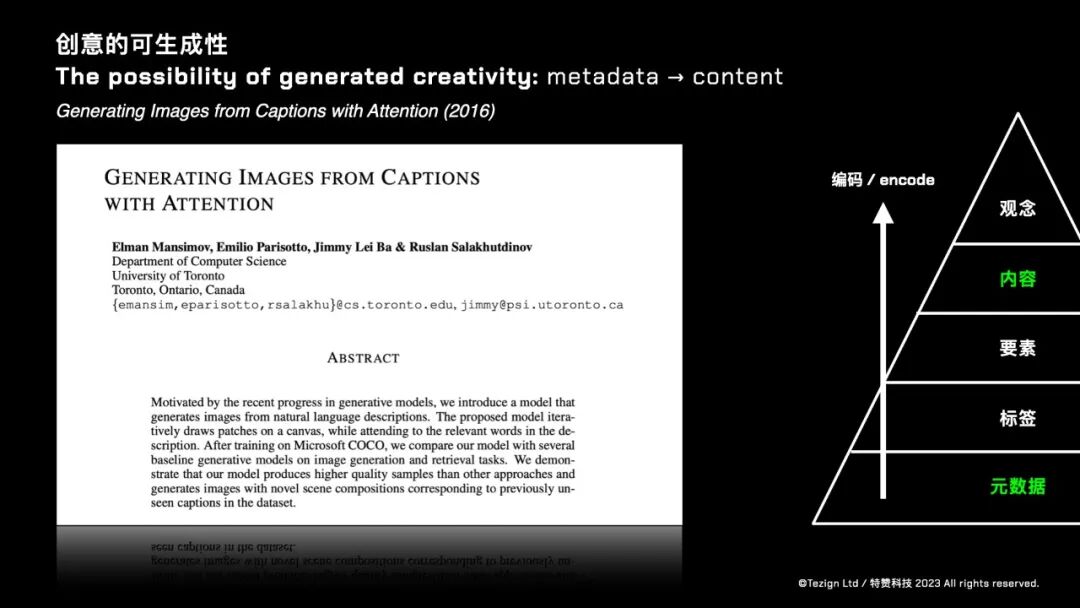
The paper included examples of machine-generated images. In the third image of the first row: a green school bus parked in a parking lot. School buses are normally yellow, so when it's green, or red, or blue, these buses never existed in the index library — they're generated. From this moment, computers generated content from metadata for the first time. A historic moment.
[
In 2019, our company worked on generation for commercial scenarios. Demand for marketing images was high and the work repetitive, so we built a generation machine from scratch — dataset, model, algorithm, workflow — with real-time feedback and optimization. The investment was substantial.
[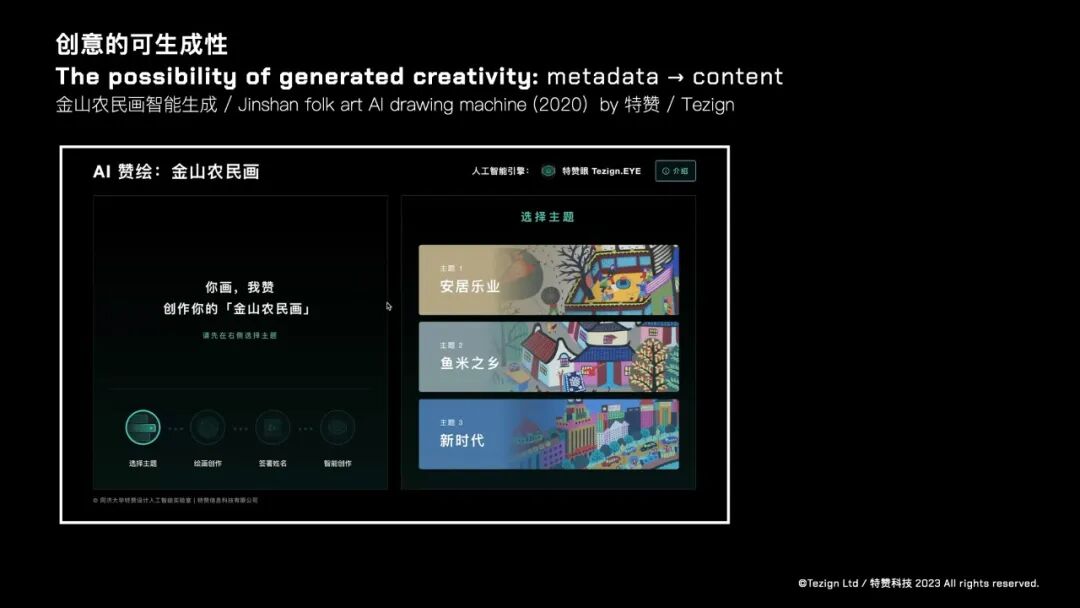
In 2020, during the China International Import Expo, we built a generation system for "Jinshan peasant painting," a Shanghai traditional handicraft. We wanted to challenge the instinct to pit AI against manual craft. Why must tradition and innovation oppose each other, rather than using AI to help handicraft flourish?
Few people knew about Jinshan peasant painting — too little patience to learn, too little dissemination. So we built a generation system where anyone could generate Jinshan peasant paintings by sketching.
How did we do it?
First, build a Jinshan peasant painting dataset. Second, develop an algorithm. Third, build a system. Along the way, we did some humanistic thinking. I've always emphasized: "technology at the front, humanism at the back." Several considerations:
First: generation from nothing, or recombination of existing elements from the dataset?
Second: 60-70 point results, or 100-point results?
We chose recombination of original elements, producing 60-70 point images. Why? Using original elements showed respect for the source material. Aiming for 60-70 points meant signaling to existing artists that new technology wasn't replacing them — just lowering the barrier for public engagement during popularization. Every technology carries social and humanistic considerations that shape how it's used. Focusing only on cost reduction and efficiency, only on long-term development, isn't optimal. Through this, we found a paradigm where AI and handicraft complement each other.
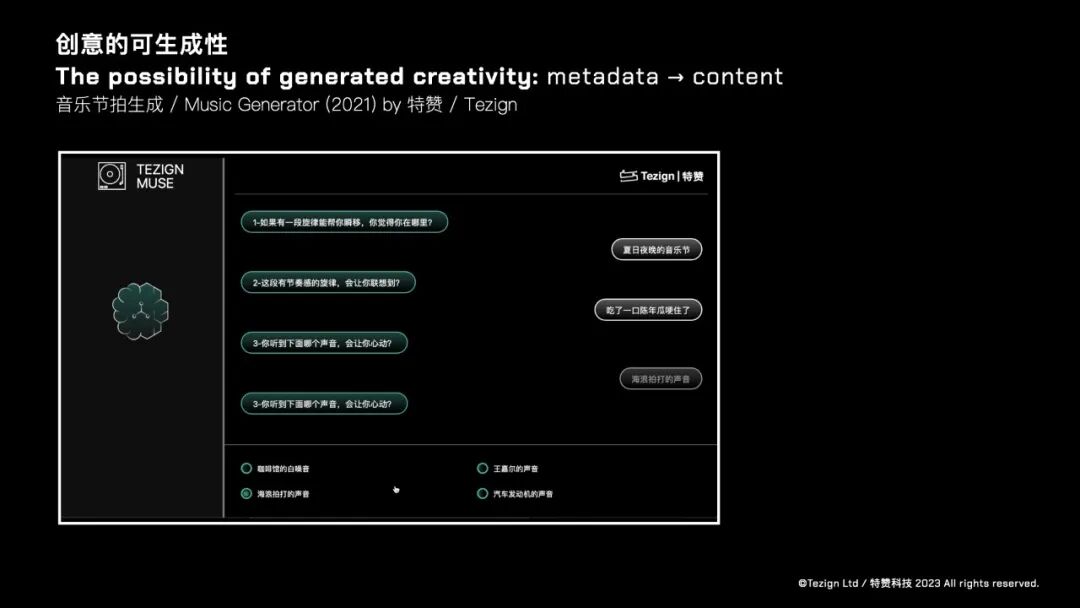
Many young people at our company love street dance. Traditionally you need music first, because music is hard to find. But our music generation system lets you start with dance moves, set rhythms at specific points, then generate music. We have our own BGM, with sounds collected from every corner of the company, then AI-remixed together. Human-machine collaboration is becoming multimodal.
AI has developed extraordinarily fast in the past year. In the next decade, 66% of content will be produced by generative AI. Two data points to emphasize this: from year zero to year ten of smartphones, about 31% of phones became smartphones. From year zero to year ten of cloud computing, about 55% of computing became cloud. Generative AI will penetrate faster than both — these are statistics from the US investment firm Bessemer Ventures.
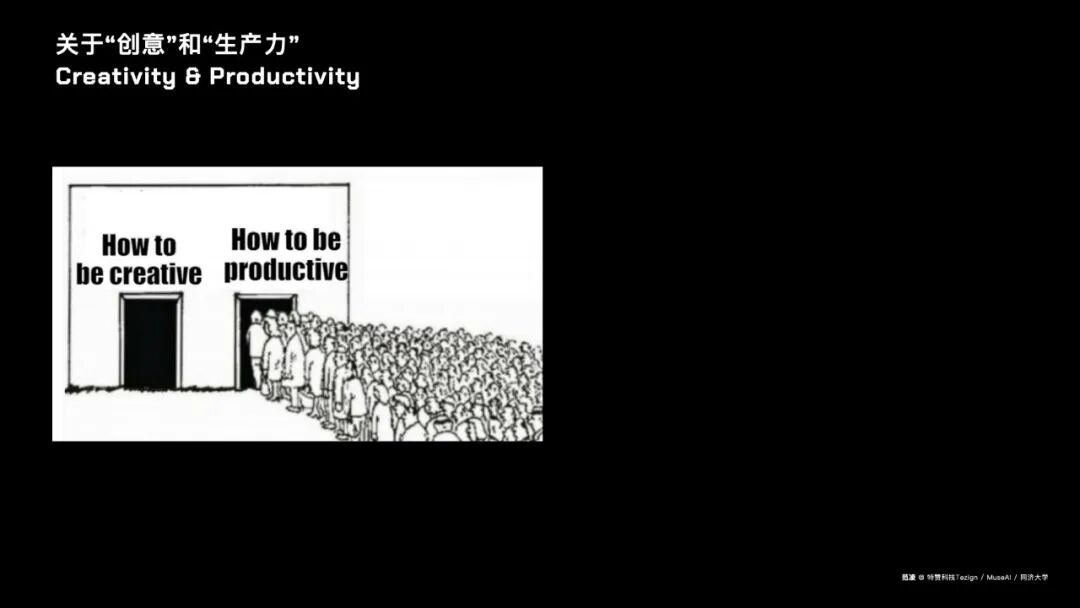
What does generated content or creativity mean for human work and life? Most everyday discussion centers on cost reduction and efficiency. In Chinese discourse, we rarely discuss how to make humans more creative. When creativity and productivity are set in opposition, people gradually forget all the interesting things that exist between them.
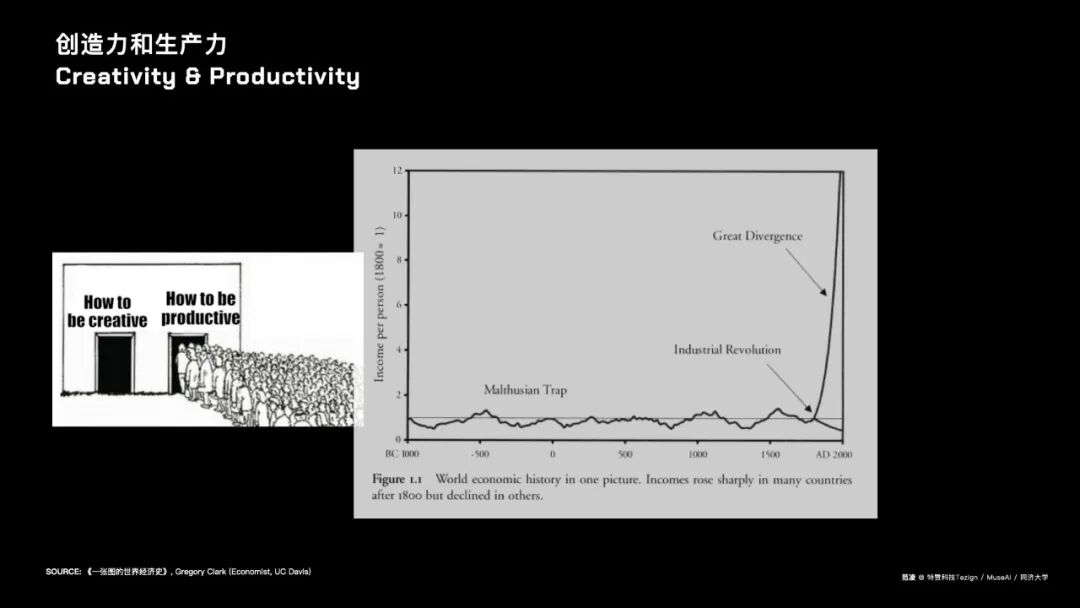
The American economist Gregory Clark drew A Farewell to Alms: A Brief Economic History of the World. The horizontal axis is time, the vertical axis is relative income per capita. The inflection point is the Industrial Revolution. Before the Industrial Revolution, disposable income per capita barely changed — the Malthusian trap, which people simply couldn't break through. Only with the Industrial Revolution did disposable income dramatically increase. What this graph implies is that economic history, political history, and the history of technology that permeates everyone's daily life are isomorphic.
[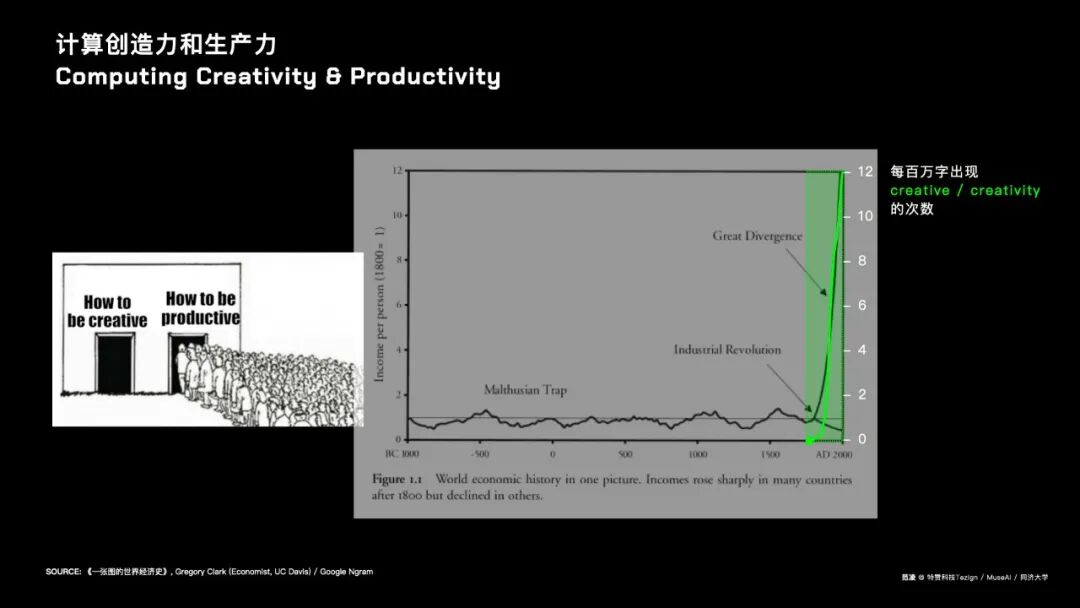
Let me add another dimension here. Try searching online for when the Chinese word chuangyi (创意, literally "creative idea") first appeared — and I mean search for the term itself, not the concept. Creativity has existed as long as humanity has, but when people start using a specific word for something, that's when they begin doing it consciously. By tracking the frequency of chuangyi's usage, we can see that while we can't prove technology drives creativity, we can at least establish a correlation with how often people talk about creativity. Creativity itself is hard to quantify, but mentions of it are quantifiable. What this shows is that conscious, deliberate creativity emerged only after productivity had been massively unleashed — after living standards began to rise.

From the Renaissance to AIGC: The Mechanism of Creative Production
Once we connect creativity to productivity, we find the two shouldn't be set in opposition — just as we shouldn't say AI boosts productivity at the expense of creative workers.
If we trace back far enough, the Renaissance gave us perspective — a technique that made painting teachable, that transformed it into a craft.
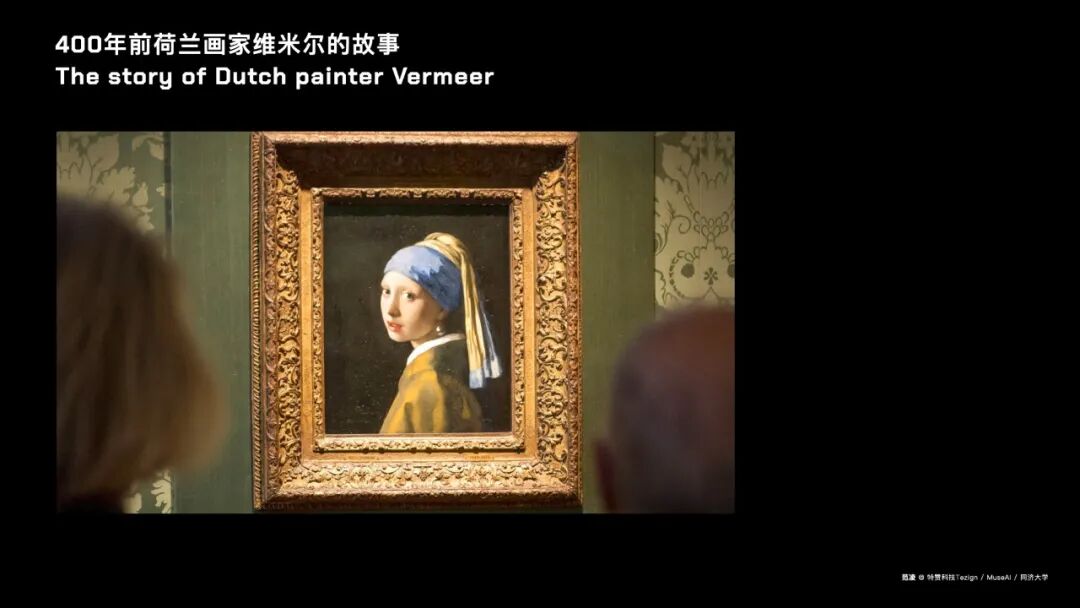
The Dutch artist Vermeer painted his most famous work, Girl with a Pearl Earring. It has some distinctive qualities. First, the canvas is remarkably small — the subject's face is life-sized. Second, Vermeer's mastery of light and shadow is so extraordinary that it's nearly impossible to distinguish from optical instrumentation. Many art professionals have wondered: how exactly did Vermeer paint?
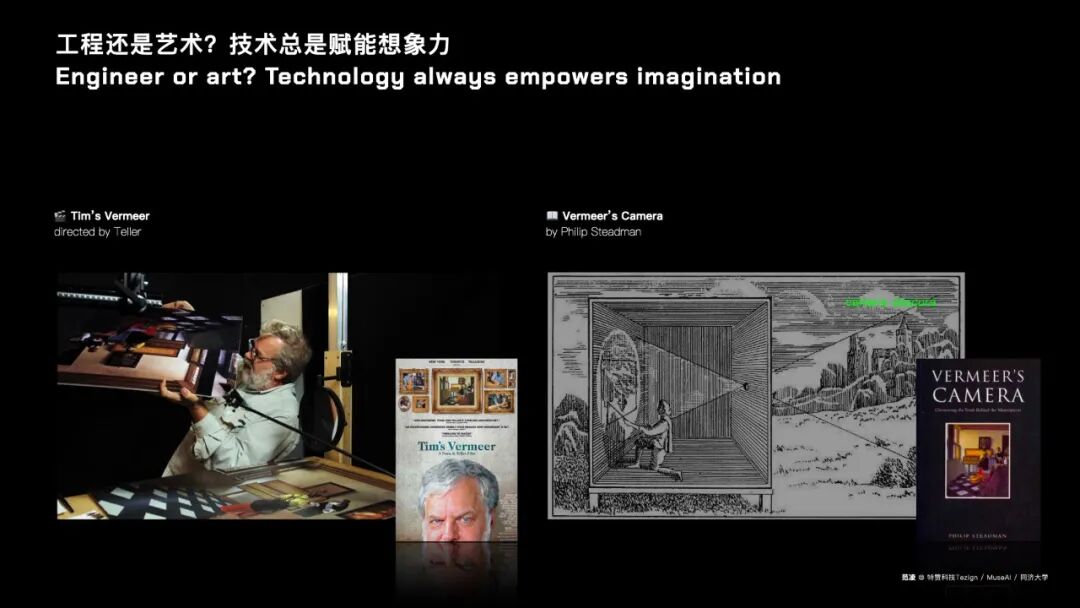
The 2013 Oscar-nominated documentary Tim's Vermeer reconstructs Vermeer's tools and process. He built a projector, using camera obscura principles to cast an image into his studio and then painted from it — hardly what we imagine when we think of a traditional artist. Unlike painters who worked purely with brush and canvas, Vermeer constructed a darkroom. Through pinhole imaging and secondary refraction, he produced an upright image to trace.
So was Vermeer an artist or an engineer? Are art and mathematics in conflict? To me, these tensions are artificial. In Vermeer's time, his studio was off-limits to visitors — essentially an R&D lab. It sat on the second floor of a building next to the church in Delft's city center. Why did Vermeer paint only figures and still lifes? Because only objects arranged in a room could be captured through camera obscura. Why were his paintings so small? Because his studio was small. Why was his treatment of light so precise? Because he was tracing optically projected images. This was enormously illuminating. People easily pit advanced tools and methods against creativity, yet during the Renaissance, creativity was toolmaking.
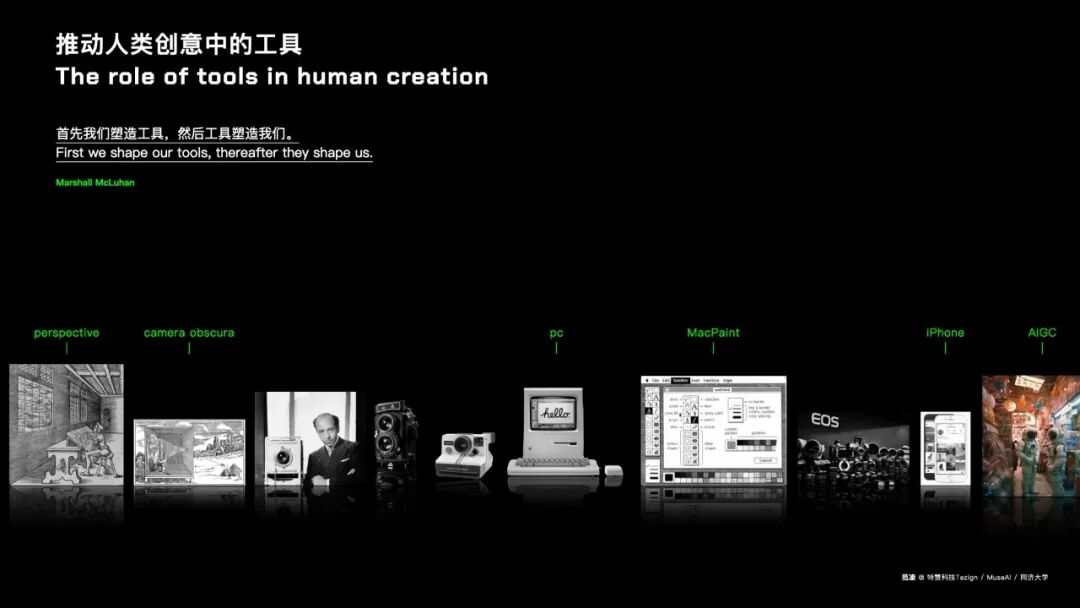
First perspective, then the darkroom. After the darkroom came a tool that seemed existentially threatening to art: the camera. Photography was faster and cheaper than human draftsmanship, yet art didn't disappear. Artists pioneered deliberately non-representational work, deliberately blurred work. Art moved from walls to floors, from static to kinetic, from motion pictures to entertainment industries and gaming. Every new technology makes existing technical skills seem less important, but new technologies exist to liberate humanity — giving us more time and energy to think about what's next, to create something new.
The media theorist Marshall McLuhan, who shaped so much of Silicon Valley's thinking in the 1960s, put it memorably: "We first shape our tools, and then our tools shape us." We create a tool; it transforms how we live; and we in turn create new environments, new contexts. When a technology arrives that shocks the world, there has never been a moment when human creativity was more essential.
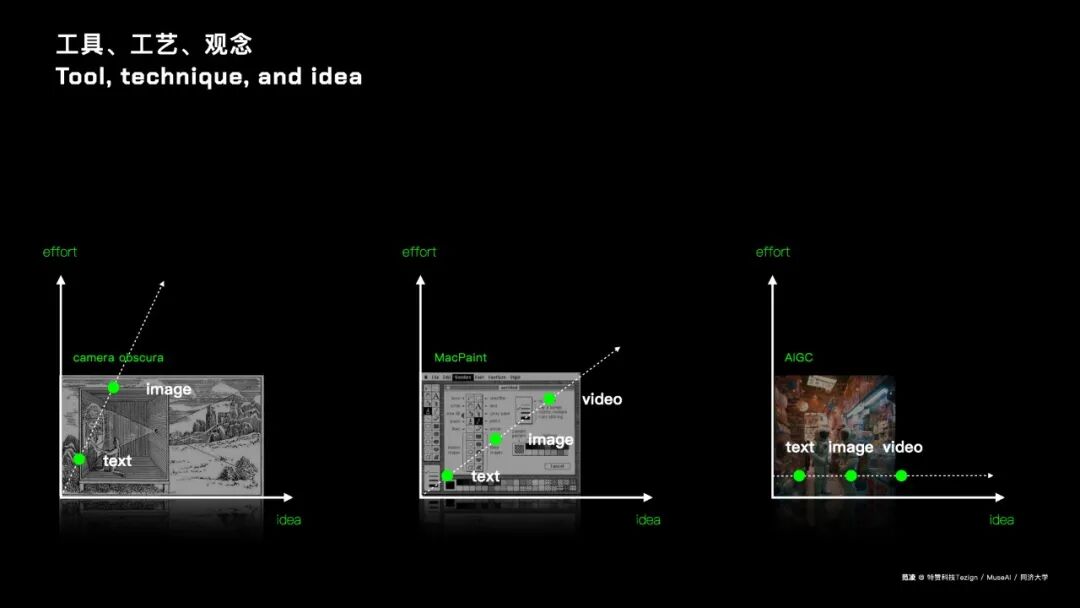
What exactly is changing?
First, tools. The camera is a tool, the computer is a tool, much of the Agricultural Revolution consisted of tools. Second, craft — what tools enable. Third, ideas.
Each evolution of tools makes it easier for humans to express ideas. Before perspective, painters struggled to teach or communicate visually because even basic principles like objects appearing smaller at distance weren't codified. Perspective itself was a tool; once it existed, it could be taught. Cameras and computers followed the same pattern — every generation of tools lowers the barrier to creation, letting people express themselves more effectively and be understood more clearly. AI is no different: it makes expression and creativity more democratic, more accessible.
Due to space constraints, this article covers only one-tenth of the course content. Click the poster below to listen to the full course!

Today, creating art on a phone is as effortless as speaking — just enter a prompt, and images or even videos appear automatically; 3D models will follow. Craft that once demanded enormous time and effort becomes increasingly simple, which means more people will adopt these techniques to express richer, more complex ideas.

How AIGC Will Affect Creative Productivity
What impact do new tools have on work?
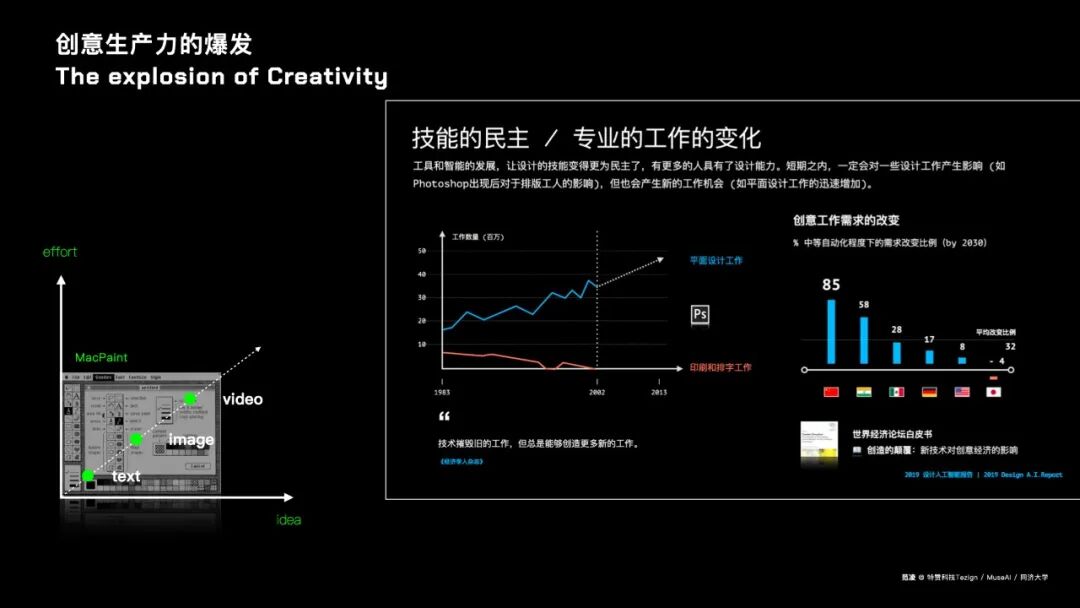
MacPaint was the drawing application of the previous computing era, the predecessor to Photoshop. Its emergence and continuous iteration spawned countless digital art tools, producing two effects:
First, typesetters vanished from history — the last print shop requiring manual typesetting closed in 2002. Second, Photoshop dramatically transformed creative work. U.S. data shows that graphic designer positions quadrupled after Photoshop's introduction.
So while tools may displace certain jobs in the short term, over the long term they bring new creators and spark prosperity in other roles.
Due to space constraints, this article covers only one-tenth of the course content. Click the poster below to listen to the full course!

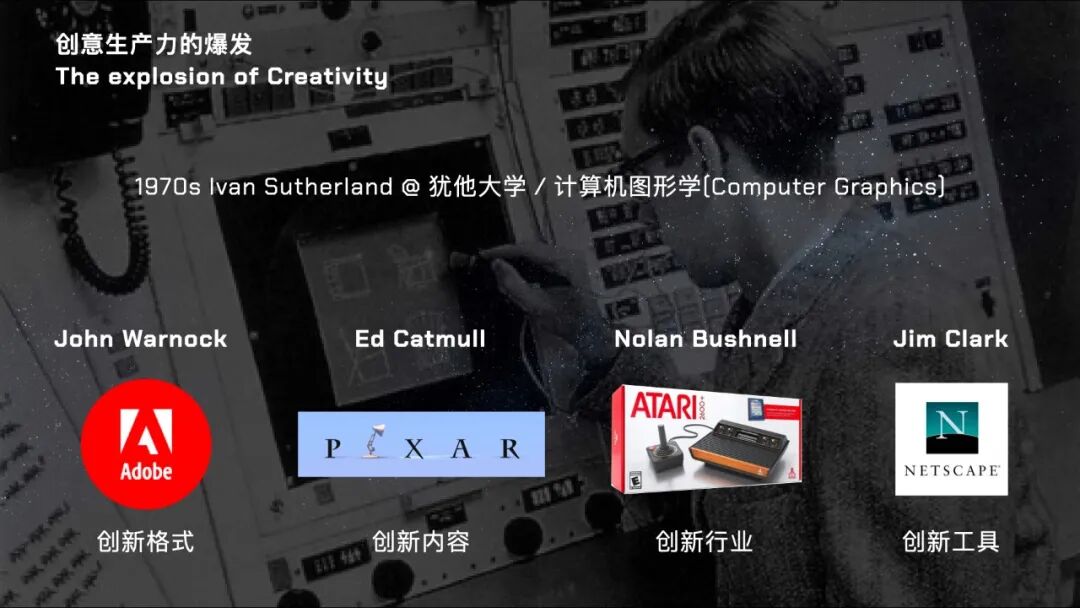
History is an arrow, flying from the distant past toward the future. AIGC is that arrow, just released — potentially a once-in-fifty-years technological breakthrough. The last such breakthrough was computer graphics. Without computer graphics, we wouldn't have the computers we use today. The University of Utah made foundational contributions to this field, where Professor Ivan Sutherland trained four students: John Warnock, who founded Adobe; Ed Catmull, who founded Pixar; Nolan Bushnell, who founded a gaming console company; and Jim Clark, who founded Netscape, the first commercial browser. Every tool, every product, every person's work was epoch-defining.
So AIGC's opportunities may not emerge from tech giants or elite universities. They may arise somewhere unexpected, among a small group of people who use these new technologies to forge entirely new models. No AIGC format has yet created a fundamentally new mode of content production — so far, people only see AI making traditional content more efficiently. Whether an industry will emerge from nothing remains uncertain. AIGC has triggered an enormous explosion: a quantitative explosion in productivity, like Photoshop before it, but also a qualitative explosion — the emergence of entirely new species.
Steve Jobs once said we can only connect the dots looking backward. In retrospect, everything makes sense, but moving forward, you just figure it out step by step. Since the path ahead is inherently uncertain, people need to grasp fundamental or meta-level questions.
OpenAI CEO Sam Altman once posted a tweet that could be expressed as a formula: Creativity = (Remix of the past + Inspiration) × (Quality of feedback + Number of iterations). The more crucial part of Altman's message was this: people tend to assume creativity is about maximizing inspiration, but in fact you should maximize the latter two variables — feedback quality and iteration volume. We imagine creativity as a sudden flash of insight, but Altman emphasized two things: first, it's editing what already exists; second, it depends on high-quality feedback and high-volume iteration.
Good to Great introduces an important concept called the Flywheel. What is a flywheel? You start something slowly, then it spins faster and faster, with better and better results. Amazon's flywheel works like this: better customer value drives more sales, more sales enable lower costs, and lower costs enable better customer value. AI follows the same pattern: better data and compute produce better models, better models and better prompts produce better content, and better content loops back to become better data. AI is constantly iterating and feeding back.
How do humans participate in creation? Many still imagine relying on occasional bursts of inspiration, but that's not how creative production actually works. Hemingway had a distinctive method: he often wrote his first draft standing on one foot, forcing himself to finish quickly, then lay on the sofa smoking a cigar and revised slowly. For these creators, no work is completed in one go — the creative process is continuous iteration, like a flywheel.
The emergence of new tools makes creation increasingly affordable, expression increasingly accessible, and enables people to produce more and more easily within the same timeframe, leaving more time for thinking and discussion. Simply put, in the AIGC era, people should focus more on how to iterate and feedback on creative work with higher efficiency and quality. This is both opportunity and challenge.
AIGC Has Become Essential in New Business Scenarios
As a university professor, the greatest frustration isn't publishing papers — it's proving your work has value. Eight years ago, starting from my school lab, I founded a technology startup: raise funding, build product and technology, then tackle the market. This cycle repeated eight rounds. As funding grew, the company invested heavily in R&D.
Tezign mainly serves enterprise clients across industries including FMCG, beauty, footwear and apparel, and retail. The pandemic accelerated digitalization demands, and the company identified new industry opportunities in commercial scenarios. The business scenarios where enterprises are willing to pay tend to be universal, with growth marketing at their core. So Tezign made commercial scenarios a priority. Though technology companies may ultimately struggle to escape marketing-related industries, Tezign focuses on product and technology — we are merely a tool.
In each industry, we carefully select seed clients who bring their industry's particularities into our technology, enabling us to develop software and services.
Three books — Sapiens, The Beginning of Infinity, and Narrative Economics — all address the importance of storytelling in human evolution. In Sapiens, one story left a deep impression: Homo sapiens defeated Neanderthals because sapiens could gossip, and gossip meant many things might be untrue. This is remarkably illuminating — gossip, originally a pejorative, became a crucial driver of human species development.
David Deutsch, author of The Beginning of Infinity, explains the concept in the book, with a subtitle reading "Explanations That Transform the World." Deutsch proposes that different scientists constantly seek scientific phenomena and explanations. We can never prove science is absolutely correct, but there is always a more correct explanation — using formulas, using reasoning. Thus Einstein's explanation of the universe was somewhat better than Newton's, so people accepted it, and someday a better explanation will replace Einstein. Science proceeds this way.
Why do people believe a piece of paper has value? Why do they believe invisible digital currencies have value? Why do they believe some brands are more valuable than others in the same product category? Narrative Economics explains that much economic value is created through narrative; helping enterprises narrate better is how value is captured. Better narrative is expressed through various content forms — images, text, video, seeding content, brand content, and so on.
In recent years, the brand content ecosystem has transformed dramatically.
First, content touchpoints have multiplied — online, offline, owned, third-party, and more.
Second, content velocity has accelerated. Four or five years ago, enterprises might need content only four times a year; now every store under a brand has different content daily.
Third, content types have proliferated. It began with text, like newspapers; evolved to audio, like radio; then visual content, like television; now there's everything from metaverse content to podcasts, which many brands favor. Moreover, it's not just about having content — it must be personalized, as if hundreds of millions of consumers require hundreds of millions of distinct content pieces.
Over the past four to five years, influenced by digitalization and online abundance, the content landscape has changed so dramatically that humans alone cannot solve these problems — only "human plus machine" can.
Just as Vermeer needed to design a tool before creating, in today's environment, if you want to use technology to solve problems and seize AIGC opportunities, you shouldn't just build surface-level applications. You need to establish your own infrastructure — there must be systematic elements behind driving enterprise efficiency and growth.
Within this system, we need to borrow a technical term: "Stack." You need an interactive interface at the front end, with numerous layers behind it, from GPUs and databases at the bottom to where brands actually operate at the surface. Each operating scenario represents various battlegrounds — all public domains require spending, while private domains require enterprise self-build.
Beneath these battlegrounds lies what supports surface-level interaction: digital infrastructure, formerly called the middle platform. Every brand's first step is managing its own products — the product technology stack, including product management systems, product supply chain systems, and so forth. Over the past five to six years, many enterprises began building user asset management. Some have repositioned themselves from product-centric to user-centric, requiring service processes built around users. When enterprises know who their users are and what products they have, they need to connect products with users — this is the content technology stack.
What does the content technology stack mean? Think of it as the part of the iceberg beneath the water. Product, user, and content are all important, and because product and user came first, their technological maturity is higher. Content is only now being established, encompassing how to produce content more efficiently, more diversely, how to manage it better, and how to distribute it.
Our AIGC Case Studies
First, enterprises need to build a metadata system so that all content can be understood and recognized by machines — encompassing every content format, image, text, video, content tags, content workflows, and content interactions.
For example, under the traditional model, getting a product listed for Double 11 required sending an email describing the product, and the email chain would get incredibly long, impossible to search, impossible to archive. The new model puts all content onto a single dashboard. Product listings have various placement graphics, and the dashboard can intelligently recognize them. In the content management system, you simply fill in which images meet the listing requirements, then list with one click. If certain images underperform, you can pull the data in a mini-program and swap them out. The whole process shifts from a static email to a dynamic panel, and every image on that panel has provenance — this is how content gets connected.
What's the benefit of connecting everything? Enterprises can analyze, systematically replace content for specific sections, use AI technology, and use infinite canvases to continuously generate new content. The simplest example: major promotional launches can be endlessly generated with AI.
In another user scenario, creative computability can be leveraged more effectively. If you have dry product information on one side and rich content on the other, you can use barcodes to associate content with products. Why connect them? Because content determines whether products sell.
Take a certain offline shopping mall: if a brand doesn't have enough content, the mall won't run events for them. In the CEO's weekly management meeting, they review content with every business line's GM — first confirming whether content exists, then whether it's good. Having content means not missing opportunities, so products and their corresponding content must be connected. A single SKU needs to be present across roughly 100 channels, each requiring at least 10 pieces of content, some needing 10+ placements, some placements requiring personalized content for different users, each placement needing massive content variations — that's thousands of content pieces per product. With 100 or 1,000 products, the volume becomes staggering, demanding this kind of systematic mapping and management.
Once mapping is in place, product metadata can potentially connect with content metadata, since all this content serves business purposes. Two additional dimensions can be added: the first is "business data" — why create this content? For acquisition, retention, attracting which consumer segments? The second is "performance data" — how is the content performing? With these two dimensions, the relationship between products and content can be better connected.
Once products and content are connected, many things become possible. For instance, people can use AI to generate images or videos. Since you know where this content performs and which scripts work better, you can extract those scripts, swap products, swap characters, swap scenes, and create massive amounts of mixed content. Script extraction can use GPT; scene swapping can use image recognition. This isn't simple single technology — it's the combination of multiple AIGC technologies.
A Footwear and Apparel Brand Case
For a certain footwear and apparel brand, KOL-endorsed shoes sometimes didn't match their endorsers — for example, a very muscular male KOL promoting a very slender running shoe. What we needed to do was connect all products with KOLs, making content-product relationships correspond. We've done extensive generation work in the footwear and apparel industry, with opportunities to pull back content performance data for Adidas and other brands, then replicate what performed well historically. Good content isn't determined by eye — it requires past performance data to predict what will work next. Through this approach, generating Xiaohongshu copy, videos, and images becomes low-cost and high-performing.
A Beauty Brand Case
A certain beauty brand, due to high customer value, began operating user journeys, needing to connect preferred content with every conversion step. We promoted sales through multiple differentiated paths, with each path fronted by sales associate services — each associate serving hundreds of clients. Our work made these associates more personalized, helping them know how to intelligently converse with hundreds of clients and what content to recommend. Behind this are content tags, metadata, then AI-generated personalized sales scripts — not only enabling associates to smoothly handle hundreds of clients, but making each client feel important and special.
These enterprise and brand cases require both the intelligence of every team member and a technical Stack foundation. In discussions with some partners, we've found many enterprise teams can't match our vision — like expecting a brick-and-mortar structure to go above six stories; you need to switch to reinforced concrete. The essence is the underlying technical Stack.
The author of The Nature of Technology said: "Technology is a collection of phenomena captured and put to use. Or rather, technology is the programming of phenomena for a purpose." In fact, all technology has purpose behind it, and these purposes can become more universal through technology. People shape tools, tools then shape people; people shape technology, technology then shapes people. When enterprises keep insisting they can't build these technologies, it may not be a people problem — it's an architecture problem.
Human-Machine Collaboration: The Future "Me" and AI
Whether from the bird's-eye view or the frog's-eye view, what we see is technology empowering imagination and creativity. But on the other hand, AI also poses challenges to humanity — some worry about children's education, young people worry about personal development, entrepreneurs and clients wonder whether they should get into AI early... Behind these questions lies human anxiety about uncertain environments. This requires us to refocus on a word — "me," here referring to every person, which can be explored through several keywords:
The first keyword is imagination. Nothing is more important now than imagination. AI's emergence isn't the culprit behind unemployment and creative devaluation — on the contrary, it will drive the next generation of creativity, just as the camera's invention influenced Impressionism. I've been deeply influenced by Nicholas Negroponte. At MIT, Negroponte conducted experiments that he systematically turned into an innovation landmark: the Media Lab. Unlike previous approaches that limited creativity to concrete objects, Negroponte wanted to create relationships. He built a device resembling a 3D printer with metal blocks in the middle and a small mouse inside; the metal blocks would change the internal space based on the mouse's movement. Negroponte described this as creating a relationship between the mouse and the metal blocks — a statement that created a new discipline: interaction design. My major was human-computer interaction. Today, the internet is interaction, smartphones are interaction; interaction has become the object of creation.
After retiring, Negroponte launched a project: One Laptop per Child. This extends the idea of interaction. Negroponte believed that if you want to solve poverty in Africa, you shouldn't just give people money — could you give every African child a laptop cheap enough, durable enough, and internet-connected enough? Children love to tinker; once connected, they'll keep exploring. Give them a tool and they can elevate their own cognition, and elevated cognition can influence those around them, potentially changing an entire village's cognition. I deeply agree: knowledge shouldn't be taught, it should be influenced.
Our company has also built many non-profit AI products, like MuseAI. Recently we've been collaborating with schools and NGOs. One NGO leader was deeply moved — he felt that rural children aren't behind in learning, but compared to urban children, they often haven't encountered human-made beauty: art, music, and such. These children lack creative confidence, and don't know whether they have creativity. Early in our institutional collaboration, we used simple tools to let rural children create simply. These children loved it, and the impact on us was profound.
The second keyword is creation. The image above shows Steve Jobs and Steve Wozniak at the Homebrew Computer Club in 1976. As two dropouts, they firmly grasped the chips, circuit boards, and personal computers that were just emerging in that era. The same applies today — people can discuss, question, but none of it beats actually doing. Our company has only one slogan: It's time to build and create. "Stop talking, just do it." Nothing in this period can be thought through clearly; it can only be done clearly.
In consumer-facing scenarios, AIGC technology has mostly shown up as chatbots. But when you actually try to use it to solve business problems, you realize it's still early days. The Minesweeper game in early PCs was played almost entirely by double-clicking the left and right mouse buttons — because beyond entertainment, its real purpose was teaching users how to operate a mouse. People didn't know how to use a mouse back then, but once they got familiar with it, it felt incredibly natural. AI is the same.
The design scientist Buckminster Fuller once said: "By introducing a new artifact into the environment, you can spontaneously induce people to drop their old, problem-generating behaviors and devices. For example, if people urgently need to cross a rushing river, as a design scientist I would design a bridge. I'm quite certain this would cause them to spontaneously and permanently abandon the life-threatening behavior of swimming across." When people start using a new tool, think of it as that bridge — then find the way to completely solve the problem, and keep experimenting.
The third keyword is joy. Before 2019, our company conducted some research on human-machine collaboration — things like brain-machine ratios, studying the relationship between humans and machines in work.
The diagram shows three types of relationships. The first is where things become increasingly automated and machines increasingly capable — the Capability brain-machine ratio 1. The second is where machines are very good at something, but individuals also enjoy doing it and don't want to delegate it — the Subjectivity brain-machine ratio 2. For example, some designers enjoy researching and gathering materials, which in machine terms translates to data mining — something machines excel at, but designers relish the process and don't want to hand it over. The third relationship is trust. Statistically speaking, autonomous driving is safe, but people can never fully trust an empty driver's seat — this is a matter of cultural trust, the Trust brain-machine ratio 3.
There are tasks people genuinely dislike doing. Often it's not that tools are stealing human jobs, but that humans are stealing jobs from tools. But never forget: all tools and software are developed with humans at the center. They must make human life and work more fulfilling. In our coexistence with tools, we should think about where the incremental value lies, where human frustration exists, and whether using tools can resolve it.