"DiSight Medical" Cui Di: Solving Pain Points in Fundus and Microsurgery with High-Precision Ophthalmic Surgical Robots | Linear Capital Portfolio Interview Series

In July 2023, Linear Capital portfolio company Hangzhou Disight Medical Biotechnology Co., Ltd. successfully performed a subretinal thrombolysis procedure for treating macular hemorrhage at Zhejiang Provincial People's Hospital using its "Disight MicroEdge" ophthalmic surgical robot — **the first such procedure in Asia**. The company achieved its clinical milestone just two years after founding, and completed [three rounds of financing](https://mp.weixin.qq.com/s/...) in 2023 alone.
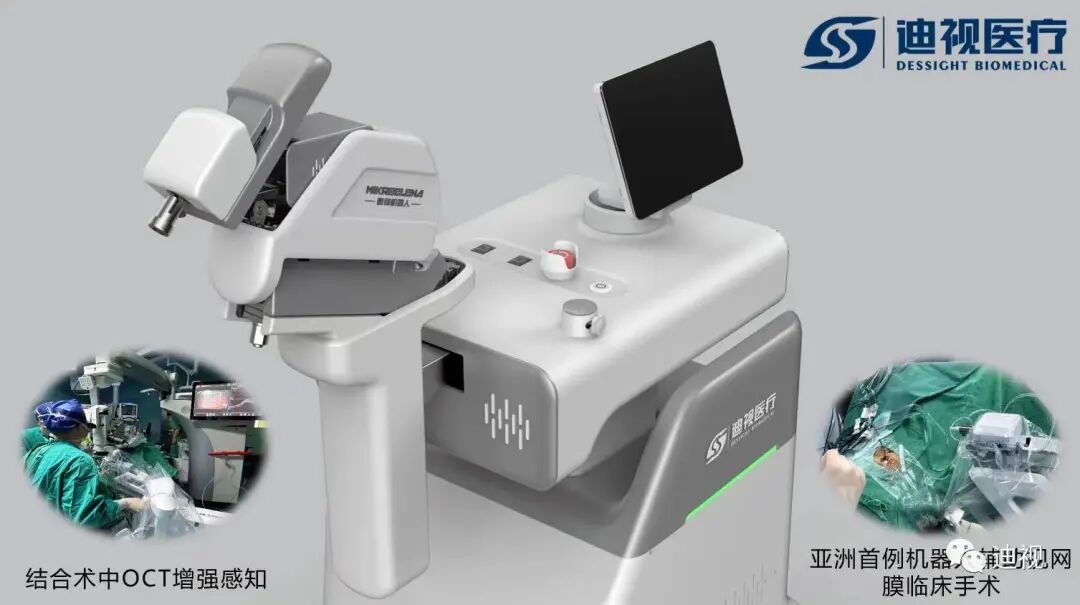
In July 2023, Digisight Medical, a Linear Capital portfolio company, successfully performed a retinal sub-thrombolysis surgery for macular hemorrhage using its "Digisight MicroEdge" ophthalmic surgical robot at Zhejiang Provincial People's Hospital — the first such procedure in Asia. The company achieved its clinical goal just two years after founding, and completed three rounds of financing in 2023 alone. Linear Capital led Digisight Medical's Pre-A round and continued to strongly support the company in subsequent rounds. In early 2024, the Linear Capital Portfolio Interview Series invited Dr. Cui Di, founder and CEO of Digisight Medical, to share the R&D story behind "Digisight MicroEdge" — one of the world's most precise ophthalmic surgical robots — and the company's future development plans.
The "Linear Capital Portfolio Interview Series" is an interview program by Linear Capital. Through in-depth conversations with portfolio company founders, it shares stories of tech investment and tech entrepreneurship with a broader audience. For more interviews, please click "Read More" at the end of this article.
Q: Linear Capital A: Dr. Cui Di, Founder and CEO of Digisight Medical
Q: How did the founding team meet, and what led you to start the company?
A: Before returning to China to start the company, we were all in Germany and had worked on projects together. My own research background was in biomedicine, and after graduation I worked in the pharmaceutical industry. My team and the other early members' universities and affiliated hospitals had collaborated on projects before (drug delivery for ophthalmic surgical robots). Before I returned to China, some alumni and friends we knew had already gone back to start companies, including some in robotics. We saw that in 2021, industrial robots and service robots were booming in China, with a much more active market environment compared to Germany. If we were to start a company in Germany, the process to obtain startup funding would be relatively long, and we wouldn't have the same language advantages as local teams. So we believed that returning to China was a better choice — it would allow us to quickly commercialize our technology.
Second, in the direction of ophthalmic surgical robots, we had been collaborating with ophthalmologists since 2015. Their demand for surgical robots was very clear, and years of accumulated experience gave us deep understanding of the ophthalmic treatment industry. At that time, we saw that no domestic companies were working in this direction, and felt it was a good opportunity.
Considering all these factors, we believed ophthalmic surgical robots addressed a real need, and that the timing was right for commercialization.
Q: What was the fundraising situation like at that time, how did you meet Linear, and what has the collaboration been like?
A: In 2021, the overall fundraising environment was quite active.
I first encountered Linear in 2021 when I returned to China to participate in Hangzhou's Overseas High-Level Talent Entrepreneurship Competition. Songyan (Huang Songyan, Partner at Linear Capital) was a judge at that time. We won first place in that competition. A few months later, when we began seeking investment from market-based institutions, we had more contact with Linear's investment team.
My impression of Linear is that they really understand the state and needs of early-stage teams — they understand technology and respect our perspectives, able to think from the entrepreneur's point of view. Early-stage teams inevitably have immaturities in team completeness, commercialization, and business model. Linear was able to identify the technical characteristics and strengths of our team. Because Songyan and his team had deeply researched robotics, they were relatively familiar with supply chains, mechanical structures, and control systems, and on this basis were more tolerant of other less mature aspects. Second, the Linear team was very supportive and respectful of our ideas. Songyan once said that as entrepreneurs, we understand our company's development and industry better than investors do, and we shouldn't change our plans to cater to investors' ideas. You could really feel their genuine support for early-stage entrepreneurs.
Q: Why ophthalmic surgical robots, and what makes them more difficult compared to other types of robots?
A: Different robots solve problems from different angles. For example, laparoscopic surgical robots solve accessibility and visualization problems. Some abdominal regions are narrow, and doctors cannot see certain organs or lesion areas with the naked eye, making it difficult to reach with handheld instruments — the corresponding robots need to solve these problems. There are also navigation-type robots; for example, in neurosurgery, doctors cannot see inside the skull with the naked eye and may need to do 3D reconstruction and real-time preoperative planning for more precise operation during surgery.
Ophthalmic surgery approaches from another angle — it is a surgical category with extremely high precision requirements and very low tolerance for error. After pupil dilation, doctors can directly see most areas of the fundus through a microscope, and handheld instruments can reach the corresponding lesion areas. But the difficulty lies in precision control: the doctor's eyes can see and hands can reach, but they may not be able to accurately position or completely control tremors. The ideal precision for fundus surgery is no less than 10 microns, but human hands have approximately 100 microns of tremor. If injecting medication into a certain area, the injection needs to be maintained for 1-3 minutes — holding steady by hand for one minute, tremor increases significantly. Achieving precise positioning and preventing tremor are the first pain points that ophthalmic surgery needs to solve.
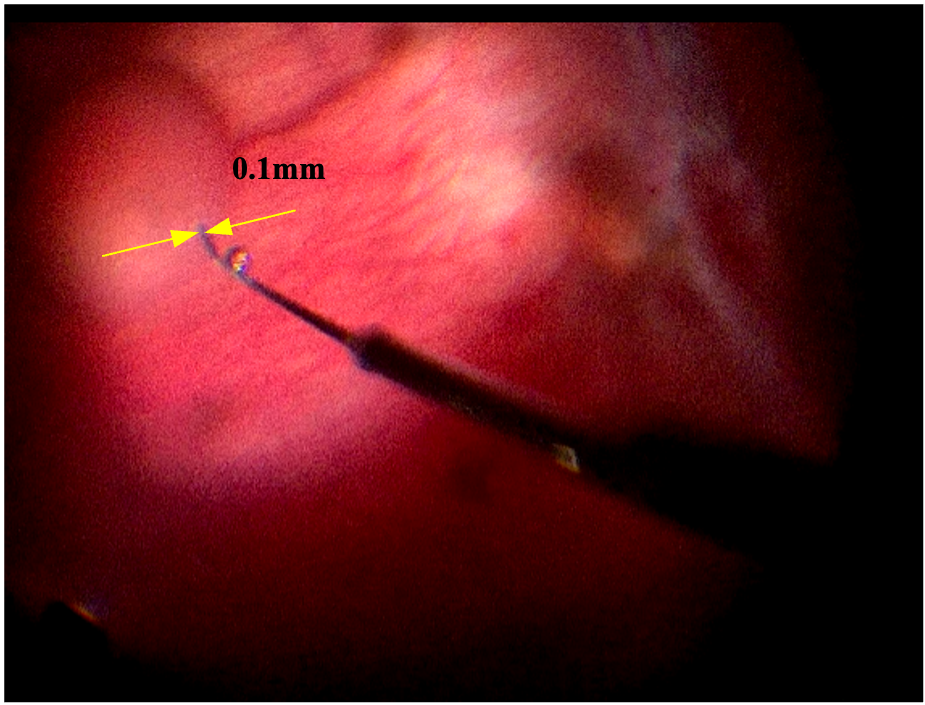
Doctor operating Digisight robot for in vivo rabbit retinal subretinal injection
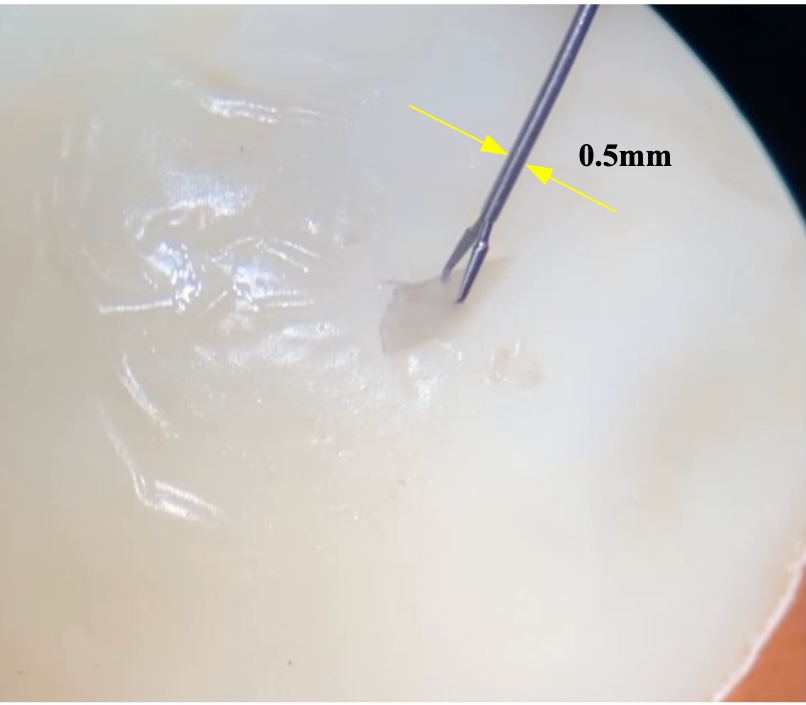
Doctor operating Digisight robot for peeling of 20µm-thick egg membrane
Digisight microsurgical robot peeling sesame skin thinner than a hair's diameter
Our team has been working on this research since 2015, closely collaborating with doctors, understanding this industry and doctors' pain points. Based on this know-how, we have iterated through 5 versions so far. Our robot achieves motion precision of up to 3 microns through personalized physician-engineer collaboration, multi-degrees-of-freedom based on master-slave control, and proprietary flexible structure and actuation technology, solving the pain points in ophthalmic surgery. In 2023, the Digisight MicroEdge ophthalmic surgical robot successfully completed Asia's first retinal sub-thrombolysis surgery for macular hemorrhage at Zhejiang Provincial People's Hospital.
Q: What is the biggest challenge for Digisight in building ophthalmic surgical robots?
A: The challenge for our ophthalmic surgical robot is that some robots can first purchase robotic arms and build upon them, but our situation is that there are currently no robotic arms available with high enough precision for our needs, so we have to start from the ground up, completely self-designing, including controller system architecture and overall mechanical design.
Q: You mentioned in an interview that Digisight's ophthalmic surgical robot involves design, simulation, execution, and other stages, and that during iteration you sometimes completely scrap everything and start over. Can you share some important product iteration milestones?
A: Yes, Digisight has been established for less than three years so far. But we had already been exploring this direction before the company was founded — from 2015 when scientific research began to 2023 when human clinical surgery was performed, it took about 8 years and 5 versions of iteration. From research prototype to clinical robot, the entire drive system, master-slave control method, and key components are all completely different from before.
Research and clinical applications pursue different goals. Research pursues the ultimate in multifunctionality; clinical applications pursue meeting clinical needs while being safe, reliable, and stable. Therefore some functions that don't meet clinical needs have to be removed, and of course we also need to meet corresponding medical device standards — this was the first major iteration.
The second iteration was based on specific clinical needs. The performance prototype was designed for single-eye operation: if surgery was needed on the left eye, the machine was placed on the left; for the right eye, the prototype was placed on the right. In actual use, moving the robot made things complicated, so we decided at that time to make a binocular-mode robot — this is also where our surgical robot is more advanced than similar foreign products. But the challenge was that although the robot's travel distance only increased by an interpupillary distance of a few centimeters, changes in mechanical structure led to weight changes, and corresponding changes in motor loads... many key components and mechanical structures needed to be redesigned. In summary, a seemingly small change actually affected the entire R&D process. This is just the tip of the iceberg from our first two iterations.
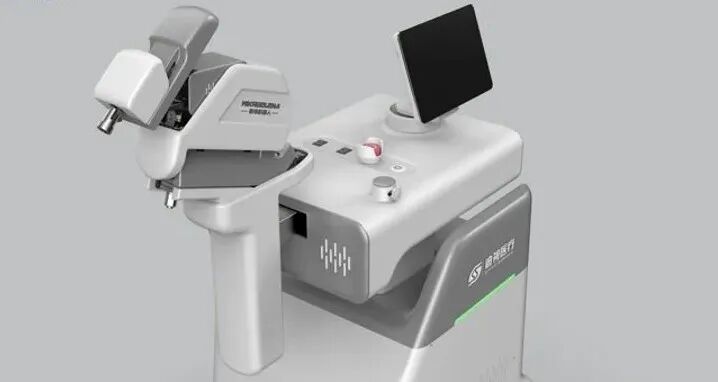
Q: Linear has consistently emphasized an investment logic of TPF — Technology Problem Fit — using technology to solve key pain points in industrial upgrading, bringing significant efficiency improvements and value empowerment to achieve commercial value. What problem does Digisight's ophthalmic surgical robot solve, and what is the commercial value of solving it?
A: The problem that ophthalmic surgical robots solve is very much a real need, and a large part of it is aimed at future incremental markets. On one hand, the Digisight MicroEdge ophthalmic surgical robot can make existing ophthalmic surgeries better, because it solves the problems of precise positioning and hand tremor, and can perform better than even the best doctors; on the other hand, there are some high-difficulty surgeries that currently very few doctors can perform due to technical bottlenecks, and the real need for these surgeries is very strong — actually a large gap. Therefore a large part of the future market may be incremental, making it difficult to estimate using existing market size. But overall, we start from ophthalmology and expand to microsurgery, making this technology into a platform technology that can be applied in different departments.
Q: With the help of ophthalmic surgical robots, what can doctors do that they couldn't do before?
A: Here doctors can be divided into senior and junior doctors. Senior doctors, meaning associate chief physicians and above, represent the pinnacle of human medical and surgical development — they can perform most surgeries. But some high-difficulty surgeries, such as eye stroke surgery (the most difficult fundus surgery), or vascular bypass in ophthalmology, as well as future gene therapy and cell therapy surgeries — these are extremely difficult surgeries, and fundus diseases often lead to irreversible blindness. Faced with such ultra-high-difficulty surgeries, even senior doctors find it hard to overcome human physiological limits in operation. Currently very few doctors in China can perform this surgery, so surgical robots are very much needed — technology that surpasses human physiological limits to break the status quo.
Junior doctors more represent the普及程度 of medical standards. With surgical robots, many surgeries that were originally very difficult — requiring ten years of training for a doctor to perform — may now be possible with five years of training with robotic assistance. This can expand the scope of medical coverage. Fundus surgery has a time window for treatment; in some remote areas, if robots can perform this surgery, patients won't need to be transferred to large hospitals and wait in line.
Q: What do you mean by "surpassing human physiological limits"? How do the robot and doctor work together?
A: For retinal subretinal injection surgery, first the lesion is located, then in terms of depth, it moves forward about 100 to 150 microns. 150 microns is approximately equal to two hair strands. When human hands move two hair strands' distance, we have no concept of it, can't feel it — human eyes also find it hard to locate. Second, it not only needs to puncture to this position but also maintain it for about 1-3 minutes to complete drug injection. Basically human hands cannot maintain stability for that long; if injecting quickly, it's easy to cause drug reflux and inflammation. The difficulties are first precise positioning, second preventing tremor — our first-generation product mainly solves these two problems.
In this surgery, the robot plays an assisting role. The master is the doctor, the slave is the robot — it moves according to the doctor's intention. The entire injection process of this surgery is divided into several steps: first it needs to position outside the eye — through the doctor controlling the robot's gimbal for extraocular positioning, then intraocular positioning, then through controlling the handle, gradually bringing the tip closer to the retinal lesion area. During the process, if drug injection to the subretinal position is needed, the robot needs to remain still; at this point human hands no longer intervene, requiring about 3 minutes. Taking injection of 200 microliters of drug as an example, the robot slowly injects; during the process the doctor only needs to monitor time, speed, and flow rate. After injection, intraocular withdrawal is performed — this entire process is always under the doctor's monitoring, with the doctor making decisions.
Q: So you also need to "train" doctors?
A: Yes. Regarding the several versions I mentioned earlier, doctors from collaborating hospitals were all involved. So far our robot has been used in six human clinical surgeries, and doctors' operational proficiency has greatly improved. During the first surgery, although doctors had already done some animal experiments, the entire process from debugging the machine to completing surgery took one hour. By the 5th case, this process was shortened to 15 minutes.
Q: Can Digisight's ophthalmic surgical robot perform the very difficult retinal injection surgery?
A: Digisight's surgical robot can perform subretinal injection. Currently some doctors in China can perform this surgery, and we find that more and more doctors are willing to try after learning about it. This is not only a supplement and improvement to existing surgical capabilities, but also promotes future gene therapy. Abroad there are already some approved gene therapy drugs that treat certain genetic diseases caused by gene mutations by injecting drugs into the subretinal space. These patients' retinal structures themselves are normal, which is precisely why the tolerance for injection error is very low — absolutely no mistakes allowed. For example, a patient may have night blindness and can't see clearly at night; if the surgery fails, they may not be able to see clearly during the day either. The challenge for this type of surgery is relatively high, so ophthalmologists believe that if gene therapy is to truly become普及 in the future, it will definitely require robotic assistance.
Q: Using ophthalmic surgery as an entry point, Digisight also plans to extend to microsurgery. What specific diseases and corresponding surgeries are currently planned?
A: Ophthalmology is a typical application scenario of microsurgery. Expanding from ophthalmology to other microsurgery departments involves quite a few departments — vascular surgery, neurosurgery, hand and foot surgery, lymphatic surgery, etc. all involve vascular anastomosis surgeries below one millimeter. These surgeries are all expandable surgical procedures for us. Abroad, surgical robots have already been used in 500 cases of micro-anastomosis clinical surgeries, with obvious advantages over manual operation. Currently China is also gradually developing training for this type of surgery.
Q: In 2023, Digisight Medical successfully completed Asia's first retinal sub-thrombolysis surgery for macular hemorrhage at Zhejiang Provincial People's Hospital. This is considered a benchmark case for Digisight. What was the implementation process like?
A: The entire launch process started in April 2023, with many steps in between including ethics review, training, informed consent, and clinical enrollment, etc. By July there was the first clinical enrollment. It looks like only three months, but Digisight established this clinical goal when founded in 2021, and began preparing with doctors for this goal at that time. Currently internationally there is only one European company that has done the global first case at Oxford.
Doctors' willingness was quite important. They were willing to collaborate with us, to take this robot that had never been used on humans into clinical surgery, especially such a high-difficulty surgery. First because they had confidence in their own skills — they could also do it manually. Second, they trusted our team — since founding we had collaborated extensively with them, asking for their feedback to optimize the product. Third, our robot had undergone many animal experiments with guaranteed stability. Therefore we were able to relatively smoothly perform the first clinical surgery.
Its significance, for the entire industry, is proving that domestic medical technology in this field is no longer following foreign countries, and can be at the same level as the most advanced international benchmark cases. From a medical level, this type of surgery has very high requirements for doctors; the emergence of robots can assist doctors in surpassing human physiological limits, and with new surgical tools new surgical procedures can be opened up — some previously untried, non-existent procedures may all be achievable through robots in the future.
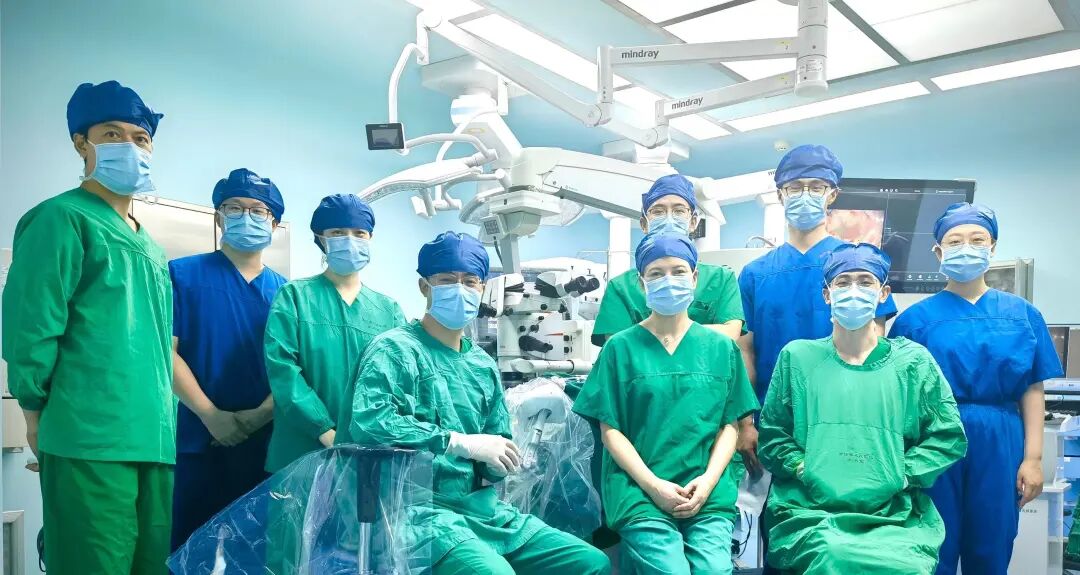
In July 2023, the "Digisight MicroEdge" ophthalmic surgical robot successfully completed the first retinal sub-thrombolysis surgery for macular hemorrhage at Zhejiang Provincial People's Hospital
Q: So far, how many surgeries has the Digisight MicroEdge surgical robot completed in total?
A: Currently 6 cases. The surgical patients' vision improved significantly — most who came were blind patients, blind for periods ranging from several weeks to one month, and after surgery they could see eye charts and even read. Doctors' feedback was that with robotic assistance, they felt more relaxed mentally during surgery. And if more problems or unexpected situations were discovered during surgery, doctors could decide to have the robot stop at that position, see more clearly through imaging before proceeding to the next step, and during drug injection, doctors could more autonomously choose injection time and control injection speed, no longer dependent on how long human hands could hold steady.
Q: Besides Zhejiang Provincial People's Hospital, are there plans to deploy at other hospitals? In 2024, how many more hospitals will use the Digisight MicroEdge ophthalmic surgical robot?
A: We are currently about to commence registration clinical trials; the first batch of collaborating hospitals is expected to be more than 10.
Q: Compared to other products, what particular problems and challenges does ophthalmic surgical robot deployment encounter?
A: From a commercialization perspective, some types of surgical robots have longer development histories and already have mature charge catalogs (referring to surgical consumables charge catalogs), and doctors have undergone extensive training — for example, laparoscopic surgical robots. In comparison, Digisight's ophthalmic surgical robot is an innovative product, and not many doctors have been trained on it, so we also need to take on part of the role of training doctors.
Q: Your role has shifted from researcher to entrepreneur. In this process of technology productization and product commercialization, what have you experienced that differed from your initial expectations?
A: From a technical perspective at the time, the team thought that during productization, if we solved the most difficult technical problem, basically 80% of problems would be solved. But in actual productization, the challenge wasn't that most difficult problem, but rather many small problems.
For example, we solved the core precision problem quite early, but subsequent series of adjustments all revolved around making the robot more stable and controllable, while also considering cost. Especially for medical devices, it involves a series of compliance standards — it's not complete just because performance is achieved.
Additionally for commercialization, as mentioned earlier regarding training and charging issues, the investment is also quite substantial. How to promote and普及 still has many challenges.
Q: What are the short-term and long-term plans next, and do you have plans for overseas markets?
A: In the short term, we will still focus on ophthalmic microsurgical robots, creating a truly commercially successful product. In the long term, we hope to use products to drive the development of the entire industry, hoping the company can form a robotic micro-manipulation platform centered on micro-technology to improve our medical standards in related areas. This is our goal — not just making products, but ultimately hoping to achieve overall improvement in core medical capabilities around treatment methods.
We will go overseas. Digisight makes innovative medical devices, and for some treatment methods such as gene therapy and cell therapy, going overseas may target countries or regions with more advanced medical levels and higher market acceptance, such as Europe and the United States.
PS: Digisight Medical welcomes patients with fundus diseases to participate in clinical trials.
About Linear Capital
Linear Capital is an early-stage investment institution focused on "frontier technology + industry" — that is, frontier technology represented by data intelligence, digital new infrastructure, next-generation robotics technology, and new technology transformations in traditional fields (such as biomedicine, materials, energy, etc.), applied across vertical industries to greatly improve industrial efficiency, empower them to solve pain point problems, and complete industrial upgrading — achieving excess returns in commercial value through substantial increases in industrial value. It currently manages ten funds with total assets under management of approximately $2 billion.
Our investment stage focuses primarily on leading angel to Series A rounds, with typical investment amounts of $3-8 million or equivalent RMB per project.
To date, Linear Capital has invested in over 120 entrepreneurial teams at early stages, including Horizon Robotics, Kujiale, Sensors Data, Tezign, Rokid, Guandata, Agile Robots, and others. The combined valuation of Linear's invested projects is approximately $20 billion.
In the near term, Linear Capital is striving to become the best "Data Intelligence Technology Fund," and in the long term, gradually build itself into the most influential "Frontier Technology Application Fund."