After Raising 200 Million Yuan, AI Hardware Entrepreneur Chris Pan Embarks on His Own Odyssey | Linear Voice

After every temptation, still knowing why you set out in the first place.
This past weekend, The Odyssey held its mainland China premiere. It's Nolan's biggest global opening to date, and the fastest film on Letterboxd to hit one million logged watches. The real victory of this epic was never about conquering a city — it's about still knowing why you set out in the first place, after every temptation along the way.
Last summer, an AI hardware company borrowed this story for its brand name at founding: OdyssLife. Its founder, Chris Pan, had just left a major tech firm to pursue what many saw as an "anti-human" idea: a necklace that hangs around your neck, recording every single thing you eat.
After closing a 200 million yuan funding round in Q1 this year, Pan entered a kind of "retreat" — rarely speaking publicly or meeting investors. With The Odyssey now in theaters, we sat down with him last week for a morning conversation about product, technology, team, and what they've learned in their first year of building.
In Homer's epic, Odysseus spent ten years returning to Ithaca after victory in war. Later, Kubrick borrowed the name for 2001: A Space Odyssey, turning an interstellar vessel into the modern spiritual expedition — restoring humanity's most primal vision of evolution.
The Odyssey is a long journey home. Odysseus left Troy, crossed storms, straits, and uninhabited lands, spending a decade to reach Ithaca again. Twenty-seven centuries later, the Odyssey is no longer just a hero's story. It has become a broader metaphor for anyone who ventures into the unknown, continuously evolves, and ultimately rediscovers themselves.
This is the story behind OdyssLife's name.
A year ago, Pan left a major tech firm to build a smart necklace that records what you eat. He tried to use AI hardware to capture "eating" — the most daily, yet hardest-to-digitize behavior — allowing people to regain awareness of their bodies and health in an era of ever-encroaching technology, and to understand themselves anew.
Over a year of exploration, Pan moved from the grand vision of a multimodal entry point to focusing on the small matter of "eating." He stepped back from the excitement of external validation like valuations, returning to product, technology, and the user's actual experience. This process is the story of how a team charts a course without a map, stays clear-headed amid external hype, and keeps moving forward together when the product remains immature and the destination still distant.

Every Odyssey begins not because somewhere else is better, but because the old life no longer answers new questions.
We met Pan after he'd left ByteDance to start his own company. As a product manager, he'd built Coze and Doubao smart glasses from 0 to 1 there. Before that, he worked on the Xiaoyi algorithm and HarmonyOS at Huawei. Major platform, mature pipeline, AI tailwind — to outsiders, this was already the optimal path.
But he always felt a restless constriction by the system. Hardware follows its own rules: from concept to mass production requires sufficient validation cycles, and business lines can't wait. When they can't wait, the solution often simplifies to "replace the person." Over time, no one wants to bet on something six months out.
"People who build hardware might need three pancakes to get full, but everyone tends to want to skip the first two and eat the third directly," he said. "The collaboration style at big companies is closer to a crowd assembling through a massive organization. But 0-to-1 things still require people to rally together and tackle them as one."
After starting up, the most immediate change was the soaring speed of decision-making.
For example, they needed to manufacture a software-hardware integrated motherboard — factory lead time two months, with a certain probability of scrapped prototypes. The choice: whether to run three or four lines in parallel, at three or four times the cost.
"This decision took fifteen minutes internally. We talked it over at dinner that night and wired the money." The same thing in his previous life would have taken one to two weeks of preparing materials, individual negotiations, and finance processes — three weeks gone.
The flip side of speed: no one else bears these decisions for you. The judgment is yours, so are the consequences. But without taking the first step, you never know the result.
"You have to move forward one step before you earn the right to judge whether you're better off staying put or going further."

In the wearables market, sleep has produced Oura, exercise has Whoop. Only "eating" — the highest-weight factor for health — remains empty. Traditional diet apps ask you to pull out your phone before lifting chopsticks, aim, photograph, search, estimate weight. In reality, no one completes this ritual for a handful of chips grabbed on impulse.
Initially, Odyss wanted to do far more. Social features, task management — all appeared in the first version of their pitch deck; diet was merely the entry point. But startups don't believe in hypotheses, only user feedback.
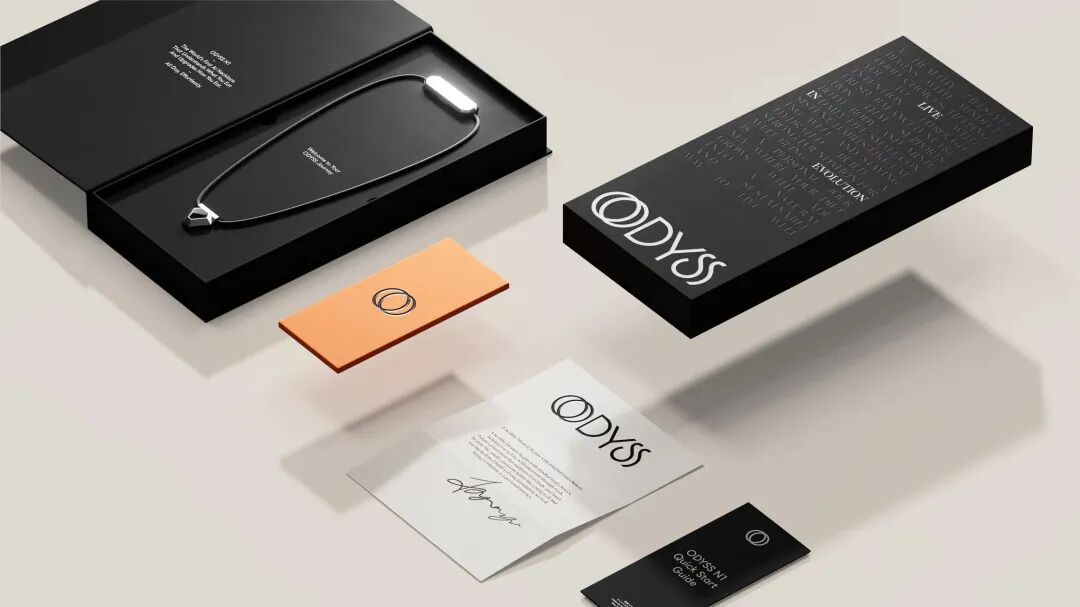
Once, the team handed prototypes to users and observed everything from unboxing through wearing, downloading the app, and logging in. Soon, problems they'd never discovered began surfacing. Some didn't know how to detach the lanyard and simply pulled it over their heads. Though the app was designed to be minimalist, users found it too clean — they didn't know what to do next.
"Beautiful design must be simple; fewer words means more beautiful. But when words become too few, user comprehension costs rise dramatically."
The more important discovery came later: users don't want something constantly managing them.
"Our earliest interested users really just needed you as an observer beside them, telling them what happened and what they should do. Don't judge them, don't score them, or compare them to others — that becomes, to some degree, a kind of harm or burden."
So the team started subtracting, even cutting heart rate and blood oxygen. "Exercise products don't close the loop on diet, so why must my diet product close the loop on exercise?" They kept only the thing everyone does every day, yet has never been truly recorded.
"Eating is the most important thing for health, but right now you don't know how you eat." With this realization, Odyss found its direction for the first time.
As for form factor, he never wavered. Users complained about comfort, paint chipping, wear and tear — but almost no one in a year said "the necklace doesn't work, try something else" — because users couldn't imagine what other form factor could accomplish this.
And form factor determines something more fundamental: "How long users wear it doesn't depend on how much data you provide, but on how low the friction is." Like Oura, originally a sleep product — theoretically removable during the day, but no one actually does. Friction low enough, and always-on becomes an unthinking habit.

In the narrow strait, to the left the whirlpool Charybdis that swallows ships, to the right the sea monster Scylla that devours sailors. Faced with such extremes, sailors cannot force their way through — they must find an exquisitely precise course.
Once truly committed to building a necklace that only tracks eating, the problems grew increasingly specific.
A photo can identify a dish, but struggles to tell you how much was eaten. The best multimodal models on the market achieve roughly 70-80% accuracy on single-image portion estimation; ordinary diet apps often err by 50% to 100% — the same physical item measured by ten products might yield 100 grams from one, 20 grams from another. Obsessing over single-photo precision was practically a dead end.
"Eating is a continuous process; it shouldn't be judged from a single moment."
The team pivoted to recording continuous eating image streams, and developed a chewing sound algorithm — like a voice assistant recognizing wake words, it detects the act of eating from ambient sound, then aligns body-leaning posture and other markers with the video feed for the model. Not single images but image streams, every bite broken down.
For Chinese cuisine — widely acknowledged as difficult — Pan's answer was pragmatic: "I took what other products couldn't recognize about Chinese food and made it recognizable. That's a 0-to-1 thing; 1-to-100 comes later."
Hardware refinement is another narrow path, testing judgment. "The moment you have any requirements for power consumption and size, a factory will tell you it can't be done — when it actually can. When they say can't, it might truly be impossible, or it might yield with some pushing."
The lanyard was pushed through exactly this way. The team initially used a silicone casing similar to charging cables, directly wrapping copper wire. In internal testing, many users reported the cord rubbing back and forth against their necks like a bath towel. When users wanted to remove the necklace, their instinct was to pull the cord — making it prone to breaking. So they wanted to add a support material inside that could resist pulling while not affecting electrical current and signal transmission.
Supply chain responses were nearly unanimous: impossible. Finally, through the team's efforts, they solved it with an entirely new wiring approach — now their own patent. By the Pro series, they'd added a motherboard layer, an extra chip, and a larger camera — yet volume decreased and power consumption dropped. "If you'd shown me this solution a year ago, I would've thought how is this even possible?"

In The Odyssey, the Sirens never harm by force. They simply sing — drawing out the most secret desires and vanities in sailors' hearts, repeatedly telling you "come closer, and you'll get more." All who heard their song steered toward them, dying in the waters around the island. Odysseus had his sailors plug their ears with wax and bound himself to the mast, surviving only thus.
Early this year, Odyss closed a 200 million yuan round led by a top-tier firm, its valuation climbing steadily. By conventional wisdom, they should have pressed the advantage; instead, Pan actively hit pause.
During that period he frequently met investors and fellow founders, increasingly prone to feeling "I really understand this market." But returning to the company: the person in charge of models knew exactly where models stood, the hardware lead knew where supply chain bottlenecks were. Much of what he'd confidently told investors was already outdated — the company iterated faster than the stories he told.
"If you front-load positive feedback too much, making the funding moment the peak of positive feedback for the entire company, then the entrepreneurial path afterward becomes a downhill slope."
He also guards against something more insidious: resource abundance makes people lazy. "With sufficient resources, you don't need to use your brain — just do everything. But human mental energy is finite; you will definitely lose focus — this isn't a money problem, it's a human energy and excitement problem."
Watching peers raise hundreds of millions per round, Pan wasn't immune to anxious moments. "But early-stage market stuff — it's all self-imposed delusions. Often you're just giving yourself a reassurance pill; that doesn't mean it's actually useful for the company."
Numerical smoothness frequently masks underlying problems. Odyss's early overseas cold start used email signups, with astonishingly low costs. Conventionally, conversion further down the funnel shouldn't differ too much. But once they started collecting deposits, new information gradually emerged.
"We wondered, why don't these two data points align? Later we found users were very interested, very much in need, but had concerns: I've never seen this product — does it actually work? I've never heard of this company — could it be a scam?"
This is probably the original sin of all new categories. A smart ring appears online, even with just one image, and you know what it does. But a necklace that watches you eat — this never existed before. The fork in the road is brutal: is this incomplete education, or is the category itself flawed? Odyss's answer wasn't "think more" but "finish it first."
"From when a product is invented to when it's proven or disproven, an enormous amount of work must be done in between. When you don't complete that work, you're far from knowing whether this thing is right or wrong."
Precisely for this reason, when a few major firms announced plans for necklace form factors this year, he wasn't anxious — even slightly excited: "With major firms joining me, users actually buy in more."
New category birth requires education costs; more players entering means accelerated market education. As for who ultimately remains, the answer always lies in the product itself.
Pan joked, "Your first-sale data is the page in your competitor's立项 report. Copying is unavoidable, worry is useless — but the first mover's advantage is, you decide when to show your cards."

The most memorable part of the entire epic for him isn't the Cyclops, nor the Sirens, but a bag.
The wind god packed all adverse winds into a leather bag for Odysseus, leaving only a westward tailwind. Seeing Ithaca's coastline nearly within reach, the exhausted Odysseus fell into deep sleep. The crew grew curious: he'd guarded it so closely all journey — it must be treasure, taking a little couldn't hurt. The bag opened, winds burst forth, blowing the ship back into the vast sea.
"So often, the difficulties Odysseus encountered on the road weren't objective — not the Cyclops, not Poseidon. What truly blocked them was human nature," Pan said. "At certain nodes, the journey isn't over, but people can't sit still anymore." This is why he values team more than product.
In The Odyssey's ending, Odysseus finally triumphs — but he is the only one to return to Ithaca alive.
"The first time I read it, I didn't really understand. Why not simply curse him to death, instead letting him live while watching everyone around him die?" Pan said. Later, he realized some losses are more protracted than death itself. "It's equivalent to losing everything, yet having to endure that pain for a long time."
This isn't the ending he wants. Pan hopes that five, ten years later, the people around him are still those who set out together at the start, still able to trust each other back-to-back. In Odyss's first year, aside from one colleague leaving for family reasons, none of the remaining thirty-some members voluntarily departed.
For this entrepreneurial Odyssey, "coming home" isn't just returning to where you started — it's that the people who started together are still standing on the same deck.

Unlike Odysseus, Odyss's Odyssey has only just set sail.
Pan set himself a concrete goal: deliver the first batch of Pro products by year-end, sell 100,000 to 150,000 units next year. For a first-generation hardware product, this is already a solid number. But what excites him more than sales is one day having ten thousand active online users — "we need to see in our community that users' lives have truly changed because of our product."
He believes dietary health will become a larger market than sleep and exercise. "What I can foresee is first reaching the same magnitude as current unicorns in sleep and exercise, then surpassing them." Pan believes this track will eventually produce a company worth ten billion dollars.
In his view, Odyss is currently ahead by a wide margin, but ultimately may not be — the team should always stay vigilant. This is a marathon; winning and losing aren't decided at the starting line.
Odyss doesn't want to make decisions for everyone. Technology doesn't always lead people to better places, but Pan cares more about whether, when someone one day decides to face themselves and understand themselves, this process can be a little easier because Odyss exists. "Even if only a few people change because of it, this Odyssey will have been worth it."
In Homer's epic, whenever Odysseus is about to meet a turning point, the sky always first glows with rose-colored dawn. Odysseus spent ten years returning to Ithaca. But the real meaning of this story was never "he made it back" — it's that he still remembered why he set out.
This is Odyss's first year. Now, they may not yet see Ithaca's coastline. But at least, the sky is beginning to lighten.