Silicon Valley Founders and Executives' Year-End Roundup: 30 Pieces of Advice for Entrepreneurs | Bolt's Picks

As Sam Altman said, the beginning of the year is the best time for reflection.

In 2024, thanks to rapid AI progress, the barrier to building products has dropped and competition has intensified. Though today's tools are more powerful than ever, it's still no easy feat for startups to succeed. First Round Review, the content arm of Silicon Valley's renowned venture firm First Round Capital — often called "the Harvard Business Review of venture capital" — reviewed its founder interviews from 2024 and distilled 30 pieces of advice from entrepreneurs and executives, drawn from their firsthand experience. We've translated and condensed the key takeaways below; you can click the "read original" link at the bottom of this article to read the full piece.
1. If you haven't found PMF, make a big adjustment to your company — incremental tweaks won't cut it
Lattice founder Jack Altman once shared how he got stuck at the first layer of PMF and what adjustments he made.
"We saw at our previous company that quarterly OKR planning was a pain point for many companies. So we initially built an OKR software tool. However, while this was a real problem, we never managed to build software that actually solved it," Altman said.
He identified two signs that he was stuck: "First, it was hard to get people to actually pull out their credit cards and pay for our product. Lots of CEOs and HR leaders would say, 'We really like this product. We'd love to manage OKRs better. Can we try it?' But when we tried to get them to pay, it was extremely difficult."
"The second issue was that even when we got customers using the product — even when the whole company was using Lattice for OKR planning — by the next quarter, users felt forced to use it. In Q3, we found that users weren't naturally using our product," he said.
His proposed solution was striking: "If you're stuck, the only way out is a big adjustment, not incremental tweaks. At a certain stage, finding PMF requires more than gradual improvements or spending more time," he said. For Lattice, this meant several pivots before ultimately landing on performance management.
Generally, if what you're doing isn't getting much traction, what you probably need isn't a 10% adjustment — it's 200%.
2. Ask yourself hard questions for more rigorous self-reflection
Whether you set three New Year's resolutions every year or remain skeptical of the ritual, the start of the year naturally puts people in a reflective state.
Review once asked founders: among all reflection questions, which ones have been most helpful in making you pause and think about your business, team, or personal leadership? The responses ranged from highly experienced entrepreneurs to first-time founders. Here are some of the most illuminating questions Review selected:
- "Is the work I'm doing today actually effective in moving the company toward success?" — Colin Zima, CEO and co-founder of Omni
- "What's the hardest part? Am I working on it?" — Wes Kao, former co-founder of Maven
- "Is our current product direction determined by inertia, or by what's actually correct?" — Eilon Reshef, CPO and co-founder of Gong
- "What topic am I avoiding discussing?" — Johnathan Nightingale, co-founder of Raw Signal Group
- "Where are we right now, amid the relentless chaos and management?" — Kareem Amin, co-founder and CEO of Clay
3. Mine for conflict to quickly identify problems and context
Carta CTO Will Larson has observed certain patterns. For example: "A major problem many engineering executives face when joining a new company is assuming that what worked at their previous company applies to the new environment."
Quite the opposite, Larson said. To do good work, you need to "mine for conflict" — deliberately seek out opposing viewpoints, even inviting people who disagree to challenge your ideas. After moving from Uber to Stripe, he tried to implement the automated tooling system he'd used at Uber. Before acting, he asked some senior engineers for their thoughts and found they hated the idea. At first Larson thought, "This person is being unreasonable," but he later realized their opposition was correct. Stripe's technical architecture was completely different from Uber's; his initial proposal simply didn't align with Stripe's needs.
His advice to engineering executives: don't just talk to your peers. The most valuable perspectives usually come from those closest to the problem. Larson added: "You can usually get buy-in from other executives fairly easily, but getting validation from those who know the specific problem best is much harder. Their input is most valuable because they know the details. You can't lie to them — they know the truth."
Successful leaders typically ask: "How can I change myself to fit the organization?" rather than "How can I force the entire organization to fit me?"
4. Use these 12 questions at your next product review
Tara Seshan spent seven years in product at Stripe, holding multiple key roles and launching several products from 0 to 1. She noted that if you want to make sure you're building the right thing, you can look to Stripe's product development process.
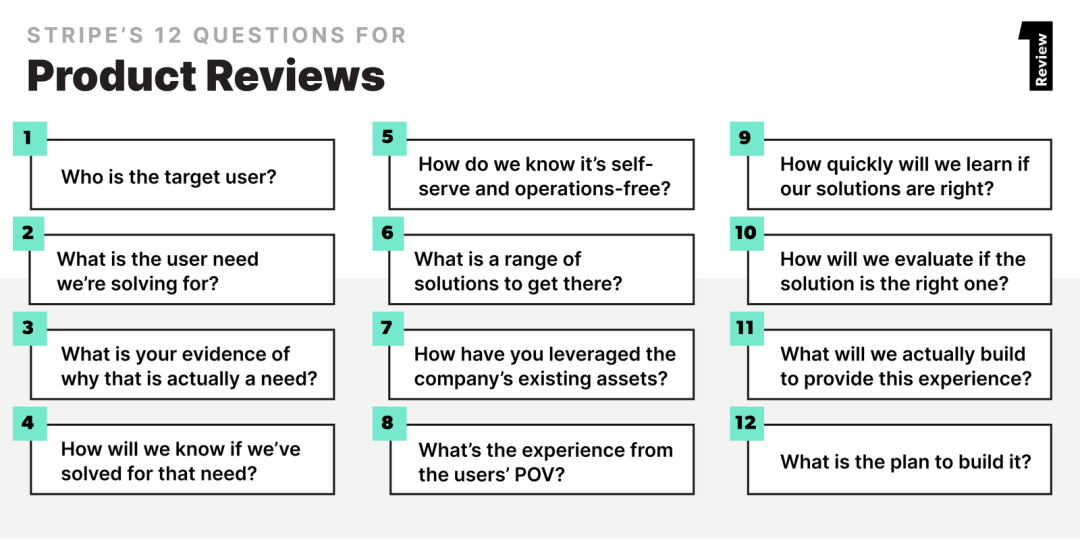
"Specifically, Stripe asks a set of questions at every product review — 12 questions — with one strict requirement: you cannot move to the second question until you've thoroughly answered the first," Seshan explained. "Not every review covers all questions. Sometimes a team will say, 'I've only answered the first four,' or 'We answered questions 1-6 in the last review, so this time we'll go deeper on the remaining ones.'"
The core of this process is preventing teams from jumping straight into product experience and skipping crucial context.
"You're trying to build a product that can win in the market — no one gets it perfect on the first try. Software is never 'done,' and the first version always has many issues. But without clear context, it's very difficult to evaluate a product effectively," Seshan added.
Here are the 12 questions:
5. Early employees are critically important
Whether in product, engineering, or go-to-market, finding true executors is the top priority for startup hiring. Dock co-founder and CEO Alex Kracov noted: "You don't want to hire people who just say, 'I need to hire a bunch of contractors, full-time employees, or agencies to help get this done.' Instead, you need people who can roll up their sleeves and deliver results themselves." So when evaluating candidates, he makes sure they pass what he calls the "button-clicker test."
Kracov, as Lattice's third employee and first marketing hire, had no SaaS experience when he joined (literally none). But he passed the button-clicker test with flying colors. "I learned a lot of scattered but useful skills — using Figma or Sketch, building websites, running a campaign. I could not only talk about marketing but actually do the work myself. If I didn't know how, I'd watch YouTube videos and teach myself."
A major mistake many people make in early marketing hires is choosing people who talk a good game, only to find they need to hire others to do the actual execution.
6. Stick to your annual plan
Entering 2025, many companies have already set and finalized their annual plans. Yet however perfect that January document looks, unforeseen changes always lie ahead — whether new market competitors, shifts in customer behavior, or disruptive emerging technologies. Businesses need to balance adaptability with commitment to their goals.
Linktree Chief Product Officer Jiaona Zhang, in creating an annual planning guide, invited top experts from Linear, Vanta, and Notion to share their insights, particularly on handling unexpected disruptions.
Vanta CRO Stevie Case emphasized the importance of repetition: "No matter how small your company or what stage you're at, set a fixed time, place, and rhythm to review and remind your team of the original goals."
She noted that the root problem is usually this: once the year begins, teams get busy with various matters, gradually lose focus, and eventually drift completely off plan. Work then falls into a reactive cycle of "week after week, month after month" — focused on immediate tasks while losing sight of long-term goals.
This doesn't require an overly complex process. Here's the lightweight check-in framework Zhang implemented at Linktree:
"We prepare a scorecard template for each quarter with 3-5 key cross-functional goals. We hold a weekly scorecard meeting — a lightweight check-in mechanism. Everyone needs to score their goals and indicate whether things are 'on track,' 'at risk,' or 'off track,'" Zhang explained. "If a metric is yellow or red, you need to clearly state what specific help you need. This way, there are no surprises in the quarterly business review. We can make decisions and adjustments based on actual conditions at any time."
7. Use an interest-capability matrix to derive startup ideas
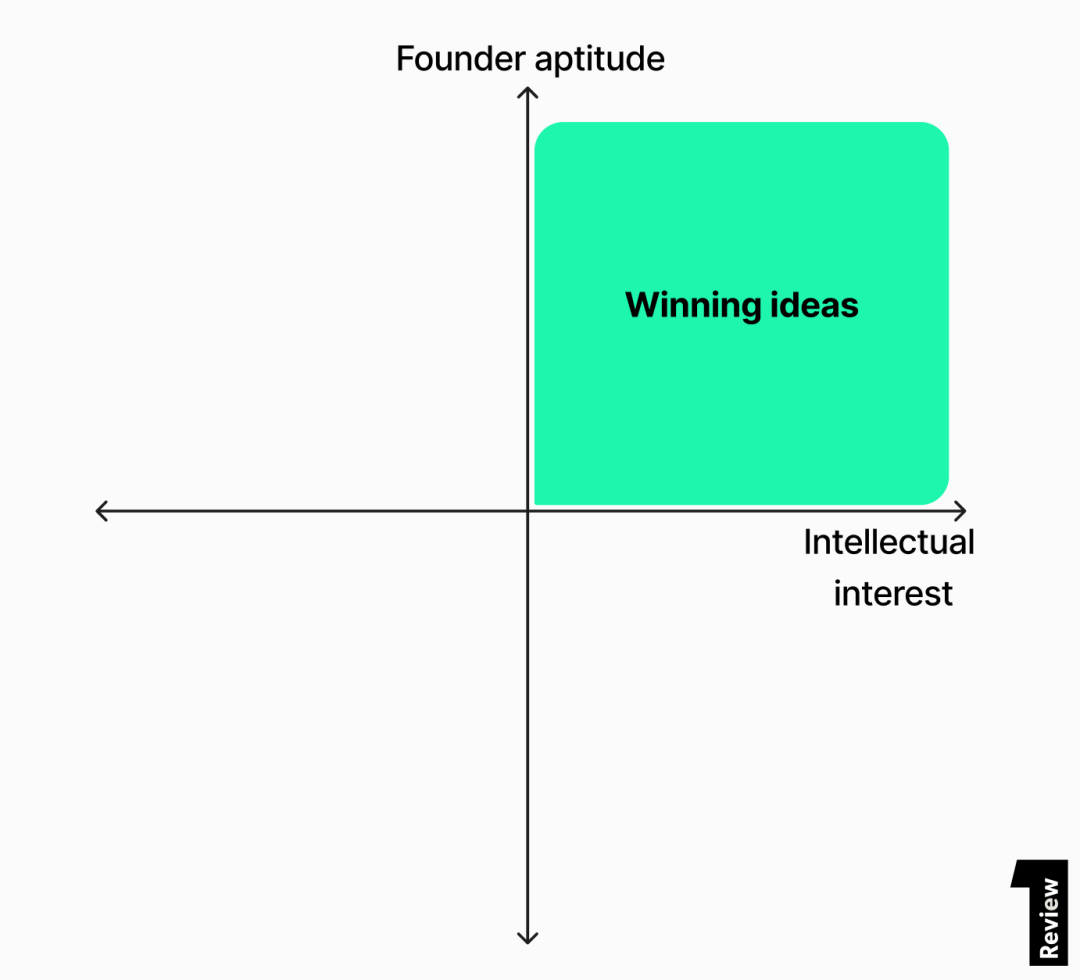
When searching for startup ideas, many founders follow market trends or personal interests. But Crossbeam CEO and co-founder Bob Moore cautions: "This is only one dimension of founder-market fit." He believes the best startup ideas should not only align with market trends but also solve problems in areas where you excel.
As a serial entrepreneur, when Bob Moore was planning his third startup, he wanted to swing for the fences — building a public-company-level success, rather than selling the company like he had twice before. He brainstormed dozens of promising ideas and gradually whittled them down, eventually designing a simple two-by-two founder-market fit matrix. He asked himself:
- Intellectual interest in the idea/problem: How much fun would I have doing this? Would it blow my mind?
- Founder capability: What unique experience do I have that gives me native talent for solving this problem?
8. Challenge the dogma of "just focus on one thing"
"Find a niche, then expand" is conventional wisdom that rarely gets questioned. But Replit founder Amjad Masad took a different path. While most founders narrow their focus early, Masad deliberately kept his company's vision broad.
When Masad saw competitors like Glitch go all-in on JavaScript in 2018, he made a controversial choice — building a general-purpose platform. Meanwhile, he noticed Python gaining traction in CS101 courses and data science. By maintaining broad coverage rather than betting on a single programming language, Replit perfectly captured that wave.
The bet paid off: by 2020, Replit's user base and engagement were 10 to 100 times higher than its closest competitors. Replit has kept pushing boundaries, recently launching an AI Agent that can generate complete applications from a few lines of text.
Masad admits that supporting multiple languages was a gut-wrenching decision, because Silicon Valley orthodoxy preaches "do one thing and do it extremely well." Yet his choice proved the potential of a different strategy.
9. Founders/executives should learn to "chew their own cud"
One of the biggest lessons Matt MacInnis has learned across his career — as founder of Inkling and now COO of Rippling — is that executives need to get comfortable being uncomfortable. "The hardest problems always land on my desk, because if the answer were obvious, they would have been solved several layers below me. The essential job of an executive is handling these 'nuclear-grade' problems."
However, MacInnis has noticed a dangerous "outsourcing" tendency when executives face complex or high-stakes decisions. This reflex to seek external advice carries two hidden risks:
- Risk one: It weakens first-principles thinking. "The danger of taking advice is that it can relieve executives of the responsibility to think through problems independently — which is literally their job," MacInnis says. "The point of college isn't walking into a classroom and being handed the answer. You have to work through the problem yourself."
- Risk two: It reinforces the illusion that a "correct answer" exists. "When you make decisions purely based on advice, you get a false sense of confidence because it came from someone you trust," he adds.
This isn't a blanket dismissal of seeking advice. Rather, it's about maintaining a cool, reflective stance on whether you should immediately seek others' input. "You might agonize between options A and B for days or even weeks — if you're lucky enough to have options. But ultimately you learn two things: First, you have to find balance in uncertainty. Second, what matters is how quickly you can make a choice and learn from it, not whether you got it right from the start."
As an executive, you can't just let others graze and chew while you do nothing and get the milk. You have to get your hands dirty.
10. Avoid hearing only what you want to hear
Whether pitching an emerging startup, launching a new feature, or shipping a new product, the more invested you become, the easier it is to hear only what you want to hear.
As a user research expert, Jeanette Mellinger's job is to help founders and product leaders "put on earmuffs when they're only listening to opinions they want to hear." She emphasizes that when you hear "oh, this product is great," that's precisely when alarm bells should ring. You need to make room for the feedback you don't want to hear — that's what makes your product better.
Mellinger shares a few techniques to spot and avoid leading questions before they mislead you:
- Watch your adjectives: If your question to users contains adjectives (like "easy"), you're actually signaling your own opinion. Instead, try more neutral phrasing: "Can you tell me about this experience?"
- Correct bias through follow-ups: While it's best to avoid leading questions with adjectives, sometimes you can't. In those cases, first give the respondent an out: "To what extent was this easy?" Then flip it: "How difficult was this?" This balances perspective.
In user research, what you need to learn is precisely the truth you're afraid to hear — this helps you avoid wasting massive amounts of time building something nobody wants.
11. Don't expand blindly; hire only when the business actually needs it
In building Zapier into a $5 billion company, founder Wade Foster takes pride in breaking conventions and avoiding cookie-cutter startup advice. From day one, he took a different path, setting up shop in Columbia, Missouri — far from high-growth startup hotbeds.
This contrarian spirit also shaped Zapier's fundraising strategy (a single $1.3 million round) and its approach to team growth.
"Lots of people told us, 'You could grow faster by hiring more people.' But I think too many companies and investors glorify 'growth at all costs,' which sometimes leads to 'more people, more problems,'" Foster says.
As a first-time founder, if you try to scale from 10 to 100 people in year one, you'll have massive internal problems.
Foster believes Zapier's "slow and steady" approach made the founding team the people who truly understood the business best.
"It meant we did every job ourselves at first, so we deeply understood every part of the company. When we eventually hired for key roles, we could clearly see how to set them up for success. We knew what good looked like and what didn't, because we'd done the work ourselves."
That's not to say Zapier never grew its team, but the curve was more gradual. "We went from three founders in year one, to seven employees in year two, then 16, 35, then 75. Basically doubling every year," Foster says.
So when should founders consider hiring? Foster recommends waiting until some part of the business is screaming for it. For example, when Zapier's founders found themselves doing customer support from morning till night, they realized it was time to hire more people.
12. Avoid the glamour vortex
Clay had a long journey finding PMF — from zero revenue in spring 2022 to now signing over 2,500 customers including Anthropic and Notion. Co-founder and CEO Kareem Amin recalls how the team frequently fell into a "glamour vortex": something a prospect said would sound exciting and feasible — a need slightly different from their current work — and they'd try to build it to win that customer.
They dabbled across different use cases, target customers (ICPs), and minimum viable products (MVPs) until Amin decided the company had to focus and stop reshaping the product for any single customer's needs.
"That meant, among the customers we were talking to, find the ones who would actually buy our product as-is, make sure those people got equal service and product, then sell to them — without doing more custom development for any one customer and letting that keep happening." He found it helpful to establish strict internal rules, telling the team: "Once we've agreed on something and put it in the sprint, nothing changes. If you have a new idea on your commute, drop it. We'll be open-minded and have spontaneous ideas during planning, but once we're in execution, unless data changes, we stick to the plan."
At the startup stage, there's a common mental trap: "We're just missing this one thing..." But this thinking actually masks the true signals of product-market fit. When demand is strong enough, customers will buy your product and be willing to wait for follow-on features. That's the most direct sign your product has value.
13. Don't be discouraged by a surge of customer complaints
In the early stages of finding PMF, the most typical founder behavior is wanting to hear praise from customers/users, whether in data or word-of-mouth. In Gong's early days, CPO and co-founder Eilon Reshef received plenty of less-than-positive feedback — yet this feedback showed that their early customers genuinely cared about the tool they were building.
Criticism beats being ignored, because if customers ignore you, they simply don't need your product. If customers start complaining, that's usually a good sign — it means they have expectations for the product and want to see it improve.
14. Treat your deal lead as a coach and helper
There's no shortage of advice on how to nail a fundraising pitch; but few people tell you what happens when your project advances to investor discussions, especially partner-level meetings. As a former founder and First Round partner, Liz Wessel discovered a common blind spot from her own fundraising experience at WayUp: even the most prepared founders often overlook it.
Whether you're a first-time founder or have raised before, Wessel's advice is the same: your "point partner" — the investor who ushered you into the partner meeting — is your most powerful ally.
"Remember, after an initial one-on-one meeting, the probability of VC investment is roughly 5%, and the odds of even getting that first meeting are far lower," Wessel says. "But if your project has advanced to the point where it's being discussed by the relevant decision-makers at a VC firm, the likelihood of investment becomes significantly higher. If you've made it to the partner meeting stage, your chances are much higher — after all, the investor who brought you in has committed the entire team's time to this meeting, which signals they already have some conviction in the deal."
"As a first-time founder, I didn't realize during my own fundraising that the investor you're directly working with is often 'on your side.' By introducing you, they're signaling to the whole team that they believe you and your company are worth spending time and energy on."
To make the most of this relationship, request a 30-minute call with your point partner before the first partner meeting. Here are some questions worth asking them:
- How much context do the other attendees have?
- Given who's in the room, which parts of my pitch should I emphasize more?
- How much time should I spend on founder background versus business overview?
- What additional prep work should we do before the meeting?
- Which aspects of the business might the team have the most questions or hesitations about?
15. Find the hidden metrics
Rachel Hepworth, CMO at Notion (formerly head of growth at Slack), points out that product-led growth companies face a major challenge: acquiring registered users is easy, but understanding how they're supposed to use the product and extract value from it is hard.
Hepworth recommends not waiting weeks or months to see if users convert to paid, but instead identifying early behaviors that predict whether someone is likely to become a paying customer. At Notion, here are a few behaviors that signal potential paid users:
- They invite collaborators
- They create multiple documents within 24 hours
- They sign up with a work email
"Finding the metrics in your funnel most correlated with free-to-paid conversion is key to improving that conversion rate."
Rachel Hepworth emphasizes not to simply follow conventional metrics blindly. She says that, taken in isolation, whether a product's active user ratio is 70% or 30% isn't actually that important — what matters is what those metrics mean.
16. Do more rigorous reference checks
Before interviewing a candidate, any good hiring manager does extensive preparation — carefully crafting each question, anticipating whether the person will hesitate or answer well. Yet when it comes time to make reference calls, this careful planning often goes out the window.
Many hiring leads treat reference checks as a box-checking exercise (simply asking "what do you think of this candidate?"), outsource them to recruiting partners, or skip them altogether when pressed for time.
To make reference checks more rigorous, we collected go-to questions from founders and executives in our community and compiled them into a comprehensive guide for hiring managers. Here are some highlights:
- What was this candidate better at in this role than anyone else you've worked with? — Nadia Singer, Chief People Officer at Figma
- Would you hire this person again in almost any role? — Anique Drumright, VP of Product at Rippling
- The candidate mentioned that [xx] was a frustration at their previous company. Do you remember this situation, and what trouble did it cause them? — Sidharth Kakkar, Founder and CEO of Subscript
- Can you share someone who may not have gotten along well with the candidate? Why do you think they couldn't collaborate effectively? — Brett Berson, Partner at First Round
- Tell me in detail about this role and what success looks like in year one. Do you think the candidate would excel in this position? — Claire Hughes Johnson, former COO at Stripe
17. Reshape the category, don't reinvent it
Sometimes the more subtle approach carries more value: finding the gap in an existing market and positioning your solution as the key to filling it.
As founder of Studs, the Gen Z-beloved D2C brand for ear-piercing services and jewelry, Bubbers focused on redefining the entire ear-piercing experience — from the piercing itself to aftercare to styling. She says: "I had to make customers understand that what we do is completely different from a tattoo parlor on the street."
When you're creating a new category or inventing an entirely new product, you first need to invest in brand building, content creation, and audience education. Only when people truly understand what you're doing can you become a category leader.
18. Invest in "ten-minute managers"
In 2016, when Anna Binder joined Asana as head of people, the startup had just completed its Series C and was in rapid growth mode. Yet its talent strategy remained relatively simple: hire lots of great engineers quickly, then build quickly. So Binder essentially joined what she called a team of "ten-minute managers" — people new to management, eager to build their toolkit.
She found that one of the hardest skills for these new managers to master was giving constructive feedback. The task isn't easy, but it's crucial for startup managers. She says: "If you're not uncomfortable giving feedback every week, you're not doing your job."
So one of her first priorities was strengthening new manager training, including how to deliver direct feedback. "Research shows that high performers are twice as motivated and inspired by constructive feedback as average performers," Binder says. "And when I say 'constructive,' I'm not sugarcoating — I mean negative feedback."
She sees this as a virtuous cycle: invest in young managers, teach them how to give constructive feedback; then they apply the same approach to high performers, motivating them and further elevating their capabilities.
But for many early-stage startups, redesigning or introducing new manager training may not be realistic. So founders can encourage managers to do weekly self-reflection. Every Friday afternoon, managers should ask themselves: "Did I feel uncomfortable this week? Did I give hard feedback?" If the answer is yes, they're contributing to the company culture.
19. Sometimes you need to step back to see the forest
A defining trait of startup founders is telling people they work 80-hour weeks, weekends included. But Dennis Pilarinos, founder of Unblocked and a second-time founder, says one of the biggest lessons from going back to zero-to-one is that sometimes the best way to solve a problem is to temporarily step away from it.
Pilarinos says: "I now have proof that sometimes distance from a problem helps you solve it better. When I spend a day away from something that's driving me crazy, coming back to it, it becomes much simpler to solve."
At his first startup, Buddybuild, he often burned the candle at both ends. Now, he keeps his entire Saturdays for himself — no phone, no computer, no work. He recalls: "As a first-time founder, I could barely imagine that other people didn't come into the office on Saturdays, because I was so used to that way of working."
This simple buffer keeps him balanced through the ups and downs of startup life. He says: "You're never as bad as you think you are, and you're never as good as you think you are." Easy to say, hard to truly internalize. On the day you sign a big deal, you feel invincible. When systems are down for hours, a demo fails, or a customer churns, it feels like the end of the world.
When you can distinguish the trees from the forest, everything becomes clearer. This approach runs counter to the feeling of perseverance, because people typically believe that if you just keep grinding at a hard problem, you'll eventually find the solution.
20. Go all-in on finding growth levers
Last year, Matt Lerner, founder of SYSTM, posed a question: "If you knew that in building an early-stage startup, you needed to go through 1,000 mistakes to unlock rapid growth, how would you adjust how you operate?"
He believes that any startup's early phase requires learning through hard trial and error. Why not do those experiments as fast as possible?
Large companies can deploy massive capital and headcount across multiple channels, hoping one works, but they often don't know which channels are effective. Startups with just a few employees, a few million dollars, and 1-2 years of runway don't have that luxury — they must find small actions that can attract large numbers of customers quickly.
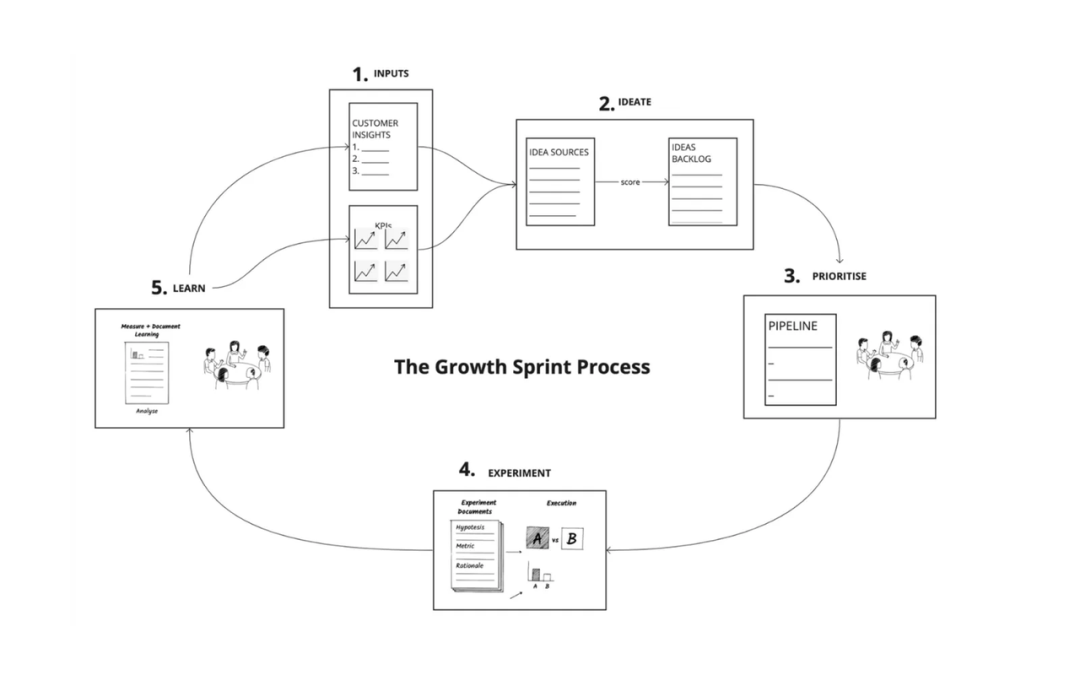
Lerner proposes five steps for growth sprints:
- Input: Gather customer insights, data from your growth model, past experiments or ideas.
- Ideate and score: Categorize ideas, select a shortlist ready to test in the current sprint.
- Select: Pick the most promising ideas to experiment with.
- Experiment: Design and run experiments to validate the ideas.
- Learn: Extract lessons from experiments, document and share your findings.
For startups, finding effective growth levers is a matter of survival. Most startups fail to find these levers and never make it.
21. Set direction before hitting the gas
In startups, "fast" has become conventional wisdom. But speed without direction only gets you lost faster.
Guillermo Rauch, founder and CEO of Vercel, summarizes his early mindset in building frontend cloud services as: "Focus on iteration speed, not just speed. Speed is going fast. Iteration speed is going fast with direction — you know where you're headed."
For Rauch, this meant being clear about what direction the software he was building was going, even if it required slowing down to listen to customer feedback. He says: "This philosophy has manifested in my career as sometimes the best solution being to do less development and focus more on customer needs. Sometimes it's carefully listening to what customers are trying to tell us. For someone who likes to move fast, this was the right addition to my mental framework for truly lasting success. In the early days, finding direction is the most important thing you can do."
22. Build good data habits before building a data team
Doordash Chief Analytics Officer Jessica Lachs, summarizing her decade of leading the company's data work, offers one core piece of advice: Build good data habits in your company as early as possible, even when the company is still young.
In the early stages, she recommends focusing on core metrics related to product-market fit. These metrics vary by company but typically include:
- User acquisition
- Customer engagement
- Revenue generation
- Operational efficiency
However, growth often arrives before you know it. Before you realize it, you may have accumulated thousands of customers and massive amounts of data — and that's when you need a dedicated analytics team. If the answer to any of the following questions is "no," it may be time to form a formal team:
- Do you believe you're measuring the right metrics?
- Have you set measurable goals for every area of the business?
- Do you understand the key drivers of business value?
- If performance is above or below expectations, do you know why and can you accelerate or adjust course?
- Are you identifying new growth or profitability opportunities?
- Are you satisfied with how priorities are set within the company?
- Do you understand the economics of the business and how pricing or discounts affect the tradeoff between growth and profitability?
- Are you using experimentation best practices to guide decisions?
23. Let everyone contribute to community building by unlocking your users' potential
When startups think about building community, they usually imagine a top-down, carefully curated approach. Notion, however — now known for its vibrant global community — was born from a radically different strategy.
Notion's first Head of Community, Ben Lang, took a seemingly risky approach: he handed control of community building to the most passionate users.
He explains: "We never restricted people to one way of behaving, doing community top-down. Instead, our strategy has always been to encourage people to make awesome things with Notion and empower them to share what they've built."
Lang and his team discovered that enthusiastic users who were already creating content or hosting events around the product were ideal partners. Thus, the Notion Ambassador Program was born.
This relatively low-cost strategy was particularly well-suited to an early-stage startup at the time. All the Notion team had to do was provide resources and support — early access to features, event funding, exclusive Slack groups — while letting ambassadors maintain full control of their own platforms.
This counterintuitive strategy paid off handsomely. Today, Notion has a global network of over 300 ambassadors, with community-led events happening almost daily. This approach of empowerment over control helped Notion build a community program at a scale far beyond what an internal team could have achieved alone.
24. Design your org structure around what your product needs
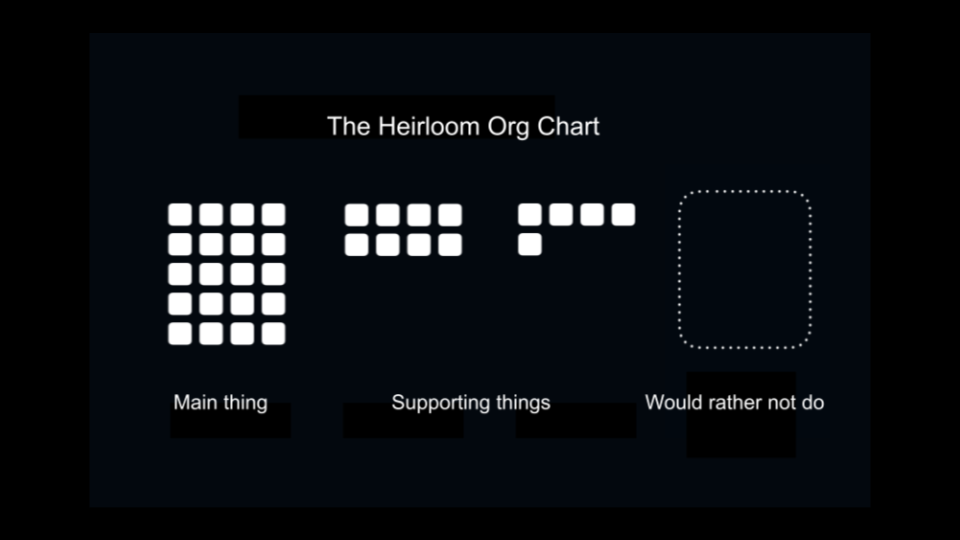
Most startups design their org charts chasing visual neatness and symmetry — dividing product teams into pods of 5-8 people. But Nan Yu, Product Lead at Linear, says this overly aesthetic approach often sacrifices effectiveness. A beautiful, perfectly symmetrical org chart invites suspicion and speculation because it signals that the founder's attention will be scattered everywhere.
Yu advocates for a "heirloom tomato" org chart — one that may look irregular and lopsided, but delivers far greater impact where it matters. "If you're a startup, there are probably unique things that make your product special, and you should invest more resources in those areas and give those teams enough flexibility — not just to build the first version of the product, but to handle the user feedback, maintenance, bug reports, and product polish that will inevitably follow."
Teams and scopes of work don't need to be divided by uniform standards; they don't need to be mutually exclusive or narrowly defined. Such a structure adapts more flexibly to market and product evolution.
25. Borrow marketing creativity — but don't steal from your own industry
When brainstorming your next marketing campaign, your first instinct might be to see what competitors are doing. But Krithika Muthukumar, who led marketing at Stripe and OpenAI, advises against limiting yourself to competitor inspiration. She even encourages borrowing ideas from completely different industries.
"At Stripe, we borrowed from people who did things well, but most of those ideas came from outside our space. We weren't trying to one-up competitors — we drew heavily from healthcare, from companies launching new programming languages, even from security."
Copying competitors' products feels uninspired and lowers the ceiling of what your brand could otherwise achieve.
26. For long-term goals, temporarily abandon what feels most comfortable
During expansion, you may need to make tradeoffs, sacrificing short-term gains for greater long-term growth. This was exactly the dilemma Pinterest faced when trying to expand internationally. At the time, U.S. growth was surging while international markets showed virtually no progress.
"The team could always run experiments to bump U.S. growth by a few percentage points," said Casey Winters, then Head of Product Growth. "So naturally, everyone focused on that rather than figuring out how to get Brazil from zero to one."
"This is the marshmallow test: do you eat the marshmallow in front of you, or wait a bit to get a second one?" Winters continued. "Even if founders can pass this test, the rest of the organization might not."
(The marshmallow experiment was a series of classic psychology studies conducted by Stanford University's Dr. Walter Mischel in preschools. Children could choose 1) one marshmallow as a reward, or 2) wait until the experimenter returned to the room to receive two marshmallows. Research found that children who delayed gratification longer generally performed better later in life.)
Ultimately, founder Ben Silbermann made a decisive call. He told the company that target metrics had to be set for five non-U.S. countries. Simultaneously, they shifted focus away from U.S. growth — and accepted that these metrics might decline.
Once a product finds market fit, getting the team to pivot toward projects that won't pay off in the short term is extremely difficult.
27. Just demoing the product is effective sales
For first-time founders, especially those with technical backgrounds, sales is often the thorniest obstacle. To ease this anxiety, people tend to over-engineer the sales process. Yet Vanta founder Christina Cacioppo found that the simplest approach sometimes works best. She designed a two-call process:
- Step one: Needs discovery and basic explanation
- Step two: Product demo
"I thought this two-step process was genius," Cacioppo said. But one blunt customer pointed out: "This really just needs one call where you show the product directly, 30 minutes, done."
She ultimately discovered that rather than designing complex sales processes, it's better to simply demo the product directly to other founders. "Selling to other founders works better because they'll tolerate the 'let me show you the product first, then we'll do the sales talk' approach," she explained. "They've been through similar situations and prefer talking about the product itself rather than being pitched."
28. Do things for customers, not for yourself
Pilot's founding team identified a problem — one that traced back to when they started their first company a decade earlier. As co-founder Jessica McKellar put it: "The strongest feedback from customer research was that handling finances and accounting remained an unsolved problem."
The seasoned entrepreneurs McKellar and her two co-founders, Waseem Daher and Jeff Arnold, decided to focus on providing bookkeeping and tax services for startups.
As three MIT-trained computer scientists, they could have easily built a pure software solution. But doing so might have missed what customers actually needed.
"Talking to business owners and founders, no one said I want more accounting software," McKellar said. "What they wanted was for someone to fully take over this problem and give them peace of mind."
This was a lesson learned from their previous startup: they had designed a product for themselves as engineers rather than one that served broader customer needs. After adjusting course, Pilot achieved tremendous success, reaching a $1.2 billion valuation.
Founders must be careful not to become overly constrained by their own experiences, ensuring their products truly resonate with target users.
29. When legal issues arise, skip lengthy written memos and just call your lawyer
Legal matters can be a headache-inducing necessity for entrepreneurs — expensive, time-consuming, yet crucial for long-term success. Especially in early stages, founders prefer to focus energy on rapidly advancing the business rather than spending time on incorporation documents or compliance paperwork.
On one side, founders eager to move fast; on the other, conservative legal processes. Hopin Chief Legal Officer Irene Liu has extensive experience balancing these tensions, and she shares counterintuitive advice: skip written memos whenever possible and just get on the phone.
"Call as much as possible, because it's more efficient," Liu advises. "You can ask follow-up questions quickly, and it's cheaper because answering a call is faster than writing an email."
If written materials are necessary, Liu recommends requesting a one-page brief summary rather than a full memo. Additionally, if working with your current lawyer proves difficult, don't force it. "The founder-lawyer relationship is like an intimate relationship — compatibility depends on chemistry and communication effectiveness," Liu explains. "If it's not working, move on and find the next one."
30. Beware innovation destroyers
Stanford University adjunct professor Steve Blank once said: "Innovators usually believe their industry will welcome new ideas. But reality often doesn't unfold as smoothly as business school textbooks describe."
Whether you're a newcomer battling established competitors, or fighting to maintain agility and innovation within a large company, Blank has observed common tactics for destroying innovation — particularly resistance from incumbent industry leaders. Their typical manifestations include:
-
Spreading FUD (fear, uncertainty, and doubt): Positioning innovative products, services, or ideas as "threats" and "risks" — implying that anyone who supports them is putting their career on the line.
-
Highlighting risks and challenges to existing conventions: For example, emphasizing the high costs of switching to a new product or service, or stressing that some users will resist change.
-
Claiming the existing team is already innovating: Saying that current R&D or engineering teams are already working on something similar, or that they could do it better and cheaper.
-
Manufacturing "innovation theater": Launching internal innovation projects that borrow existing staff and processes, creating the appearance of innovation without making any substantive changes.
Founders and innovators at large companies should anticipate that established organizations and firms will fiercely defend their vested interests and market share.
📮 Further Reading



Linear Bolt Bolt is Linear Capital's dedicated investment program for early-stage, globally oriented AI applications. It upholds Linear's investment philosophy, focusing on technology-driven transformation and helping founders find the shortest path to their goals — whether in speed of execution or investment approach. Bolt's commitment is to be lighter, faster, and more flexible. In the first half of 2024, Bolt invested in seven AI application projects including Final Round, Xinguang, Cathoven, Xbuddy, and Midreal.