Three Funding Rounds in One Year: This "Crossover" Graphics Engine Is Hot in VC Circles

For Particle World, Wu Xiaomao has an ambition: to become a world-class company. By AI Planet (ID: ai_xingqiu) Author: Sun Yuan

For GritWorld, Xiaomao Wu has one ambition: to build a world-class company.
By AI Planet (ID: ai_xingqiu) Author: Yuan Sun
In 2015, game engines began making inroads outside gaming. Hollywood VFX houses, sports broadcasters, database companies, and animation studios all started approaching game engine firms for non-gaming work. But adapting game engines for non-gaming use came with serious limitations — development cycles stretched to two or five years, consuming enormous time and resources.
At the time, Xiaomao Wu was at Crytek's headquarters in Germany, serving as both project director and technical director. He founded the Cinebox team, contributed to CryEngine's development, and worked deeply on Crysis 2 and the Xbox One launch title Ryse: Son of Rome. He also explored how to apply real-time game rendering technology to film and TV production.
Through this transition from gaming to non-gaming applications, Wu saw where the next-generation graphics engine could cross into new domains. The tool could be generalized beyond gaming and non-gaming scenarios — it could be handed to everyday consumers to co-create content.
The latent demand for graphics rendering in non-gaming sectors represented massive opportunity for game technology to expand. The push by UE and Unity into film, automotive, industrial, and other non-gaming verticals only confirmed Wu's prediction.
But innovative projects rarely thrive inside large corporations. A game company suddenly pivoting to non-gaming risked being seen as "neglecting its core business." And Wu's identity as a technical expert had somewhat "masked" his managerial capabilities and natural talent.
The seed of entrepreneurship took root. That same year, GritWorld was born in Germany, becoming one of the earlier developers of next-generation computer graphics engine technology. Wu completed his transformation from technical expert to founder.

Dual-Engine Strategy, Defining the Third-Generation Computer Graphics Engine
"For GritWorld's global market, the first step must be China." Wu judged that China would be the base and breakout point for the fourth industrial revolution. For engine vendors, this meant massive opportunities in industrial digitization — a dividend period for domestic engines was coming.

GritWorld Founder and CEO Xiaomao Wu. Source: Company
In film and animation, Wu's past engagement with Hollywood had shown him their rigid pipelines and investment patterns — and revealed China's opportunity to disrupt and set new standards, particularly by applying game technology to high-definition film and animation.
Beyond that, China's digital capabilities and scale, combined with government investment and execution power, ranked among the world's highest — enough to strongly advance smart cities and mixed reality. The tolerance for early-stage user testing was also far higher in China than abroad.
This vision of starting from China to achieve international leapfroging brought Wu back to build his team. From the outset, he targeted non-gaming markets, using game technology to attack non-gaming domains, and on this foundation built a complete third-generation graphics engine with a targeted "cloud + mobile" dual-engine architecture.
Wu explained that the "dual-engine" approach carries high technical barriers. "These barriers aren't mainly about being stronger than competitors — they're about architectural advantages that create computational differentiation, and the technical moat formed by having engines on both ends."
GritWorld's core engine product, GritGene, comes in cloud and edge versions. The cloud version provides portable high-definition cinematic rendering and editing tools for film and animation, commercial real estate, and digital advertising. The edge version delivers rendering and interaction tools for XR mixed reality and lightweight, low-power, low-barrier applications.
The cloud/PC version of GritGene has three key characteristics.
First, the engine features a hybrid renderer that organically fuses traditional real-time game rendering algorithms with ray tracing.
Second, the cloud/edge version of this third-generation graphics engine adopts full Vulkan APIs. Unlike legacy game engines burdened by historical baggage, this interface breaks through the organic fusion of offline and real-time rendering — guaranteeing cinematic quality alongside strong performance. Its customizable rendering pipeline, plus better asynchronous loading and parallel data stream processing, make it suitable for rapid content creation in high-definition film and animation, architectural visualization, and digital advertising.
Third, the engine's kernel and editor can be conveniently decoupled, fulfilling GritWorld's original design intention of adapting to different domains.
Wu noted that the cloud version's most distinctive feature compared to other engines on the market is its ability to hybrid-render cinematic quality. The IP animation Ghost Blade, co-produced with Xuanji Technology, stands as the best proof — and GritWorld's first landed case in animation.

Source: Company
"Most engines rendering high-definition film footage would just slap on ray tracing or slightly more rational algorithms. But GritWorld's engine achieves this very efficiently — generally under five seconds for quick output — reaching cinematic quality. That's an innovation in rendering itself."
The edge version's hallmark is low power consumption. It not only solves the battery drain problem that plagues games as daily applications, but also offers better scalability for multi-core mobile CPUs than current game engines, with efficient development and debugging tools. When higher quality is needed, it can leverage edge-cloud collaboration.
Wu candidly stated that the edge version's major improvements — changing professional users' privileged access to traditional game engines — mainly serve future C-end users, enabling ordinary consumers to use these smarter tools. The engine has already been tested and validated through collaboration projects with major tech companies.
Combined, this dual-engine-driven architecture provides a flexible and efficient next-generation engine solution for cross-domain gaming and non-gaming rendering at different resolutions and precision levels.
"Current cloud gaming solutions basically put all computing power in the cloud, then push it to local devices via video streaming. This isn't cost-effective — it ignores local computing power and faces instability from network fluctuations. GritWorld's dual-engine architecture runs the engine across edge and cloud, ensuring high-quality smoothness across different terminals while avoiding wasted computational resources on the device side. It's more commercially sound, and users get a better experience."
Top VCs Compete to Bet on the Next-Generation Operating System Through Game Engine Innovation
For GritWorld, Xiaomao Wu has one ambition: to become a world-class company.
Admittedly, in the gaming market, GritWorld faces two technically mature competitors in Unity and Unreal, each with user bases in the hundreds of thousands and valuations near $30 billion.
But GritWorld's strategy doesn't directly enter gaming. Instead, it first serves non-gaming markets — whose scale rivals gaming's — enough to support intense competition with both.
The reason is simple: game engines don't directly apply to non-gaming domains, so non-gaming enterprises face high maintenance costs, programming complexity, and R&D investment.
GritWorld established its "cross-domain" DNA from inception. Its UI and pipeline apply directly, and through hardware-software integration, it can customize and build excellent products for specific industries and major enterprise clients.
"GritWorld's ecosystem is still relatively weak, and the technology remains in development. People unfamiliar with this track struggle to understand what we're doing — some even think we're arrogant. But in China, if you're talking about building a third-generation graphics engine, a dual-engine architecture, and connecting low power with high quality — that's only GritWorld."
In 2018, the R&D-focused Wu met GritWorld's benefactors: Linear Capital and Jiangmen Ventures. Can Zheng, Linear Capital's managing director with a graphics background, and Qiang Shen, Jiangmen Ventures' co-founder and CTO with extensive hardware and software experience, understood GritWorld's vision. This marked the first professional institutional validation Wu had received in three years of entrepreneurship.
Wu frankly stated that Linear Capital and Jiangmen Ventures' appearance truly launched the company's self-developed engine R&D. That investment held epoch-making significance for GritWorld.
"Before, we didn't dare take that step."
Linear and Jiangmen's investment opened the capital floodgates. Hillhouse, Baidu Venture, and other notable institutions poured in, extending offers to the third-generation graphics engine. GritWorld completed three funding rounds in roughly one year.
With a third-generation graphics engine, it became possible to achieve intelligent, portable, high-quality content creation on low-power devices like phones — and to build something like a "3D version of CapCut," a content creation tool accessible to everyone. The technology's cross-industry applications let the industry glimpse a next-generation operating system of the future.
To date, GritWorld has deployed its graphics rendering engine across multiple non-gaming domains including film and animation, smart cities, and mobile AR. Users no longer need to hire professional technical teams to write extensive plugins and work around software limitations of gaming graphics engines to complete projects.
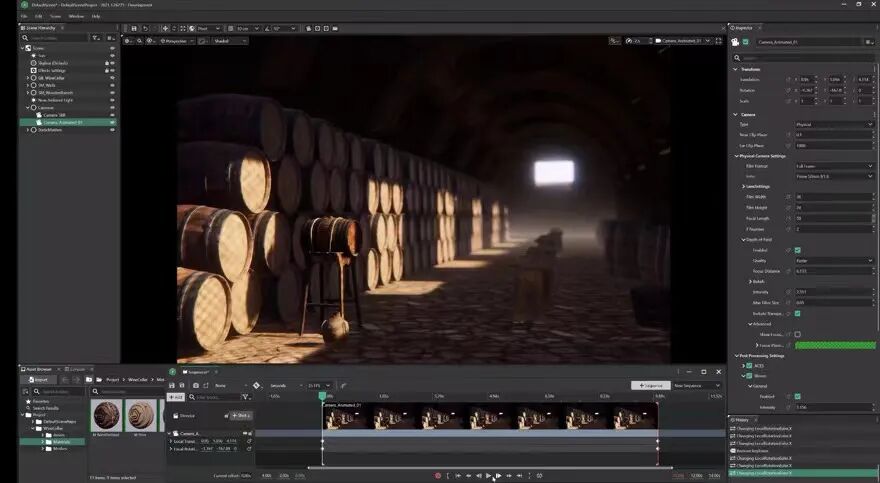
Source: Company
In Wu's plan, GritWorld will unify rendering across domains within one to two years, enabling rapid output so users no longer struggle with conversions between multiple renderers. Taking smart cities as a representative example, it will provide a cloud-to-edge joint deployment solution for digital interaction, becoming a mainstream standard solution provider for digital interaction engines in the Chinese market.
But this is only step one. Next, GritWorld will target the next-generation edge-cloud open world — the gaming market where everyone participates — returning to gaming itself to create phone-based content creation gaming experiences. Then, when mixed reality content explodes, it will become a foundational interaction tool and cloud digital asset provider for entering mixed reality.
"Open-world gaming architecture doesn't just support games — it gets generalized into entertainment, adopted in work and daily life. Finally, when metaverse technology architecture and ecosystems mature, we hope to become a core component and standard interaction tool within that operating system."
Wu believes the metaverse's arrival will bring disruptive changes across cloud computing, cloud hardware, network transmission, content tools, and business models. The graphics engine may be the sole connector linking these technologies — iterating a new form of system by stringing them together.
"This is what I see as the core of the third-generation graphics engine. We're also building our ecosystem around GritWorld's third-generation graphics engine. Going forward, I believe the graphics engine track will only get hotter. As its status rises, it will become a critical tool that needs to be built first for entering the metaverse."
After six years of hyper-speed dual-engine development, as GritWorld's third-generation graphics engine matures, transformation will become its next priority.
According to Wu, GritWorld currently serves 30 enterprises with over 60 landed projects. But starting this year, it will gradually reduce collaborative projects and focus on a model of partnering with major enterprises to capture markets — serving more enterprises and users through standardized products and SaaS.
"Through years of extensive project collaboration, the team has understood what products the market actually needs. Now it's time for standardization."
In Wu's view, if a technology company doesn't make the transition to product standardization and SaaS, it will grow increasingly weak, with competitiveness dropping sharply.
"Product standardization will serve more customers in current application domains and drive rapid revenue growth. Additionally, when expanding into other domains, GritWorld can partner with collaborators to serve more fields, or let developers take standardized products to empower more markets."
Currently, GritWorld's business model comprises four components: first, revenue from landmark joint projects with major enterprises; second, subscription-based SaaS services; third, digital asset usage sharing from pushing tools and digital content to consumers through major enterprise partnerships; fourth, revenue sharing from jointly launched IP works.
Wu stated that as demand for digital content grows, the call for game engines across industries grows more urgent — GritWorld faces the opportunity of a new game engine for cross-gaming domains, namely the third-generation graphics engine.
Meanwhile, consumers and players are increasingly eager to participate in digital content creation. So GritWorld can, while crossing domains, directly put this tool in the hands of more consumers and C-end users — an enormous opportunity that may arrive alongside the metaverse.
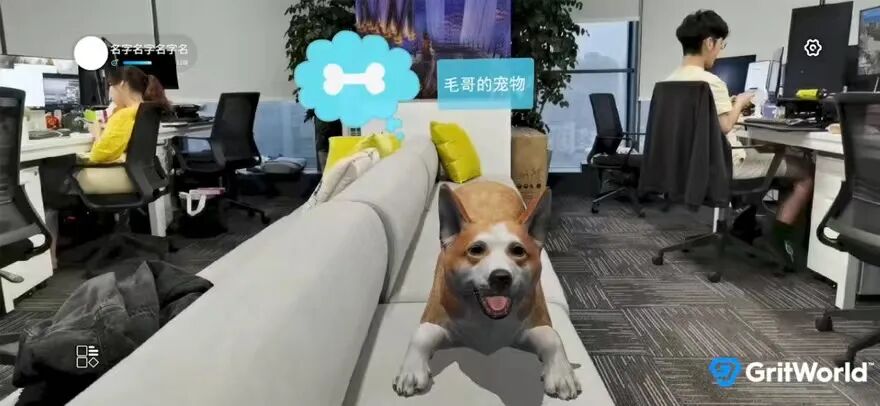
Source: Company
But Wu also knows that graphics engine ecosystems need time to mature. "The engine itself involves massive work, requires good investment, and demands hiring enough R&D personnel to gradually get things right — including commercialization, which is quite challenging."
GritWorld currently employs over 220 people, with core engine R&D accounting for over 60%. To attract game programmers from outside gaming, it has assembled an international team from 22 countries, with offices in Shanghai, Guangzhou, and Frankfurt, Germany.
Seven years since founding, GritWorld is advancing toward Wu's vision — creating technology that can reach every corner of the globe. Now, it's being seen by the world, starting from China.
(Header image source: Company)