"Zhangyu Power" Closes $50 Million New Funding Round, Linear Capital Continues to Double Down | Linear Portfolio

Accelerate the development of world foundation models and a "hand-brain integration" platform.

Today, Zhangyu Power announced it has completed a new $50 million funding round, bringing its total raised over the past three months to nearly 1 billion RMB.
Founded in early 2026, Zhangyu Power has assembled a top-tier team around its SYNTH deep-thinking brain architecture. Following this round, the company will accelerate R&D on its world foundation model and "hand-brain integrated" platform, with plans to release its foundation model and core products in the second half of 2026.
Linear Capital was Zhangyu Power's first investor, and has continued to back the company in subsequent rounds.
Zhangyu Power (SynapX) has officially announced the completion of a new $50 million funding round, bringing its total raised over the past three months to nearly 1 billion RMB. This round once again brings together top-tier investment institutions, led by Jinqiu Fund, Xinlian Capital, and Huangpu River Capital, with participation from JAFCO Asia, HouXue Capital, Hong Kong Talent Tech Fund (HKTT), and Panga Capital, while existing shareholders including Linear Capital continue to increase their support. Meanwhile, the company's next round of 500 million RMB is also nearing completion. Founded in early 2026, Zhangyu Power has continued to attract broad attention and recognition from leading capital, industrial resources, and domestic and international clients. In a short period of time, the company has assembled a top-tier team around its SYNTH deep-thinking brain architecture: with the world foundation model at its core, supported by policy models, the SYNData vision-force-touch full-modality data system, and dexterous manipulation hardware platform, forming a closed loop from models and data to real-world execution. Following this round, Zhangyu Power will accelerate R&D on its world foundation model and "hand-brain integrated" platform, with plans to release its foundation model and core products in the second half of 2026.

World models are becoming the key paradigm for AI's transition from the digital world into the physical world. Their significance lies not in generating more realistic visuals, but in enabling models to develop computable understanding of how the real world operates, and further acquire the ability to simulate, intervene in, and optimize the world.
Using the depth and breadth of world model generation as its benchmark, Zhangyu Power proposes a three-stage evolution roadmap for world models:
- WM1 - Generation/Interaction: Models possess weak physics modeling capabilities, sufficient for content generation and game interaction in digital worlds;
- WM2 - Physics/Action: Models require strong macroscopic physics modeling capabilities, able to anticipate how actions change states and outcomes, with strong physical plausibility, interactivity, and controllability, supporting embodied intelligence in real-world action;
- WM3 - Universal Optimization: World models will advance from macroscopic physical action into microscopic physics and complex high-dimensional systems, becoming a foundational method for humans to understand patterns, design interventions, and optimize the real world.
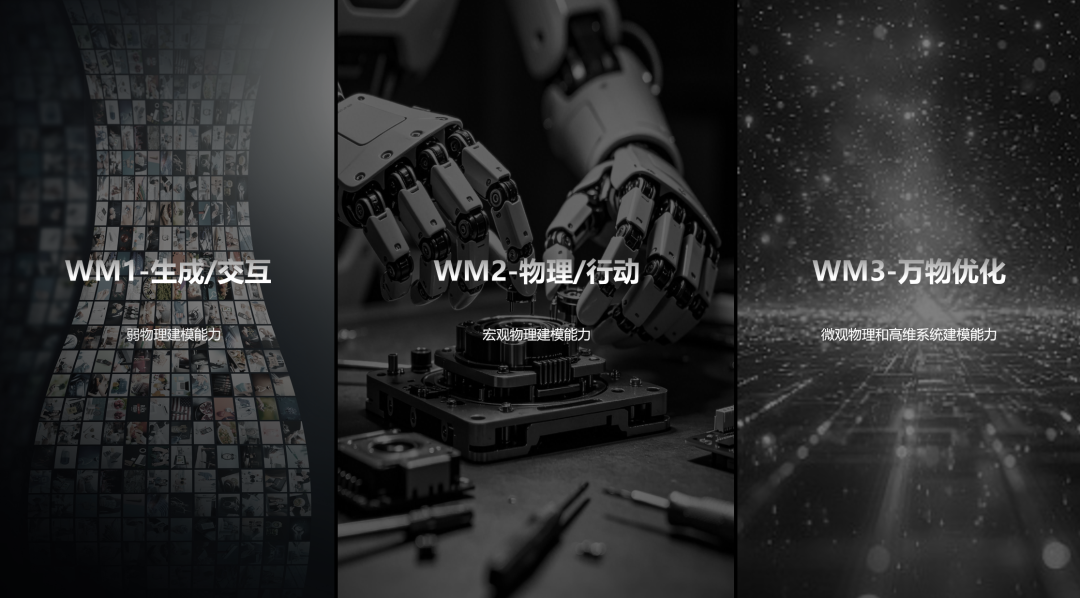
Based on its understanding of world model development stages, Zhangyu Power is currently focused on WM2 - Physical Action World Models: moving from weak to strong physics modeling, enabling models to progress from predicting the next frame to predicting physical world states and actions, thereby acquiring more general and generalized physical causal modeling capabilities.

Based on the three-stage world model evolution roadmap, Zhangyu Power has further clarified the advancement path for physical AI from single-task generalization toward open-scene general and generalized operation: True physical intelligence must enable model capabilities to enter the real world through general-purpose manipulation, with hand and brain co-evolving through collaborative optimization.
Zhangyu Power is the first to propose a five-level productivity progression for physical AI:
- L1 Rule-Driven Systems: Operate based on preset rules and fixed workflows, such as industrial automation;
- L2 Single-Task Generalization: Possess within-task scene adaptability but limited cross-task generality, such as single-task flexible operations like folding clothes;
- L3 Constrained-Scene Cross-Task Generalization and Generalization: Able to transfer across tasks in scenarios with limited task quantities and well-defined task specifications, such as hotels;
- L4 Open-Scene Cross-Task Generalization and Generalization: Able to face more open task quantities and definitions in unconstrained environments, such as homes;
- L5 Superhuman Physical Intelligence: Capable of self-evolution, far exceeding human performance in complex physical tasks.
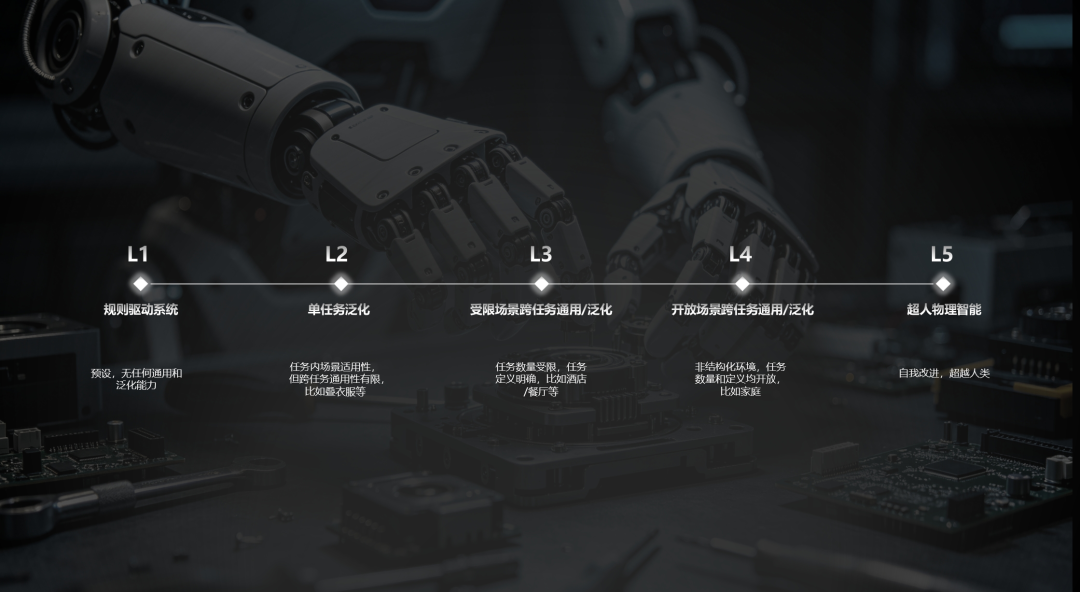
What Zhangyu Power focuses on is not any single-point demo, but using "hand-brain integration" to support physical AI's evolution from L2/L3 toward L4/L5: bringing the causal modeling capabilities of world models into real-world execution, moving from robust single-task generalization toward cross-task, cross-scene transfer, ultimately forming general-purpose operational intelligence in open environments.

Physical AI is not just a single model or single piece of hardware, but whether world foundation models, dexterous manipulation hardware, and product and systems engineering can form a closed loop and synergistic force within the same organization. Just four months after founding, Zhangyu Power has already assembled a star talent team rarely seen in the industry, encompassing top AI-native large models, robotics hardware, and product systems. Team members come from leading tech companies including ByteDance Seed, Baidu, Horizon Robotics, PhiGent Robotics, Xiaomi, Huawei, NIO, Xpeng Motors, Li Auto, and Meta, and the team is rapidly approaching 100 people.
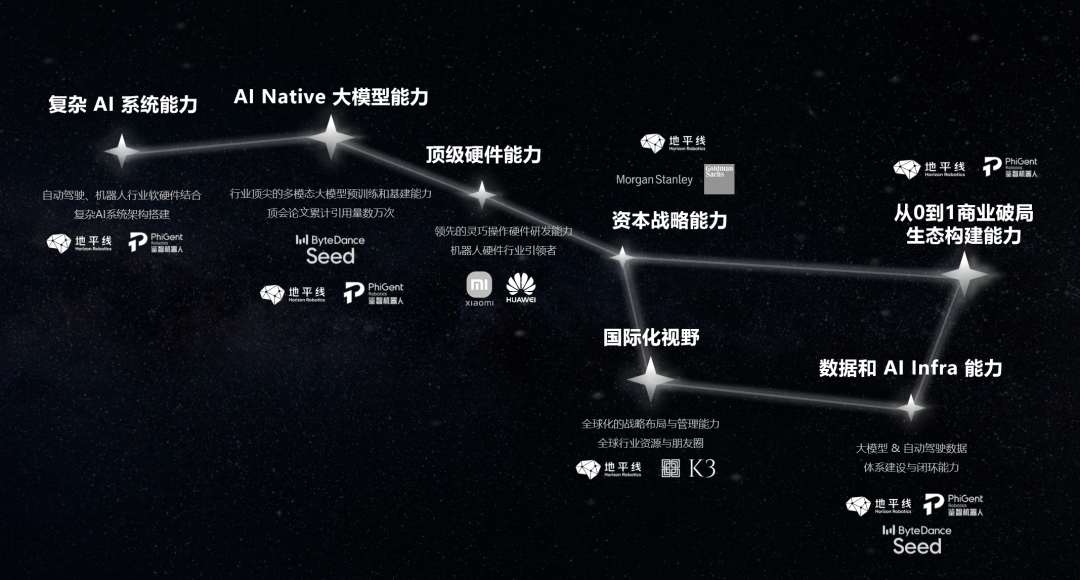
Recently, a top-tier robotics hardware co-founder and multimodal large model partner have officially joined**, further strengthening Zhangyu Power's "reach for the sky, stand on the earth" team architecture: reaching upward to possess industry-top foundation model capabilities, standing firmly downward to possess dexterous manipulation software-hardware products, AI infrastructure, and embodied data systematization capabilities. Zhangyu Power is already a full-stack physical AI team capable of converting model capabilities into physical productivity.

Zhangyu Power proposes the SYNTH deep-thinking architecture, connecting real full-modality operation data, physical action world models, and policy execution, giving embodied brains more general and generalized strong physics modeling and action capabilities, accelerating physical AI's evolution from L2 toward L5.
- SYNData accumulates real operation data, transforming human operation processes into robot-learnable data assets.
- SYNWorld learns physical causality, simulating how actions will change world states and task outcomes.
- SYNAction transforms simulation results into executable policies, bringing model capabilities truly into robotic manipulation.
Zhangyu Power will continue strengthening the strong physics model capabilities of the SYNTH deep-thinking architecture as its "brain," and the real execution capabilities of dexterous manipulation end-effectors as its "hands," driving the conversion of model capabilities through hand-brain integration into real productivity for physical AI.

Around SYNData, Zhangyu Power has established three product paths: DexUMI, EgoBio, and Ego. DexUMI targets high-precision full-modality data, EgoBio targets low-interference scalable full-modality collection, and Ego targets pure-vision native operation data. Since launch, SYNData has received high attention and recognition from domestic and international clients and industry partners, with continuous inbound interest around data collection, scene co-construction, and technical collaboration.
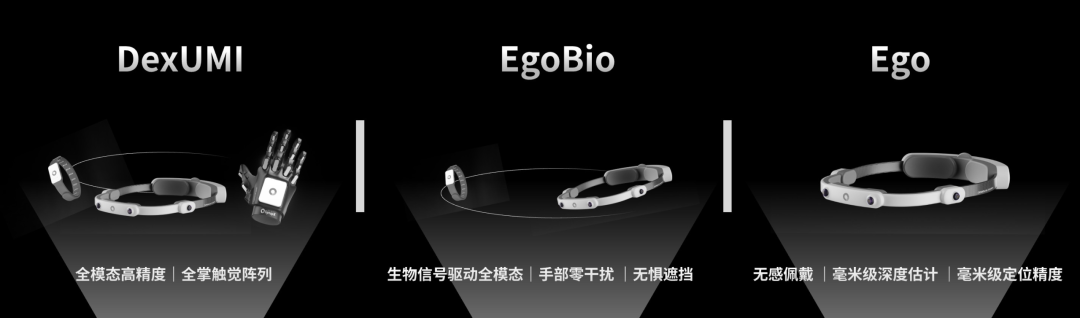
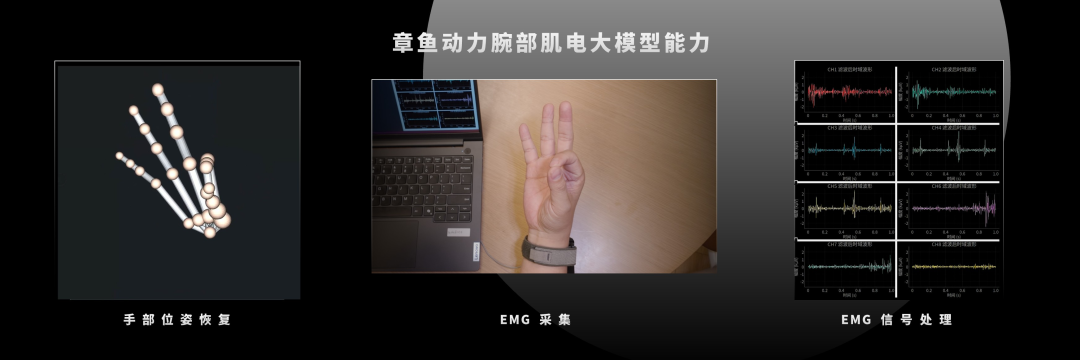
Zhangyu Power is the first in the industry to propose the Bio2Robot concept**, using AI large models to convert human biological signals into data robots can apply, and is the first to publicly propose incorporating high-density electromyography into physical AI's vision-force-touch full-modality data system**. Electromyography is not only immune to visual occlusion but can also capture contact and force application that vision struggles to observe.
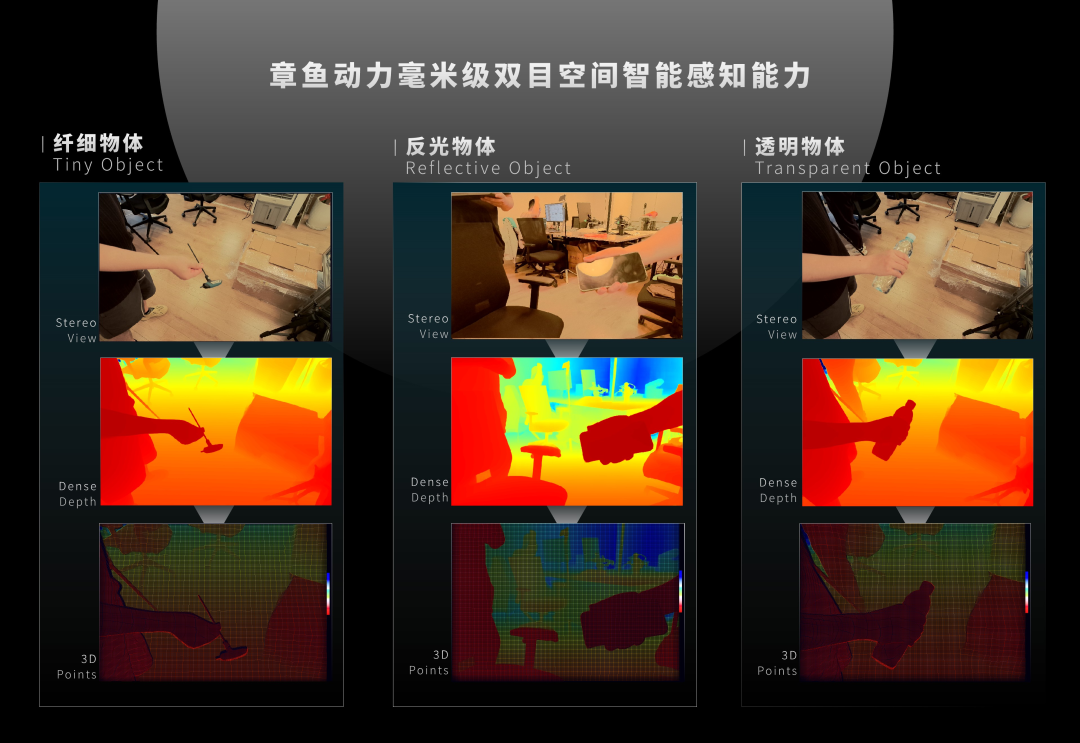
Zhangyu Power is the first to apply automotive-grade binocular spatial intelligent perception know-how to embodied intelligence scenarios, able to recover millimeter-level and true-scale dense 3D information in real operation scenes, with extreme robustness to transparent and reflective surfaces.

Since its founding, Zhangyu Power's technical approach has continued to receive external validation. In the official ICRA 2026 competition concluded in April, in the Reasoning to Action track online competition, the team scored 8.48, ranking first in China and second globally, demonstrating the company's early capabilities in embodied intelligence algorithms and manipulation tasks.
More importantly, the physical action world model and "hand-brain integrated" platform being advanced around the SYNTH deep-thinking architecture have already received broad recognition and partnership interest from domestic and international clients and industry partners. This represents a systematic judgment of Zhangyu Power's underlying technical approach, team organizational capabilities, and long-term platform value.
Dalong Du, Founder and CEO of Zhangyu Power, stated: "As AI moves from the digital world into the physical world, the core challenge is giving intelligence the ability to predict, intervene in, and continuously learn from the real world. World models are evolving from weak physics to strong physics. Their essence lies not merely in realistic generation, but in establishing strong physics modeling and representation capabilities: understanding physics, anticipating consequences, taking better actions, and continuously evolving through feedback.
The breakthrough in physical AI will ultimately occur through the integration of 'brain' and 'hand,' jointly building physical world AI coding infrastructure. Only when world models possess strong physics modeling capabilities and enter real tasks through dexterous manipulation will intelligence become productive force that changes the real world."