The $50 Trillion Table: The Scramble for AI's Gateway to the Physical World | Linear Voice

The physical world doesn't accept "roughly right."

AI is leaving the screen. From generating text, images, and video, it's advancing further into designing, validating, and manufacturing real products. A $50 trillion physical world is becoming the main battlefield of the next technological competition.
In this migration, CAD is no longer just an engineer's drawing tool. It carries geometry, materials, processes, and manufacturing constraints — and may become the critical gateway through which AI understands physical rules, invokes engineering capabilities, and acts upon the real world.
Ziqian Technology, a Linear Capital angel-round lead investment, was founded by Min Gong, who has personally experienced both industrial CAD and real-time 3D technology systems. How does he understand the contest for the gateway to physical AI, and how will he enable AI to move from "drawing the world" to "making the world"? Below are Ziqian's reflections.
In the tech world of 2026, NVIDIA and OpenAI remain at the top, while SK Hynix and Samsung have risen strongly. A cast of old and new giants are scrambling for the spotlight, but the truly intriguing player among them is Jeff Bezos.
After stepping down as Amazon CEO in 2021, Bezos has hardly been idle: he went to space using Blue Origin's technology, invested in Altos Labs to explore longevity science, and co-invested in Figure AI to bet on humanoid robots.
Space industry, biomedicine, embodied intelligence — none are anything but the most elite domains of advanced manufacturing. These tracks may appear distant from one another, but they all point to the same longstanding problem: when a physical product's complexity extends to tens of thousands of components, the difficulty of moving from R&D through validation to mass production rises exponentially.
Improving a jet engine's thrust by just 10% could take a decade of conventional R&D due to engineering complexity alone. Bezos hopes to use AI to accelerate this cycle from conception to manufacturing by tenfold or more[1].
In November 2025, Bezos returned to entrepreneurship with Prometheus — the first time since leaving Amazon that he formally assumed the CEO role at a company.
Just seven months later, Prometheus closed its latest Series B round at $12 billion, the largest Series B ever for an existing AI startup.
Burning through cash at this rate, yet capital is so willing to bet — what makes Prometheus worthy?
What Bezos is offering the market is far more than a single product. It's an entry ticket to reshaping the global industrial system.
In Bezos's eyes, it approaches the form of an engineering foundation — the closest real-world落地 of "JARVIS" from Iron Man: building an AI tool system that can assist engineers in designing and manufacturing physical products[2]. In other words, using AI to reengineer engineering and manufacturing.
Prometheus's technical foothold lies in the physical world, which connects to a larger industrial theme: physical AI.

At GTC Paris last June, Jensen Huang did the math on physical AI: behind factories, logistics, and humanoid robots lies a $50 trillion industrial table[3].
What does $50 trillion mean?
According to Bloomberg's latest forecast, by 2030, the broad generative AI market encompassing compute, software, and related services will reach only $2 trillion[4]. Huang's estimate for physical AI clearly encompasses a physical economy重塑 on the order of hundred-billion-dollar markets spanning manufacturing, logistics, and energy.
For now, physical AI lacks a strict definition. Loosely understood, it means AI that can comprehend physical rules and act upon the physical world.
Intelligent driving and humanoid robots are currently the two most intuitive applications — the former enabling machines to perceive, judge, and act on roads; the latter attempting to give AI a body that can enter real environments. But whether the ultimate carrier is a car, robot, or other industrial equipment, one fundamental truth remains: for AI to truly act upon the carbon-based world from the silicon-based world, it cannot bypass the fact that the real world is 3D.
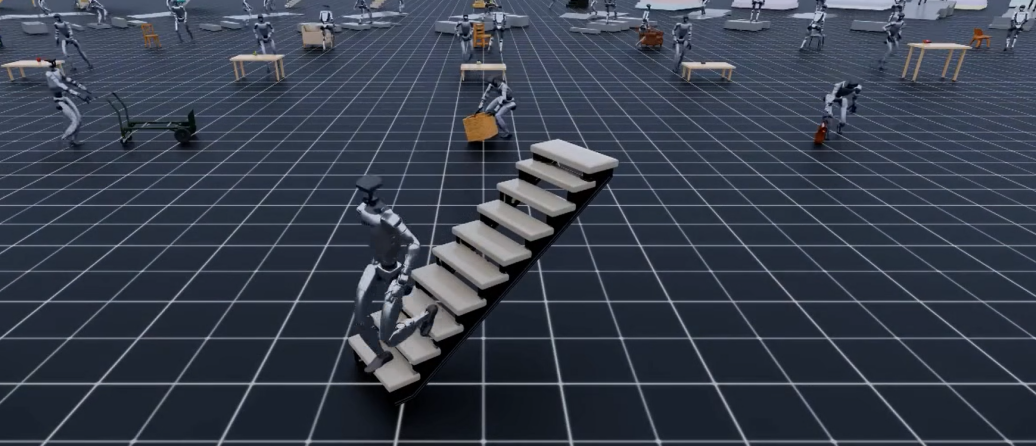
NVIDIA robotics research: exploring the 3D world
With massive market opportunity and entirely new track challenges, tech giants, frontier researchers, and industrial capital are all finding their own angles of entry on AI's path into the physical world.
The first to push physical AI into public view was Jensen Huang. He has repeatedly declared at conferences like GTC and CES that "the next generation of AI is physical AI." Beyond that, Huang placed his daughter, Min Huang, in NVIDIA's Omniverse division (3D simulation), while his son, Spencer Huang, oversees robotics — both unquestionably strategic priorities for NVIDIA's next decade tied to physical AI.
"AI godmother" Fei-Fei Li founded World Labs to bet on spatial intelligence, aiming to enable AI to understand the 3D world. Yann LeCun, after leaving Meta, founded AMI Labs with a core focus on teaching AI to predict changes in the real world. And Bezos's move with Prometheus goes directly to manufacturing scenarios as a foundational engine.
Over recent years, AI's silicon-based capabilities have advanced along the dimensions through which humans perceive the world: text for language expression, images for visual expression, video adding the dimension of time. Each new dimension unlocked has drawn capital and talent rushing in, rapidly turning a new technical continent into a刺激战场.
Returning to 3D and the physical world, everyone will eventually enter. Only this time, the battlefield's form is no longer identical to the generative world.

In exploring how to complete 3D mapping of the physical world, two fields have already been深耕 for years — gaming and industry.
Gaming is a natural use case, for simple reasons. The industry needs massive 3D assets — characters, environments, props — and character movements and environmental interactions inherently must conform to physical laws. Real-time 3D engines like Unity and Unreal exist to serve this need.
Industrial 3D operates on entirely different logic, and connects more directly to the physical world.
In the probabilistic world of generation, images and video that are roughly correct are surprising enough. But in industrial-grade scenarios, products with less than 99% precision may be scrap. A screw hole off by half a millimeter shuts down the assembly line; poor surface continuity handling causes cascading problems in machining and simulation.
Ziqian Technology founder Min Gong has experienced both 3D worlds firsthand: the industrial software system represented by French CAD giant Dassault, and the gaming and real-time 3D world represented by Unity. This experience gives him more direct bodily knowledge of the differences between the two paths, which he summarizes as the distinction between "painting skin" and "painting bone": 3D in the virtual world first serves perception and presentation; 3D in the manufacturing world must serve verifiable engineering outcomes[5].
In the "virtual-to-virtual" world, AI's most important capabilities are generation speed and expressiveness — solving content production efficiency, with commercial paths closer to game assets, film production, marketing display, and virtual spaces.
In the "virtual-to-manufacturing" world, generation is only step one. A 3D model must also be editable, measurable, simulatable, and machinable, preserving engineering intent. Connected to the physical world, AI must specifically understand geometry, materials, constraints, forces, processes, tolerances, and manufacturing feedback — ultimately delivering a digital object into the real world that withstands reality's检验.
The market ceiling for gaming 3D is determined by content spending; industrial 3D faces the entire manufacturing sector's R&D, design, and production budgets.
Bezos's return with Prometheus, Huang's relentless advocacy for physical AI — both point to the same trend: AI's main battlefield is shifting from generating content to generating products, from transforming the software world to transforming the hardware world.
In Iron Man, Tony Stark need only give a vague idea, and JARVIS can mobilize various devices to gradually turn a sentence into a wearable piece of equipment. Real-world engineering systems are far from this smooth. Human creativity must first be translated into geometric models, then pass through computation, validation, machining, and assembly. Information loss at any stage, and the final product may deviate from the original vision.
And for decades, this industrial-grade high-precision gateway has primarily been realized through CAD (computer-aided design) software.
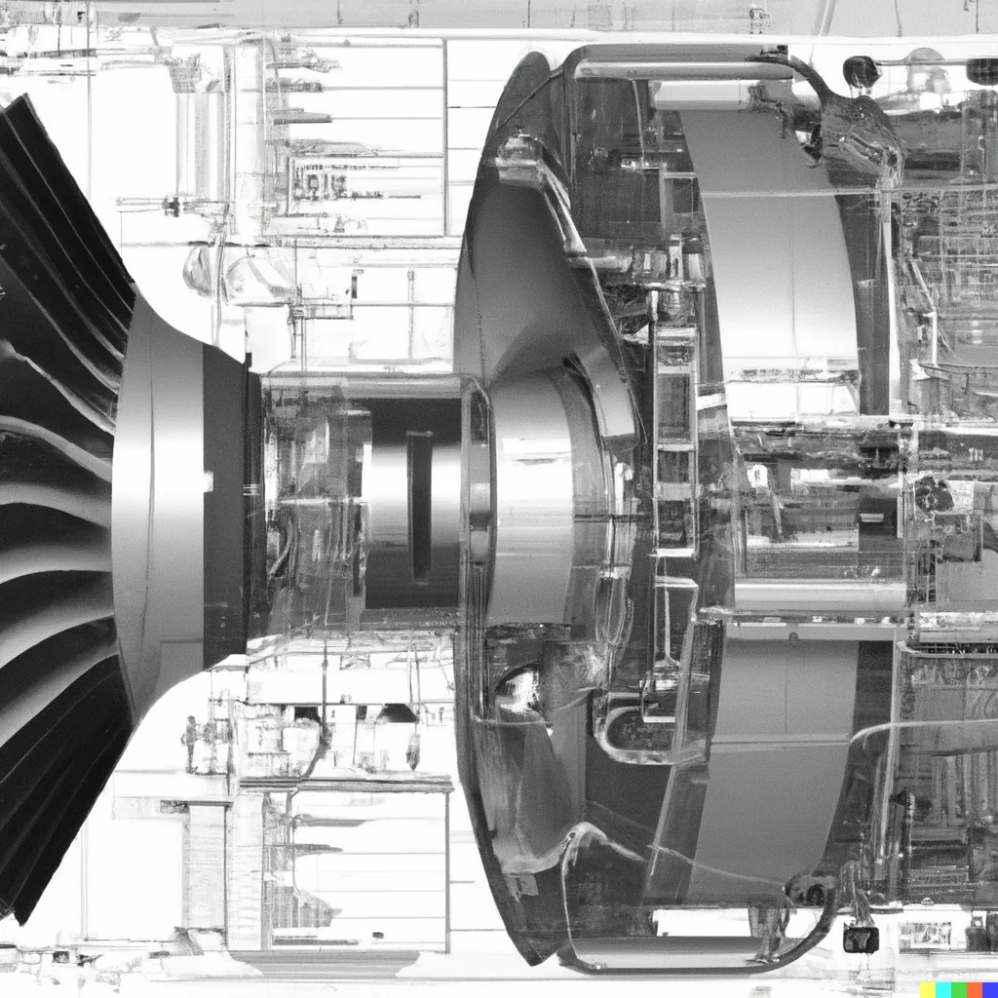
CAD detail of a jet engine
CAD may look like drawing software, but it is in fact the physical foundation of modern civilization. Architecture, machinery, aerospace, shipbuilding, medical equipment, textiles and apparel — all industries are tightly bound to it. One could even say that CAD has沉淀 the greatest amount of industry know-how that humanity has accumulated in the physical world.
As AI begins entering 3D, the closer to the physical world, the more precision and constraints are needed; the closer to manufacturing systems, the more CAD's gateway value will be highlighted. But this is also where AI's difficulty in connecting to reality lies: how to re-constrain general capabilities into engineering problems, enabling AI to transform the world faster and more reliably?

Selling CAD in the past was fundamentally selling to engineers for human use. With AI capabilities evolving to where they are today, CAD has gained a new user: machines.
This means CAD's business logic is no longer just about enabling humans to draw more efficiently, but about enabling AI to complete engineering operations more reliably. This is a transformative impact of AI on CAD — changing not just the frontend experience of the gateway, but also the value distribution.
When machines become the new users, CAD shifts from a human-machine software dependent on interfaces and commands to infrastructure that AI can directly invoke. The software foundation needs to modularize and interface tools, enabling AI to understand intent, decompose tasks, and complete closed-loop operations. Further, business models will shift from per-seat licensing to task-based, call-volume, and workflow-based pricing.
Ziqian Technology founder Min Gong has a more direct summary: The previous generation of CAD helped humans project intent into the digital world, while what Ziqian aims to do is the reverse — enabling electrons to truly operate the world of atoms, forming a closed loop between digital design, physical validation, and real-world manufacturing.
Overseas giants are also approaching this goal from different directions. NVIDIA attempts to build physical AI's training ground through Omniverse, simulation platforms, and compute infrastructure. Traditional industrial software giants like Dassault and Siemens choose to extend engineering boundaries around industrial software and digital twins.
Traditional industrial software giants possess deep product systems, but their historical architectures are massive — turning a supertanker is no easy task, and AI-native transformation will inevitably pull at the entire product stack. Generative 3D companies excel at visual generation but lack engineering constraints and manufacturability. General large model companies possess stronger intelligence, but behind that generality lies a lack of necessary core tools and data assets in vertical industries.
For a team with long years of deep cultivation in the 3D world, Ziqian Technology believes that CAD sits at the boundary between the virtual and real worlds. It is both a tool for humans to design products, describe space, and express engineering intent, and infrastructure connecting simulation, manufacturing, and physical execution. What CAD models carry is not merely three-dimensional form, but physical principles and manufacturing processes. Compared to images and video, it provides a digital expression closer to the essence of the physical world.
Driven by this philosophy, Ziqian Technology has formed a technical path from generating the physical world, validating the physical world, to closing the loop on the physical world — the Dream Loop.
Phase one is "point and shoot" Agentic CAD.
With large models granting software understanding capabilities, and based on Ziqian Technology's cloud-native 3D CAD foundational tools, long-term accumulation of industrial data, and iterative evolution of its harness system, Agentic CAD can comprehend natural-language engineering intent, decompose user goals into a series of executable modeling actions, and invoke reliable geometric modeling tools to complete operations.
This process resembles AI coding for the 3D world. What it changes is not just modeling efficiency, but the fundamental way humans interact with industrial software — shifting from humans learning the machine's operational language, to machines understanding human creative intent.
Phase two moves from physical structure to physically validatable products.
As the core principle of realizing physical AI lies in understanding physical rules and acting upon the physical world, at this step, products enter Ziqian's physical world simulation platform for validation — verifying accuracy against mechanical, kinematic, dynamic, and motion-control physical rules. This process can self-close-loop and iterate with Phase One's product generation, until outputting the most rational and optimal solution.
Phase three advances to manufacturing, completing the ultimate purpose of acting upon the physical world.
The coherent operation of these three phases will truly compress the time from human creative conception to physical realization to one-tenth of what it was, or even more极致.
For Ziqian, this is not simply a cloud-based CAD software, nor purely an efficiency improvement analogous to Prometheus. It is the precise alignment of AI with the physical world. When more judgment and imagination can be entrusted to human engineers, CAD of the future will become a new gateway for human creativity.

The narrative of emerging industries often begins with a grand term, then grows into a comprehensive industrial ecosystem.
Looking back at several waves of technological change, shifts in the gateway have often determined the power structure of industries. In the personal computer era, operating systems became the gateway for software development and hardware adaptation. In the mobile internet era, iOS and Android controlled the rules for developers. In the AI training era, CUDA turned the GPU from a piece of hardware into a compute platform developers couldn't bypass.
The connection between AI and the physical world will follow the same pattern.
On this path to reshaping the global industrial system, Bezos is not alone in seeing the opportunity. In China, a cohort of cloud-native industrial software companies similarly began embedding AI capabilities into real engineering and manufacturing processes earlier on. Today, the targets that all pursuers are chasing have become increasingly clear:
Whoever first becomes the first stop for AI entering the physical world will truly hold the definitional power of "JARVIS."
References:
[1] Prometheus, Jeff Bezos' AI startup, is now worth $41 billion, Axios.
[2] Bezos AI Startup Prometheus Completes $12 Billion Funding Round at $41 Billion Valuation, Wall Street News.
[3] Nvidia believes physical AI systems are a $50 trillion market opportunity, GamesBeat.
[4] Generative AI Market Poised to Reach $2.3 Trillion by 2032 as Agentic Systems Proliferate and Infrastructure Demand Surges, According to Bloomberg Intelligence, Bloomberg.
[5] Digital Twins: From "Painting Skin" to "Painting Bone," Toward Industrial Internet and Smart Cities, Yicai.