Failure Is Not the End: Lessons Learned from 6.5 Startup Attempts | Bolt Recommends

Great ideas are nothing without execution.
Ron Garret is a brilliant software engineer, entrepreneur, and filmmaker. He was the co-founder and CTO of Virgin Charter and an early employee at Google. Before that, he worked as a rocket scientist at NASA's Jet Propulsion Laboratory. He recently updated his blog with a post titled I am (not) a Failure: Lessons Learned From Six (and a half) Failed Startup Attempts, recounting the 6.5 "failed" ventures of his life and the lessons he learned from them.
We've organized and translated the author's article; you can read the original by clicking the "Read Original" link.
Not long ago, I wrote this: "I've had many, many failures in my life. (Hmm, maybe I should write a blog post about that.)"
So here it is. But I'm not writing this to complain. Despite all my failed attempts, I've ended up living a pretty good life. I think if my younger self had heard these stories, I might have felt less pressure — understanding that not succeeding at many things doesn't mean your life is a failure. Maybe there's some "younger version of me" reading this right now. I hope they can take something from it.
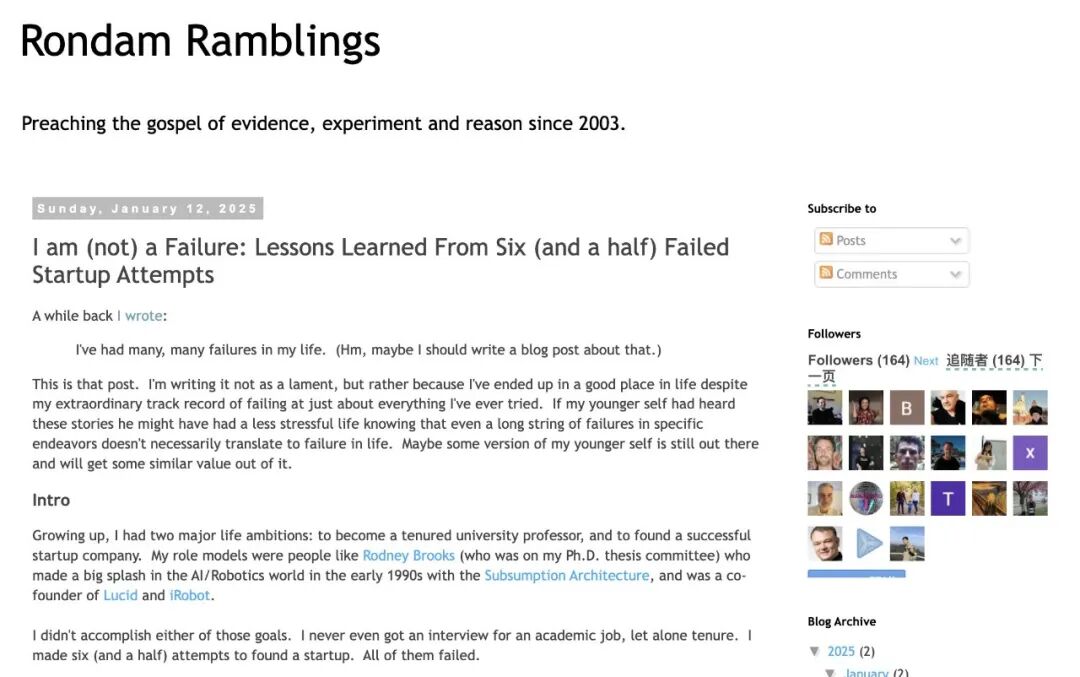 Photo | Author's blog
Growing up, I had two main life goals: to become a tenured professor and to found a successful startup. My role models were people like Rodney Brooks, who served on my dissertation committee and made waves in AI and robotics in the early 1990s with "Subsumption Architecture," while also co-founding Lucid and iRobot.
I achieved neither of these goals. I never even got an interview for any academic position, let alone tenure. And I attempted to start 6.5 companies — all of which failed.
Failure #0: The Death of the Professor Dream
In elementary school, my dream was to become a doctor — specifically, a brain surgeon. That dream died in high school biology class. We had to dissect fetal pigs (unborn piglets from sows that died during pregnancy due to miscarriage, premature birth, or other causes), and I discovered I was far more squeamish than I'd imagined. So I traded the scalpel for a computer keyboard and set my sights on artificial intelligence.
Fast forward to 1991. I'd just received my PhD and started sending out my CV to computer science departments (in academia, this is called a "vita"). Unfortunately, my timing was terrible. It was the height of the "AI winter" and a recession. The few universities still hiring received hundreds of applications, and I wasn't a particularly outstanding candidate. My publication record wasn't strong enough — no journal articles at all. Though my main conference publication was well-received, it apparently wasn't "academic" enough for the field. In the end, I didn't get a single interview.
So I stayed at my then-current employer — NASA's Jet Propulsion Laboratory (NASA JPL). To put it simply, my career at NASA JPL had its ups and downs, but eventually entered a long, steady decline from which it never recovered. However, the reason my career went downhill wasn't NASA JPL or any external circumstances. It was because I gradually realized that scientific research wasn't what I'd imagined. In the real world, research isn't some Platonic pursuit of objective truth. It's first and foremost a human enterprise, intertwined with human ambition and frailty — including my own.
My career lasted as long as it did because I learned, at least to some extent, "how to work the system." On the surface, I was moderately successful — I eventually became the most-cited AI researcher at NASA (according to Citeseer, a popular metric at the time). But over time, I grew increasingly disillusioned with my own work, and the entire field seemed stuck in a stagnation I was powerless to change. Eventually, I left.
Lesson learned: Academic research isn't a panacea (and I think it's even worse now than in my day).
Failure #1: FlowNet
In the summer of 1990, I worked as a visiting graduate student in Rodney Brooks's lab at MIT. There I met a brilliant hardware engineer named Mike Ciholas. He later founded a company that now employs dozens of people and bears his name. He pitched me an idea for a new computer network design he called "FlowNet." We even built working prototypes. If these had made it to production, they would have beaten the competition by more than an order of magnitude on price-performance.
We talked to multiple VC firms, but none gave us a term sheet. Only later did we realize why: the investors knew something we didn't. Fast Ethernet was coming. It would be expensive at first, but would quickly be commoditized and crush any competitor regardless of technical superiority. We built our prototypes in 1993; Fast Ethernet arrived in 1995. By 1997, we had to shut down.
Lesson learned: Going head-to-head against infrastructure and industry standards is almost guaranteed to fail. Much more capable teams than ours learned this the hard way over the years.
Interlude: Google
In 2000, I joined a then-obscure Silicon Valley startup (Google). I've told this story elsewhere. I mention it for two reasons: first, it sets context for what follows; second, though the company was undeniably successful, this was not my success. In fact, on a personal level, I consider my time at Google another failure.
(Translator's note: Ron Garret joined Google as a software engineer in 2000 and was an early employee. He worked there for roughly a year, mainly on two projects: AdWords and Translation Console. In previous blog posts, the author revealed that his primary reason for leaving was the weekly commute by plane between Los Angeles and the Bay Area, which created significant inconvenience. After 9/11, the commute became even more difficult, ultimately prompting his decision to leave.) More info: https://flownet.com/ron/xooglers.html
During my time at Google, I made a series of mistakes and suffered badly from impostor syndrome. I stayed for a year, then returned to JPL, planning to ride it out until Google's IPO.
Failure #2: IndieBuyer
Google's IPO gave me enough financial freedom to quit JPL and pursue my startup dreams more seriously. In retrospect, I should have moved to Northern California and joined an incubator like Y Combinator. But I'd lived in Los Angeles for 17 years by then — the longest I'd ever stayed in one place in my life. By any standard, I'd put down deep roots. Plus, I'd always loved magic and film, and LA was the center of both industries. So I decided to try something in entertainment.
I founded a company called IndieBuyer, aiming to become the "Netflix of independent film." Our thesis was that as technology made filmmaking easier, it would produce a flood of valuable but underappreciated work. These films couldn't find audiences because the existing distribution system was designed for capital-intensive projects. Our business model was to sell DVDs (still very popular at the time) with a money-back guarantee: if you bought one of our recommended DVDs and didn't like it, you could return it for a full refund. The return data would feed a recommendation engine that would, over time, increasingly accurately predict who would like what kind of film. In the long run, we aimed to intelligently match niche products with niche audiences at scale.
The idea had merit, and with more substantial funding, we might have succeeded. But in reality, I was funding the company entirely from my own savings. After several years of slow growth, I lost confidence and ultimately decided to shut it down. We'd tried to find outside investors, but with a live product that wasn't showing enough growth traction, they weren't interested.
Lesson learned: It's really, really hard to make money in the movie business.
Failure #2.5: Evryx
This is the "half failure" mentioned in the title. I count it as half because though I was actively involved, I wasn't a founder. Evryx (later renamed SnapNow) was founded by another engineer who'd worked at JPL. The company was an early pioneer in reverse image search. It used an algorithm called SIFT (Scale-Invariant Feature Transform) to match photos taken on phones against a repository and provide information about objects in the images. I never fully figured out what their business model was, but the technology looked cool.
Once, I happened to mention the company to a friend in passing. He became intrigued, dug deeper, decided to join as CEO, while the founder became CTO.
About a year later, the company hit a crisis: the founder/CTO started behaving erratically, and the CEO (my friend) decided he had to be fired. The CEO asked me to step in as interim CTO until a permanent replacement could be found. The company limped along for another year or so, but ultimately folded in 2007, largely due to that year's financial crisis. Though the CEO had managed to secure a new round of funding, it was voted down at the shareholder meeting — and the decisive vote came from the fired CTO. He voted against the financing, causing the company to collapse within weeks. The bankrupt company was acquired by a private investor at a fire-sale price, and I never heard of it again. It did own some potentially valuable IP; perhaps the acquirer was able to do something with it.
Lesson learned: Even smart people do incredibly stupid things. The CTO voted against the financing because he didn't like the terms and didn't want his stake diluted. The result: his undiluted stake became worthless.
Failure #3: iCab
In 2009, my wife and I took a cruise around the Pacific. At one point, we were in Ho Chi Minh City, Vietnam, and needed to get back to the ship, but couldn't find a taxi. I thought: there are taxi drivers everywhere here, they all have phones, many even have smartphones. Why not build an app where I can broadcast "I need a car at this location"? It was a brilliant idea. Unfortunately, Garrett Camp and Travis Kalanick had the exact same thought at the exact same time. They founded a company called Ubercab, later Uber. I founded one called iCab.
But iCab was doomed from the start. It never even properly incorporated as a company. I assembled a team, mostly people I knew from Evryx, and we built a working prototype app. But we could never figure out how to recruit drivers. We were in Los Angeles, tried pitching the idea to taxi companies, but they had zero interest. The idea of using black cars or limousines never even occurred to me. Without supply, we gave up before we ever really launched.
Lesson learned: A brilliant idea isn't enough — you need execution. And sometimes that requires another brilliant idea to complement it.
Failure #4: Virgin Charter
In 2010, my wife and I decided to rent an apartment in Santa Monica so we could spend more time by the ocean. I started frequenting a venture capital firm's office. One day, a man named Scott Duffy walked in and asked if he could hire us to do due diligence on a company he was considering acquiring. I don't remember the company's name; its main business was collecting commercial intelligence on the private aviation industry.
During due diligence, we learned that the private jet market was extremely fragmented and inefficient. There were dozens of operators, most owning only a handful of planes. At the time, perhaps a few thousand private jets were available for charter, but only three operators had fleets of more than 100 aircraft. The largest was NetJets (if memory serves), with about 250 planes — roughly 10% of the market.
To match customers with aircraft, a secondary industry had emerged: charter brokers. If you wanted to charter a private jet, you'd call a broker, provide your travel needs, and the broker would make calls, send emails, and faxes (yes, faxes were still popular then), trying to find a matching plane. From quote to confirmed booking, the process took hours or even days.
Worse, after the plane dropped you off, it had to return to base. Typically, this was handled one of two ways: one, you paid for the plane and crew to wait and take you back; or two, you paid for two round trips. About 40% of private jet legs flew empty (no passengers). This created a secondary market: brokers trying to sell these empty legs. If you were lucky enough to find one matching your needs, you could fly private at a steep discount — since the empty leg was already paid for, any additional revenue was pure profit.
But most private jet clients wanted to fly on their own schedule and route, not pick random empty legs. So very few empty legs actually sold. If you were flexible enough about timing and routing, though, you could find some incredible deals.
My business plan:
Whenever an industry has inefficiencies, someone can find opportunity. I realized the core problem was the lack of a centralized demand information platform. If we could collect all the data about "who wants to go where, when," we could dispatch fleets far more efficiently. We did some analysis suggesting this could be a multi-billion dollar market — if we could execute.
The problem: both customers and suppliers depended on brokers. To succeed, we needed to break this dependency on both sides simultaneously. How?
I designed a three-phase plan:
Phase 1: Build a bridge between users and brokers. Create a website where people input travel requirements, and sell this data to brokers as leads for a very low fee. This charge was actually a smokescreen to hide our ultimate plan of replacing brokers. Brokers would see it as an irresistible offer: spend very little to get more customers.
Phase 2: Connect customers directly with operators. Once we hit critical mass with users, we'd feed this customer data directly to charter operators, letting them bypass brokers. We'd provide this data for free, and automate the booking process to make it faster and more efficient. As a bonus, operators would keep the commissions that previously went to brokers.
Phase 3: Centralized dispatch services. Once we attracted enough operators, launch a centralized dispatch system to reduce empty legs. Any operator not participating would have to charge higher rates to cover empty leg costs, and market competition would eventually drive all customers to our platform.
To this day, I believe that if we'd executed this plan, it would have been extremely successful. In fact, the plan was so compelling that Richard Branson (chairman of Virgin Group) acquired the company for $10 million before we even launched. Our original company name was Smart Charter; we later launched as Virgin Charter.
The turning point:
I strongly opposed selling to Branson, but my two co-founders insisted. I couldn't persuade them. I later resigned from the company but kept my shares, harboring a faint hope that my instincts were wrong, that Virgin could make the Smart Charter vision work. My fears proved correct.
After Virgin took over, they completely changed our business model to go direct-to-consumer, because that played to Virgin brand strengths. But they ignored how the private charter industry actually worked. The private jet market is a very small, high-end niche involving large sums of money, but with a limited customer base — and these customers don't like being treated like ordinary consumers.
At our peak, the company employed dozens of salespeople who had almost nothing to do. Ironically, under our original business model, the company would have needed fewer than ten people and could have run on a single server. Even with 100% market share, private charter transaction volume just isn't that high.
Lesson learned: Choose your partners with extreme care. Success in one industry doesn't necessarily translate to another. And when changing a business model, you must thoroughly understand industry dynamics. Virgin tried to attack a niche, high-end market with mass-market tactics — and failed.
Failure #5: Founder's Forge
After the private jet debacle, I decided to design a business that could operate entirely independently, without partners. This was around when Bitcoin was emerging, though it hadn't yet broken out of geek circles. I'd always been interested in cryptography, and certain aspects of Bitcoin fascinated me — particularly its use of public-key cryptography and digital signatures. I foresaw that credit card fraud would become an increasingly serious problem because the credit card protocol is fundamentally flawed: the credentials used to authorize transactions aren't bound to specific transactions, so they can be reused. This is the root of most credit card fraud today. That's why your credit card has a chip — it contains a key that generates digital signatures, preventing transaction credentials from being reused and making them harder to steal (though not impossible).
But this chip can't be used for e-commerce. Not because it's technically impossible, but because the supporting infrastructure didn't exist at the time. In theory, you could use a USB card reader to execute the same protocol as a POS terminal, providing identical protection. Or you wouldn't need any hardware at all — the entire protocol could run in software on your computer or smartphone. This would cost almost nothing and eliminate most credit card fraud. So why wasn't anyone doing it?
Because banks control the credit card system, and banks don't care (about credit card fraud). Why don't banks care? Because they treat fraud costs as a cost of doing business and pass them on to consumers. And they do this in a hidden, clever way that makes it nearly invisible. But that's another story. At the time, I hadn't fully realized this. I thought solving credit card fraud would be welcomed, or at least not strongly opposed. I was wrong.
I knew banks controlled the credit card system and that they were a massive, ossified industry nearly impossible to penetrate. So I devised a plan to disguise the credit card fraud solution as a completely different product targeting a completely different problem and market.
My plan:
In starting and running companies, I'd found financial record-keeping to be a major pain point. Keeping books updated is tedious; most companies need to hire entire teams for this (which is why "finance departments" exist).
Record-keeping is tedious because records and transactions are separate. This separation is a historical artifact. You can easily hand someone a dollar, write a check, or swipe a card — but this doesn't automatically create a record. In most cases, you need to manually match transaction records to actual transactions.
But in an era where most transactions are already electronic, this separation is completely unnecessary. In theory, we could design an interface where authorization and record-keeping are the same operation, so they stay synchronized. My idea was to offer a service combining transactions and record-keeping, ensuring they always remain in sync. The authorization system's underlying layer would quietly use digital signatures as the authorization mechanism. Users wouldn't really notice these digital signatures, much like most chip card users today don't understand how they work.
I named the company "Founder's Forge" because the initial target market was startups. The name was a nod to SourceForge, the popular open-source hosting site at the time. But this was just a cover — my real plan was to replace credit cards in e-commerce with digital signatures.
Of course, to make any of this work, I needed to get money moving, and to get money moving, I needed a bank. I'd always known this would be the hardest step, so I focused on it from the very beginning, even before completing a product prototype. But things took an unexpected turn — I never even finished a prototype, because banks ultimately proved an insurmountable obstacle, and in a very unexpected way.
I approached several banks with this proposal: I was developing an accounting system for startups and wanted to connect it to actual financial transactions. Therefore, I needed an API that would let me authorize transactions on behalf of customers. Customers would formally authorize me as their agent, so everything would be legal and compliant. The benefit to banks: I could bring them a steady stream of new business — Silicon Valley's most promising startups.
Surprisingly, this proposal received very positive responses. I got favorable feedback and follow-up meetings from six different banks. I thought I was halfway to success.
Then things took a dramatic turn. Every bank that had initially expressed interest reversed course, one by one. Worse, not one told me why. They just said: "Sorry, we can't do this." And stopped returning my calls. At one bank, I'd even connected with their CTO, who was genuinely excited about the idea — but he too suddenly backed out. By then, I'd been working on Founder's Forge for about six years. I finally gave up and fell into a profound existential crisis.
Lesson learned: Never underestimate the banking industry's ability to kill innovation (also, it really does seem to be controlled by mysterious people you can never reach).
Failure #6: Spark Innovations
I don't quite remember how this one started. I had a partner for this venture who handled business and was also an excellent designer and front-end developer. So we made a strong team.
Our product inspiration came from an observation: people misuse Microsoft Excel, using it for things it was never designed for — particularly as a substitute for SQL databases. Our idea was to build a product with a spreadsheet-like front-end interface but with a SQL database back-end. We had three prospective customers who seemed very interested.
While developing our MVP, we met with a friend in venture capital. We mentioned our project, not intending to formally raise money, just sharing information. In a moment worthy of Silicon Valley legend, he got so excited about the idea that he actively demanded to invest, just to get a foothold. We hadn't wanted to take any investment before product launch, but he insisted, so we compromised.
The turning point:
In short, the product launched, but our three launch customers suddenly lost interest and didn't tell us why. This was eerily similar to my experience with banks at Founder's Forge: no feedback, just sudden silence. By then, my partner had to step away because he needed a paying job. I tried a last-ditch effort to pivot the company into something I could build alone, but that obviously didn't work either.
Conclusion
Those are my 6.5 failed startup stories, plus a failed academic career. Yet it all still added up to a good life. Of course, Google's success was an important turning point, but I don't think it's the whole story. I learned a lot and grew tremendously. My happiness now comes mainly from liking who I've become through growing, learning, and changing from each experience — someone who can keep trying, keep failing, keep trying again, keep finding my own path, and most importantly, someone who enjoys doing these things.
📮 Further Reading



Linear Bolt is Linear Capital's dedicated investment program for early-stage, global-market-facing AI applications. It upholds Linear's investment philosophy, focusing on technology-driven transformative projects, with the goal of helping founders find the shortest path to their objectives. Whether in speed of action or investment approach, Bolt's commitment is to be lighter, faster, and more flexible. In 2024, Bolt has already invested in 11 AI application projects including Final Round, Xin Guang (心光), Cathoven, Xbuddy, and Midreal.