A Conversation with Manycore's Huang Xiaohuang: Fifteen Years as a Founder, Still a Youngster at Heart

A story about trust, growth, and mutual success.
"Between the Lines" is a deep-dive video podcast produced by Linear Capital. The guest for its first episode is Huang Xiaohuang, co-founder and chairman of Manycore Tech.
Fifteen years ago, Huang Xiaohuang and his classmates Chen Hang and Zhu Hao returned from Silicon Valley to start a company in China. Harry Wang, founder of Linear Capital, made Manycore's very first angel investment personally. After Linear Capital was formally established, it continued to back the company across multiple rounds, writing a long story about trust, growth, and mutual success.
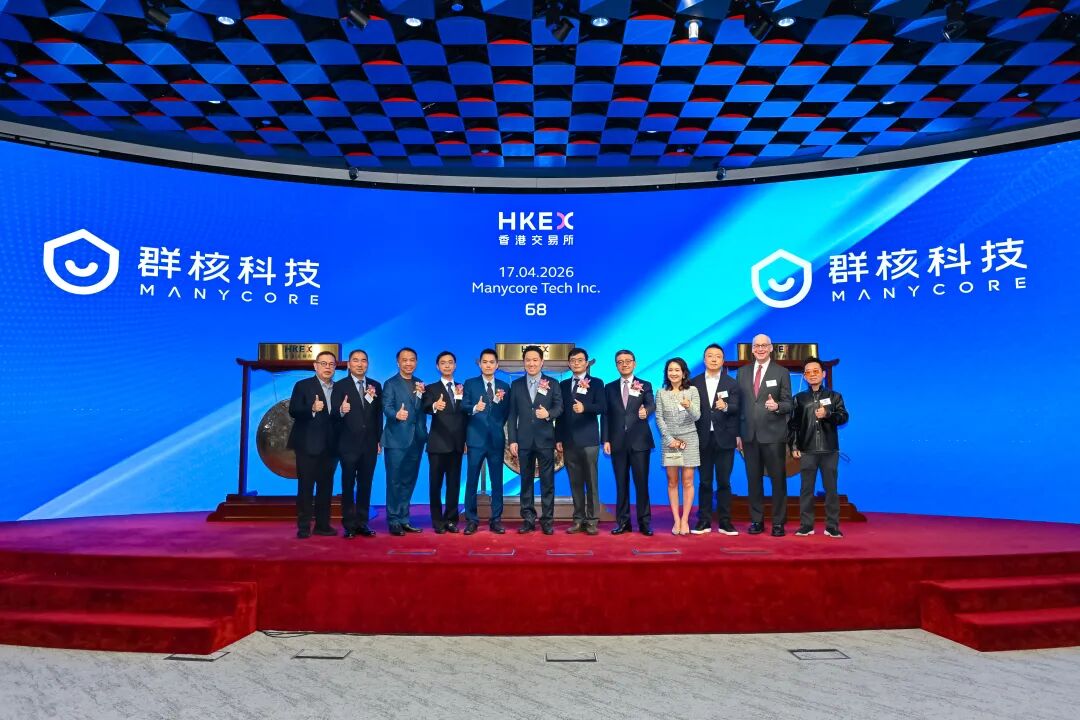
Manycore Tech officially debuted on the Hong Kong Stock Exchange today as the "first spatial intelligence stock," but in this video podcast episode, you'll see more of the young man who has spent fifteen years building a company, tasted every flavor of the entrepreneurial journey, and still believes he can "change the world in an even bigger way."
Today, Manycore Tech (00068.HK) listed on the Hong Kong Stock Exchange as the "first spatial intelligence stock," opening 171.65% above its IPO price and becoming the first of Hangzhou's "Six Little Dragons" to break into international capital markets.
Looking back to the beginning, Harry Wang, founder of Linear Capital, was Manycore's earliest angel investor — he not only provided the first check but also introduced key institutional investors. After Linear Capital was founded, it continued to increase its stake in subsequent rounds.
From first meeting to enduring partnership: seventeen years of knowing each other, thirteen years of running alongside. This is a long story about trust, growth, and mutual success.
On the eve of the IPO, Harry specially invited Huang Xiaohuang, founder of Manycore Tech, back to the Linear Capital office to record the inaugural episode of "Between the Lines." From evening deep into the night, across more than four hours of conversation, they began with their first meeting at the Zhejiang University Silicon Valley Alumni Association, speaking of directions that weren't understood, wrong turns taken, and also of surprises when paths circled back and moments when they found their rhythm again.
As the interview drew toward its close, what we saw was still that young man who, after fifteen years of entrepreneurship having tasted all its flavors, still believes he can "change the world in an even bigger way."
This written excerpt is approximately 14,000 characters. The video experience is even better ↓
$500K and the Disdained NVIDIA
▍Harry Wang: Let's start with the story of that first round of funding. I actually only learned recently from some reports that someone stood you up the day before you returned to China. How did that feel at the time?
Huang Xiaohuang: Getting your valuation slashed in half at the last minute — definitely pretty upsetting, but thinking back after all this time, it seems totally normal, and I completely understand.
▍Harry Wang: You told me a joke once — back then when you went out and said you were from NVIDIA, people would say "your work experience isn't great."
Huang Xiaohuang: When I was fundraising, several VCs told me, "Oh, this company doesn't seem very promising, and you've also worked there a relatively short time." After hearing that, I quickly changed my resume to say I'd worked in Silicon Valley without naming the company. One famous fund's investment manager even said to me, "Your undergrad is good, your grad school is good — how did you end up working at NVIDIA?"
▍Harry Wang: It's pretty surreal — nobody could have imagined that more than a decade later, NVIDIA would become one of the world's largest companies. If you'd held onto that stock back then, you'd be legendary. But I'm wondering, is it possible that Manycore today is what NVIDIA was fifteen years ago? I personally still hope to see that day come.
Huang Xiaohuang: I used to treat it as a stain on my resume. But there wasn't much I could do — after all, most investors thought that way at the time.
▍Harry Wang: We first met at a Zhejiang University Silicon Valley Alumni Association event, but I really had no idea back then that this connection would lead me to know you and invest in you. Manycore was the only one out of twenty early-stage projects in my personal angel investing during those couple of years that actually made me money.
▍Huang Xiaohuang: The only one? That success rate is pretty low, isn't it?
▍Harry Wang: Haha, nothing I could do — maybe my abilities were truly limited back then. But only by going through that process do you understand the true nature of the VC game, and then figure out how to improve your hit rate. My first investment in Manycore was only 500K, right? I remember Chen Hang asked if I could invest 1 million, and I ended up refusing. Do you know why?
▍Huang Xiaohuang: I kind of forgot. I remember after Chen Hang asked about the 1 million and got rejected, he went back and was depressed for quite a while.
▍Harry Wang: There were really two main reasons. One you probably know — I was collaborating with two other people at the time; if everyone thought it was good, we'd invest together collectively, and if not, I'd invest personally. The second reason was that I'd lost money on so many projects I'd invested in, so I'd mentally prepared myself that angel investing was basically charity. But I still really liked that geek vibe you guys had, so I invested.
But looking back, if I'd gone with your idea, I could have made double on that investment, right? But then I think it's all fate — whatever's meant to happen will happen, everything is the best arrangement. Rejecting his 1 million back then — maybe I'm the one depressed about it now, but at least I made half of what Chen Hang wanted me to make.
Not Understanding You But Insisting on Teaching You How to Build a Company
▍Harry Wang: You didn't have that many funding rounds. Which ones were easy, and which were especially difficult?
▍Huang Xiaohuang: The first round was the hardest; everything after that was relatively easy. Looking back, a team with our credentials actually becomes more attractive over time, and our business kept growing steadily with a very stable operating style. We could predict crises or major shifts in the era ahead of time and make adjustments in advance.
▍Harry Wang: Right, it looks very steady, but you keep capturing structural opportunities brought by technological transformation.
▍Huang Xiaohuang: This is also what we internally emphasize as going with the momentum.
▍Harry Wang: Were there any rounds that, looking back, you shouldn't have raised?
▍Huang Xiaohuang: Bad investors are very negative feedback on operations — for example, constantly suppressing you in everything to achieve their own goals.
Of all the investors I've interacted with, good investors are ones who, when you have an idea, keep introducing you to similar projects and practitioners in the market to exchange with; or even if they don't agree, they trust your character, don't cause trouble for the company, and give you support when needed.
But the worst investors are those who not only don't agree but try to impose their thinking on you. To some extent, an investor's methodology and framework are more like experiences summarized from the capital market, and they may be lagging.
▍Harry Wang: So understanding the new world requires a new language system, a new conceptual framework — only then is it possible to understand how this new world operates.
▍Huang Xiaohuang: But I don't think everyone needs to understand you; if you don't understand, just don't be nasty about it, right? We've probably been relatively lucky. I have many friends around me who encountered this kind of investor very early on, and they had to tear everything down and start over.
▍Harry Wang: How do you get through that? If a core investor keeps singing a different tune, especially on some key decisions.
▍Huang Xiaohuang: You just maneuver, like running a company — given enough time, there will always be a turning point.
Making a Conclusion After Five Minutes Is a Kind of Arrogance
▍Harry Wang: What kind of investors have really helped you a lot?
▍Huang Xiaohuang: I think most investors I've interacted with have been pretty good. As I said earlier, some of my ideas are solid and some aren't — I'll adjust myself. But I definitely don't want you to tell me it's not solid after listening for just five minutes. I spend at least several months researching something before I decide to do it.
▍Harry Wang: Making a conclusion after listening to you for five minutes is actually a kind of arrogance.
▍Huang Xiaohuang: Actually, investors have access to more information rather than experience. Much of that information is crucial and helpful to me — especially when there's something we want to do that another company tried and failed at. If they introduce that person to me and we chat, I immediately realize with crystal clarity that this isn't solid.
▍Harry Wang: So an investor needs vision, connection-making ability, and willingness to make introductions, right? Whether you have the capacity to absorb it is a matter of your own ability.
Do you remember something? Back then you wanted me on your board, and I refused. Looking back, I don't regret it, because the boundary of my thinking at the time was to be a pure angel. When you need me, give me a call, and I can show up — help where I can, and leave me out of it where I can't.
▍Huang Xiaohuang: What I actually regret most is raising too much money in 2020 and 2021, not burning it into anything meaningful, and then the era changed dramatically.
▍Harry Wang: Right, that's also a necessary lesson. Were there moments when the pressure was so intense you wanted to cry?
▍Huang Xiaohuang: Relatively few. I'm still a rational person — I'll be anxious but I won't cry. Like in our first year of entrepreneurship, we got rejected countless times, but the overall investment environment was just bad then. Then when the product made some progress in 2013, investors came looking for us all at once, fighting over allocation so fiercely they almost came to blows.
Then there was a period when our company only had a bit over 1,000 people, and a giant poached 500 of them — it felt like you'd fallen onto a giant's main track. But you know what happened after — every time in those painful moments, things always turned around. Having been through so many ups and downs, you learn to meet soldiers with generals and dam water with earth.
Transformation Can Only Be a CEO-Led Project
▍Harry Wang: How would you describe the game of entrepreneurship?
Huang Xiaohuang: First, our ultimate goal hasn't been achieved yet. When we started out, we definitely wanted to change the world in a big enough way. In the process, I actually found the goal kept getting bigger. But I've discovered that as long as you survive, you'll always have new opportunities. Under the spotlight of the era, companies keep changing, but the stage doesn't always belong to the same few companies. So entrepreneurship means always standing at the forefront of the era, adjusting in time while keeping yourself alive.
▍Harry Wang: You must have developed a methodology for transformation by now.
Huang Xiaohuang: Every time we transform, I have to personally take charge of rebuilding the team — it's basically like building a brand new company. And the old business gets handed to current partners or other executives to manage, ensuring the new business can upgrade without interference.
▍Harry Wang: But where does the initial idea for each transformation come from?
Huang Xiaohuang: You have to keep learning. Actually everyone knows the direction the era is heading; the hard part is figuring out what product to build. For most companies, it's often because existing things are constraining you that it's hard to do new things. A company's adjustment is systemic.
So across several transformations, our underlying technology basically hasn't changed much. Underlying technology operates on decades-long cycles, but the application layer above changes very quickly. The core issue of transformation may not even be organizational process or such things — it's that to build something new, you need new people, and you need to burn money.
▍Harry Wang: So you find new people rather than building a team internally?
▍Huang Xiaohuang: We look both internally and externally. But you can't just transfer the existing whole team over. Among people who've been with you for years building the company, some will fit the new direction and some won't.
We've made many mistakes like this in the past — putting adequate old-timers in place first, and then it might turn into a complete mess. It's not out of malice on their part, but their capability boundaries are right there.
So for new things, it's best if we co-founders ourselves take the lead and focus on doing it. Many companies trying to transform might hire a VP or some executive from outside to do it — the pressure on that person is too great, and there are lots of internal conflicts. For example, some old employees want to join your new project, and if you don't agree, aren't you making enemies?
▍Harry Wang: So it can only be you few stepping up.
▍Huang Xiaohuang: Transformation is definitely a CEO-led project.
▍Harry Wang: Were there moments when you three argued and said, this can't be done this way?
▍Huang Xiaohuang: We argued more in the early days of the startup. Now we basically don't argue anymore — we're like an old married couple, very rational. Every discussion is strictly about the issue at hand. Everyone makes mistakes, but whoever owns it decides and takes responsibility.
People from Different Backgrounds Tend Toward Mediocrity
▍Harry Wang: Let's talk about you three brothers. You've been together for 15 years since founding the company. Teams like that must be extremely rare.
▍Huang Xiaohuang: We met in school, worked on projects and research together. There was never that feeling of being bossed around like an employee.
▍Harry Wang: A lot of founders get along fine as classmates, but when you become co-founders carrying real weight, certain capabilities or personality issues surface under pressure. Did you have moments like that?
▍Huang Xiaohuang: I think first of all, maybe it's because all of us have relatively mild personalities. We're never sharp or confrontational.
▍Harry Wang: I don't think I've ever seen you genuinely angry. Even during your hardest moments, I'd call you and eventually I'd feel like cursing, but you'd say you understood the situation. At that moment, I actually felt a little heartbroken for you.
▍Huang Xiaohuang: Losing your temper doesn't solve problems. So I never lose my temper at the company either. Everyone communicates very rationally. Our company operations are generally very stable. Even when there are big storms externally, our internal operations and mindset stay very calm.
Our strategic approach is steady and methodical, leaving no openings for competitors. In any business we capture, there's basically no chance for a number two. We just push forward step by step.
▍Harry Wang: So you don't easily launch new businesses or pursue a second curve, but when you do commit, you invest firmly. After all, temptations are always out there. Sometimes you charge in and end up discovering it's a trap.
▍Huang Xiaohuang: We think through everything very clearly. We don't act on impulse.
▍Harry Wang: But don't you feel this approach lacks some passion?
▍Huang Xiaohuang: We thought about this in the early days too. We even tried bringing in new partners with opposite personalities, but we never found anyone who meshed particularly well.
Later we realized, the advantage of the three of us having similar backgrounds is that when an idea emerges, we all understand it. For example, in 2020 or 2021, if we said we wanted to train large models or work on spatial intelligence, imagine ten managers lined up saying: "Don't mess around. Why not save the money and give us bigger bonuses instead?"
There's a counterintuitive fact: when people from different backgrounds discuss things together, the conclusion tends toward mediocrity. It's probably similar to what you get from asking AI today — maybe not bad, but hard to produce something truly exceptional or outstanding.
▍Harry Wang: I strongly agree with that. You end up with the greatest common denominator.
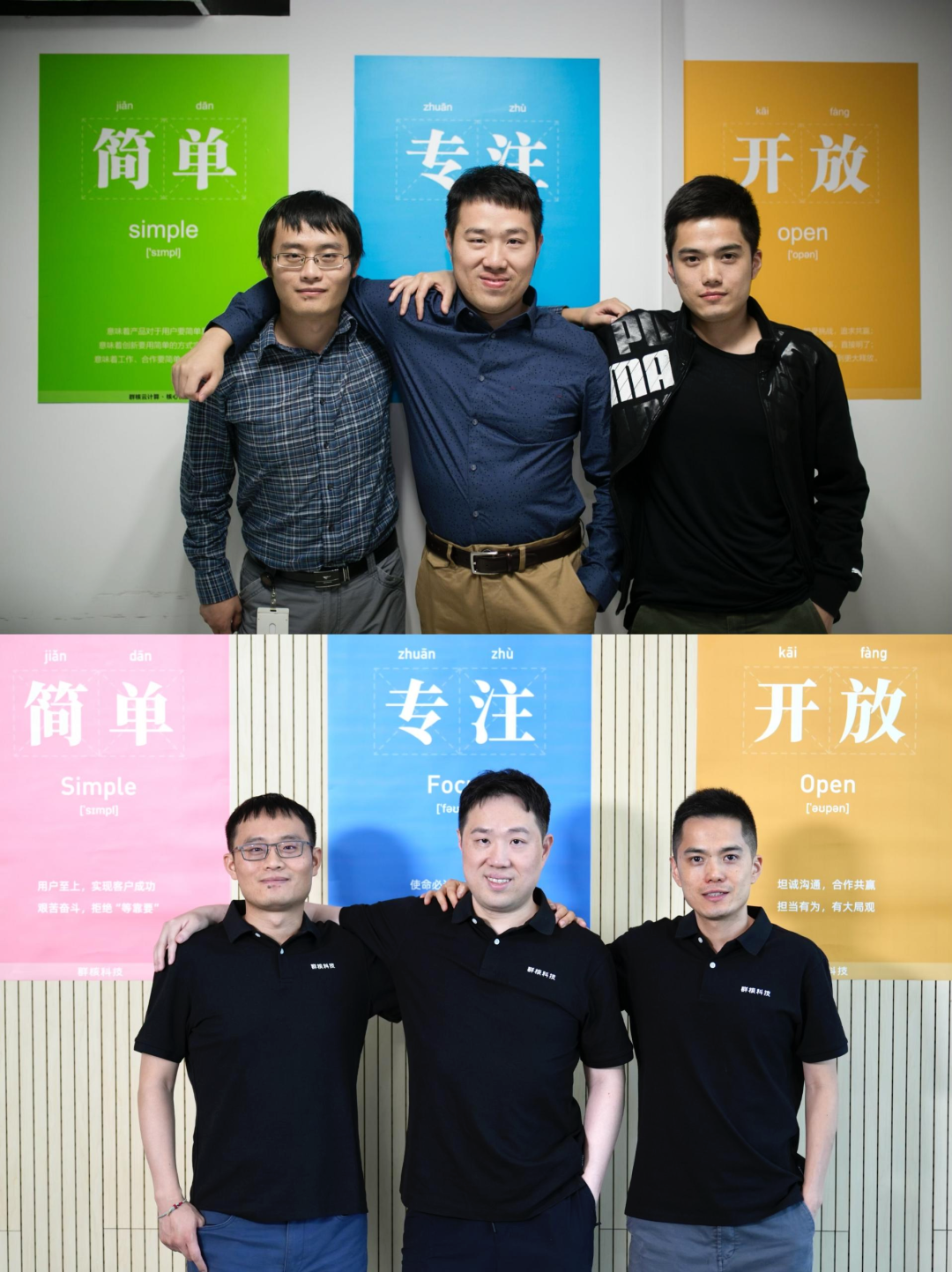
Group photo of the three co-founders of Manycore Tech, ten years apart
Leveraging the Hangzhou Six Little Dragons to Recruit Better Talent
▍Harry Wang: An important turning point in your ups and downs was the Hangzhou Six Little Dragons?
▍Huang Xiaohuang: Yes. After we got some attention, we had an internal principle: the core is still to make the product better, and try to leverage this visibility to recruit better people — use visibility less to make money or even to hustle for money.
We believe spatial intelligence is the trend of the era. But when you actually do it, you find that besides the people at Manycore Research Lab, very few colleagues have been exposed to these things. Fortunately our old business was quite profitable, so we felt it was fine if people didn't understand, fine if we didn't raise funding — those were solvable problems. The hard part was talent.
When those talented people came and looked around, they'd think: "Huh? If I'm training models, why wouldn't I go to Alibaba or ByteDance?" I remember in 2024, I received resumes from over 1,000 people, personally interviewed those candidates, and in the end only one person accepted the offer.
▍Harry Wang: 1,000 to 1. That's really not easy. Though your hiring standards are also quite high.
▍Huang Xiaohuang: But after the "Hangzhou Six Little Dragons" went viral, in 2025 I've reviewed at least over 4,000 resumes and interviewed many. Resumes from C9 universities increased 9x compared to 2024, overseas student resumes increased 20x. In the end we recruited over a dozen exceptionally outstanding people, which made us very happy. It was this group of outstanding young people who came in and gradually trained these models.
Spatial Intelligence as the Right Bridge for Us
▍Harry Wang: You accumulated so much of the world's largest indoor 3D data over the years, which enabled your later ambition to pursue spatial intelligence?
▍Huang Xiaohuang: This might be a chicken-and-egg problem. If I were to directly build large language models today, even if someone on the team could do it, we'd feel we had no chance of winning. But because we accumulated so much spatial data, we found a point that suited us — becoming the bridge between large language models and the physical world.
▍Harry Wang: You should be one of the biggest promoters domestically in defining the direction of spatial intelligence. You also open-sourced things like SpatialLM and SpatialGen. Why are these important?
▍Huang Xiaohuang: Spatial intelligence actually includes spatial reasoning, understanding, generation, reconstruction, and so on. So internally we divided into several teams exploring these directions respectively. Our earliest open-source project was SpatialLM last March, which essentially converts point clouds scanned from the physical world, including 3D Gaussians, into scripts that large language models can understand.
This "understanding" is a bit different from what we normally mean. Many people's definition of understanding is knowing this is a table, that is a chair. But think deeper — as a child grows up, you'd mark and handle sharp corners and places where they could fall. This is an innate human ability for spatial understanding and reasoning.
But how do we give machines this ability? That's the direction we're working toward. So at that time we initiated SpatialLM — from Spatial to Language Model.
▍Harry Wang: So it's not just knowing what something is and where it is, but also what it means to me, to others? The machine has to learn to reason, so it can interact in three-dimensional space.
▍Huang Xiaohuang: Actually I've thought about whether starting a new company for this would move faster. But I feel I still have to answer to all shareholders. That's my obligation.
▍Harry Wang: You're very decent to your shareholders. But many people in this market probably don't think that way.
▍Huang Xiaohuang: I know how other entrepreneurs play the game. But often, making more or less money isn't the most critical thing. At least in our value system, we still hope that when we achieve something, we get applause from those who walked with us, not a chorus of curses.
▍Harry Wang: This is actually a kind of filtering. People who appreciate this will stay and walk very far with you, just like how during your hard moments there are always people willing to stand up and help you.
▍Huang Xiaohuang: The most fundamental thing about a company is that you have to make products that are valuable to society and the world, and top teams that can keep walking with you. Many other things can be sacrificed to a degree, but not sacrificed for nothing. If we paid a price, I definitely have to absorb the lessons.
Big Pond, Small Fish or Small Pond, Big Fish
▍Harry Wang: Over these dozen or so years, what mistakes nearly killed you?
▍Huang Xiaohuang: The biggest lesson was probably in 2021, when we were about to IPO and expanded too optimistically. Of course we've reviewed this many times since. Actually, if we were truly put back at that moment to choose again, you could only reduce losses — there was basically no way to avoid that pit.
▍Harry Wang: But why was this mistake unavoidable? For instance, slowing down a bit in the process, or investing less.
▍Huang Xiaohuang: I think we could have invested less. At the time we were making big bets in two directions: AI and real estate/construction. We reviewed this many times afterward. I said give me 100 more tries, and unless I could travel back in time, there was no avoiding this pit. The signals the market was giving, from both rational and emotional perspectives, pointed to a super perfect track.
▍Harry Wang: So when some things are going crazy, people sometimes still need to deliberately stay sober.
▍Huang Xiaohuang: We mapped out two types of businesses. One type feels like it has great value to society, very meaningful, but you don't know how to make money. The other type makes money immediately. Everyone's intuition is to do the latter, but what actually made us money was mostly the former.
▍Harry Wang: What you're doing now with spatial foundation models is exactly this situation.
▍Huang Xiaohuang: I believe if we keep doing it, there will definitely be better business models. Many investors think this burns money, but I think whether a company in this world can make it depends on your position in the industry chain.
Over the past dozen or so years, the core reason entrepreneurship in China has been so focused on business models is that most companies don't have real core technology, so at that point you're competing on business models. But say you have the world's only gold-making technology — what business model do you need? You just sell it directly.
▍Harry Wang: The paradigm of this era is changing. Before, it was about finding a way to make money and then executing that playbook with speed to the extreme. Because those things had too low a barrier — as soon as a second person knew, they'd copy immediately. But if you truly have know-how and can build barriers, that kind of uniqueness is invaluable.
▍Huang Xiaohuang: I've always believed that products with real value to the world and society will always find a way to make money. Of course there are also many products with awesome technology that didn't end up making that much money.
▍Harry Wang: Many people actually go to the other extreme.
▍Huang Xiaohuang: I often ask this question: there's a product in a very large market where you might not necessarily become number one, versus a direction where you can become number one but the market isn't as big — which would you choose? In other words, choose to be a "big pond, small fish" or a "small pond, big fish"?
▍Harry Wang: If you ask my choice, first I think this pond can't be too small even if it's small. I need to see a path from small pond big fish, to find a connecting channel that lets me swim into the big pond and become a big fish there.
▍Huang Xiaohuang: So do you first choose the big pond or first do the small pond?
▍Harry Wang: Looking at me founding Linear Capital to do early-stage tech investment, I'm definitely trying to be a big fish in a small pond. But one, this pond isn't as small as imagined, and two, it's a pond I like. I think you guys also chose a pond you're genuinely interested in.
▍Huang Xiaohuang: Back when we built Kujiale, we didn't know how this thing would make money either. But once we pushed it to market, we found it pushed very easily. Something with uniqueness has immediate effect — customers will even help you figure out how to charge. So we summarized this internally: we must develop technologically competitive products and then turn them into products.
▍Harry Wang: And your personality is suited for this too. You'd get bored doing "me too" stuff.
▍Huang Xiaohuang: Right. And the products where we lost the most money were all "me too" attempts.

Forging Thor's Hammer
▍Harry Wang: You have an interesting perspective — you openly admit you're walking around with a hammer looking for nails. A lot of people think that's wrong.
▍Huang Xiaohuang: I think this comes from my time at NVIDIA. I was working on GPUs, on CUDA. The whole thing was fundamentally disruptive to the CPU framework. If you went looking for nails directly, you'd only find CPU-optimized scenarios — nothing suitable for GPUs. You had to build the thing first, then test it in different scenarios.
▍Harry Wang: The large language models we see now were born from this same logic.
▍Huang Xiaohuang: When ChatGPT first came out, people just used it for casual conversation. Now it helps us do so many things, and it'll be even more different going forward. They built an incredibly powerful hammer and went around smashing every nail they could find. And once you hit one, suddenly all these other nails start popping up.
▍Harry Wang: But hammers come in different grades. How do you know if your hammer is "Mjolnir" or just a little wooden mallet?
▍Huang Xiaohuang: Honestly, some of it comes down to luck. When we hire AI people, we have folks working on language, images, video, 3D — it's hard to say upfront which domain will produce the most powerful hammer. It's like you can't look at how dominant large language models are today and say they had strong foresight. The Transformer architecture — everyone in academia was experimenting with it.
▍Harry Wang: After all, when Ilya and his team published that paper at Google in 2017, not a single company — Google included — believed it would have such massive impact later. That's why they let those people leave to start OpenAI.
▍Huang Xiaohuang: So we also ask ourselves: If the nail was that big, would Google really not see it? They invented the thing themselves. So you have to find a way to forge "Mjolnir." Then everywhere you swing, it's a hammer.
Hiring People Who Can Use AI to Discover Relativity
▍Harry Wang: So given Kujiale's current financials, is this large-scale investment primarily about building a moat for the future?
▍Huang Xiaohuang: We've always wanted to invest more in R&D. You can't overinvest if you're pointed in the right direction. Of course, we've made mistakes before — hiring a lot of engineers to do "ancient-style programming."
▍Harry Wang: "Ancient-style programming" — I like that term.
▍Huang Xiaohuang: Before 2022, it was all "ancient-style programming." Later we realized a lot of this code doesn't need humans to write anymore. So what do you do with the thousand-plus engineers you already hired? You help them transition.
Before 2023, the priority in hiring engineers was cost-effectiveness. For example, a good Java engineer in Beijing, Shanghai, Guangzhou, or Shenzhen might cost 30,000 or 40,000 RMB per month. But in second- or third-tier cities, you might find a less experienced engineer for 20,000 and bring them up to speed through training.
But that's not how it works now. It's like how investment firms hire analysts: if they get it right, one project might return 100x; if they get it wrong, everything they do is garbage. Even if their work is meticulous and thorough, being wrong makes it meaningless. In that situation, would you still hire analysts based on cost-effectiveness?
▍Harry Wang: No. What you want is someone with a higher probability of being right, whether through their own judgment or by using tools — anything that increases their odds. So the gap between people widens again.
▍Huang Xiaohuang: But when you chat with these people normally, everyone seems like good friends. It's only when you actually get to coding that the gaps reveal themselves. Top-tier people just see the solution and write it.
▍Harry Wang: But people genuinely aren't equal in talent. Some have programming talent, others have language gifts, some guys are just great at closing deals. Everyone has their own angelic gift.
▍Huang Xiaohuang: And often the question is: If this person is 1% better than that person, how much premium are you willing to pay for that 1%? Let me give a programming example. Person A can write something at 91% quality, Person B at 90%. Looks like just a 1% gap. But now AI can write at 89%. So Person A is actually producing twice as much as Person B.
▍Harry Wang: But I always feel the difference between these brilliant people and ordinary engineers isn't just 90% versus 91%. That intuition during parameter tuning, the feel for when something's just right — there's some innate talent in that.
▍Huang Xiaohuang: Our hiring experience now is that intelligence matters most. Fast learning ability, strong hands-on skills — that's the absolute core. It's a lot like the gaokao. You need to solve problems fast, practice diligently, have good memory. So it turns out the people the gaokao selects are especially well-suited for building large models.
▍Harry Wang: That explains why so many Chinese people are behind the world's top models, right?
▍Huang Xiaohuang: Right. Maybe China's gaokao system is especially good at filtering for the kind of AI engineers we need.
▍Harry Wang: So after all this, our talent selection mechanism has actually become a massive institutional advantage in the AI era. That's truly unexpected.
▍Huang Xiaohuang: In our interviews now, I personally verify that AI can't solve our coding problems first — because AI can only do what's findable on the internet — then we give them to candidates, who can use AI to help solve them. This is like asking: Before relativity existed, how would you use AI to discover it?
So many of our current interview questions come from internal research papers we've finished but haven't published yet. We see what candidates can do with them. What's interesting is that their problem-solving ability correlates quite closely with their gaokao scores.
▍Harry Wang: Actually, if you look at Reinforcement Learning (RL), it's essentially giving AI problems to strengthen its reasoning ability. Exaggerating a bit, RL is basically a gaokao model — endless practice tests. Was there ever a moment in this process where you felt the shock of emergent intelligence?
▍Huang Xiaohuang: I think if we train a model and don't feel awed by it, we shouldn't launch it. Never launch just for the sake of launching. What matters in model-building is capability.
▍Harry Wang: At this point, an engineer's level, their luck — these can make huge differences.
▍Huang Xiaohuang: I have to say, after you enter society, luck is a very important factor.
▍Harry Wang: I'm particularly interested in one topic lately: how do you scientifically improve your luck?
▍Huang Xiaohuang: Walk the straight path. I've seen many friends around me who, somewhere along the way, start going down crooked paths. When that happens, everyone is cursing you — your luck definitely won't be good.
I think many of Kujiale's key turning points came from people willing to share important information and advice with you. If you listen and adjust in time, you might catch some opportunities. So stick to the right path, and opportunities will eventually come.
▍Harry Wang: How do you understand talent density? From your perspective, what makes a top talent? Do you look for experience or intelligence?
▍Huang Xiaohuang: It varies by era. Right now, top talent definitely means someone who's trained large models, who's both experienced and smart, with strong execution. But besides the top tech giants, it's hard to hire these people. So you settle for the next best thing.
This era calls for smart people; the previous era called for experienced people. When an industry's technology stabilizes, experience becomes more valuable. But when an era changes too fast, experience becomes worthless, and learning ability and hands-on skills become valuable again.
▍Harry Wang: We also evaluate imagination internally. Because AI changes so fast — where might a path emerge, where might things turn around? Without imagination, if you make an early judgment, that door might close on you.
▍Huang Xiaohuang: Talent density is still tied to organizational culture. In an authoritarian organization, you just need an elite leader. In a flat culture, having many like-minded people matters more. Some companies struggle to transform because their people are all from the past — how can the company not stay in the past?
When we started working on frontier things like spatial intelligence, a lot of people thought it was nonsense and a waste of money. But my technical partners who share my vision would feel this direction was right, could sense the beauty in it.
▍Harry Wang: The ability to resonate with beauty — that's quite important for an organization too.
Giving Extra Bonuses to Employees Who Lost Millions
▍Harry Wang: In training spatial intelligence models, what are the particularly difficult points?
▍Huang Xiaohuang: Every day is a hurdle; every step forward is a challenge. For instance, one wrong parameter tuning choice, and you've directly lost a million in costs. This happens regularly. And these problems are so abstract — you can't think your way through them.
▍Harry Wang: So when you encounter a million-dollar mistake like this, how do you treat the employee responsible?
▍Huang Xiaohuang: Still encourage them, give them extra bonuses. Don't fear failure — our company allows failure. Of course, internally I'm bleeding. But more than that, I want to build processes and systems to reduce these mistakes.
▍Harry Wang: But the person themselves still has to be excellent, right?
▍Huang Xiaohuang: Right. First you have to assess if this person is excellent. If it's some incompetent veteran employee who insists on messing around with model training themselves, that employee needs to be reassigned. But if it's someone you consider among the best you can find, you still need to encourage experimentation. After all, model training failures are common. I believe no one wants to mess things up.
▍Harry Wang: If they're afraid to take the risk of messing up, they'll never accomplish anything.
▍Huang Xiaohuang: Right, so there's definitely risk. If you punish people for failure today, no one will want to try anymore. Our principle is: You can't let people who are working hard be punished. But calibrating this is genuinely difficult. I asked Yan Junjie at MiniMax today how he handles this — seems like everyone thinks similarly.
▍Harry Wang: I can share a story. Back at Facebook, I was probably one of the few people who took down the entire website for an hour. That hour was definitely worth a lot. I had only been there two years at the time, and I wondered if this was when I should leave. But my direct manager said, "Harry, it's fine. You took down the entire company website. From today on, you're a Qualified Engineer."
▍Huang Xiaohuang: That's the right culture. We made a mistake in the past by creating a rule that said if the website went down, we had to assign blame. Because there was a time when I was doing a client demo and things crashed. But later I realized the side effects were huge. Every time we wanted to push a new version live, everyone said no — nobody wanted to take the risk.
▍Harry Wang: I really agree with that. You need to know who made the mistake, but whether the response is punishment or encouragement depends on the individual, and on what kind of culture you're trying to build at the company.
▍Huang Xiaohuang: So later we changed it to where if someone made a mistake — the kind of mistake that was bound to happen — we'd even send a Spring Festival gift package to their family. Of course, the前提 is making sure the person didn't do it on purpose.
▍Harry Wang: Exactly. Employees already feel enormous pressure when they know they've done something wrong. If it's someone very talented, that pressure at this moment could very well affect their performance going forward.
▍Huang Xiaohuang: And we made countless mistakes during our own startup journey — how can you expect employees to never make any? But we still need to use systems to minimize repeated mistakes as much as possible.
▍Harry Wang: A lot of the time your achievements are built on 99% of your past failures.
▍Huang Xiaohuang: And especially in the large model era, if you demand that a model never have problems, that its outputs be 100% correct, then you might as well not use it at all.
Interning at Microsoft to Meet Gates
▍Harry Wang: Let's change topics and chat about some fun stories from the past. When you were ten years old, who was your idol?
▍Huang Xiaohuang: The only one I can remember is probably Bill Gates. Though he's had his fall from grace now, of course.
▍Harry Wang: Why Bill Gates?
▍Huang Xiaohuang: I remember I had just started learning the DOS operating system, and then I saw Gates saying that in the future, graphical interfaces like Windows would completely replace DOS. I thought, how is that possible? Then in just two short years, Windows 95 came out and it was exactly as he said. That was the first time I experienced how truly impressive people can make predictive, transformative changes to technology's development.
So in my first year of grad school, I specifically interned at MSR because I heard you could visit Gates's house and take photos with him. I didn't expect that in my first month there, he retired. I was upset about it for a long time.
I've loved computers since I was young — I taught myself programming in elementary school. My hometown wasn't any big city, there were no dedicated programming classes, but I discovered I could learn on my own. Besides studying for exams, I just loved writing programs.
▍Harry Wang: Your idol back then was Bill Gates. What about now? Have you basically lost your illusions about all idols?
▍Huang Xiaohuang: Basically disenchanted with all of them. Now I think you should broadly learn something from successful people.
Are You "Seeking Truth"?
▍Harry Wang: Let's talk about our alma mater. I don't know what your impression of Zhejiang University was before, but I remember when I was in college I still felt it was a bit on the earnest, low-key side. These past few years though, I feel like there's been a world of difference in its reputation. Especially in the capital markets, Zhejiang University entrepreneurs are very popular now. How do you view this phenomenon?
▍Huang Xiaohuang: Honestly I was pretty disappointed when I first went to Zhejiang University, because I ranked around 60th to 70th in the province on the gaokao, so getting into Peking University or Tsinghua University would have been very easy. But because we filled out our applications before the exam, that year the math section was especially difficult — and I was particularly strong in math, physics, and chemistry, but weak in English and Chinese — so my ranking shot up. I was first in my class on the gaokao and went to Zhejiang University. My grandfather was even a bit angry when he found out, because he didn't know the school and felt I had wasted my score.
But after I got there, I felt the academic atmosphere was quite good. The biggest shock Zhejiang University gave me was that right when I arrived, upperclassmen were constantly灌输 all this information about entrepreneurship and computer competitions, and the classmates around me were all doing it, so I worked hard to try it too.
▍Harry Wang: That might just be the stage setting for your life. So what did Zhejiang University actually leave you with?
▍Huang Xiaohuang: Anyway, I feel like the people around me first dared to think, and second dared to do. But they weren't great at talking about it — very pragmatic, sometimes even too pragmatic. Once our PR head wrote a piece that was actually quite good, but a partner just asked one question — "Do you think we've 'sought truth'?"
▍Harry Wang: Hahaha, our school motto — "Seeking truth, pioneering new trails" — you should have answered that we "pioneered new trails."
▍Huang Xiaohuang: This completely stumped our PR head: "What do you mean? You think it's too浮夸?" I quickly helped explain that it's our school motto, meaning don't write about things that don't exist, keep it pragmatic. It absolutely wasn't about criticizing him — it's just that we constantly use this phrase to reflect on ourselves.
Sometimes even when I've done a few too many interviews, other partners will remind me not to get carried away, to look at whether our capabilities match up with public expectations of us, and if they haven't reached that point, do fewer interviews.
▍Harry Wang: Right, we've always reflected on ourselves this way too.
▍Huang Xiaohuang: So I feel like a lot of Zhejiang University people do first and promote later, rather than hype first and then react by doing something.
▍Harry Wang: And they'll often describe a 10 as a 7 — Zhejiang University people have this characteristic.
The Late-Night, Late-Rising Origin Story
▍Harry Wang: I have a question — I may have asked it back then, but I don't know if your answer has changed: Why did you start a company?
▍Huang Xiaohuang: First, the idea of starting a company was cultivated at Zhejiang University, when everyone was promoting entrepreneurship. Then the second wave was after I went to work in Silicon Valley — every weekend there were all these sharing sessions about entrepreneurship and VC, I couldn't focus on my work at all, constantly thinking about what kind of venture I wanted to build myself.
Another reason was my work habit of working at night and sleeping during the day. Major decisions and algorithm designs were all done at night.
▍Harry Wang: What time did you go to work back then?
▍Huang Xiaohuang: The team at the time was relatively older, so a lot of people would arrive at 7:30 or 8:00, but I would always show up around 10:00 or 11:00, though I'd easily stay until 9:00 or 10:00 at night. My colleagues had some complaints — at 7:00 p.m. some colleague would come knock on my desk and ask, can you leave earlier and come in earlier in the morning? I really wanted to change my sleep schedule, but it was just very difficult. Though now that I have kids, I'm slowly starting to understand.
▍Harry Wang: I think this understanding is important. But actually, that kind of youthful contempt and arrogance toward the world is also a necessary part of growing up, or you could say, part of its charm.
▍Huang Xiaohuang: I still envy my younger self — looking at every new thing with unlimited憧憬, whereas now after seeing so much, it's just "this I can understand, that I can understand too." So why entrepreneurship is a good endeavor is because you can still constantly explore the boundaries of your understanding. Like when I watched a moon landing rocket launch recently, I was still pondering what spatial intelligence applications could be done on it.

Competitors Are a Mirror
▍Harry Wang: Let's talk about a relatively boring topic — competition and rivals. Do you worry about competition?
▍Huang Xiaohuang: I actually quite like competition, but I don't like vicious competition. Because I think whoever your competitor is, you'll increasingly become like them. For example, in the past when I took Autodesk as a competitor, I'd constantly study their organizational building, who they hired, and so on. If I chose a very traditional enterprise as a competitor, I'd find our employees' behavioral patterns would increasingly resemble theirs too.
So I think choosing competitors is an art — if the person you're studying and competing with every day is completely not who you aspire to become, it's very easy to lead you astray. Competition is a mirror for a company — you can see your future self in them.
▍Harry Wang: But sometimes in studying them, you just learn the good things and discard the bad, no?
▍Huang Xiaohuang: You end up learning both — good and bad. To put it bluntly, human decision-making ability is quite poor. Your competitor's actions certainly aren't stupid either; many of their habits and organizational structures have their own internal logic around their business. If you model yourself after them, eventually your organizational form and culture will increasingly converge with theirs.
▍Harry Wang: Would you advocate studying competitors or not studying competitors?
▍Huang Xiaohuang: You definitely have to study competitors, but you can't study just one. So we don't just study competitors — we study similar peer companies too. We've also suffered losses from competing against relatively traditional enterprises — it's not that we couldn't compete, but we brought in many people who shouldn't belong in this company's culture.
For example, if your competitor can close deals by going out to eat, drink, and KTV, then your business people will learn to do that too, and over time that culture will spread through your company.
▍Harry Wang: Actually, to exaggerate a bit, that's a slow-acting poison — drinking poison to quench thirst.
▍Huang Xiaohuang: They can survive too, but is this what you want? If it's not what you want, then quickly change competitors.
▍Harry Wang: But wouldn't you worry that the competitors and competitive products you see today, their way of existing, might not even be the biggest threat? The bigger threat might be the emergence of next-generation technology, delivering a dimensional reduction strike to your current product and technology stack.
▍Huang Xiaohuang: Yes, at least with our company's team configuration, we've never worried about dying from competition — competition has actually made us bigger and bolder. But risks always come from sudden industry shifts, sudden technology shifts. For example, when large models emerged, if you still clung to the small model approach, that definitely wouldn't work. So these are the things that actually require the most energy to constantly study.
▍Harry Wang: So how do you study and learn?
▍Huang Xiaohuang: Actually I've now discovered that most technological变革 can already be seen in academic papers — these new technologies usually first catch fire in academia. Like we saw Transformer very early on, we just weren't sure whether it would catch fire in industry.
▍Harry Wang: It's fine — Google wasn't sure either. So founders who can read papers, in this era, is that also a systematic advantage?
▍Huang Xiaohuang: That's actually not necessarily true. Including many of our colleagues with academic backgrounds, they naturally have another缺陷. For example, one technology might score only 90 points but can be applied in 99% of scenarios, while another technology scores 99 points but can only be applied in 10% of scenarios. As a businessman, which would you choose?
▍Harry Wang: Definitely the former.
▍Huang Xiaohuang: But as an academic, you'd choose the latter. So we often have huge internal conflicts — I understand the reasons behind these disputes. I don't want to dampen the enthusiasm of people with particularly strong learning and research abilities.
But from another angle, if they want me to immediately commercialize and落地 the things they propose, it really can't be done at all. This is the management challenge of being a technology enterprise — you have to very comprehensively consider cost and implementation cycle.
▍Harry Wang: How many more years do you think Manycore can exist? And how many years do you hope it exists?
▍Huang Xiaohuang: I definitely hope Manycore can become a company that lasts at least a hundred years, so I won't casually launch a business, but once I do, I hope each one can occupy a very solid stronghold — meaning even after the hype passes, it's still profitable. I've seen too many companies along the way that raised funding very smoothly; some indeed made it out, but most had their moment in the sun and then disappeared.
▍Harry Wang: You guys really are steady and methodical, advancing step by step.
Innovation Isn't Planned
▍Harry Wang: Have you started shrimp farming? Openclaw.
▍Huang Xiaohuang: We've tried a bunch of things internally, but personally I think Openclaw's greater significance is symbolizing an ecosystem — a counterweight to Anthropic's ecosystem.
▍Harry Wang: I found Peter's interview fascinating. Lex Fridman asked him why so many Silicon Valley companies working on Agentic AI hadn't built anything like what he did.
▍Huang Xiaohuang: That's perfectly normal. Innovation is rarely planned, yet big companies are always planning things.
▍Harry Wang: Though there were also plenty of small companies in that space. His answer was interesting. He said "They took it too seriously" — they couldn't enjoy the process.
▍Huang Xiaohuang: Exactly. So from my perspective, why should a company invest in more foundational, long-term technologies like model development? Because applications change too fast — this thing today, that thing tomorrow. I don't think we can catch those waves. So when I look at Openclaw, I'm really looking at what could become an engine for models within it.
▍Harry Wang: You want to be a supplier behind that engine.
The Past Decade and the Next
▍Harry Wang: So over these fifteen years of entrepreneurship, has it been more rough going and setbacks, or more laughter and joy?
▍Huang Xiaohuang: Definitely more laughter and joy. How else would you keep going? If every day was rough going, I'd have quit long ago.
▍Harry Wang: Though you guys have been luckier than most. Even when it was hard, it was really hard.
▍Huang Xiaohuang: Right, but those difficult times were rarely problems of our own making — external policy shifts, freezing capital markets, things beyond our control. You just accept them with optimism. But I think what's crucial is not blaming others for external changes.
I deal with investors frequently. Sometimes I see them beaming, offering to take me to dinner — I check the app, the market's surging, everything about China looks great. A few days later I see them again and they're like, "Ugh, it's over." I'm guessing what happened. Finally I find out: the market crashed that day. Letting your mood swing with the stock market — what's the point?
▍Harry Wang: Same as always: not overjoyed by gain, not saddened by loss. Do what needs doing.
▍Huang Xiaohuang: But if there are internal company problems, I'll definitely address them. And I'll definitely feel hurt, then reflect deeply and make adjustments.
▍Harry Wang: If you had to sum up the past decade in one sentence, what would it be?
▍Huang Xiaohuang: I think the single most important thing is this — just live happily.
▍Harry Wang: I still hear some bittersweetness in there, but overall, happiness. What about the next ten years?
▍Huang Xiaohuang: For the next decade, I still hope to build things that change the world more profoundly. What we've done these past ten years — I don't think it's been big enough.
▍Harry Wang: Xiaohuang, if in another ten years we still have the chance to sit here discussing you and Manycore, I hope I can say this to you: "I'm gratified. More than a decade later, you've returned still that same young man."
Due to space constraints, this article represents approximately one-quarter of the interview content.