A Conversation with Chen Yilun of Tashi: In the Trillion-Dollar Embodied Intelligence Arena, Only Those Who Win the War Are Heroes

The first panoramic telling of the Tashi founding story.
"Between the Lines" is a deep-dive video podcast produced by Linear Capital. The guest for Episode 2 is Yilun Chen, founder and CEO of Tashi Intelligence.
A year ago, Chen left Tsinghua AIR and co-founded "Tashi Intelligence" alongside Zhenyu Li, former president of Baidu's Intelligent Driving Group, and Wenchao Ding, a former Huawei "Genius Youth" recruit. The company raised $242 million in what became the largest angel round in China's embodied intelligence history, with Linear Capital supporting all three consecutive rounds. Yet contrary to the company's white-hot market profile, the Tashi team lives up to its name — solid, grounded, and remarkably low-key, rarely telling their founding story in public.
Most people only see the rocket's velocity. But this time, we want to talk about who's piloting it. This is Chen's first video podcast appearance since starting Tashi, and the first panoramic telling of the company's origin story, hoping to satisfy some of your curiosity about this company.
Tashi Intelligence may be the most "anti-mainstream" player in the embodied intelligence track — setting the $242 million angel record when the sector wasn't yet hot, talking World Engine when VLA was all the rage, insisting on Human-centric when teleoperation dominated.
Contrary to the company's buzz, the Tashi team remains, true to its name, steady and understated. Most people only see the rocket's speed, with curiosity and skepticism in equal measure. So today, we want to talk about who's piloting this rocket — Yilun Chen, Tashi's founder and CEO.
Chen's choices at every pivotal moment seem baffling on the surface: Physics competition保送 to Tsinghua, but chose the Electronics Department. Turned down a $500,000 starting salary after his PhD to learn hydraulics at an electromechanical company. Happy at DJI, then walked away. Built Huawei's intelligent driving from zero to industry-shocking heights, then returned to Tsinghua for research.
He says he was born loving "things that move," searching for a genuinely valuable, large-scale problem in robotics.
In February 2025, Tashi was founded, assembling a hexagonal dream team of entrepreneurs, raising three consecutive rounds, leading the industry's first tier within a year. But Chen says, "The BP hasn't actually changed each round — we're just turning what's on paper into reality." Tashi didn't start with box-moving either; instead, it went straight for the hardest industrial problem — wiring harnesses. In China alone, this field still employs 1 million industrial workers today.
In Chen's view, "There are no heroes born to win wars. It's gathering talented people to win the war and complete the era's mission that makes them heroes."
Welcome, amid the trillion-dollar embodied intelligence landscape swirling with activity, into the story of Yilun Chen and Tashi. This isn't just the first panoramic telling of Tashi's founding story — it's an answer about a "light-chaser" choosing to become "the flame itself."
This written excerpt is approximately 22,000 characters. The video experience is recommended ↓


A Physics Kid's Wuxia "Inner Power" Fantasy
▍Harry Wang: Yilun, I know this funding round went very smoothly for you all, and we've supported you three times consecutively. Though Tashi's story has just begun, it's certainly a dazzling debut. Embodied intelligence as a category is being recognized by more and more people.
They say heroes don't dwell on past glories, but everyone's present can more or less trace hidden threads to their past. I'm curious — you got into Tsinghua through the physics competition, but chose electronics. What were you thinking then?
▍Yilun Chen: I attended middle school at my grandparents' house. The two of them didn't like watching TV, and there was nothing fun at home — only two kinds of books: a pile of physics books, and a pile of wuxia novels.
Gradually, I developed two major obsessions: First, I loved reading wuxia novels — I devoured almost all of them. There's a classic trope: the protagonist falls off a cliff and accidentally discovers a martial arts secret manual, then trains hard, their inner power grows until they achieve mastery. These stories always got my blood pumping. Second, I loved physics intensely. When I studied physics hard, I fantasized that maybe one day I too could achieve mastery and become a great scientist.
▍Harry Wang: Physics wuxia master — that's quite an interesting combination.
▍Yilun Chen: In middle school, I always felt I had real talent for physics. I finished all high school physics in junior high, started university-level general physics in eighth grade, and finished differential equations in ninth grade. But all of this was really me projecting myself into the "hard training for inner power" scenario.
Later I competed in physics olympiads, convinced I had to become a great physicist, maybe even someone like Einstein. But a few things changed my perspective, and I've benefited from those lessons ever since.
The first was the physics competition itself. I advanced smoothly all the way to the national training camp, where 25 students would be narrowed to 5 representing China at the International Olympiad. We trained in Shanghai, and after about a week, you discovered a painful truth — everyone arrived thinking they were the next Einstein, but then you realized all 25 of them thought that.
▍Harry Wang: But 20 would eventually leave disappointed.
▍Yilun Chen: So I realized then that I wasn't uniquely special. I didn't make the final five. But this taught me something important.
The second thing was two books I loved in middle school. One was Landau's Ten Volumes — it's about a variational principle (everything follows minimum energy dissipation). Reading it felt like a revelation; it made me believe the world must have underlying patterns. The other was The Feynman Lectures on Physics — he could explain something deeply physical so compellingly, and this process felt so fascinating to me, I realized I might be an engineer at heart. Later, about half our training camp went to Peking University's physics department. Those who went to Tsinghua almost without exception chose the Electronics Department.
▍Harry Wang: I remember Feynman had a saying: "If you can't explain a concept to an eight-year-old, you probably don't understand it well enough."
▍Yilun Chen: Exactly right. This later became what people call the "Feynman Technique" — I've tested it personally, it works.
Born Loving "Things That Move"
▍Harry Wang: You've also said before that you naturally love things that can move. When did this start?
▍Yilun Chen: Physics and math have a crucial difference. In math, when you're solving problems or doing derivations, often you don't know what it's for. But in physics, after you work through something, you can verify it in reality — and that excitement is completely different. Back then, the provincial team sent me to a university to supplement my physics experiments, and I went through all their undergraduate physics labs. I felt fantastic — this was so much more interesting than pushing formulas.
▍Harry Wang: So from then on it was "when you can use your hands, don't waste words." I also remember you had a mind-blowing moment in 2007 watching the Boston Dynamics robot dog on ice. Can you reconstruct that scene?
▍Yilun Chen: Right, I was doing my PhD at University of Michigan. My direction was statistical machine learning — essentially the precursor to today's AI. Those years I almost became a mathematician, spending every day in the library flipping through mathematical theorems to prove my methods satisfied some optimality principle.
But Michigan was actually extremely strong in robotics. The famous ostrich-legged robot came from our department's Professor Jessy W. Grizzle. So you can imagine, on one side I was desperately deriving formulas every day, on the other side I watched my roommates playing with moving things in the robotics lab — I was incredibly envious. But I noticed they were still using very traditional methods, so while it moved, it was quite clumsy.
In 2007, Boston Dynamics was already posting videos on YouTube. That hydraulic dog, slipping on ice, getting pushed but maintaining balance — for anyone studying algorithms or robotics, this was mind-blowing. For that era, this performance was generationally ahead. And unlike academic work, there was no paper to study how they did it. So this industrial product actually sparked my curiosity even more — I was completely hooked.
▍Harry Wang: Sometimes people get particularly obsessed with hard things. So how much did this influence your later career and entrepreneurial choices?
▍Yilun Chen: It had enormous influence. When I saw this, I knew it was what I wanted to do. I'd spent a lot of time on algorithms before — you input a bunch of numbers, output a number. But what does that number mean? If that number can be directly perceived, even seen creating value, the satisfaction is completely different.
Besides the Boston Dynamics dog, Tesla's electric vehicles also gave me huge shock. Especially when the Roadster came out — you just thought it was incredibly cool. These moving things made you feel these algorithms were truly something.
▍Harry Wang: Like seeing light, right?
▍Yilun Chen: Right, seeing light, so you chase it.
▍Harry Wang: Looking back, many phases of life present something that attracts you, keeps you up at night. Those are the lights guiding where you should go — don't let them slip away after the next morning.
The Career Start of Walking Away From $500,000
▍Harry Wang: Given your PhD direction, getting into those top Silicon Valley companies shouldn't have been hard. Yet you chose to learn hydraulics at an electromechanical systems company. How did you make that choice?
▍Yilun Chen: This was indeed a very anti-mainstream choice. Upon graduation, first my advisor strongly urged me to stay in academia — "Yilun, I think you're suited to be a professor." But I preferred doing practical things, so I ended up with three offers.
The first was doing quantitative trading on Wall Street, with a $500,000 annual salary in 2011 — definitely a huge sum of money. The second was more conventional, at Google, with maybe dozens of people wanting to refer me. Around $150,000 a year, quite good for a fresh PhD.
Harry Wang: That compensation package was really rare. First time I'd ever heard of dozens of people at Google pushing for one candidate. Maybe everyone figured your referral bonus was easy money, haha.
Yilun Chen: The third option was the one I chose — a company called Eaton. Honestly, I'd never heard of it before. A Tsinghua alumnus was there and told me it was a Fortune 500 company. Most importantly, his department was called the Innovation Center, and it had a fascinating operating model.
First, the department was newly established, reporting directly to Eaton's CTO, so it had visibility at the top. Second, the way they worked felt very much like a startup. Their head had come from Siemens' TTP group and was essentially running the department like a venture capital firm. Employees pitched ideas, and the company funded them in A, B, and C stages to turn concepts into products, even bringing them to market.
Harry Wang: Very interesting set of rules.
Yilun Chen: He told me, "Don't think of this as a job — it's a learning experience, basically an MBA." And as an innovator, I could move across Eaton's various business units. I looked into what businesses Eaton actually had, and the more I saw, the more excited I got. They had hydraulics, which made me think of Boston Dynamics' robot dog. At the time, Eaton was ranked number one in hybrid powertrains for commercial vehicles.
I realized I'd had this vague idea of doing robotics, but I only knew algorithms — nothing else. Here I could build something like a startup, and collaborate with experts across every field. It was perfect.
Harry Wang: Was this the first door you opened in pursuit of your dream?
Yilun Chen: Yes, Eaton was an incredibly valuable experience for me.
Harry Wang: So if you want to attract top talent, money alone isn't enough. For people who are genuinely talented and have dreams, you have to capture them with the dream itself. How long were you at Eaton? And what led you to DJI?
Yilun Chen: I was actually at Eaton for quite a while — about five years. We were a global innovation center, and they were building one in Shanghai, so I was among the first four people to set it up.
Harry Wang: That was a startup experience too.
Yilun Chen: You could say it was completely from zero to one — first defining what to do, then personally converting an underground garage into a large lab, recruiting a global team. Very exciting.

The Most Important Lesson I Learned at DJI
Yilun Chen: There were two reasons I left Eaton. The objective reason was that the original CTO was an elderly Swedish gentleman who was particularly tolerant of innovation. After he retired, they brought in an Indian-American CTO who drastically cut budgets, and many things changed.
The subjective reason was that although I was working hard, I realized what I was doing was drifting further and further from machine learning and AI. And those years happened to be when AI was developing fastest.
Because I kept in close touch with classmates and friends, I knew everything happening in Silicon Valley at the time. I knew AI was advancing extremely rapidly. I thought about it and decided — I still want to do robotics.
So where was China's best robotics team? Generally considered to be DJI. Because robotics wasn't yet a major industry then. The best people in schools were just doing competitions; for work, you went to DJI.
Harry Wang: You could see some clues through where the talent was flowing.
Yilun Chen: And at that time, what kind of robot could represent the industry's most advanced technology? Definitely not industrial robots — those were still very old-school, 1990s stuff. Autonomous vehicles hadn't taken off yet either. So drones genuinely represented the most advanced technology in robotics. Their binocular positioning, navigation and obstacle avoidance, path planning — all of it was very well done.
And I really loved DJI's products. I could feel they moved people through the beauty of technology. And there were many designs that subverted your understanding. For example, how could their gimbal achieve such low cost? How could hovering be so stable?
Also, Eaton was still a fairly typical Western large-enterprise model, with an interlocking system, but the characteristic was that everything moved very slowly. DJI, meanwhile, was releasing excellent new products every year. I was very curious how they did it. A friend of mine was at DJI then, and something he said really moved me: "You won't regret coming to DJI, because the best robotics engineers are all here." I was a bit surprised to hear it, but later I thought — actually, that seems right.
Harry Wang: But you were only at DJI for a little over a year, right?
Yilun Chen: Right. Although I was at DJI for less than two years, looking back now, it was probably the happiest period of my working life. DJI and I had what I'd call mutual interest.
I personally enjoyed programming and had built up a pretty impressive machine vision algorithm library at the time, which I'd optimized down to assembly language so it could run extremely fast. DJI's products needed to be integrated into a flying platform, which was extremely low-compute, so they were very interested in what I'd built.
What interested me about them was: how did DJI make drones? How did they make them so good? Then he said he was responsible not just for drone vision, but also for DJI's intelligent manufacturing. I'm someone with deep passion for electromechanical systems. When I heard that here I could also access the entire 3C manufacturing chain, I got even more excited.
When I first joined DJI, I thought they must have some secret to technical management to achieve such quality. Later I discovered they didn't even have a testing team, which was almost unimaginable. But I quickly understood — they didn't really need one. Every developer had a drone on their desk, meaning everyone was testing constantly. That intensity was actually far greater than having a dedicated testing team.
And every developer genuinely loved this thing from the heart. You'd often hear in the lab the sound of a drone taking off, then suddenly crashing, and the developer would slap their thigh: "Ah, memory overflow."
So at that time I felt that a rapidly iterating team with genuine, heartfelt love for the product, a pure team where everyone shared these same qualities — that power is enormous. That was the biggest lesson I learned at DJI.
Joining Huawei for Autonomous Driving Without Having Done Autonomous Driving
Harry Wang: What then led you to join Huawei?
Yilun Chen: Actually, everything was going very well at DJI, but the problem was that if I wanted to continue doing serious development and research, I'd have to stay in Shenzhen long-term, which meant being separated from my family again.
Right around then, Huawei's autonomous driving team was hiring, and a friend recommended me. I told them: "I don't know how to do autonomous driving, I've never done it." And they said: "That's fine, none of us have either."
Harry Wang: That's pretty moving too, right?
Yilun Chen: I thought, great, let's give it a try. And their hiring perspective was quite interesting — looking at it today, it's not completely right or completely wrong. At the time, they wanted someone who understood both neural networks and was very proficient in traditional CV. I asked why this profile? They said the strongest player in assisted driving then wasn't Tesla, but Mobileye, whose founder was someone very strong in traditional CV.
Harry Wang: Some people call you "the technical soul behind Huawei's intelligent driving team." What do you think of that? Worried it's excessive praise? Or does it actually have some merit?
Yilun Chen: If I'm being immodest, I think there's some merit to it, haha. First, when we first started, Huawei had no expectation that the algorithms could be done this well. The results completely exceeded everyone's expectations.
Second was about building the organization. The most headache-inducing thing after I joined Huawei was recruiting. Everyone who came to interview didn't believe Huawei autonomous driving could succeed. You felt like you weren't interviewing them — they were interviewing you. Their question was: why would you succeed? Why not Waymo or Baidu? We basically couldn't recruit people who'd returned from places like Waymo.
Third was what this thing should actually look like. Some said just doing highway driving and parking well would be enough. Some said we should go straight to Robotaxi. Some said we should follow Mobileye's path, some said Bosch's. Everyone had different opinions.
So at the time we set a goal: we wanted to bring Waymo's capabilities to every car. Now people call this FSD, but actually Huawei's ADS team was the first to physically go do this. There wasn't even the term FSD yet then — Tesla was still fighting with Mobileye. So you see, this positioning and goal-setting was extremely important. It directly determined how you planned to do things afterward and what your primary problems would be.
When we positioned our mission as replicating Waymo's capabilities in every car, three problems naturally emerged: First was cost. Waymo armed each vehicle like a tank, but you had to drive cost down, which pushed toward two things — automotive-grade low-cost lidar, and it had to be a vision-primary solution. Second was that Robotaxi and Waymo both heavily relied on HD maps at the time, but it was very difficult for every car to have access to HD maps nationwide, so a real solution was needed. Third was that you needed to handle the massive amount of interactive game theory in domestic environments, which made the entire planning algorithm extremely complex. This directly pointed to you had to use AI to solve this problem.
Harry Wang: Doing end-to-end, can't use rules. But when you first had this idea, were you also uneasy, wondering whether end-to-end could achieve the results you wanted?
Yilun Chen: Right, honestly that was probably the most mentally stressful time for me. It was completely uncharted territory — could you actually pull this off?
There was another thing that made me more determined to choose the AI path. I realized: why could Waymo's system be so good even though its system stack was quite old? Because Google's software engineering was extremely powerful. They had the best software engineers and architects, and after stacking so much code, nothing would go wrong. But after I entered the autonomous driving department, I did a simple analysis of how many lines of code programmers wrote before bugs appeared — this metric was far behind Google's. Meaning you could never accomplish this thing through the same approach.
The second realization was that we initially had a system very much like Waymo's or Apollo's — broadly divided into five layers: perception, fusion, prediction, planning, and execution, arranged in a sequential pipeline. But in practice, when problems arose, these layers would fight each other in reverse. So it ultimately became an inter-organizational bargaining problem between layers — basically, whoever argued better won. There was no objective way to pinpoint root causes. That naturally led to the idea of automating it, which was essentially the embryonic form of end-to-end, a five-layer neural network.
Breaking Through the End-to-End "No Man's Land"
▍Harry Wang: The logic here is somewhat like: once you're certain the Rules Engine path is a dead end, only AI remains — you have to bet on end-to-end. But what was your aha moment when you realized end-to-end was actually viable?
▍Chen Yilun: My strategy for going end-to-end was structured like this. There were five layers total. I pushed from top down, first AI-ifying the top three layers related to perception and prediction. That process didn't worry me too much — there were patterns to follow. But the true no man's land was Planning. It's a closed-loop AI system. Whether it could actually work in autonomous driving, where accuracy and safety requirements are so demanding, I had absolutely no confidence. The psychological pressure was immense.
But I had a simple thought at the time: find the most suitable talent globally to tackle this. I assembled a three-person squad to crack end-to-end. Wenchao (Ding Wenchao, now Chief Scientist at Tashi) was the team lead. I had a profile for who could do end-to-end: they needed to deeply understand traditional planning and deeply understand AI, to know where to actually strike. I searched globally for people like this and found only two. Both are now at Tashi.
▍Harry Wang: Haha, not bad. Talent is the most important asset. When did you feel you'd chosen the right path?
▍Chen Yilun: I believe a new technology is most shocking when it solves problems the previous generation couldn't. So the challenge I gave Wenchao was: what's the hardest scenario in autonomous driving? Urban villages. Total chaos of pedestrians and vehicles mixed together — often even humans don't dare drive there. I told him: I concede defeat with traditional methods, they definitely can't handle this. Let's see if end-to-end can. So we wanted to try.
But our first hurdle was data. We needed to collect massive amounts of human driving data, but our original fleet was built for testing autonomous versions — we were severely lacking data of humans actually driving. And at first, before data volume ramped up, there was zero effect. The pressure was enormous. Until one day Wenchao told me: "Dr. Chen, it's working! After passing 5,000 hours of data, we're starting to see something."
▍Harry Wang: Quantity transformed into quality.
▍Chen Yilun: Right. At 9,000 hours, you felt like it was genuinely learning something. Then we pushed past 10,000 hours, and it looked really good.
I still remember the urban village challenge to this day. In a cramped area of downtown Shanghai Puxi, with over 100 targets in a space the size of your palm, the car drove in autonomous mode — pure end-to-end, not like the traditional approach that needed to follow 300,000 lines of code. Wenchao really delivered. None of that was needed. With some of the simplest operations, under 30,000 lines of code, he succeeded.
Our aha moment was: this was something that even with a million lines of code and hundreds of engineers debugging, you could never achieve through the old approach. But now, using a learning-based method, it was solved cleanly and elegantly.
▍Harry Wang: I feel like those traditional Rules Engines were still solving problems within the same dimension. End-to-end, in a sense, operates at a higher dimension. Solving low-dimensional problems from a higher dimension is much easier.
▍Chen Yilun: It's still a matter of algorithmic complexity. Humans have an upper limit to the complexity of code they can manage. But end-to-end is different — it's naturally suited to handling this kind of complexity.
▍Harry Wang: Was this a highlight moment for you at Huawei?
▍Chen Yilun: Actually, very few people knew about it at the time. I remember in April 2021, we held a launch event. We just opened the cars up and let all the media come watch directly. Several days straight, driving from morning till night. And people realized this thing was actually so close to everyday life. Around then, Huawei autonomous driving really made its mark. But actually, we had an even more powerful end-to-end system behind the scenes.

Leaving Huawei at the Height of Success
▍Harry Wang: You decided to leave Huawei not long after this, right? Retreating to academia at a high point, going against the current — that's quite an unconventional move.
▍Chen Yilun: Yes, many friends have asked me about this. The most honest reasons are several. First and most important: seeing end-to-end actually work deeply shook me. I was absolutely convinced that in the coming years, all autonomous driving technical routes would converge here. But on the other hand, I believed the value this kind of dynamic system could generate absolutely wasn't limited to autonomous driving — it could definitely be applied to robotics.
So I had two choices before me: go directly into robotics, or continue pushing autonomous driving to an industry-leading position in one go.
▍Harry Wang: So you saw the dawn. But why Tsinghua University, instead of starting a company right away?
▍Chen Yilun: To my understanding of entrepreneurship, when you write a business proposal, you need to find something valuable. But end-to-end was a technical breakthrough. It could make robots extremely intelligent, but what genuinely valuable, large-scale problems it could solve was full of uncertainty. And technically speaking, what heights it could reach also needed exploration time, so returning to my alma mater was a natural choice.
▍Harry Wang: Giving back to your alma mater while researching robotics, thinking, sharpening the sword.
▍Chen Yilun: Right, I needed to find a very large problem. And I later felt that in embodied intelligence, there might be more than one large problem. So finding the right path was also important.
▍Harry Wang: So what did you research during those three years at Tsinghua? Was there anything that made you feel a real sense of accomplishment?
▍Chen Yilun: Those three years were very fulfilling, and I genuinely felt I was giving back to my alma mater. First, I helped Yaqin (Zhang Yaqin, Founding Dean of Tsinghua University's Institute for AI Industry Research) build an Innovation Center — another great zero-to-one process.
▍Harry Wang: Deep down, you love zero-to-one. From choosing your first job, you picked the cheapest but most innovative option.
When There's No Data, Look Inward
▍Chen Yilun: Yes. But at Tsinghua I actually encountered several problems. First, no data. Unlike autonomous driving with its massive data, robotics had almost none — and without data, you can't do end-to-end. Second, what was it actually useful for? Ideally it would solve influential, large-scale problems. Third, what heights could end-to-end technology reach? I might find answers to this later at Tashi.
▍Harry Wang: Was the biggest challenge during this process that you couldn't obtain large amounts of high-quality data within limited time?
▍Chen Yilun: Without massive data, I turned back to autonomous driving. Cars existed as a special form of robot before autonomous driving features — people were willing to buy them. The autonomous driving industry was already established then, and we could get massive data through partnerships with many places. But a robotic arm or a robot, without algorithms, it's hard to get anyone to bear that cost, so you can't get that much data.
I had a simple judgment at the time: if a method works for autonomous driving, it probably works for embodied intelligent robots; but if a method doesn't work for autonomous driving, it probably doesn't work for embodied intelligence either.
So this helped me with elimination. But how to obtain data, how to find genuinely valuable problems — that required exploration. During those years at Tsinghua AIR, we actually explored many ways of obtaining data.
How the 10 Million Hours Figure Came About
▍Harry Wang: I remember you said you consider autonomous driving data to be 1 million hours, but robots need at least 10 million. How did you arrive at this tenfold magnitude? Are there specific scenarios where this order of magnitude could come down? Or is it that doing robotics requires this kind of general embodied approach to truly have generalized significance?
▍Chen Yilun: This is an excellent question. My view is that neural networks are a kind of compressed representation of data. So however complex the task, you need complex neural network parameters, which require greater quantities of data behind them. This is a rough order-of-magnitude distinction.
Autonomous driving is actually one manifestation of robotic tasks at a certain complexity level. That complexity is roughly 1 million hours. Of course, for a very simple robotic task like folding clothes, you don't need 1 million hours at all — maybe about 10,000 hours to fold very well.
The reason I proposed this concept is that we believe in embodied robotics, there must exist a cross-robot, generalizable embodied foundation model, probably more complex than 10 autonomous driving systems combined. So 10 million hours is my bet.
▍Harry Wang: It's actually an engineering intuition.
▍Chen Yilun: 100 million hours might be needed, but I think probably not that many.
▍Harry Wang: Let me ask a technical aside. In reality we have massive amounts of video data. Is it possible to leverage this海量 data, perhaps through world models or similar approaches, to transfer it to robots — the latent space of how to interact with the world — and then do reinforcement learning for specific problems? Would that reduce the required hours? You mentioned you scraped high-quality YouTube videos and it didn't work out too well, but is high-quality video strictly necessary for robots to learn human-world interaction?
▍Chen Yilun: Actually, sometimes people say all roads lead to Rome. They do, but the cost varies. Some may be fast, some slow. Some seem fast but are actually very winding. From various previous practices, you develop an increasingly back-to-basics understanding of neural networks: they're essentially just a massive data compressor.
▍Harry Wang: But quite early on, you said teleoperation wasn't a viable solution. How did you arrive at that judgment?
▍Chen Yilun: It all came down to data judgment. First, can teleoperation generate very large amounts of data? Hard, because it scales proportionally with how many robots you're teleoperating. Second, for doing AI, data quality is extremely important, and teleoperation struggles to achieve human-level success rates.
▍Harry Wang: I tried teleoperation myself. You have to mentally map the machine to your hand movements and compensate for the error between imagined and actual motion. It's incredibly unnatural.
▍Chen Yilun: That's why sometimes when we see models now, their movements are all jerky and Parkinson's-like. A big reason is probably that the teleoperated data itself was jerky. Third, many real-world scenarios simply don't allow you to collect data that way. Take a fast-paced industrial setting — if you're moving slowly through it, you completely throw off the entire production rhythm.
▍Harry Wang: That method of data generation can be destructive at times. So your focus is on collecting data as unobtrusively as possible. After Tsinghua, what made you feel it was time to start a company?
▍Chen Yilun: I think entrepreneurship requires working through a few fundamental questions. First, I have conviction in embodied AI, but I had to solve the data source problem before I could evolve it toward large models. Second, I needed to find a way to prove that this data-plus-AI approach actually works — meaning at least one scenario where you could close the loop, and it should be a loop that continuously creates value. Third, you need a strong founding team — hexagonal warriors working in sync. Fortunately, by the second half of 2024, I had answers to all of these.

A Dream Team Comes Together Naturally
▍Harry Wang: How did Tashi's dream team come together?
▍Chen Yilun: At that point, Wenchao (Ding Wenchao) and Tongqing (Chen Tongqing) and I had already formed a strong technical and engineering team. Tongqing was someone I'd recruited back at Eaton; we'd worked together for over ten years, a very reliable engineer. And Wenchao has exceptionally sharp instincts and judgment about new technologies — he can break through with them.
▍Harry Wang: He really is a prodigy.
▍Chen Yilun: At the time, half of Huawei's "genius youth" hires were in autonomous driving, and Wenchao was the best of them, bar none. But our team was missing something. We were a bit lopsided — our understanding of business and business models wasn't comprehensive enough. So I'd been waiting for someone like Zhenyu. Honestly, I'd had my eye on him for a while.
▍Harry Wang: Zhenyu used to be your rival when he was running Baidu's Apollo Go. Turning an opponent into a brother-in-arms — that's quite a story.
▍Chen Yilun: Later I said to Zhenyu, often the person who knows you best and respects you most is your opponent. I said, Baidu has an open-source project called Apollo. Do you know who knows Apollo best? It's not your Baidu colleagues — it's me. I'd gone through the code line by line, studied it extremely carefully.
Then Zhenyu smiled and said, that's not the commercial version. I said, I know. A year or two before, I couldn't tell whether Zhenyu would ever leave. When I learned he was leaving Baidu, I felt the timing might be right.
▍Harry Wang: I've actually known Zhenyu for many years. I always thought this guy would be hard to get out — he was so comfortable as an executive, and he's such a steady, genuinely nice person. It was hard to imagine him starting a company.
▍Chen Yilun: So I was surprised too. Zhenyu also asked me, "Are you thinking of doing something?" And we just clicked.
▍Harry Wang: Mutual admiration. But who said "let's do this together" first?
▍Chen Yilun: Zhenyu.
▍Harry Wang: So you were waiting for this person, he appeared, and he was the one who spoke first. How did you feel?
▍Chen Yilun: There had actually been some rumors that Zhenyu might leave. I was planning to find the right moment to reach out. Then Vincent came too, and we realized none of us had actually founded a company before — Vincent's joining might fill that gap. It turned out to be an excellent team composition.
Internal Entrepreneurship vs. External Entrepreneurship
▍Harry Wang: Had Zhenyu founded a company before?
▍Chen Yilun: No, actually both Zhenyu and I had extensive 0-to-1 experience within big companies.
▍Harry Wang: What's the real difference between internal entrepreneurship inside a major company and actual external entrepreneurship?
▍Chen Yilun: Many things are two sides of the same coin. On one hand, the freedom you get from starting out is much greater — I particularly love that now.
In a big company, even when you're doing 0-to-1 work, when you launch a new project, your biggest worry is whether it'll still exist next year. For a large enterprise, it has so many businesses, all its children, and what you're doing might be the youngest child. Maybe you've achieved great results, but for the whole company, it's just a drop in the bucket. One meeting, and the project could be gone. But for an entrepreneur, what you're doing is your everything — you only have this one child.
▍Harry Wang: It's 1% for others, 100% for you. At least in entrepreneurship, you can control your own destiny.
▍Chen Yilun: On the other hand, the responsibility is different too. Honestly, in big companies you're often spending other people's money. So later you realize, when making the same decision, the cost is different — which adds to the difficulty.
▍Harry Wang: Yes, the choices are genuinely different. Even in entrepreneurship, you have investors pushing you from all sides.
▍Chen Yilun: You absolutely have to be accountable to investors.
▍Harry Wang: Wenchao is such a prominent genius youth — how did you convince him to leave? Or did you not need to convince him at all?
▍Chen Yilun: No convincing needed. He was born wanting to build robots. About half a year after I left Huawei, he was planning to leave too. I still have that WeChat conversation saved. He said: "Dr. Chen, let's do Robotics." I said, "Sure, together."
▍Harry Wang: Things that require convincing are usually hard. Many things happen naturally, when conditions are ripe.
▍Chen Yilun: I think that Aha Moment was also profoundly shocking for him. He understood what kind of impact this could have.
▍Harry Wang: So you were both illuminated by the same light.
I Especially Love It When People Disagree With Me
▍Harry Wang: How do you divide responsibilities internally — what gets discussed collectively versus decided unilaterally? Are there moments of conflict?
▍Chen Yilun: Overall, I want to maintain a very flat, pure organization. Most of the time we focus on the issue at hand, and everyone can fully voice their opinions. I'm actually someone who especially loves when people disagree with me. Why do people work together? So you can hear different voices — otherwise you might as well work alone. We actually need to be very careful when everyone is in high consensus.
▍Harry Wang: Right, I get persuaded by people at my company too. But I have a principle: I welcome you to share your views, but if all you have is opinions, we go with mine; if you have data and logic, we go with yours.
▍Chen Yilun: Often when we discuss problems, people lay out their logic and data pieces, and once the puzzle is complete, the decision emerges naturally. But sometimes we can't complete the puzzle, and people might argue a bit. But that process is good too — it drives exploration to piece things together more completely.
▍Harry Wang: Reasoning, presenting facts, and when all else fails, appeal to emotion. Because when rational discussion can't produce a clear, viable path, you have to resort to intuition.
▍Chen Yilun: Exactly right. Completing that puzzle is a great decision-making process. But often the hardest thing is, you don't even know where the puzzle is — sometimes you just have to go with shared intuition.
▍Harry Wang: So there really haven't been any fights?
▍Chen Yilun: Not quite fights, but definitely clashing viewpoints. For example, from the start we wanted to tackle something as difficult as wiring harnesses. There was a moment last year when we were discussing whether to prepare a backup plan. What if the main approach fails? But once you have a backup, it splits your forces, which actually makes the main approach more likely to fail.
There may not be a completely correct answer to this. But in the end we insisted on going with the main approach, believing we could do it. Looking back now, it seems we were indeed fine.
▍Harry Wang: No Plan B — that's also a choice.
There's an old Chinese saying, "hold the center, strike with surprise" — you have your proper path, but always try to allocate 10% to what's called Plan B. That surprise force sometimes exists to make others hesitate when attacking your main position. That's the wisdom of the ancients, but in practice it's genuinely difficult. As you said, it's easy to get distracted.
But the ancients had another wisdom: "fight with your back to the river" — at that point, everyone must unite against a common enemy. I think both make sense; it depends on your specific stage, scenario, and what suits your temperament.
You Become Heroes By Winning the War
▍Harry Wang: Speaking of Tashi gathering such excellent people, I'm reminded of something you said about heroism. You used to think you gathered heroes to win a war; now you think you gather talent, win the war, and then they become heroes. How did that shift happen?
▍Chen Yilun: I particularly love reading biographies and history. I always had a question — why do heroes always emerge in large numbers within a short period? Like how many heroes suddenly appeared during the Three Kingdoms era, and afterward, things became so ordinary. Later I found an explanation: why do you consider someone a hero? Because what they accomplished supports and creates that heroism. In certain eras there are certain things to be done; those who succeed become heroes in large numbers.
So for a long time I've used this perspective, both to motivate the team and to motivate myself. Because often when you're doing something, you may not feel like you're the person who can pull it off. Like when we were doing autonomous driving at Huawei — most of the team I recruited, myself included, had never done autonomous driving before. That was a track Waymo had already run for ten years. But after we succeeded, everyone became a leading expert in the industry.
▍Harry Wang: But here's a challenge: do you think of heroes as "individual heroes" or "collective heroes"? "Collective heroes" is often very difficult — won't this group just burn bright like a flame and then fizzle out?
▍Chen Yilun: There are indeed many historical cases of rapid disintegration after success. But I've also seen many that didn't fall apart. From my own experience, you probably need better management and collaboration approaches.
I actually agree with what Steve Jobs said — he only wanted A-players. There's a common trait in our team: these people value their own self-assessment more than others' assessment of them. In other words, even if others think something I did is nothing special, if I think it's remarkable, I get immense satisfaction from it; but if others think something is amazing while I feel I could have done better, I don't get that same satisfaction. This actually matters a lot.
The second point is whether their identification with the work can generate sustained positive feedback from it. The third is what they're ultimately pursuing. Some people, when they talk to you about something they built in the past, you might not even understand what they're describing, but they're speaking with such fervor, eyes sparkling. Even if the project was tiny, it shows how much they valued it. People who generally meet these criteria — you'll find they're incredibly easy to work with.
▍Harry Wang: The people I consider truly exceptional share two characteristics: one, they can challenge themselves; two, they can enjoy themselves. If we must attach the word "hero" to them, you can't "manage" these people, but you can "summon" them — give them that sense of mission, and inspire them.
But when these heroes come together, don't they sometimes struggle to appreciate each other? Like: "No, you have to do it my way." Aren't you worried about internal friction when heroes gather?
▍Chen Yilun: Actually, friction is often a good thing. When something is already crystal clear, there's no friction. The most valuable moment is precisely when it isn't crystal clear.
▍Harry Wang: Then maybe it's not really friction — it's productive debate.
▍Chen Yilun: It really is productive debate, and it expands the space of exploration, helping you find a better solution. People with the traits I mentioned above — they don't really care about personal face or ego, because their greatest joy comes from making something truly perfect. As long as they derive immense satisfaction from the discussion process, nothing else matters.
The Organizational Code for High-Density Talent
▍Harry Wang: So this leads to another topic — high-density talent. I believe DeepSeek's Wenfeng Liang mentioned this term in some sharing. When these heroic figures cluster together at high density, what enables them to produce so many remarkable results?
▍Chen Yilun: I quite agree with what Wenfeng Liang said, and I used to think about it the same way. I can share a number. When I left Huawei, the autonomous driving team had already reached 1,500 people. But I could feel that our team pushed things fastest at around 300 people — we'd basically completed 90% of the progress bar. So at the time, I felt we should invest more resources into data, into compute power, things like that.
Why is a team of two to three hundred a good scale? Because these are all very capable people, first, their individual capability is strong, and second, there needs to be a multiplier effect between them. This chemical reaction often depends on connections between people. Once you exceed a certain number, you can't maintain full connectivity — you have to layer.
I've observed that in large organizations, some people who could have collaborated seamlessly, once layered, their positions transform into organizational positions.
▍Harry Wang: The rituals of rules and red tape kick in.
▍Chen Yilun: Right, and collaboration becomes less flexible. But why must these two to three hundred be high-density talent? Because for them, deriving joy from the work itself is the source of motivation, and they dislike the friction of excessive coordination — so this actually enables them to work better.
▍Harry Wang: In sociology there's a concept, if I recall correctly, called Dunbar's number — that a person can maintain truly effective connections with only about 150 people. Beyond that, the quality of connection with new people naturally declines.

Run Fast When You See the Dawn
▍Harry Wang: What do you think are the necessary conditions for success?
▍Chen Yilun: When we started talking, I mentioned why I've been so tired lately — it's because I feel we've already seen the light, so we need to run fast.
For the definition of success, there might be two stages: "small success" and "great success." "Small success" is when you've explored and developed some remarkable capabilities. "Great success" is when you discover these capabilities are still interconnecting and mutually amplifying, and the growth rate is extremely rapid.
We've already very clearly seen the dawn of "small success." Fast track: one year; slow track: two to three years — achieving "small success" is not a problem. To achieve "great success," one is that the Skills already explored can rapidly expand to other domains; the second is to leverage AI's power to rapidly connect and combine them. This is actually the paradigm and contradictory problem of embodied intelligence.
▍Harry Wang: You've seen massive dawn light for both?
▍Chen Yilun: Yes, I've seen massive dawn light for both.
▍Harry Wang: That wire harness robot you demonstrated, that operation also broke a Guinness World Record — was that a dawn moment?
▍Chen Yilun: Exactly. In all of industrial manufacturing, the hardest thing to handle is wire. Back in 2017 at DJI, I also worked on smart manufacturing for the entire factory. At the time I wondered why drones couldn't be fully automated in production? Because once you open them up, it's all wires. All rigid bodies that can be aligned are easy, but soft, deformable, force-controlled things are difficult.
Why did we choose to challenge wire harnesses? Looking at history, the ancestors of all robots and robotic arms were those ABB folks, who invented an entire approach to solve the painting problem in automotive production, solving the forward and inverse kinematics of machine axes, thereby launching the era of robotic arms. At the time, the automotive industry was exploding, painting was highly unfriendly to humans — easy to get sick from inhaling it, and humans simply couldn't paint as well as machines. It seems like ordinary technology now, but back then it was incredibly difficult.
▍Harry Wang: So it was a concrete industrial problem that triggered a series of technological breakthroughs.
▍Chen Yilun: Right, a concrete problem triggered the last robotic arm revolution, and then industrial robotic arms proliferated everywhere.
The most important things in a car are the front-loading three major wire systems. The automotive industry highly embraces automation, but one of the most headache-inducing problems inside is still wire harnesses, so we're treating this as the fourth major wire system for industrial front-loading. And the solution to this problem is no longer the previous harmonic reducers, forward-inverse kinematics algorithms — it's properly born embodied intelligence AI.
Moreover, wire harness is a high ground — if you can solve this, it means you've unlocked a whole series of problems downstream. If you're generalizing from a difficult high-energy level to a lower-energy level, that's easy.
▍Harry Wang: We're very much looking forward to this. I remember you once shared a figure with us — there are a million wire harness workers in China?
▍Chen Yilun: Yes, roughly if you produce 3 million vehicles a year, there might be 150,000 workers supporting it behind the scenes, that's the order of magnitude. So it's already very difficult to find such a large concentrated population in any industrial system, doing this single thing at one point.
The Embroidery Robot Debut Is Just a Glimpse of Generalization Capability
▍Harry Wang: How is your customer expansion going?
▍Chen Yilun: Pretty well, even somewhat beyond expectations. When I was at Tsinghua, I had already done thorough scenario research — I knew, for example, that every number-one person in the automotive industry worries about supply not keeping up.
But at the start, I still worried whether customers had confidence in this, and what their acceptance level would be. Because everyone knows this is a very difficult thing, so many people would ask upfront: "Why are you doing this? Why not start with something simpler?" Some particularly friendly customers would even say: "We're willing to collaborate, but why don't you start with something easier like box-moving?"
But we still wanted to focus on the core problem, so building customer confidence could only be done through actual results. Customers won't listen to you explain the difference between VLA and World model, they only care about whether the result is higher, faster, stronger. So this was our concentrated effort last year. But customers' acceptance of new technology still exceeded expectations.
▍Harry Wang: So when chatting with customers, is there more resonance than when chatting with investors?
▍Chen Yilun: Actually, the recognition you get from customers and from investors are sometimes two different things. But indeed, the recognition from customers can more effectively transmit top-down through the entire team, boosting morale.
▍Harry Wang: I understand investor recognition is recognition of an imagined world, because we're buying your future. Customer recognition is recognition based on the real world — one represents heaven, one represents earth.
▍Chen Yilun: Yes, both are very important.
▍Harry Wang: With both recognitions you can stand tall between heaven and earth. But your first press conference, using an embroidery robot as the debut — what was the thinking there?
▍Chen Yilun: Actually, since completing the first funding round, we had half a year of very low-profile, heads-down focus on work, completely swamped. At year-end, the team got together and said, why don't we also do a press conference, to commemorate what we've accomplished this year. What were we doing this year? Working on wire harnesses, but that's too industrial a scenario, the general public understands it too little. So we crossed one skill over, and thought of using embroidery for some demonstrations. But it was actually quite easy, we didn't invest much effort specifically into this embroidery robot.
▍Harry Wang: So it shows your approach has quite strong generalization capability.
▍Chen Yilun: In a very intuitive way, it demonstrates the difference between this generation of technology and the previous generation, and I think this thing can be made even more magical this year.
▍Harry Wang: Let's keep some suspense, no rush to spoil too much.
Why Embodied Intelligence Needs China-Original Innovation
▍Harry Wang: But in your fundraising process, have these ideas and paths ever been questioned by investors?
▍Chen Yilun: Actually, from the first round, our ideas were too non-mainstream. It was like when VLA was hottest, we told everyone a World Engine story. And when teleoperation was the mainstream approach, we told you to use Human-centric.
▍Harry Wang: We have a very deep impression of this.
▍Chen Yilun: But I think a very good thing is, our BP for every funding round actually hasn't changed — we've just gradually transformed it from something on paper into something real.
▍Harry Wang: But surely there were some understandings that evolved through the process?
▍Chen Yilun: Before we started, we thought back and forth about AI as a whole for a long time. So far, it looks like we were right, there haven't been particularly major issues. Rather, some pleasantly surprising parts exceeded our expectations.
▍Harry Wang: Only era-defining new technology can produce this kind of effect.
I remember Wenchao once said something a bit "annoying." He said, "Companies in China with truly original innovation at the brain level are extremely scarce." What do you think of that? I think it's quite well said, but it's bound to offend a lot of people.
Actually, my first reaction was to think of DeepSeek. DeepSeek's innovation in engineering optimization is absolutely mind-blowing — you can't say its architecture itself is hugely innovative, but they've taken engineering optimization to the extreme. I actually believe that originality isn't only about going from zero to one from scratch. There are many original, daring, and bold innovative ideas along the way toward your goal that are also worthy of recognition as innovation.
▍Chen Yilun: I think if Wenchao were here today, he'd very much agree with what you just said. DeepSeek is extremely innovative — what it accomplished is solving an extraordinary problem under resource constraints. We've encountered this kind of problem before too.
We're fairly opposed to copycat approaches. People may notice that good technology in many industries is becoming less and less valuable, and to a large extent that's because people just take things without creating anything original. The cost of acquiring technology keeps getting lower, but the ceiling of technology hasn't been rising. So the real hope of an industry is that its technological ceiling keeps getting pushed higher.
What we've seen in the past, whether with large language models or autonomous driving, is that the typical pattern is: a benchmark work emerges abroad, and everyone rushes to converge on it as directly as possible. If this kind of benchmark work abroad keeps moving forward, domestic players keep moving forward too. That was the familiar pattern.
▍Harry Wang: Copy to China.
▍Chen Yilun: But why do I think originality will be so important for us in the embodied intelligence space? Because from our observation, there hasn't yet emerged a truly benchmark company in embodied intelligence in the US. This is a huge opportunity, and simultaneously a huge challenge. Who will take the lead? It may not necessarily be America anymore.
So why are we fairly opposed to that kind of copycat VLA approach? Because I don't consider that benchmark work — I believe there will be a far more remarkable benchmark work.
▍Harry Wang: I very much agree with this. Years ago there was a commercially quite successful company in China that was the quintessential culmination of copycatism, but positioned itself as a tech consumer brand. I don't respect that. Though I can't deny they were very successful commercially.

A Funding High Point at a Market Sentiment Low Point
▍Harry Wang: Looking back at when you started your company, the funding environment was actually at a low point, but the amount you raised was definitely a high point. How do you view this contrast?
▍Chen Yilun: We actually didn't expect it either.
▍Harry Wang: It turns out investors were all waiting through the winter, and when a little sprout struggles desperately to break through the soil, everyone cherishes it.
▍Chen Yilun: Yes, I think we were quite fortunate. The investors we met were truly remarkable — some of them had been entrepreneurs themselves. Because I enjoy reading wuxia novels, in wuxia stories when masters gather they don't even need to exchange moves to sense that the other is a master. So I had that kind of feeling.
▍Harry Wang: Yes, because I've met too many heavyweights, I can understand what you mean. In classical terms it might be "amidst casual conversation, ships and oars turn to dust." The things accumulated through experiencing many such moments — that's what lets you sense their presence.
In the first round, we all really liked the Itshi team, liked the unique path you were taking, though we weren't sure if it could work out. But after all, the price was quite expensive. Later Zhenyu messaged me saying, "Harry, we found a lead." At that time I was both surprised and delighted — delighted because a good team raising big money is definitely a good thing; surprised because should we invest at that point? But we ultimately decided we still had to invest. But we initially chose $10 million between $10 million and $15 million.
Then Zhenyu told me, you still hoped Linear would invest more. But by then you were already oversubscribed — why did you still want us to invest more?
▍Chen Yilun: Actually, a lot of the time, I feel that when people make their final judgment, setting aside all rational analysis, it's an emotional judgment. We still hoped that investors like you could participate more in what we're doing, that we could walk this path together for the long term.
I think fundraising is a process of sharing ideas and making friends. And when it comes to making friends, you want to make friends you like, to accomplish something together.
▍Harry Wang: We were also going for that, so later we didn't hesitate for long, less than half an hour, before saying we'd invest $15 million.
Provisions First, Prepare for Rainy Days
▍Harry Wang: But your second and third rounds also went very smoothly. How do you view this? Maybe I'm overthinking it, but raising money too smoothly isn't necessarily a good thing?
▍Chen Yilun: Actually, I think anything you do, you definitely go through ninety-nine tribulations — it's just that you may not know where those eighty-one tribulations will be. They might not be here, they'll be somewhere else. So for us, if fundraising went smoothly, we might hit walls in other areas. So after raising so much in our angel round, we actually became especially careful about many things. If you look at our financial records from the first year, you'll find we were especially careful about spending.
▍Harry Wang: Yes, we noticed.
▍Chen Yilun: We constantly warned ourselves internally, we can't just because our initial fundraising went smoothly, start spending money freely. We must treat ourselves as a startup. We even need to imagine, if our resources were in a state of constant depletion, how should we do this?
▍Harry Wang: Exactly. But if you have this mindset, I'll give you another piece of advice — learn to spend money. Because this money is different from money in your life. Money when you're building a company is a unit of resource, just like your talent, compute, and data. Learning to spend money is actually not an easy capability for a startup.
▍Chen Yilun: What we're doing now is maximizing our spending efficiency. Especially this year, we've clearly seen the direction, so we'll increase our spending efficiency to achieve that goal faster.
▍Harry Wang: But why did you raise so much money to begin with?
▍Chen Yilun: We have a judgment about the process of this thing. Like Zhenyu and me, we've fought ten-year battles in autonomous driving — we've seen what the first three years look like, the middle three years, the last three years. So we're treating embodied intelligence as a track that's bigger and more influential than autonomous driving.
And in this, early players may be all kinds of different ones, but in the middle three years there will also be more powerful players entering. Maybe the exploration period has one kind of landscape, and as it approaches the formation period, everyone faces more severe challenges. That time may be the critical period. So we're planning our fundraising rhythm based on what problems the company might encounter in the future.
▍Harry Wang: Understood, so you're actually preparing for rainy days. Troops don't move until provisions are ready. You're preparing to fight a big battle.
▍Chen Yilun: I think the most critical thing in fighting a big battle is provisions.
▍Harry Wang: I agree with that too, which is why we still put in a lot of money every round. Honestly, companies that we really feel are worth supporting with big money aren't that many.
Fundraising Is a Process of Finding Mutual Wins
▍Harry Wang: In the second round, I also remember this clearly. At the time I told Zhenyu, we could also participate symbolically to show continued support from existing shareholders, or we could do full pro rata. But knowing you were oversubscribed again, I said we could invest less too, maybe investing less at this point would actually help you, since there weren't enough shares. Then Zhenyu said, "Harry, you should still do full pro rata and invest more." That was quite striking to us at the time.
▍Chen Yilun: Actually, Zhenyu and my logic is this. Our partners, if we're all developing well together, then we certainly hope everyone's stake or ESOP in it can increase — this is a process of mutual winning.
▍Harry Wang: Yes, mutual success. But in the process of meeting investors, were there moments that really made you uncomfortable, really frustrated? And how did you get through those moments?
▍Chen Yilun: I think it was all okay. Because a lot of the time I put myself in the investor's shoes, and feel these questions are very understandable. And sometimes, I feel the sharper questions a seasoned investor asks, the more it just shows he's being very serious, very intent on understanding what the situation actually is.
▍Harry Wang: Yes, but they have to be meaningful sharp questions. Some investors can also be unreasonable, picking faults to seem smart.
▍Chen Yilun: Yes, so basically after a few sentences of conversation, you can figure out whether they're serious or not.
▍Harry Wang: Actually, high-level entrepreneurs can quickly tell when meeting investors whether they're interested in you or not. We had the same mindset when we were raising funds — never try to convince anyone. Many times the result is decided in the first 15 minutes, and the next 45 minutes are just enjoying the conversation.
▍Chen Yilun: Exactly, I'm now finding that for bigger decisions, emotional judgment may actually be more important.

The B-Side Beyond Entrepreneurship
▍Harry Wang: Most of what we talked about just now was entrepreneurship — that iron-willed side of you. Let's also talk about the tender side. You used to play piano, accordion, loved outdoor sports — do you still do these things after starting your company?
▍Chen Yilun: Actually, really rarely. Piano, accordion — I haven't played them in a very, very long time. On the outdoor sports side, every Saturday I take my kid swimming for a few laps. After starting the company, it's hard for me to see him Monday through Friday — he's asleep when I get home, and I'm off to work when he wakes up the next day. So Saturday is our happy time. But now the kid is getting busier with schoolwork, also quite ambitious, spending a lot of time on studying. So our happy time has turned into playing games together for a while.
▍Harry Wang: I also play two-player games with my kid. Actually, I usually have another way to relax — listening to music.
▍Chen Yilun: I like that too.
▍Harry Wang: Any singers you particularly like? For those hardest, most frustrating moments, listening to their songs to calm down?
▍Chen Yilun: I might be slightly unusual — I'm a classical music fan. From Baroque, all the way through to Romanticism. I can basically name the composer after hearing just a few bars of any typical piece.
▍Harry Wang: If I were a classical music beginner, whose work would you recommend?
▍Chen Yilun: From my own habit, if you're a beginner, I like starting from the Baroque era. I'd recommend Vivaldi's The Four Seasons. You probably know the melody — it used to play on the weather forecast all the time.
▍Harry Wang: Oh, really?
▍Chen Yilun: It's very famous. My personal favorite is "Winter," especially the second movement. It makes you feel incredibly calm. The image I have is of walking alone through heavy snowfall in winter. There are plenty of other playlists I can recommend to you later.
▍Harry Wang: That's wonderful. I feel like another new world is opening up. Personally, I'm especially fond of Leslie Cheung.
▍Chen Yilun: I like him too.
▍Harry Wang: Especially "The Wind Blows On." When something is too difficult to judge in the moment, you just let the wind keep blowing a while longer. As long as you can stay at the table, anything is possible. Whatever the outcome, you have to enjoy the process. When do you feel like listening to a song to calm yourself down?
▍Chen Yilun: Actually, it's after I've finished something important — that's when I want to listen, not during the process itself. It's a reward for myself, and a way to cool down, because my mind might be too excited. I think humans are also predictors of music. Especially when listening to familiar songs — you hear one note and predict the next, and that channels my thoughts in that direction.
▍Harry Wang: That's also a process of self-reflection and self-reminder for you.
▍Chen Yilun: There's another thing that relaxes me especially — cooking. I really enjoy cooking. During the prep work, I can manage to think about absolutely nothing.
A Name from Interstellar
▍Harry Wang: Let's circle back — why did you call the company Tashi?
▍Chen Yilun: Actually, we started with an English name, Tars. When we founded the company, we wanted to pick our favorite robot, and we realized we're both Interstellar fans. I've probably watched it with my son close to 20 times.
▍Harry Wang: That many? I've watched it at least six times myself. Do you remember when you first told me the name was Tars, I immediately said — that's the robot from Interstellar.
▍Chen Yilun: I remember, and you even quoted Tars's last line to Cooper.
▍Harry Wang: Did any of your other investors make the same connection? Immediately tell you where the name TARS came from?
▍Chen Yilun: You were probably the only one, and you recited that dialogue right away.
▍Harry Wang: Yes, I really love that film. What qualities of that character did you want to give to Tashi?
▍Chen Yilun: In the film, Tars comes across as humorous, but also extremely reliable and trustworthy. He accompanies the protagonist all the way into the most dangerous zone, and at the critical moment, he's able to make a difference.
▍Harry Wang: You just called him a person, didn't you?
▍Chen Yilun: So after we named it TARS, we immediately expanded it to Trust AI Robotic Solution. Being trustworthy — that's a very big deal. Later we also expanded it into a Chinese name, "Tashi" (它石), meaning to do things steadily and solidly.
▍Harry Wang: I actually didn't know that — steady and solid, so that's where it came from.
▍Chen Yilun: Our company is full of pretty down-to-earth people.
▍Harry Wang: I thought it was from "a stone from another mountain can polish one's jade" [it shan zhi shi, ke yi gong yu]. But there's actually something heavy in this story. Tars is in some sense one of humanity's saviors. When Cooper launched him from the spacecraft into the black hole to collect data, Tars's response was: "It's not possible." But Cooper said: "No, it's necessary." You're right, but we have to do this, otherwise humanity has no hope.
From today's physics perspective, once you cross the event horizon of a black hole, you can't escape. But based on this being the only path worth trying — if there's going to be a miracle, it can only happen inside the black hole — so he said "No, it's necessary."
And after entering, Tars still observed a lot of data about the black hole and sent it to Cooper, who then used his watch's hands, through gravitational effects, to transmit it across spacetime to his daughter. So one thing that really attracted me to Tashi, besides you and Zhenyu, was that I felt there was a lot of philosophical thinking behind how you chose the name. But I also had another concern at the time — are you putting too much pressure on yourselves?
▍Chen Yilun: Actually, being able to build such a robot would bring enormous satisfaction. I think robots should be developed in this direction. We have ideals, and we have a sense of mission.
▍Harry Wang: What if you fail?
▍Chen Yilun: Try again.
▍Harry Wang: Good. If there's a next time, definitely call us. Actually, we're quite accepting of failure. But failure caused by not giving your full commitment — that's hard to accept. After all, we have a fiduciary duty to our LPs. They trust us to find not just the most talented people, but entrepreneurs who are truly willing to bet their lives on it. When you meet someone like that, if it doesn't work once, then a second time.
So how do you think Tashi differs from other embodied intelligence startups?
▍Chen Yilun: My own feeling is that everyone is excellent right now. But we might have one difference — from the very beginning, we've been clear about what problem we want to solve. We might have a basket of problems, big and small, but our goal is very specific.
▍Harry Wang: What problem?
▍Chen Yilun: How to use robots to reconstruct our entire productivity.
▍Harry Wang: You could even go bigger — reconstruct human civilization. But if robots do everything humans do, what happens to people?
▍Chen Yilun: I'm a technology optimist. You'll find that every technological revolution has amplified human capabilities many times over, so I believe robot AI will be the same.
The Age of Superhumans Will Surely Come
▍Harry Wang: You said you want to build a useful robot that turns everyone into a superhuman. But isn't that putting too much pressure on yourself? Could it actually limit your progress?
▍Chen Yilun: I think I don't doubt this vision — I just wonder whether I'm the one who can achieve it.
▍Harry Wang: Somebody will do it. You could be that somebody.
▍Chen Yilun: But it could also be someone else. I believe this will definitely happen. Although AI has already surpassed human capabilities in many ways, human will, purpose, favor, taste — these are unique.
Today we've already greatly amplified our capabilities through various technologies. Clairvoyance, clairaudience — these have long been achieved. Hardware systems always iterate much slower than software systems. So the simplest way to amplify yourself through hardware is to make that hardware almost standardized and universal, then iterate like crazy on the software.
So I believe general-purpose robots will emerge in an accelerated fashion. I just wonder whether that will be Tashi. I hope it is Tashi. And I'm optimistic — I think I'll definitely see this day within my lifetime.
▍Harry Wang: But actually, deep down I still have a concern — unrelated to investment, purely my own thinking — if everyone really becomes superhuman, will that ultimately bring human prosperity or accelerate human extinction? I really think it's hard to say.
▍Chen Yilun: There are two views. The pessimistic one says humans might just be the boot loader for another civilization. The optimistic one says humans find ways to harness things more powerful than themselves.
I haven't seen the first scenario materialize yet, because current AI is still essentially a very large computer at its core. And humans should have two kinds of intelligence — one is the intelligence to invent tools, the other is the intelligence to harness tools.
▍Harry Wang: I also hope that through our efforts, we can ultimately promote human prosperity. If Tashi's existence can slightly increase the probability that humanity will still be thriving a thousand years from now, then our sense of mission will have been realized. Speaking more near-term — what kind of person do you hope Chen Yilun will be in 10 years?
▍Chen Yilun: My goal right now is simple: I hope that 10 years from now, I can look back on what I did during these 10 years with a sense of deep satisfaction.
▍Harry Wang: Perhaps the process matters more than the result.
▍Chen Yilun: Yes, actually often if it's just a result, it doesn't constitute great satisfaction. Only after going through ups and downs, pain, joy — what remains afterward is the greatest harvest.
Like when you solve an especially difficult problem, but every time you recall the process, the happiness comes rushing back. This kind of happiness may be what drives people to keep creating, and it lasts a very long time.
▍Harry Wang: As a species, if you're easily satisfied, our entire species just lies flat. The only result of lying flat is extinction, no question about it.
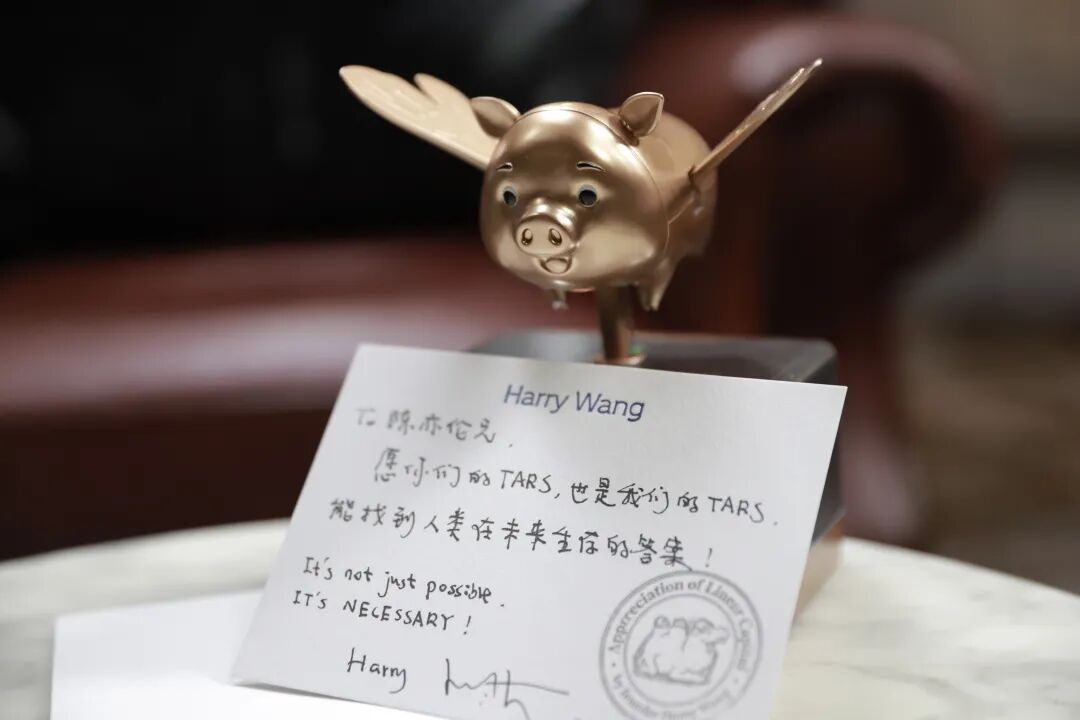
Finally, returning to Tashi's name — I'll send you a line on a postcard: May your TARS, and our TARS, find the answer to humanity's future survival. It's not just possible. It's necessary.
*Due to space constraints, this article covers approximately one-third of the day's interview.