A Conversation with Tashi's Wenchao Ding: Embodied AI May Hit Its True Emergence Moment in 24 Months

"Trustworthiness" may be the final dividing line for embodied intelligence.
During WAIC, Linear Capital's video podcast Between the Lines aired a special live episode. Harry Wang, founder and CEO of Linear Capital, was invited by Bilibili to sit down with Wenchao Ding, co-founder and chief scientist of Tashi Zhihang.
At this year's WAIC, Tashi Zhihang officially released AWE 3.5, its next-generation embodied intelligence-native foundation model. The company was also named one of just six SAIL Stars at the conference. Linear Capital, as Tashi Zhihang's earliest investor, has backed the company across three consecutive rounds.
Ding offered several bold takes during the conversation: embodied intelligence today is roughly where autonomous driving was in 2021–2022, with a true emergence moment potentially arriving in 24 months; applications are the primary productive force driving models forward; and the much-debated China vs. US embodied intelligence race, in his view, amounts to little more than a "besieged city"… These observations may seem scattered, but they all point to the same question: as embodied intelligence moves beyond demos and into real-world scenarios, where does the final dividing line lie?
Ding's career spans both engineering deployment and frontier research. He was a core technical expert on the first generation of intelligent driving systems; returned to academia in 2023 as a researcher and PhD advisor at Fudan University; and set out again in 2025 to co-found Tashi Zhihang alongside Yilun Chen, Zhenyu Li, and others, serving as chief scientist of this rapidly rising embodied intelligence star.
In this conversation, Ding offered several judgments that all pointed to the same question: as embodied intelligence moves beyond demos and into real-world scenarios, where does the final dividing line lie? His answer — "trustworthiness" may be the last dividing line for embodied intelligence.
Below is a transcript of the conversation, edited by Linear Capital. The full video is available on Bilibili by searching for "Linear Capital."

▍Harry Wang: From intelligent driving to academia to entrepreneurship, you're one of the few people who has walked both paths — engineering deployment and frontier research. More than a million vehicles ran your end-to-end algorithms, then you went back to Fudan to work on model research. Looking back at this whole journey, what's the single hardest problem you feel you've actually been trying to solve?
▍Wenchao Ding: Although there were a few transitions and pivots from autonomous driving to embodied intelligence along the way, I feel like at the core I've been doing one thing: using AI, or rather data-driven methods, to build an intelligent agent in the physical world that you can trust.
What is autonomous driving fundamentally trying to solve? We collect massive amounts of human driving data, train a network: input is images, output is actions, and this car can completely trust the network's output. To most people this seems incredible.
When we chat with large language models, their responses are sometimes accurate, sometimes a bit off — you can iterate back and forth with them. But autonomous driving can't iterate like that, because the trajectory it outputs directly controls your car.
▍Harry Wang: Get it wrong and people could die.
▍Wenchao Ding: Right, the consequences are severe — that's a very distinctive feature of physical AI. Embodied intelligence is doing something similar, just at a larger scope. It's not limited to driving; it might need to work in factories, handle logistics, clean homes.
All of these tasks, you need to be able to trust that the robot can complete them safely and stably. And the approach can't rely on hand-written rules — generally you need data-driven methods, iterating like training a large model, giving it a "brain" that can adaptively complete tasks across various environments.
So although I've worked on autonomous driving products, done research, and founded a company, it all converges on one point: how to use data-driven AI methods to build an intelligent agent in the physical world that people can trust.
▍Harry Wang: Let's use autonomous driving history as a comparison. To my limited understanding, autonomous driving has gone through three major stages: earliest was ADAS for assistance — collision warnings, lane change alerts, and so on; then came rule-based, scenario-specific autonomous driving, rather by-the-book; and later, end-to-end.
How do you see embodied intelligence technology today — what stage of development is it at? Some say it's "autonomous driving in 2019." Is that analogy accurate?
▍Wenchao Ding: Autonomous driving originated quite early — people started working on it in the early 2010s, and the available toolkit was quite limited back then. When I was doing product R&D, a question people kept asking was: you're using neural networks for this, but do they actually have interpretability? When I pushed for end-to-end R&D early on, many people asked: why should you trust a neural network to drive your car? This mindset actually hindered autonomous driving from quickly reaching its final solution. There was a process of educating engineers and educating users along the way.
Analogizing to autonomous driving, I think embodied intelligence has definitely surpassed 2019 — I'd lean more toward it being close to where autonomous driving was in 2021 to 2022. Here's my analysis:
First, embodied intelligence started from a higher base. From day one, nobody thought about using rule-based methods for it, because the scenarios are too diverse. Autonomous driving is actually just a sub-scenario of embodied intelligence — the simplest form, a robot with four wheels.
Second, the problems embodied intelligence needs to solve are objectively harder. People's expectations aren't just "it works in this scenario" — since it's a general-purpose form, they naturally want it to do many things.
So from a methodological standpoint, embodied intelligence started at a very high level, benchmarking against the most advanced large models and end-to-end systems from the outset; but the problems are also harder. Combining these two points, I place it roughly at the 2021 to 2022 level of autonomous driving.
If I divide embodied intelligence into generations, I'd roughly categorize them this way: the 1.0 era had some relatively small models that could complete specific tasks "from sensors to actions." That era has passed — its ceiling was making good demos, but it was hard to batch-deploy into scenarios and actual work.
We're now roughly in the 2.0 era, and you could feel this atmosphere at WAIC: building a relatively general-purpose foundation model that can do multiple things and do them all quite well. Although there's still distance from physical-world AGI and from large model capabilities, it can already reliably complete multiple tasks in physical space. I predict that in about 24 months, we may enter the true 3.0 era.
▍Harry Wang: What characterizes the 3.0 era?
▍Wenchao Ding: Large models have an important capability called in-context learning — for many tasks you ask them to do, there's no training data, or only very loosely related data. In the 3.0 era, embodied intelligence will also enter the in-context learning era. You ask it to do something, without needing to first collect demonstration data like now — you teach it, and it can do it. This may be the true emergence moment for embodied intelligence.
▍Harry Wang: So it's like having a one-shot capability. And this one-shot might not even need to be deliberately demonstrated — it could emerge naturally from everyday observation.
Back to Tashi — your recently released model is called AWE, AI World Engine, now at 3.5. What's the difference between 3.5 and the previous 3.0? And how does that correspond to the "entering the 3.0 era in 24 months" you just mentioned?
▍Wenchao Ding: AWE, we call it the AI World Engine. From 3.0 to now, there are several visible changes:
First, a massive increase in data volume. Under our human-centric data paradigm, we can obtain a lot of data. What's scaled up isn't repetitive data, but multi-scenario, multi-task data — basically anything a human can do, we've almost touched upon and covered.
Second, changes in model architecture. Models from the 3.0 era were often borrowed from other domains. Early VLA models were actually adapted from VLMs, with action outputs added on; later world action models, world models — many evolved from video models.
For 3.5, one of our core thoughts was: embodied intelligence, as such a large domain, should have its own foundation model. This was hard to imagine before, but with sufficient and diverse data, we can start doing it. So the most important model-level improvement of 3.5 over 3.0 is moving toward nativeness. Language models are native models, video models are native models, but those stitched-together models from before weren't. Embodied intelligence should have its own native model.
▍Harry Wang: So data is absolutely critical here. I see you've brought your data collection device, and this hand for manipulation. How does this relate to your data sources?
▍Wenchao Ding: This device is very lightweight, like an everyday glove. It has tactile feedback capture at the fingertips, and magnetic sensing signal capture on the back.
Embodied data needs to know "did the person actually feel this" — that's what touch core solves. For example, when you grab a water bottle, visually it all looks like "grasped," but gripping tighter versus looser leads to completely different future world states — grip tight and you've got it, grip loose and it drops.
Even when our hand reaches under a blanket, the small sensors on the back can accurately capture pose — it's an action capture system that works all-weather, all-scenarios. It has cameras on top and bottom to capture the environment while the person is working. You can strap FPV (first-person view) cameras on the chest and head, forming a complete kit that essentially records during everyday life.
With this data, training the model establishes a connection between two things: first, feeling what humans feel — what the person sees and senses at this moment; second, doing what humans do — predicting the person's future trajectory and actions with the model.
▍Harry Wang: Plus vision, and you can "see what humans see."
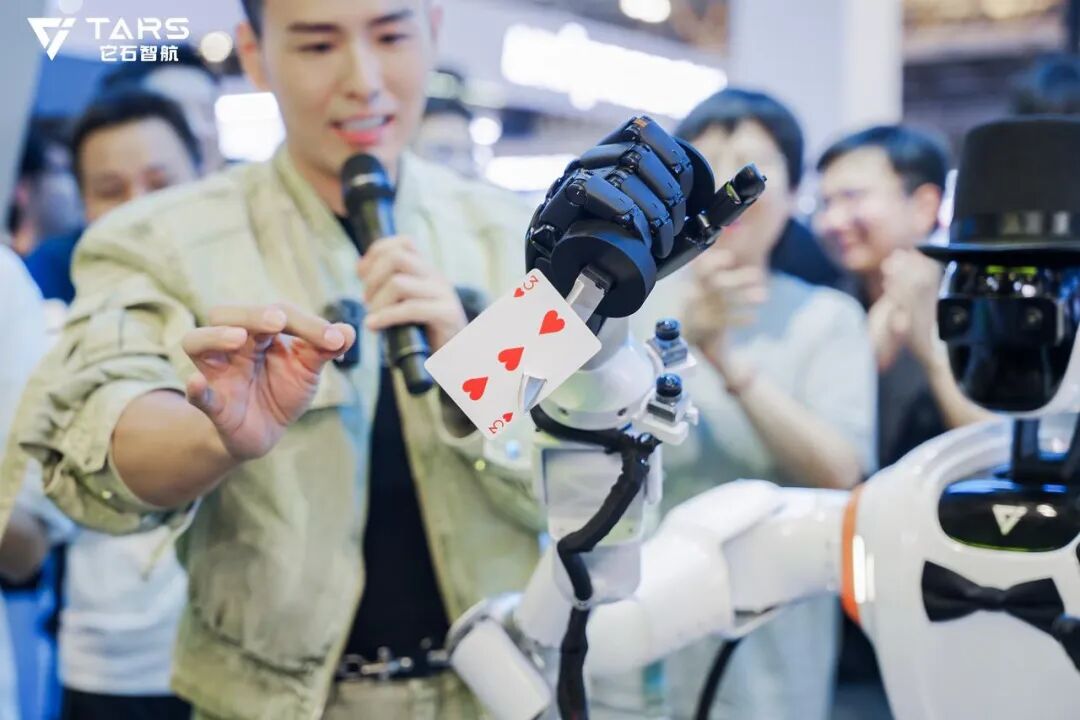
▍Wenchao Ding: Right, see what humans see. Tashi is a company with quite a bit of "OCD" — having the glove, we wanted to have the hand too. This is a 21-DOF dexterous hand, with degrees of freedom almost equivalent to a human hand, motor-direct-drive, with 21 DOFs of micro motors and reducers all integrated into such a small space. Basically any work a human hand can do, it can do.
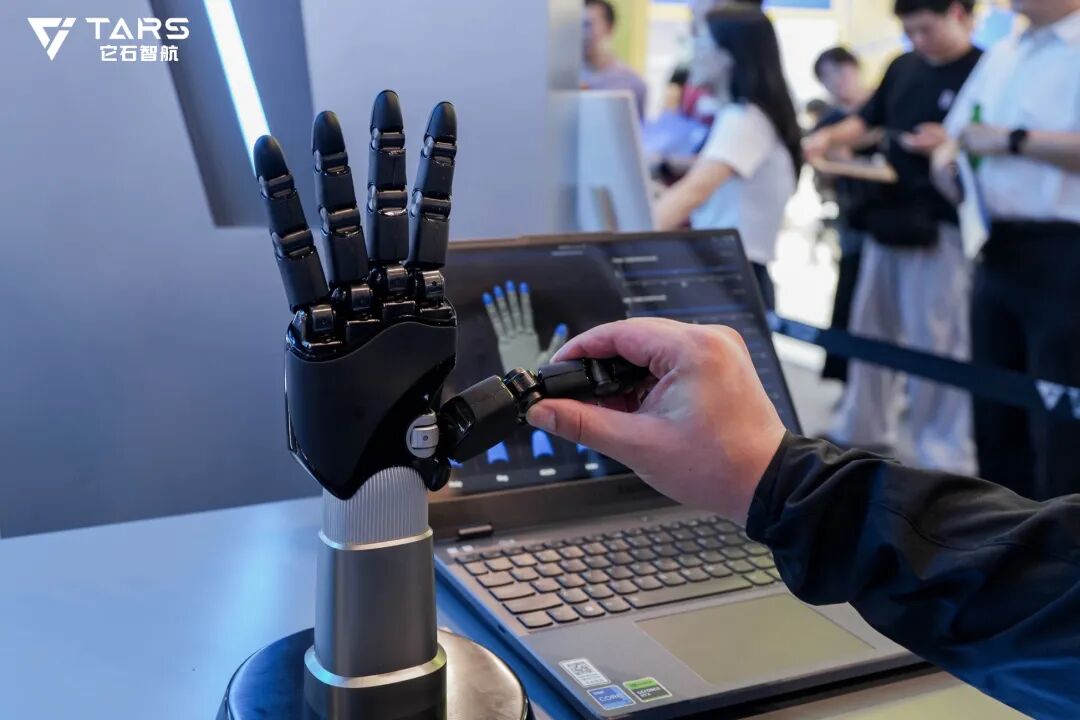
So this is an end-effector for dexterous manipulation. The glove generates data, returning to the intelligent end-effector to complete tasks.
▍Harry Wang: The collected data eventually crystallizes into model capabilities, strung together into a closed loop.

▍Harry Wang: Tashi is an extremely distinctive company. When I first met you, everyone was pushing VLA hard. You were probably the first to talk about world models. How did you decide back then that the future belonged to world models, not VLA?
▍Wenchao Ding: Our thinking at the time didn't come from watching peers. It came more from first principles, top-down reasoning.
The first predicament facing embodied intelligence then was data: it typically relied on teleoperation — capturing my movements and directly mapping them onto the robot, with the robot as the subject completing the action.
This was difficult. First, it depended on the number of robots available. Second, teleoperation efficiency was basically only one-third of human efficiency, and for the unskilled, less than one-tenth.
▍Harry Wang: I tried it once. Exhausting. Takes practice.
▍Wenchao Ding: The second predicament was that VLA models were somewhat "top-heavy, bottom-light." The VLM component's visual and language reasoning capabilities were indeed impressive, but it struggled to break through the "dimensional wall" — today we're on Bilibili, so everyone should have a feel for dimensional walls. It remained stuck in the information space of vision and language. The way to penetrate the dimensional wall was merely to tack on a head above it, what we called an "action expert."
▍Harry Wang: Forced marriage.
▍Wenchao Ding: Right, a forced marriage. This clearly wasn't the real way to break through the dimensional wall. Thinking from first principles, data acquisition couldn't stop at teleoperation. There had to be a better, lighter way to obtain it. There's only one intelligent agent in this world with that capability: humans. So we had to return to humans. We call it "human-centric," human-centric. Let humans replace robots as the primary data collection agents for general physical intelligence. That was our first major judgment.
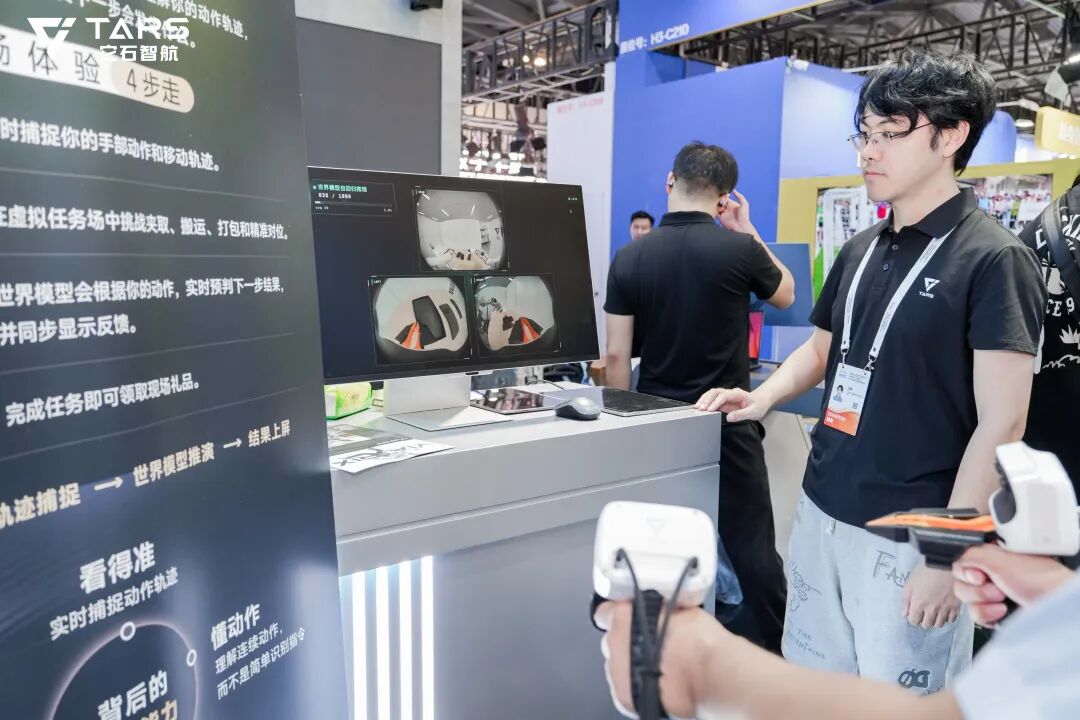
The second judgment was about models. If all data comes from humans, you face a problem: humans and robots are, after all, different "species." How do they share knowledge and capabilities? Simple motion imitation definitely isn't enough. It needs to learn the laws of how humans interact with the real physical world, implicitly learning "how you act, and the physical world changes accordingly." You grab a bottle of water, and it falls according to Newton's laws.
This learning paradigm is necessarily one driven by world models at its core. It can enormously efficiently digest "body-agnostic" or "cross-body" data. The greatest advantage of world models is obtaining cross-body capability, because humans and robots share knowledge of the world, share kinematics and physical laws. So others didn't understand us at the time, but to us this was the only solution.
▍Harry Wang: But a year and a half later, not only did people understand, they came up with five or six different definitions of world models. Some are generation-video-centric, some work in Latent Space. Your understanding and insight into where things were headed back then was quite impressive.

▍Harry Wang: When choosing applications, you picked one of the hardest — wire harnesses. What's the logic there?
▍Wenchao Ding: At the technical level, the divergence in embodied intelligence has rapidly converged this year. As you said, it's become some technical "variants" — to me these aren't real disagreements, just differences in implementation details. But there is indeed one major divergence now: Should a company building embodied foundation models have applications at all? And what kind of applications should it choose?
Our choice of wire harnesses follows clear logic: Find "real demand" — start by doing what humans genuinely don't want to do. Why did large models first succeed in coding? Because coding is genuinely tedious and dull.
When a person maintains more than 50,000 lines of code, their brain basically stops working — they no longer know why they wrote a particular line. "Shit mountain code" comes from this. The embodied domain has correspondingly tough nuts to crack.
We didn't daydream this up in an office. We researched many scenarios, actually walking into factories to see. Problems solvable by traditional industrial automation have been almost entirely swept through. Many factories you walk into are fully automated, clean, tidy assembly lines.
▍Harry Wang: The academic term is "dark factory" — keeps running with the lights off.
▍Wenchao Ding: Right. But there's one category of application that still has lots of people. Walk into a wire harness factory and you'll find it densely packed with people. How is it that in this era, so many people still do this?
It's because this task has several characteristics. First, the manipulation object is flexible. Traditional automation solves for moving and assembling fixed objects, but wire harnesses are like embroidery thread — deform at the slightest touch. Second, precision requirements are extremely high. The terminal at the end is only a few tenths of a millimeter; even humans often can't insert it correctly on the first try. Today at the exhibition we let many bystanders try it by hand, and most struggled.
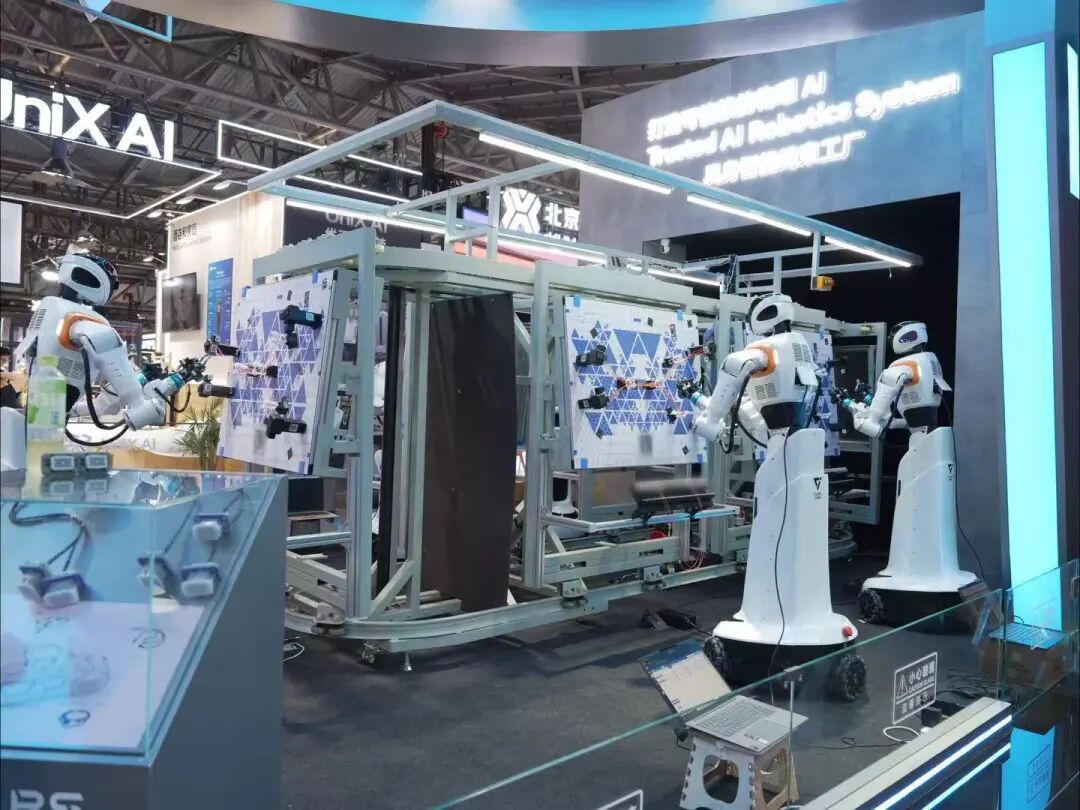
▍Harry Wang: I'll try it later.
▍Wenchao Ding: You can try — might take several attempts to get right. Third, it's extremely tedious. This corresponds to a technical term in embodied intelligence: "long-horizon task." This means doing thing after thing without stopping. A single-attempt success rate of 90% or 99% sounds high, but do it 100-plus times in a row, and the compounded probability drives end-to-end task success way down. So this type of task has never been well-solved and still heavily relies on humans. Since embodied intelligence aims to solve real problems, why not challenge what humans don't want to do? That's why we chose wire harnesses.
Wire harnesses pushed our capabilities to the limit — data requires sub-millimeter precision, model deployment requires sub-millimeter precision, mistakes require adaptive adjustment. Our algorithm stack got fully honed. Today, wire harnesses are just one sub-scenario for us. We've already begun generalizing across multiple industrial scenarios and preparing to enter more areas of human life. It's been excellent training for the company.
▍Harry Wang: You started by finding a "hard and large" scenario. "Large" connects to something you often emphasize: You must scale. I heard you have an obsession with scale. Was this obsession ground into you by the realities of those autonomous driving years? Is it still torturous now, doing embodied applications?
▍Wenchao Ding: The core of scaling is crossing the chasm from demo to real user feedback. I went through this complete process in autonomous driving. Early on, things ran well on specific routes; the problem seemed right in front of you. But when you actually productize and push to every end customer, you realize customers encounter bizarrely diverse scenarios — everything under the sun.
For example, I once worked on a route where we had an end-to-end algorithm navigate through an urban village in Shanghai's Huangpu district. There were old ladies slowly gliding along in wheelchairs, old men carrying bamboo poles, delivery drivers going the wrong way, oncoming cars squeezing you, honking, cars behind urging you to hurry.
In such extreme environments, we realized autonomous driving encounters too many situations — like infinite parallel worlds. The world is currently one way, but it could develop into all sorts of futures.
So you must establish a closed loop with users. Users take the product to every corner of China; we collect back real feedback, voices, and complaints, and improve accordingly. And we rely on data-driven methods — the more data, the more feedback, the stronger we become.
Customer feedback came like snowflakes. Some users would send voice messages. There was a button in the car; press it and you could record voice and push it to us.
▍Harry Wang: Complaining in real-time during the autonomous driving process.
▍Wenchao Ding: Right, complaining in real-time. We actually listened to all those user complaint voices. Many tickets had the original audio attached: "Why is this car changing lanes so hesitantly?" "The car behind is honking, why won't you speed up?" Because we listened to these, we made the firm decision to abandon many modules written with traditional algorithms and truly use data-driven methods for rapid iteration.
So what I mean by scaling is: scaling the listening to user voices, using data-driven methods to solve problems. From day one, embodied intelligence has been firm on this, though it's even harder now because scenarios are richer than autonomous driving, and user customization demands are higher. When robots enter homes in the future, there will definitely be even more complaints.
▍Harry Wang: Then you'll need a one-press complaint button too.
▍Wenchao Ding: **Sure, one-press complaint, haha. If you drill down into overly vertical niche scenarios from the start, the outside world seems too beautiful — you get immersed and feel pretty great about yourself. But you really need to get out there. Let users complain more, listen, then use the right methods to do things well.
▍Harry Wang: So has this difficulty already emerged clearly in your productization process? What stage are you at?
▍Wenchao Ding: **We've actually started deploying and onboarding at customer sites already, and the intensity is already quite high.

▍Harry Wang: What's the most torturous complaint right now? Can you give an example?
▍Wenchao Ding: **There are two things users care about most, and that most drive model improvement.
First is efficiency. Users have very high demands for efficiency. This is actually still not getting enough attention. At this WAIC exhibition, many booths are still working on "can it complete the task," but robots will need efficiency when they enter homes too.
Second is reliability. We algorithm people care about algorithm task reliability; users care about functional safety reliability. This is actually excellent input for us — how to ensure, from algorithm and software design, that algorithms are fully equipped with the safety to handle various unexpected situations.
These two perspectives are things you won't discover when purely researching foundation models, and they're problems unique to physical-world AI.
▍Harry Wang: Efficiency secures the ceiling for scaling; safety secures the floor. Without these two, customers aren't buying something to use — they're just buying a demo to show off.
We have a thesis: starting in the second half of this year, the market's expectations for embodied intelligence companies that have run fast and raised fast will shift. Before, you were the good student and everyone expected great things; now it's really exam time, and what kind of good student fails the exam? By year-end, the "exams" of industrialization and scaling will gradually become visible. What does this mean for the industry? Some companies say: if you're talking to me about scaling and applications now, it shows you don't understand. What do you think?
▍Wenchao Ding: This is the biggest controversy in this generation of embodied intelligence. Two viewpoints: one, wait a bit longer on the technology, build the general-purpose physical-world AI model first, then do applications; two, we should have application inputs right now.
I believe applications are always the primary productive force driving models forward. Take large language models — the more successful LLM companies may have started with "building a general model," but they quickly found the application of Coding, and the top companies that have done best all followed this path. Why? Because a general foundation model is like an endless road; even today, LLMs can get stronger, scale can get larger, self-improving can continue. It's like a vast ocean in between — you need to find a lighthouse.
AI Coding is that lighthouse. It requires the model to understand language, interact, handle long-horizon tasks — so you need Memory, Long Context, self-correction, Sandbox, continuous RL — these mechanisms align completely with the foundational technologies people talk about for large models. Real demand always comes from applications.
At our current moment, Tashi's judgment is this: invest maximum bandwidth in building a general-purpose physical AI foundation model, but don't want to be "aloof and independent" — we want to be "in the world," listening to feedback from real scenarios and real customers.
So we want to do real applications with high ROI, and we want to do them end-to-end ourselves. If you can't even do one application well, how can you expect a general model to work stably when deployed at a customer's site?
▍Harry Wang: Exactly. Zhuge Liang said he "knew a little" — a bit of this, a bit of that — but when it came time to actually do the most professional work, he might not have been able to do anything. Limited resources and people spread across too many things means you can't achieve breakthrough leaps on certain points. Only when people who actually have the problem feel great using your product will they keep paying, forming an effective closed loop.

▍Harry Wang: Back to you personally. You have experience scaling autonomous driving applications, plus a passion for frontier research in embodied large models — these two things define you as a Chief Scientist. I want to ask a fundamental question: what is a Chief Scientist? How do you work with the CEO?
Yilun is a mutual friend, also from a technical background — has there been a scene like this: Yilun says "we need results this month, get it running in the customer's factory," and you think "the model needs one more strength boost, the answer is right in front of us"? Being Chief Scientist of such a distinctive embodied company at a young age, how do you position yourself? At the end of the day, I'm especially curious: what is the basic cultivation of a Chief Scientist?
▍Wenchao Ding: Let me start with something counterintuitive: deep down, I've always seen myself as an engineer. If there were a "Chief Engineer" title, that would be me.
How to define science? Its essence is solving problems through systematic, correct methods — hence "scientific problems." What I did all day in academia was "distilling scientific problems" — science and problems cannot be separated. What is engineering? Solving problems through engineering methodology. So the two are connected, both converging on problem solving.
And in frontier areas like embodied intelligence, scientific problems and engineering problems have already become difficult to separate. Many problems we work on can't be found in papers; academia hasn't progressed here yet, my students are just starting to research them. This is an "inversion" — it was the same in the later stages of autonomous driving.
Academia can only find angles to do clever, original problems, and struggles to make progress on scaling; industry can do scaling, large-scale data and model training.
So I unify science and engineering under the problem-solving framework: we approach problems with an engineer's attitude, but the methods and technical means we use have already entered the realm of scientific problems.
▍Harry Wang: This seems to be a common characteristic of embodied and large model companies. Researching new problems, but with strong application drivers behind them. It used to be that science and engineering were kept very separate. So what is the core role of a Chief Scientist?
▍Wenchao Ding: Being able to propose new ideas, but that's just the starting point. I've always said I'm a "bridge-builder." After proposing a new idea, you build a bridge all the way to where users can actually use it. What I do is discover particularly promising solutions and build bridges to customers, to actual solutions.
Day-to-day, it's discussing with engineers on the front lines: what is the correct solution? Then making the call. But after making the call, you can't just walk away. Many people think scientists propose ideas, do small-scale validation, then leave it — others say "it doesn't quite work," and you say "you implemented it wrong." We can't be like that.
This era has especially strong demands for practice. Plus now with AI Coding, the boundary of practice has become simpler. I go deep into engineers' code; I didn't have time to look at every line before, but now I can look at a lot, all the way down to "did this problem ultimately land in the product and produce results." That's the theme of my daily work.
▍Harry Wang: Then we should give you a new title: Chief Science Engineer.
▍Wenchao Ding: Yes, Chief Science Engineer, haha.
▍Harry Wang: As Tashi has developed, through the model iteration process, have there been Aha Moments — feeling that intelligence has emerged, filled with wonder about the future of embodied intelligence? Or shock, that works too.
▍Wenchao Ding: Two points. The first is relatively intuitive. After large-scale pre-training, using a small amount of demonstration data to post-train it on a task, it emerges with behaviors completely absent from the post-training data, even things it never did in pre-training.
Let me give an example. When doing desktop organization and home storage tasks, we found it would mobilize its other hand, which was completely outside the demonstration scope; the rhythm of left-right hand coordination would also change on its own. What you taught it was: first close the pencil case, then coordinate both hands to open the backpack and put it in. But it could first pull the backpack over, do most of the work with the right hand, then coordinate both hands to put it in. It would change task order on its own, change your definition.
This is like teaching a child — they won't strictly follow your 1-2-3-4-5, they'll discover on their own. Children rely on the memory of human history and genetic pre-training; we rely on large-scale human operation data for pre-training. This was an Aha Moment for me — it convinced me that large-scale pre-training can truly bring emergence in embodied models, rather than simple overfitting.
Second, we're trying to continuously reduce post-training investment, compressing it to hour-level, eventually approaching the minimum of in-context learning. We did an experiment: after ultra-large-scale data pre-training, post-training uses only very basic data to "activate," just like SFT for large models.
Of course, these two haven't reached the level of "truly understanding physical-world AGI," but at least they've shown me signals.

▍Harry Wang: Back to data. What's the relationship between your Human-centric approach and UMI?
▍Wenchao Ding: UMI is a paradigm extended from academia: obtaining data through wearable grippers. Our data acquisition method is called Human-centric — we proposed this concept quite early. Now there's also a new term called Ego-centric (first-person perspective-centered), where you don't wear gloves or end-effectors, just strap a motion camera on your head to collect data.
We've done extensive cross-embodiment research, from human-collected data to robot transfer. We found that humans have strong "fine-tuning based on feedback" capabilities that can't be learned from video alone. Like grabbing a water bottle — visually they all look similar, but a tiny difference leads to a huge error, and future development diverges completely.
So we've always emphasized that the end-effector is extremely important. Our Human-centric approach, compared to Ego-centric or UMI, first and foremost truly targets the "human" as an embodiment, completely capturing what is seen and felt.
▍Harry Wang: My understanding, which may not be correct, is that rather than fitting someone else's definition, it's FPV (first-person view) plus end-effector feedback, camera collection — recording the reliable details of how humans do things to the maximum extent, and learning transferable knowledge for machines from that.
▍Wenchao Ding: Yes.
▍Harry Wang: On the technical roadmap, you said there's no disagreement that everyone is heading toward world models, just different sub-schools within the major school; but on data sources, there's still quite a bit of disagreement. What differences will this create? In a year and a half, will everyone start talking about Human-centric, like with world models back then? Do other paths have their advantages?
▍Wenchao Ding: Each has applicable scenarios and advantages, but some are bigger than others. Right now many people analogize it to a "pyramid" — when people can't describe something with a unified method, they start talking about "pyramids." I can analyze the differences among several methods.
First, simulation. The essence of simulation is humans trying to be the "ruler" of the world. Through programming and physical law modeling, creating virtual environments that infinitely approximate the real world. The advantage is that in scenarios where accurate modeling is possible, it can get applications done — for example, humanoid robots singing and dancing, which basically all go the Sim-to-Real route.
But the difficulty is that human energy is limited; you can't create a world as complex as the real world — if you could, you'd have already solved embodied intelligence. So there's a bit of a paradox: building a sufficiently realistic simulator may be equivalently difficult to building a general-purpose physical AI, or even harder. So simulation's biggest weakness is when scaling.
Our conclusion is: to scale, the core is "from where, to where." If you want to go into the real world, you must come from the real world. If data is collected from data-collection factories or closed scenarios, it can't go back to the real world.
▍Harry Wang: You can only go back to wherever you were when collecting the data.
▍Wenchao Ding: Right. For true generalization, you must obtain real data in a generalizable way. I don't think something fundamentally different from Human-centric will emerge; from first principles, this is just how it is.
As for teleoperation and real-robot data, they're definitely high-quality, application-specific data. If you don't want to do general-purpose physical AI, don't have such grand ambitions, there are indeed scenarios where generalization isn't required and getting the job done is enough.
But Tashi's pursuit is to go further on generality. My intuition is: the better the foundation model, the easier it is to deploy downstream applications. We've observed this with large language models, and I think embodied intelligence will replay the same story.
▍Harry Wang: Does Human-centric have bottlenecks or drawbacks?
▍Wenchao Ding: The biggest problem is the extreme demand for fine-grained AI processing. You're basically capturing everything a person sees and feels, but humans are an incredibly flexible species — different heights, builds, behavioral habits. During collection, their actions may not even be intentional; they bring in all kinds of unpredictable behaviors that are very hard to regulate.
With such rich data sources that are also fundamentally different from the robot's own body, how do you build a reliable AI paradigm to digest and assimilate it? This is a massive challenge with implications for the entire pipeline. When data comes in, can you automatically perform scene understanding, filtering, and mining? Can your model architecture effectively fuse linguistic reasoning, latent action trajectories, and end-effector tactile feedback? Not the simple stitching-together you see in VLA or World Action Models, but actually mapping the distributions and relationships among multiple native modalities in the data onto your model architecture design.
So this path has tremendous upside and imagination, but the difficulty is that it keeps raising the bar on you.
▍Harry Wang: This fits your偏执 (obsessive streak) of "setting the highest difficulty level from day one."

▍Harry Wang: Let's talk bigger picture. What's the difference between embodied AI in China versus the United States?
The common market narrative is: China is strong on hardware bodies, the US is strong on models. I think that's only surface-level. The deeper difference is philosophical: most in the US think "get the model working first, then transfer to various bodies — if the model is strong enough, it can solve any problem"; China thinks "we have abundant scenarios, strong bodies, and decent model foundations too — why not build through applications?" Of course I'm being somewhat极端化 (polarizing) here. From your perspective, how do you compare the two sides?
▍Wenchao Ding: I think it's a "fortress besieged." I've talked to many American entrepreneurs, and they actually really want scenarios, want application-driven traction, but face more constraints. A robotics team at a major US tech company told me it takes 6 to 12 months to iterate on a hardware design and get samples. With that iteration speed, how do you do applications? Customers won't wait for you. All you can do is assemble whatever research-grade bodies you can buy and keep doing model research. It's that朴素 (straightforward) — not that much deep thinking behind it.
▍Harry Wang: Not that much deep thinking behind it.
▍Wenchao Ding: Right. Chinese entrepreneurs equally want to build general-purpose physical AI.
But China has a "happy problem" — its manufacturing and hardware capabilities are so complete that everyone can throw things together quickly. You build one today, someone else builds one tomorrow. So you have to demonstrate capability. If you just stay in information space, when people ask "what exactly are you doing," you can't say "I'm training a really awesome model, I'll share it with you when I've mastered the divine technique."
▍Harry Wang: It's all survival tactics forced by reality.

▍Harry Wang: Back to the opening question. Much of what we see in embodied AI is still more about "being able to move," performing; the next direction is increasingly about "understanding," being able to work. Between these two stages, what's the core challenge that will send embodied AI companies down divergent paths between life and death?
▍Wenchao Ding: This brings us back to Tashi's vision: building trustworthy physical AI. Everyone understands "physical AI," but those three words "trustworthy" — easy to say, yet heavier than a thousand jun.
Trustworthy means trustworthy end-to-end. You have to trust the joints, the reducers, the complete machine; trust the reliability of the model and application; trust it to work 7×24 without interruption; even when it enters your home, you don't worry about it smashing your carefully selected dinner plates.
"Trustworthy" may be the final watershed for embodied AI. Can people use what you build with confidence? Autonomous driving is already infinitely close. Today's L2 — users of algorithms we previously developed say, "I just need to supervise very lightly, and it can take me everywhere." I'd also encourage viewers to try the most advanced autonomous driving — it's improved enormously compared to a few years ago. It's crossing this threshold.
The final, most critical step for physical AI is breaking through "trustworthy." This requires companies to polish the full stack from hardware to software to algorithms to models, cleaning up every corner case. For a company to achieve exponential growth like large models, "trustworthy" is the core inflection point. Why are AI Coding tokens growing so fast? Because people feel it's genuinely trustworthy, even more trustworthy than human engineers. The turning point is right there.
▍Harry Wang: From Transformer in 2017 to becoming trustworthy — that's a nearly nine-year journey.