"Deep Principle" Closes Series A2 Round, Joins OpenAI and Others in *Science* to Discuss AI4S Exploration | Linear Portfolio

AI4S shouldn't stop at the "selling shovels" stage.

Today, Deep Principle, a seed-round portfolio company of Linear Capital, announced the completion of its Series A2 funding round. The round was led by Jinma Investment, with continued oversubscribed participation from existing shareholders including XtalPi, Qigao Capital, and BV Baidu Venture Capital. The proceeds will be used to iterate and upgrade its dual-engine algorithm system combining LLM and Diffusion, refine its full-stack product matrix including Agent Mira, and advance the strategic implementation of AI Materials Factory and its proprietary pipeline.
Notably, a feature article published by Science on February 27 provided an in-depth analysis of Deep Principle, OpenAI, FutureHouse, and others' cutting-edge explorations in building scientific intelligence evaluation benchmarks. From this vantage point, the company's rapid progress in AI4S R&D, financing, and commercialization over its two years of existence has been remarkable.
Recently, China Entrepreneur interviewed its founder and CEO Haojun Jia, discussing the entrepreneurial journey that began on MIT's campus. Zhengzhe Zeng, partner at Linear Capital, was also invited to participate. Below is the interview.
"If the company is a ship exploring the deep ocean, I'm the one person who absolutely cannot abandon it." Deep Principle is headquartered in Hangzhou, and its founder Haojun Jia has named his office "Columbus." In his view, starting a company at the brand-new frontier of AI for Science is no different from "Columbus discovering the New World."
Since its founding a little over a year ago, Deep Principle has been sprinting ahead in R&D, financing, and commercialization. Every morning, Jia maintains a five-to-ten-minute practice of deep thinking, taking stock of current risks and where the next target lies. This habit began in 2023 when Jia started his company. At that time, he was pursuing his PhD at the Massachusetts Institute of Technology (MIT).
AI for Science refers to using AI to make new scientific discoveries. In 2023, the American Baker team and Google DeepMind developed the deep learning model "RFdiffusion," which predicted approximately 200 million protein structures and enabled one-click design and generation of proteins. In 2024, the Nobel Prize in Chemistry was awarded to the Baker team and the DeepMind team.
That same year, Jia officially founded Deep Principle. The team applies AI to materials R&D based on the fusion of generative AI and first-principles calculations. To date, Deep Principle has developed six proprietary algorithm modules, integrated into a self-built platform called "ReactiveAI." Recently, the platform was upgraded to a materials discovery agent (Agent Mira), which can autonomously mobilize data and resources to conduct chemical materials R&D according to customer requirements.
In 2025, AI4S reached a critical inflection point. In August, China's "AI+" initiative was released, identifying AI4S as an important direction for upgrading the paradigm of scientific discovery. On November 25, Trump signed the "Genesis Project" executive order, elevating the use of AI to transform scientific research methods to a national priority in the United States. During the same period, hundreds of AI4S startups emerged in Silicon Valley.
Subsequently, U.S. national laboratories, OpenAI, and DeepMind continued to increase their bets on AI4S. On January 12, 2026, NVIDIA and Eli Lilly announced they would spend $1 billion over five years to establish a joint research laboratory in San Francisco for AI drug development. On the same day, Anthropic announced healthcare and life sciences services to help Claude users share health records. General research engines such as Kosmos and Biomni were also launched in succession.
Domestic tech giants responded quickly. Tencent established a life sciences laboratory in September 2025; Alibaba promoted the development of the LucaOne large model, the industry's first biological large model jointly covering DNA, RNA, and proteins; ByteDance specifically established an AI for Science team integrated into its Seed department, and co-built an "AI + high-throughput joint laboratory" with BYD's lithium battery division.
"Using AI only for chatting and video generation is a bit of a waste." Jia told China Entrepreneur. He believes the most valuable aspect of AI is empowering unknown domains for humanity: "All scientific progress is fundamentally driven by new discoveries."
In November 2025, Deep Principle completed a Series A round of over RMB 100 million. It was co-led by the Alibaba Hong Kong Entrepreneurs Fund GBA Fund, managed by Gobi Partners, and Ant Group, with follow-on investments from existing shareholders including Lenovo Capital and Incubator Group, Taihill Venture, and BV Baidu Venture Capital.
Although on the eve of value explosion, Jia still starts each morning thinking about the company's direction from a pessimistic angle. This stems from the many uncertainties remaining in AI-empowered scientific research.
On one hand, the domain of scientific discovery has historically been relatively closed and conservative, especially in industry, and data access has constrained the development of vertical models. On the other hand, the standardization and digitalization of chemical materials R&D is still a work in progress, with historical data lacking in both quantity and quality. In other words, the data foundation for AI-driven scientific discovery is quite weak, and collaboration mechanisms are not yet sound.
But in Jia's view, beyond racing against the tech giants, what matters more is how quickly Deep Principle can achieve industrial implementation of AI4S and create value with its technology.

From childhood, Jia was fascinated by two things: science and computers. This became the origin of his entry into the AI4S industry.
In 2015, when Jia was an undergraduate, he chose physics. As a sophomore, he was already using CPUs for first-principles calculations based on the Schrödinger equation. But at that time, computational limitations made this extremely time-consuming and labor-intensive, with virtually zero commercial potential. "You'd submit a computing task, and supercomputers would run for days."
All this changed in 2018. GPU computing power had advanced by leaps and bounds — efficiency improved by tens of times. Molecular calculations that previously took days could now produce results in minutes. Meanwhile, neural networks were being widely applied, and AI was starting to be used to "predict" molecular behavior patterns rather than relying solely on brute-force calculation.
This led Jia to perceive the enormous potential of AI in chemical materials R&D. In 2019, when Jia had just started his PhD at MIT, he proactively requested to change advisors to find a professor working in this direction. He ultimately studied under MIT chemical engineering professor Heather Kulik, a leading figure in AI-driven chemical design.
Heather Kulik and Nobel laureate John Jumper, a core member of DeepMind, were among the earliest scholars globally to use artificial intelligence for scientific discovery. Jumper's research direction was AI prediction of protein structures; Kulik applied AI algorithms to the field of chemical materials discovery.
At that time, Jia's senior labmate Chenru Duan had already been researching the AI for Materials direction for a year. Duan worked on underlying AI algorithms and computational methods, while Jia focused on materials application transformation and reaction systems. From a research perspective, the division between Duan and Jia resembled a combination of "principle" and "practice." This division continued into Deep Principle's founding: Duan is responsible for technical architecture and algorithm R&D, serving as CTO, while Jia handles strategy, customers, and team building as CEO.
In Heather Kulik's assessment, Duan possesses "outstanding academic leadership" in the AI4S field, while Jia is "the bravest student" when facing complex research challenges. In the assessment of angel investor and Linear Capital partner Zhengzhe Zeng, "the two of them starting a company together is a perfect match."
Although Jia had successfully entered the AI4S research group, at that time AI functioned more as a "tool," and its applications quickly hit ceilings. The industrialization of AI4S remained shrouded in fog.
"The mainstream thinking then was using AI to accelerate traditional processes — calculating faster, fitting more accurately," Jia said. "Many people were hit by the apple, but only Newton proposed the law of universal gravitation. The vast majority of the rest were verifying the discoveries proposed by these极少数人. AI became a research tool, but the research paradigm itself didn't change: 99% of scientists were still doing verification work, and the hypothesis-generation环节 still relied on human intuition."
The turning point came at the end of 2022. The emergence of ChatGPT made Jia realize that "generative AI" represented a qualitative leap compared to previous AI. Thus, Jia and Duan began very close academic collaboration, jointly researching how to apply generative AI technology to chemical materials R&D. Throughout their doctoral studies, Jia and Duan published over 60 papers in top-tier journals and platforms including Nature flagship journals, and pioneered multiple new AI for Materials models.
At that time, the industry predominantly used large language models in areas such as molecular synthesis and pharmaceuticals. But the core problem in chemical materials R&D was not "lack of knowledge" but "lack of verifiable candidate structures." A large language model might write a paper about catalysts, but it couldn't directly generate a computable molecular coordinate file.

In the feature article published by Science on February 27, Deep Principle, OpenAI, FutureHouse, and others' cutting-edge explorations in building scientific intelligence evaluation benchmarks were analyzed in depth.
Therefore, in the chemical materials field, differentiated models were needed to compensate for large language models' limited understanding of structure. The Diffusion Model entered their field of vision. Its outputs are structured data that can directly interface with simulation and experimentation.
Moreover, chemical reactions involve multi-object systems where symmetry must be considered, and traditional SE(3) (equivariant diffusion models) struggled to address this. Jia and Duan decided to develop their own graph neural network to ensure symmetry in chemical reactions, while combining this network with diffusion model architecture to create a system capable of generating complete chemical reactions.
In 2022, their work achieved a major breakthrough — they became the first team worldwide to verify that diffusion models could directly generate chemical molecules and chemical reactions. In 2023, this research, published as a cover paper in Nature Computational Science, demonstrated that new chemical reactions could be generated in seconds, whereas traditional methods required weeks of manual derivation.
Diffusion models were originally a technology from the image generation field. Applying them to molecular generation meant AI shifted from "predicting the known" to "exploring the unknown." It is understood that Deep Principle is currently advancing both diffusion generative models and large language models — two generative AI approaches in parallel.
But challenges followed in quick succession: How to ensure the physical feasibility of generated material structures? How to guarantee materials could be synthesized?
Deep Principle's solution was to construct a "hierarchical generation" architecture: First, the underlying layer uses diffusion models to generate coarse-grained structures — essentially sketching the "draft" structure of molecules. Second, based on first-principles calculations in quantum chemistry, precision computation refines the details. Third, the top layer combines high-throughput experimental validation of stability — using automated experiments to test whether the "draft" is feasible.
This "AI model prediction — computational support — experimental validation" workflow has improved computational efficiency by hundreds of times. "Our latest model can generate and screen thousands of candidate materials within minutes," Jia stated, "whereas traditional high-throughput computing takes months."
This closed loop is currently named the "ECML system," which Deep Principle also calls "the fifth paradigm of AI materials R&D."
Algorithms, data, and computing power are the three essential elements of AI, among which algorithms are the main battlefield for AI companies to build moats. Based on this, Deep Principle developed six proprietary algorithm modules: ReactGen (molecular generation), ReactBO (broad screening), Reactify (precision calculation), ReactControl (resource scheduling), ReactNet (synthesis navigation), and ReactHTE (high-throughput experimentation). These six algorithm modules cover six steps spanning the entire process from R&D, synthesis to validation of a new material.
In short, Deep Principle applies large model technology across the entire chain of materials R&D, synthesis, and validation. This closed loop constitutes Deep Principle's ReactiveAI platform.
Most scholars take about 6–8 years to complete an MIT PhD; Jia finished in only five. When he graduated in 2024, numerous domestic and international tech giants extended offers, but Jia decided to start his company. Though almost everyone around him opposed this, Jia firmly believed that with the explosion of generative AI and the differentiated advantages his self-built platform ReactiveAI had achieved in materials discovery, the timing for his entrepreneurship had arrived.

Before receiving Linear Capital's angel investment, Jia had not yet graduated from MIT, and had never even met them in person. But their connection was forged during a campus sharing event at MIT.
At that time, Harry Wang, founder of Linear Capital, was invited to share his experience transitioning from engineer to investor with students from MIT, Harvard, and other universities. Jia was among the students. In subsequent interactions, Jia also left a deep impression on Zhengzhe Zeng, partner at Linear Capital. "Haojun really stood out — a young Chinese guy who was already serving as president of MIT's Chinese Students and Scholars Association at such a young age."
During that period, Jia had attracted attention from more than just Linear Capital. Before Jia and Duan's two-person team had even graduated, armed with only a several-dozen-page PowerPoint, they received dozens of investment term sheets.
Previously, Jia had planned to accept an approximately $3 million investment contract from a well-known early-stage incubation fund. But on the eve of closing, the other party made last-minute changes to term details. Jia proactively abandoned this term sheet. At that time, he had no need to worry about fundraising.
But to Jia's surprise, capital markets shift rapidly. In 2023, the market entered a contraction phase, and even once-hot projects were frequently ignored.
In October 2023, Zeng contacted Jia. "We talked from 8 p.m. to 3 a.m. U.S. time — a full 8 hours just on future planning alone." After this "marathon-style" due diligence test, Deep Principle ultimately secured this angel investment from Linear.
Zeng stated that one reason for investing in Jia was a unique charisma he possessed.
Since Deep Principle was formally established in 2024, the company grew from its initial duo to continuously attract experienced talent from well-known enterprises including Microsoft, Meta, Dow Chemical, BASF, and Saint-Gobain. "Almost everyone joined at a pay cut," Jia said. The most representative example is the joining of Luyang Zhang as Deep Principle's COO.
Zhang was a former executive at Tenstorrent and Horizon Robotics. The offers before him were all quite attractive — executive positions, million-yuan salaries, and so on. Jia noted that Zhang, as an internationally renowned expert in "high-performance computing + autonomous driving" technology and products, had early on realized that AI would bring enormous transformation to scientific fields. From early 2022, he had been deeply involved in Deep Principle's founding, serving as a company advisor.
But an external advisor is no substitute for full-time commitment. To persuade Zhang to join full-time, Jia pulled out all the stops. At that time, Zhang had just become a father, with his entire family living in Canada. To convince him to return to China to start a company, Jia needed to win over his family as well.
To this end, Jia invited Zhang, along with his wife and their newborn child, to tour West Lake. To put Zhang's wife at ease during the excursion, Jia pushed the stroller with one hand while speaking frankly with Zhang.
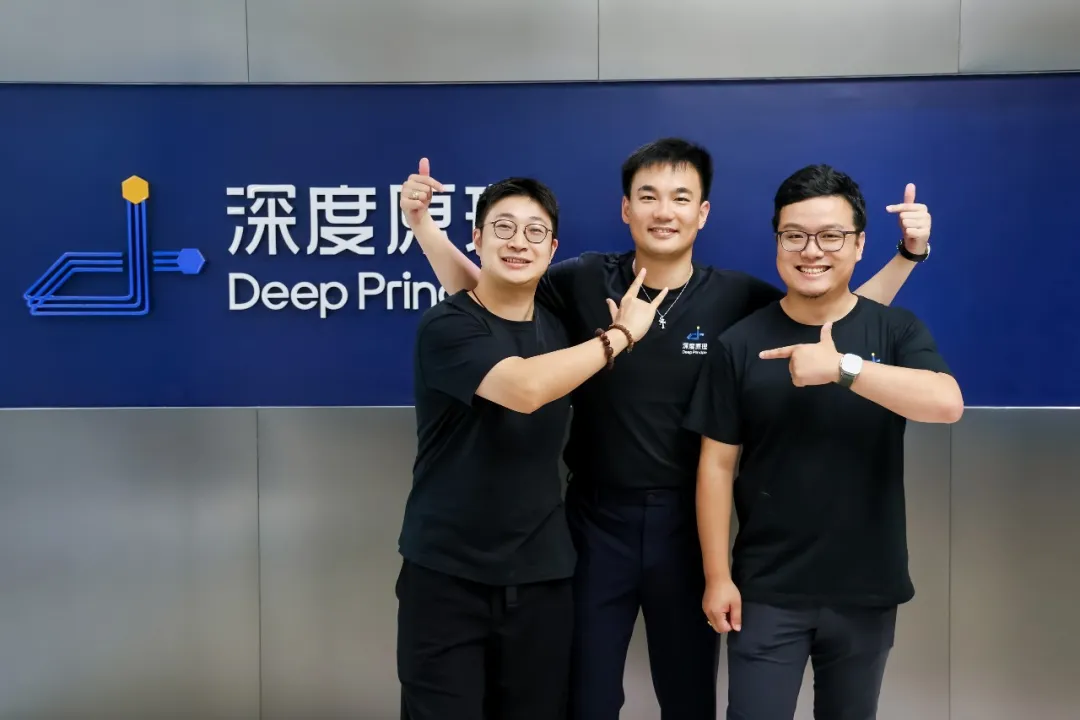
From left to right: Chenru Duan, Haojun Jia, Luyang Zhang
"He has always been very clear about what he wants, with very strong execution." This assessment of Jia was consistent within Linear Capital. In March 2024, the two parties reached a $5 million investment. A little over a year later, Deep Principle completed multiple funding rounds, totaling hundreds of millions of yuan.
During this period, the AI4S track also became a capital favorite. AI for Drug leader XtalPi became the first Hong Kong Stock Exchange 18C listing in 2024, achieving profitability in the first half of 2025. Industry unicorn DP Technology completed a Series C round totaling over RMB 800 million in December 2025, with cumulative fundraising previously reaching billions of yuan. Overseas, Periodic Labs led by a16z announced $300 million in funding in 2025; Lila Sciences received over $400 million led by Flagship and ARK; CuspAI received $100 million from NVIDIA and other giants to build a "search engine" for materials discovery.

"I've been sensitive to money since I was young. When I was very little, if you asked me what 15 + 27 equals, I wouldn't know. But if you asked me how much 15 yuan plus 27 yuan is, I could calculate it immediately." Jia frankly admitted that he is a pragmatic person.
Since Deep Principle established itself in Hangzhou, the company began tirelessly expanding its customer base. Jia has done the math clearly: "learning through doing" allows earning money while improving platform performance. In 2025, Deep Principle secured orders worth tens of millions of yuan, with customers spanning multiple fields from the health and personal care industry represented by a European multinational beauty giant, to the materials and energy industry represented by a leading fine chemical manufacturer.
Among these, the collaboration with the European multinational beauty giant boosted the company's confidence in commercialization. In early 2025, the company encountered a typical challenge in the beauty field — stability of active components. In expensive cosmetics, certain core molecules are highly active, delivering excellent beauty effects but also meaning poor stability and short shelf life. Thus, the company hoped to find a ligand additive among more than 8,000 molecules in China's "Inventory of Existing Cosmetic Ingredients" to enhance overall formulation stability.
This work traditionally relied on experimental deduction, consuming months and carrying high costs — every 50g of test raw material cost tens of thousands of yuan.
How much value AI could deliver, the company was then watching with a wait-and-see attitude. But through Deep Principle team's persistence, the company signed a POC (proof-of-concept) collaboration with Deep Principle. Simply put, the other party gave Jia one chance to try.
Based on the mechanism of the target molecule's high activity itself, combined with first-principles calculations and large model reasoning capabilities, Deep Principle completed the screening work within one month. The six molecules ultimately recommended all significantly improved target molecule stability, achieving expected results.
"After completing the experiments, the formulation performance and efficiency shocked them." This R&D task that would take years was completed on Deep Principle's platform by just two engineers within weeks. This trial run also opened the door for Deep Principle to enter the beauty field. The collaboration evolved from the initial POC to deeper strategic cooperation including molecular design and reaction route optimization.
This joint R&D collaboration with the beauty giant also clarified Deep Principle's commercialization path. Jia frankly admitted that at the current stage, "co-developing terminal vertical applications with customers is easier for popularizing AI than selling platforms." Platformization is a setup "to cultivate a larger market for the future," not the revenue mainstay at this stage.
In Jia's planning, as Deep Principle scales up, with the ReactiveAI platform and agent Agent Mira as the foundation, the company will shift from "project-based" to "productized" models, with platform subscription (PaaS) as a revenue source.
Additionally, the "last mile" problem currently faced by the industry is that computationally predicted materials often fail during the synthesis phase. Therefore, in the second half of 2025, Deep Principle began building its own automated laboratory, AI Materials Factory, to directly confront the practical implementation problem of materials synthesis.
In Jia's view, when starting a company at a brand-new frontier, the business model can only be figured out through practice — it cannot be rigidly copied from any existing company. "AI4S should not remain at the 'selling shovels' stage. If you believe you have a good shovel, you should get down in the trenches and dig for 'gold' yourself."
According to relevant evaluations, existing general-purpose large models struggle to meet AI4S needs. Domain-specific algorithms must be developed based on the physics and chemistry principles of specific disciplines. Deep Principle's ReactiveAI platform is a specialized architecture optimized for chemical reaction and materials property prediction. This deep integration of "algorithms + domain knowledge" is difficult to simply replicate.
Another investor in Deep Principle stated, "Deep Principle's interdisciplinary team and computing power adaptation capabilities are also important moats. AI4S requires composite teams of 'AI algorithm experts + materials/chemistry/biology experts + engineering talent.' Building and磨合 such teams is extremely difficult."
However, Jia's ambition is not merely to compete with domestic players, but to go global. He believes that in the current AI for Science field, China and the U.S. stand at the same starting line, with the industry gathering momentum. At this stage, it's easier to overtake on the curve, and Chinese AI4S companies represented by Deep Principle are opening a new chapter for the industry.