"Deep Principle" Closes Over 100 Million RMB Series A to Power Global Materials Science with AI | Linear Portfolio

We've made substantive commercial progress with leading industry clients.

Today, Deep Principle, a technical pioneer in the AI4S space, announced it has raised over RMB 100 million in its Series A round.
Deep Principle is a technology innovation company founded by an MIT-affiliated team, with its founding team bringing deep expertise at the intersection of AI and science. Through continuous technical and product breakthroughs, the company has achieved substantive commercial progress with leading industry clients, securing commercial orders exceeding RMB 10 million within roughly a year of its founding.
Linear Capital led Deep Principle's seed round, and we are bullish on this internationally minded technology company led by a post-95 MIT PhD, with continued follow-on support in subsequent rounds.
On November 24, Deep Principle, an AI for Science pioneer whose seed round was led by Linear Capital, announced it has raised over RMB 100 million in Series A funding. The round was co-led by the Alibaba Hong Kong Entrepreneurs Fund (Greater Bay Area Fund), managed by Gobi Partners, and Ant Group, with pro-rata oversubscription from existing shareholders Lenovo Capital and Incubator Group and Taihill Venture, continued follow-on from BV Baidu Venture Capital, and participation from multiple other institutions.
The proceeds will be deployed across three main priorities: 1) accelerating R&D and upgrades for Agent Mira™, an agentic AI system for materials discovery; 2) advancing the build-out of its L4 high-throughput autonomous lab, AI Materials Factory™, and its R&D pipeline; and 3) deepening partnerships with leading international and domestic clients to solidify its lead in technology deployment.

Deep Principle is a technology innovation company founded by an MIT-affiliated team, with its founding team bringing deep expertise at the intersection of AI and science.
The company's pioneering diffusion generative models have been published as cover papers in two major Nature sub-journals, Nature Computational Science and Nature Machine Intelligence: OA-ReactDiff, launched in 2023, was the first 3D chemical reaction diffusion generative model, achieving transition-state structure prediction in just 6 seconds on a single GPU — solving an industry pain point where traditional quantum chemistry calculations could take days or even months. In early 2025, the company released the upgraded React-OT model, leapfrogging prediction time to 0.4 seconds while reducing error by over 25%, with significantly improved adaptability to unseen and complex reaction systems. This July, research published in Advanced Science further validated React-OT's superior accuracy and reliability in transition-state search compared to traditional machine-learning potential methods.
Additionally, the company made strides this year in applying large language models to science (LLM for Science), leading development of the LLM-EO (Large Language Model for Evolutionary Optimization) workflow, which leverages the intrinsic knowledge and reasoning capabilities of LLMs for generative design of transition-metal complexes — published as a cover paper in the premier chemistry journal Journal of the American Chemical Society.
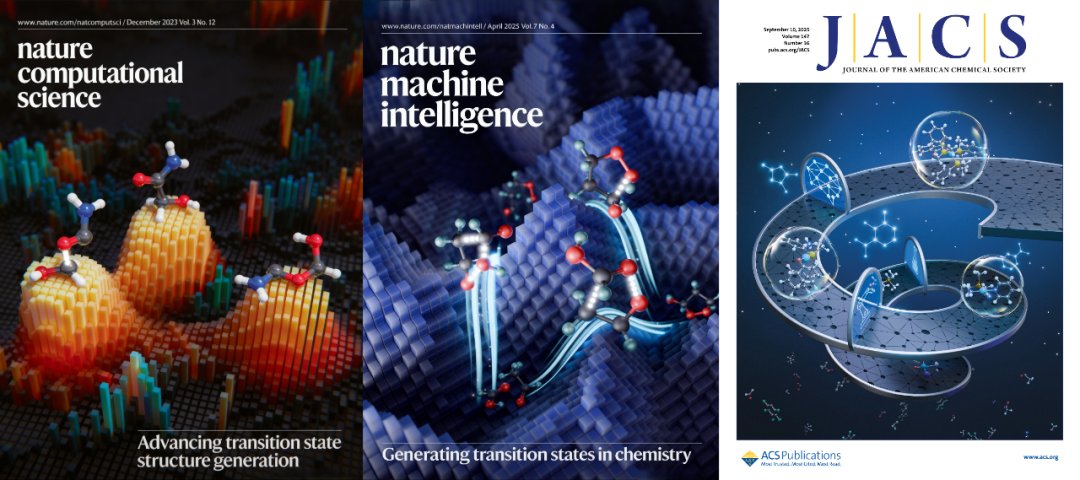
Deep Principle's diffusion generative models and large language models published as cover papers in leading journals
The company is advancing in parallel along both generative AI tracks — diffusion models and large language models — in a complementary "Diffusion + LLM" architecture, laying groundwork for subsequent agentic delivery. These systematically validated advances in generative AI, verified by top-tier journals, are pushing AI for Science from concept toward deployable, scalable industrial capability.

Deep Principle's founding team, recognizing China's complete new materials and fine chemicals supply chain, vast materials R&D demand, and highly efficient industrial application environment, returned to China in 2024 to build the company and drive deep integration of their technology into industrial scenarios.
Building on deep research foundations, the company developed six algorithmic modules — ReactGen (molecular generation), Reactify (precision computation), ReactControl (control models), ReactBO (broad screening), ReactNet (synthesis navigation), and ReactHTE (high-throughput experimentation) — integrated into the ReactiveAI platform. The platform recently achieved a critical leap, officially upgrading to the materials discovery agent Agent Mira:
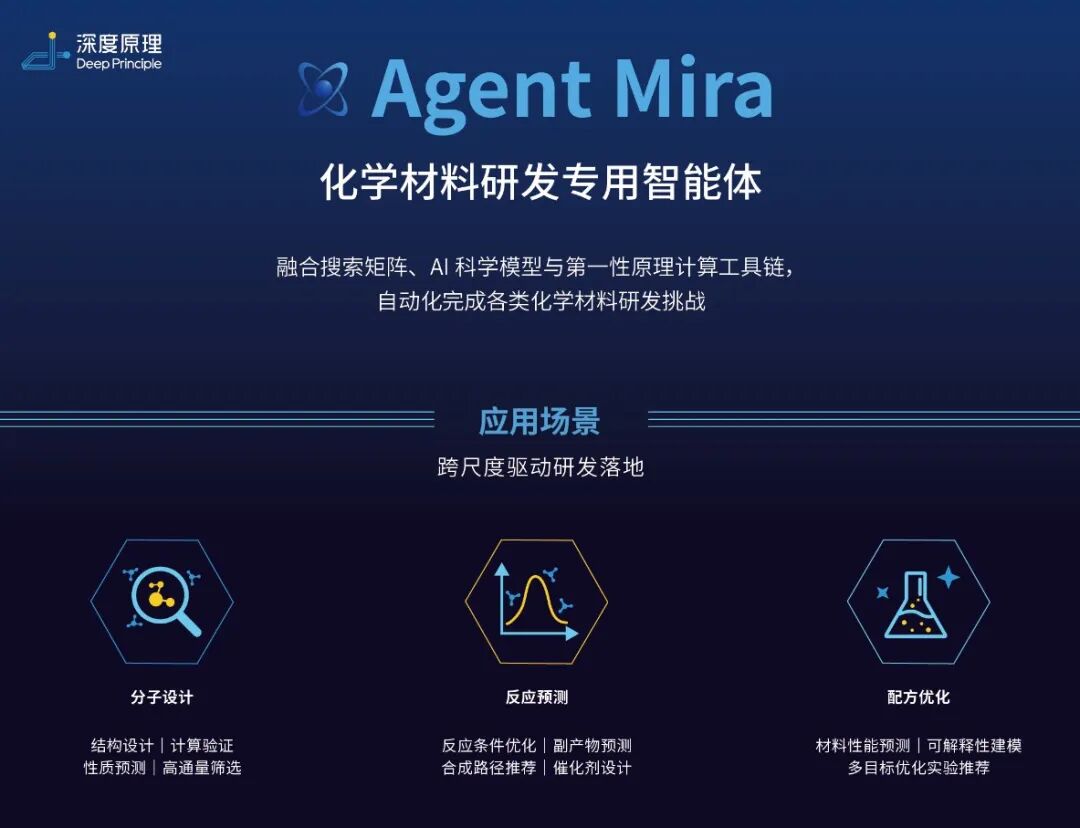
Agent Mira application scenarios
Agent Mira can intelligently call upon proprietary algorithmic models, high-precision datasets, and computational tools based on actual R&D needs, with capabilities spanning molecular structure design, chemical reaction prediction, and materials formulation optimization — orchestrating full workflow tasks through natural language instructions, moving generative AI and first-principles computation from "cutting-edge black tech" to "new industrial routine."

Through continuous technical and product breakthroughs, Deep Principle has achieved substantive commercial progress with leading industry clients, securing commercial orders exceeding RMB 10 million within roughly a year of its founding.
In the supramolecular materials space, the company partnered with Shanhai Innovation to build the AI supramolecular materials platform "Synthrix™ 1.0," leveraging ReactiveAI's broad screening and molecular generation capabilities to enable precise prediction and high-throughput screening of its supramolecular materials library — using AI computation to screen millions of candidate structures in place of traditional trial-and-error experimentation.
In the personal care sector, the company is working with L'Oréal, using the ReactiveAI platform to predict and explain, at the chemical reaction mechanism level, how individual ingredients affect formulation performance — delivering quantifiable benefits in shortened R&D cycles, improved prediction hit rates, and reduced R&D investment.
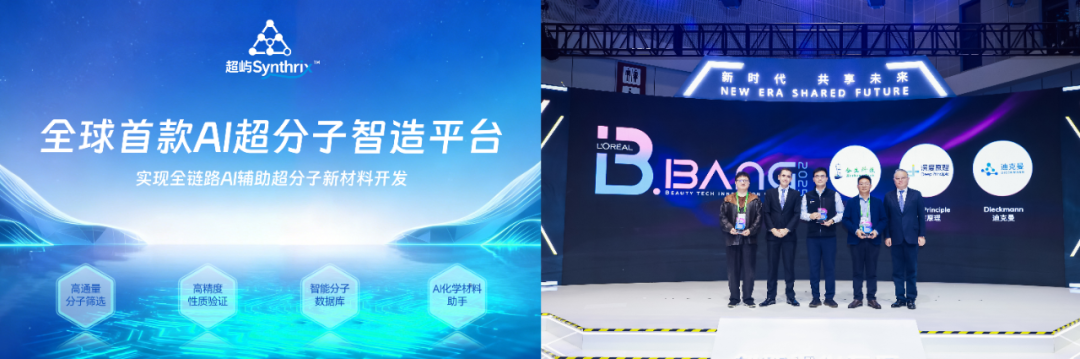
The company has achieved phased commercial progress with leading clients including Shanhai Innovation and L'Oréal
Beyond this, the company continues to co-create with strategic shareholder XtalPi, focusing on intelligent and automated R&D in chemical materials, building a next-generation full-chain intelligent materials R&D platform for the industry. The company is also advancing multiple key projects in new energy, fine chemicals, and other sectors, continuously expanding its industrial boundaries.

Centered on its proposed ECML R&D paradigm (integrated Experiment-Compute-Machine Learning decision-making), the company has initiated development of its L4 high-throughput autonomous lab (High-Throughput Autonomous Lab), AI Materials Factory.
AI Materials Factory is orchestrated by the proprietary agent Agent Mira for resource scheduling, precise experimental design, and efficient execution, connecting the core modules of the ReactiveAI platform to cover the full chain from molecular structure design, chemical reaction prediction, and materials formulation optimization through high-throughput validation and data feedback — creating a closed loop of "AI model prediction — computational support — experimental validation."
On one hand, AI Materials Factory will drive deployment of Deep Principle's technology and products across strategic domains including new materials, nutrition and personal care, and new energy — accelerating iteration from model prediction to experimental realization. On the other hand, it will advance internal proprietary pipeline development, continuously incubating an innovative materials matrix based on the ReactiveAI platform and pioneering new frontiers in emerging and cutting-edge fields.
Deep Principle will use this funding round as a new starting point to drive deep integration of technological innovation with industrial demand, injecting continuous AI momentum into the advancement of global materials science.