Harry Wang: God Only Opened Two Doors to AI's Future — One in America, One in China | Linear View

The adaptable survive; the evolved lead.

"To be or not to be: in the AI dominated future" — that was the theme of this year's Linear Capital AGM, and the existential question weighing on most people in this AI era.
As 2025 draws to a close, we share the reflections of Harry Wang, founder and CEO of Linear Capital. In his view, the sunset of an old era and the rise of a new one form a long tail, not an overnight switch. Those who fail to embrace the new changes won't lose to machines — they'll lose to the people who know how to use them.
When easy money disappears, hard money becomes the battlefield for heroes. At this new starting line of AI, the adaptable survive; the evolved lead. Here's to new chapters in 2026.
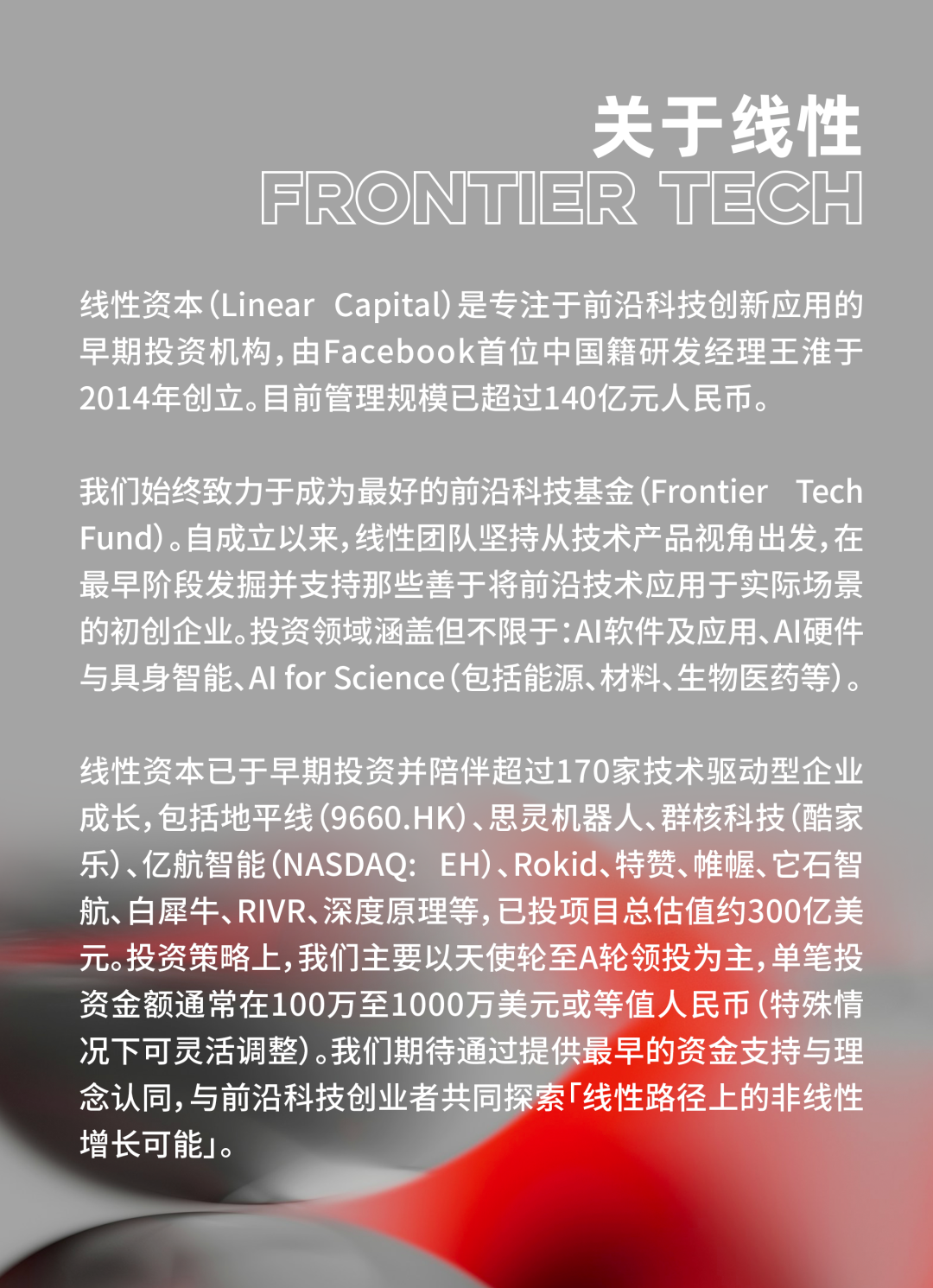
Over a decade ago, as one of Facebook's earliest and most influential Chinese engineers, Harry Wang returned to China with a technologist's romanticism and founded Linear Capital, focused on early-stage tech investing from Day One.
When he dissected Silicon Valley methodologies in his bestseller The Facebook Effect, AI was still a sci-fi term that only "crazies" discussed. But today, whether you believe in AI or not, it genuinely concerns the survival of every individual and our species.
Looking back at 2025, Linear Capital maintained a steady deployment pace in AI, investing over $100 million.
Under AI's non-linear acceleration, how do we rethink investment logic? How do we view US-China tech competition? When thinking becomes computable and judgment predictable, where does human value retreat to? Below, Harry's answers:

We were talking about AI ten years ago. Back then, if you said AI would become a monopolistic core force in the future, everyone would think you were crazy — because neither technologically nor commercially could you really prove it.
But today, whether you believe in AI or not, it genuinely relates to our future survival as individuals and as a species. The speed of change in this world always exceeds even the most optimistic expectations.
I come from an engineering background; I studied machine learning in my PhD. But this new wave of AI capabilities, from ChatGPT 3.5's launch to now, has kept refreshing my expectations of its upper limits. What's stunning isn't always the speed itself — it's the acceleration.
I believe that before this superpower of AI, God has opened only two doors on Earth: one in America, one in China.
The first door is in America. I must acknowledge Americans' pioneering spirit in this space — sometimes savage, but capable of true 0-to-1 breakthroughs. They have wild ideas, daring to imagine and attempt what others won't. Sometimes this temperament may feel uncomfortable, but you can't deny its effectiveness.
The second door is in China. Chinese people have unique advantages — our 1-to-100 scaling capability is unmatched globally. We have patience, strong vision, and more importantly, an obsession with "taking things to the extreme." Historically, Chinese people were very pioneering, but after reaching a certain point, we'd be satisfied with Greater China and unwilling to go further — which was fortunate for other regions at the time.
But now, times have changed.
These two doors, in my view, are the doors to future survival. How to choose between them? As an individual, you may only be able to go deep through one door; but as an organization or institution like ours, you must understand the rules behind both doors simultaneously.
That's why we did something internally at Linear: we require all our team members to subscribe to and use the best AI models from both China and the US, with full company reimbursement. The amount isn't much, and it's not really a perk — it's survival training for the AI era.
When the team uses ChatGPT, Gemini, and Claude alongside DeepSeek, Moonshot AI, and others, an interesting phenomenon emerges: American models do lead in data openness and creative divergence, but often fall into certain levels of "self-censorship"; Chinese models are actually more open on dimensions like DEI. So depending on what you're doing, if you want a relatively complete perspective, you should reference the best models from both countries.
In the AI era, whose model you use determines your angle on the world — a single perspective is fatal.
Speaking as investors, we haven't invested in foundation models ourselves, primarily because as an early-stage fund, putting that money in often amounts to throwing it away — the reputation might be nice, but the returns may not be that great. China's best foundation models have taken a more cost-effective, inclusive AI path. On this view, I'm prepared to be wrong — if I get proven wrong, I'd actually be happy.
In the US-China AI competition, a long-neglected variable is emerging. Borrowing from alcohol proof, I call it CBV — "Chinese by Volume." I've done some data research that may not be precise. Among top US AI researchers, the Chinese proportion is close to 50%; at OpenAI, the share of Chinese heritage among AI researchers is also high. This means that the current AI competition at the talent level is essentially a contest between an America with "50% CBV" and a China with "100% CBV." When I was an engineer at Facebook over a decade ago, there was a similar situation, but back then it was 25% vs. 100%.
The underlying logic is the real distribution of talent and engineering capability. Behind AI lies mathematics and engineering — tedious matrix operations and parameter tuning. And Chinese people have unique patience, discipline, and scale advantages in these two areas.
I have a half-joking formulation: AI model competition is competition between Chinese people in America and Chinese people in China. But there's a key distinction: top Chinese talent in America is strong at innovative breakthroughs, while domestic Chinese talent may have advantages in engineering, scaling, and continuous optimization. These are two different capabilities, both of which will be crucial going forward.

Let me share my views on the future — speaking too far out is meaningless, so I'll stick to within our lifetimes. I have a judgment that may sound harsh but I firmly believe: within the next 1-3 decades, AI will certainly achieve dominance; by 2030, 30% of existing human jobs will be replaced by AI; by 2040, another 40%; by 2050, humanity's current work system will be fundamentally restructured — there'll basically be nothing left for humans to do.
Many find this timeline too aggressive. But honestly, I may still be conservative here. Why? Because acceleration matters enormously here, plus paradigm shifts or leaps. We can hardly understand this change with linear logic — though our firm is called Linear, we've always encouraged non-linear thinking to understand how the world changes.
Let me give a simple example: mobile phones were commercially deployed in the 1980s, but by the early 1990s penetration was still under 1%. By 2000, penetration had begun to climb. Today, apart from some remote areas, global mobile penetration exceeds 100%. AI's penetration curve will only be steeper — ten times steeper, even a hundred times.
Of course, what's most unsettling isn't the speed of replacement but the logic of it. Many people think their work is creative and unique, but actually it may not be — or at least mostly isn't. The harsh truth may be: your "flash of inspiration" has probably occurred many times before in human history.
And AI's power lies in its ability to learn from similar "flashes of inspiration" recorded by someone somewhere in mathematics, physics, chemistry, or any field 100 or 200 years ago, and ultimately deliver that "flash of inspiration" into your content.
When creativity becomes a scalable "commodity," where is our value anchor? I'm not preaching pessimism. On the contrary, I think this gives us an opportunity to rethink "human value." If repetitive creative work can be replaced, then what is truly human and irreplaceable?
Of course, everyone knows current large models have a problem — they "hallucinate with a straight face." This is the original sin of probabilistic models: the choice of next token often rests on infinitesimal probability differences. The best answer and the second-best, third-best may differ by only 0.0001% in probability.
But I believe that to a large extent, AI is already "eating our lunch." This imperfection reveals a harsher truth: AI doesn't need to become superhuman, doesn't need to score 100 on every subject to replace you — it just needs to exceed expectations for your specific role across composite dimensions.
Many are still waiting for the ultimate forms of AGI (Artificial General Intelligence) or ASI (Artificial Superintelligence), not believing that day will come soon. I still believe the vast majority of jobs will be replaced, so we proposed a concept internally: "AI for everything." This isn't a slogan — it's our daily behavioral准则. When you encounter a new problem, your first instinct should be "Can AI help us do this? Can I complete this with AI's help?" This completely changes our workflow.
This sounds simple but is extremely difficult in practice. Because for most of us, all the experience, intuition, and workflows formed over the past two to three decades were built on the inertial logic of the "Pre-AI era." Whether you can enter the next era depends on whether you can personally break these inertias and place AI as the premise of all thinking.
I have massive reading demands daily. Now, I first use Notebook LM to digest books and generate podcast scripts. I walk two to three kilometers to and from work every morning and evening — perfect time to listen to these AI-generated podcasts. AI doesn't necessarily deepen my understanding of issues, but greatly boosts my efficiency, then I decide which content merits deep reading. Now, reading new content without AI assistance — it's not that you can't read well, but the time needed to reach the same level of understanding will be far more than others'. In an era where speed is everything, efficiency gaps are existential gaps.
This even creates a new form of "social filtering": where we used to focus on a person's values and professional background, now we may also need to look at how they use AI and how they think about AI. We put forward a rather direct view: "Not embracing AI means death" — not physical death, but the death of your competitiveness and your value of existence.
In my view, however brilliant one was in the previous generation, those unable to learn and recognize "AI-lize everything" and "AI first" will be eliminated. Many well-known successful entrepreneurs and investors — maintaining the status quo, your lives may be fine. But if you want to continue succeeding in the new era, you must become "AI-first" people and collaborate more with younger generations, understanding their practices and ways of thinking.
An old era's sunset and a new era's rise form a long tail — it doesn't change overnight. If you can't embrace these new changes, you won't lose to machines; you'll lose to the people who know how to use them.

Many people ask me: China's AI field is so hot now, fundraising and investing so frenzied — is this a bubble?
I answered this seven or eight years ago: There are two kinds of bubbles. One is a soap bubble — when it pops, nothing remains but a mist on the ground. The other is a beer bubble — beer with foam tastes much better than beer without; beneath the foam lies substantial, aromatic beer.
On the compute battlefield, NVIDIA remains the undisputed king. Jensen Huang is not only a great engineer but also a great salesman — he knows the right things to say and do at the right time. In my view, NVIDIA's greatest pressure is China's rise in compute, but this will take time.
AI may have bubbles now, but we believe many areas likely have beer bubbles. In embodied robotics, for instance, the "ChatGPT 3.5 moment" hasn't arrived yet — when it does, I believe this may be the greatest revolution since the Industrial Revolution, and American anxiety will rise another notch. So while we've also felt there are bubbles, we've still resolutely deployed significant capital.
For example, our portfolio company Bai Rhino — though we invested years ago, this is the first year they've truly entered a meaningful scaling phase, with business growth exceeding 20x year-over-year. They've率先 completed mass production readiness for unmanned logistics vehicles meeting automotive-grade standards, and raised over $100 million this year.
Another example is Taire Robotics, which attracted attention for its funding amounts this year — $120 million in the first round, $122 million in the second; we participated in both rounds as their third-largest investor. Their initial application was in wire harness scenarios, an area with massive labor demand that was previously difficult to automate. Just days ago, they demonstrated the world's first robot capable of autonomous embroidery, becoming the first company globally to break through the wire harness manufacturing challenge in robotics.
In tech investing, you must respect the present state while helping them think about the future. When things truly land, applications will show a massive J-curve. So early on, investors need to maintain steady composure. Regardless of short-term market noise, in the long term, this direction is the inevitable path of physical world digitization.
When ChatGPT 3.5-level capabilities are injected into robots, it will be the greatest transformation since the Industrial Revolution — because it will no longer just process digital signals, but directly manipulate atoms.
What will future factories look like? I can describe a scene: various robots in a factory sharing the same base architecture, but with end effectors that can be rapidly swapped. They can interact with each other — possibly in language we understand, possibly not; as long as they're given a clear goal, they can run autonomously. Which machine plays what role mainly depends on reconfiguring perception modules. Today these robots make phones; tomorrow they might switch to drones — just deploy a new model from the cloud, adjust the end effector, and the entire conversion might take only minutes.
To realize this vision more efficiently and at lower cost, I believe there are only two places in China: the Yangtze River Delta and the Pearl River Delta. Behind this lies the spillover effect of China's EV supply chain in these regions. The future of robotics is essentially the second explosion of China's electric vehicle industry chain. These supply chains highly overlap with automotive, especially EV supply chains. In a sense, robotics' future is an extension of the EV supply chain.
In recent years, China's rise in consumer electronics has also been remarkable. Of this year's "Hangzhou Seven Little Dragons," we were the earliest investor in two of them. We invested in Rokid ten years ago — they've been all-in on smart hardware, recently breaking Kickstarter's global crowdfunding record for smart glasses, with first-round pre-sales sold out and delivered.
And products like DJI, Insta360, and Shokz performing globally — there are reasons and history behind this. China has manufactured or OEM'd so many electronic devices for the world, building powerful supply chain capabilities in this space, and in the process cultivating many talents who don't just understand technology, products, and supply chains — increasingly, companies understand how to do distribution and marketing.
This evolution in capabilities is spawning a new generation of entrepreneurs. They don't just understand technology; they understand human hearts. So we believe there will be many future entrepreneurs who both know how to make a great product and how to sell it well. When AI algorithms can truly understand emotions and are cleverly packaged into hardware you can't put down, things change. It's no longer a tool — it becomes part of your emotions; you'll want to use it, you'll depend on it. This is the decisive factor for consumer electronics' next decade: who can make products people "want," not just "need."
Humans are becoming increasingly lonely, and you are creating value.
We also pay close attention to AI's acceleration of the journey from scientific discovery to commercialization — new materials, chemistry, biopharmaceuticals, these are all important directions. We invested at the seed stage in Deep Principle, a startup founded by a group of post-95 MIT PhDs, currently working with leading industrial companies to explore and implement China's AI4S commercialization path.
Today, whether in mindset or organizational structure, research and industry are sometimes integrated. In my view, future IPO winners and Nobel laureates may well belong to the same company. This was hard to imagine before, but is entirely possible in the future.
In this context, we truly hope not only Chinese enterprises benefit, but the whole world benefits from technology. Because science itself shouldn't have national borders behind it, though commercialization does. This returns to Linear's longstanding vision: "Frontier Tech, Frontier Productivity, Frontier Lifestyle — All for a Better Society."

Finally, I'd like to briefly address geopolitics. I've referenced scholars who study historical mega-cycles. Historically, the cycle of global dominant power transitions is roughly 150 years. Portugal, Spain, the Netherlands, Britain, America — each led for about 150 years. Counting from WWII when America gained global leadership, nearly 80 years have passed. By this calculation, the next 30-70 years may be a window of power transition.
But this won't be a blitzkrieg — it will be "Tai Chi." Americans excel at Western cowboy-style confrontations — open guns, open knives, head-on clashes; while China is using "when the enemy advances, we retreat; when the enemy retreats, we advance" strategy, playing Tai Chi, borrowing and neutralizing force to stretch the confrontation into a prolonged game.
Our investment strategy has also shifted somewhat: where we previously focused mainly on China domestic projects, we now pay more attention to overseas teams that can integrate global resources, especially those that can leverage China's supply chain. We invested in RIVR in Switzerland, and BTRY — they come with globally leading technology, not to raise money in China, but to genuinely integrate China's manufacturing and engineering capabilities into the global innovation network.
Globalization isn't dead — it's just restructuring. In the coming decade, only by understanding, valuing, and seizing the new opportunities brought by AI development and geopolitical transformation can enormous value be created.
Returning to my opening theme: "To be or not to be: in the AI dominated future." In this era of dual shocks from AI and geopolitics, survival itself is the deepest innovation. We no longer pursue "predicting the future" — that would be too arrogant — but even so, we hope everyone can benefit. What we've learned is to continuously adapt amid uncertainty — Be adaptive!
I'd also like to share our new standard for finding founders at Linear Capital. In recent years, we've found that outstanding founders need a trait: "healthy paranoia." They truly believe they can change the world, but are willing to start by changing themselves. They stay vigilant in good times, optimistic in bad.
I've seen too many founders who want to change the world but are unwilling to change themselves. Those who truly achieve things are always those who first change themselves, then influence others.
Our generation of tech investors is fortunate — we've witnessed American technological innovation and personally experienced China's scaling rise. We respect America, but we are also Chinese. This identity can sometimes feel撕裂, but we strive to build bridges between the two worlds.
An interesting phenomenon: this year, more entrepreneurs, founders, and young people are returning to the market, and more talent is returning from America. But I must also say: the easy money is gone; hard money is the battlefield for heroes. In this era, what matters is whether you've already set out, whether you've broken your past inertias, whether you're prepared to face a completely different future.**
AI isn't the endpoint, but a new starting line. At this starting line, the adaptable survive; the evolved lead.
I hope that when next year's end comes, we can all gather again with new stories and new insights.