How to Do SEO in the Face of Massive AI-Generated Content | Bolt's Pick

Always create valuable content for your users.

Founded in 2006, HubSpot is an American customer relationship management (CRM) platform. Its blog, the HubSpot Blog, focuses on marketing, sales, agency, and customer success content, with over 400,000 subscribers and more than 4.5 million monthly visitors. Recently, HubSpot Blog User Acquisition Manager Curt del Principe sat down with marketing expert Amanda Sellers to discuss AI's impact on web SEO rankings, evolving user search habits, organic traffic versus paid marketing, and more. The conversation was published on the HubSpot Blog platform.
We've organized and translated the interview to help readers better understand how generative AI is affecting SEO and how to respond. The original article can be accessed via the "read more" link.
🔍 Key Takeaways
1. Generative AI excels at recounting objective facts but lacks original insights. Unique perspectives and differentiated angles are what it takes to gain an edge in Google search rankings, and these typically come from real lived experiences and proprietary data.
2. AI search engines haven't truly gone mainstream yet, but companies need to pay attention to what AI returns to users in chat interfaces, because the quality of those responses can influence user perceptions of brand image to some degree.
3. AI is eroding the effectiveness of Google Search as a channel, but Google remains critical for business marketing. Compared to paid marketing, SEO-driven organic traffic is sustainable and repeatable.
4. Amanda Sellers' three recommendations for SEO marketers:
- Produce original content: Merely generating factual content is no longer enough to attract audiences, since tools like ChatGPT can easily handle that. Creators need to define their positioning and focus on unique content that can't be found elsewhere.
- Compensate for AI's limitations: Treat AI as a tool, but understand its limitations and fill those gaps with a distinctly human perspective. This unique viewpoint will differentiate you from those using ChatGPT to write the same articles.
- Always create for your users: Whether writing blog posts, news updates, or product landing pages, focus on the value you provide to readers.
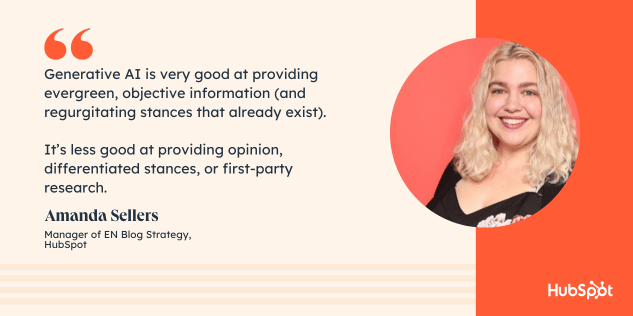
Image | Amanda Sellers bio
Part.01
How Is AI Affecting SEO?
1) Will AI impact SEO rankings?
Amanda Sellers said: "I believe Google's Helpful Content algorithm update (and the broader emphasis on EEAT) is a direct response to AI content creation."
Helpful Content refers to a major update Google made to its search ranking algorithm in late 2022. This triggered a series of follow-up adjustments throughout 2023, aimed at elevating content that meets Google's quality guidelines: Experience, Expertise, Authoritativeness, and Trustworthiness — collectively known as EEAT.
The goal of EEAT is straightforward: to ensure content created genuinely for people appears in search results, rather than content engineered to game search engines.
"Theoretically, the emergence and widespread adoption of generative AI means the floodgates for content volume have been thrown open."
But more content doesn't necessarily mean better content.
Amanda Sellers explained: "Generative AI is very good at providing already-proven objective facts, or rehashing existing viewpoints. But it's not good at offering unique insights, differentiated angles, or primary research."
Unique insights and differentiated angles are what's needed to gain an advantage in Google search rankings right now, and these often come from real-world lived experience.
"Generative AI cannot create things that don't exist in the real world, because it isn't alive and cannot experience things," she added.
2) Have AI search engines changed SEO?
In February 2023, Microsoft beat Google to the punch by embedding an AI chatbot directly into its search product (Edge). In response, Google hastily unveiled its own AI-powered search engine (SGE). But by late 2023, Google quietly delayed SGE's launch.
So what happened?
Amanda Sellers said: "First, the threat from Bing AI search to Google's market share never materialized." As of early 2024, Google still controlled 91.47% of the global search market, having declined just 1.5 percentage points year-over-year.
"Second, SGE could threaten Google's ad revenue," she added.
According to SEC filings, Google's ad revenue reached $237 billion in 2023 — which depends on users staying within Google's ecosystem.
"Finally, there are numerous infrastructure challenges that need careful handling."
The most significant challenge? Large language models (LLMs) aren't actually ideal search engines.
New information emerges in the world every day. Google simply needs to update its index to capture newly created web pages, videos, or social media posts. For an LLM to learn new knowledge, it must add this new content to its training data and retrain the entire model before it can update.
That said, this hasn't stopped some users from treating chatbots like ChatGPT and Perplexity as genuine search engines. When a user asks AI search engines questions related to your industry or brand, what the AI returns in the chat interface deserves corporate attention, because the quality of that AI response can influence user perceptions of brand image to some degree — even though AI search engines haven't truly gone mainstream yet.
This leads to the next question: If LLMs haven't dramatically changed search tools yet, have they changed user search behavior?
3) Is AI changing how users search?
Early on, people worried that users might turn to ChatGPT for answers instead of Google. In early December 2024, Gartner predicted that due to large-scale LLM adoption, Google search volume would drop 25% by 2026. This prediction sparked panic among some marketers.
Could some traffic loss be due to users completely abandoning Google?
Amanda Sellers said: "Changes in user search behavior are difficult to quantify. This kind of behavioral shift is typically slow and broad."
"I started noticing some decline in query demand for our pages. The reason might be that for certain user questions, asking ChatGPT could be more effective than reading a blog post, thus reducing queries. But 2023 had all sorts of fluctuating factors, so it's hard to determine whether AI adoption was the main cause."
So while this possibility exists, it's not yet significant enough to warrant major concern.
It's also worth noting that search needs satisfied by ChatGPT may have been zero-click searches all along.
In other words, users get answers directly from AI search engine results without needing to click through to your website. While this isn't good news for site traffic, optimizing for AI search engine results could significantly boost brand awareness and influence.
This raises a longstanding question: In the AI era, how should we approach SEO?
4) Has AI changed the balance between organic traffic and paid marketing?
Amanda Sellers said: "No matter how strong the basket, putting all your eggs in one basket is never a good strategy. This is a view I held before AI became widespread, and I'll continue to hold it."
(For SEO practitioners, this is a lesson often learned after getting hit by algorithm updates.)
"Google remains an important channel for business blogs because SEO-driven organic traffic is sustainable and repeatable."
This contrasts with paid marketing channels like email, paid advertising, or social media.
But is AI changing the power dynamics among these channels?
Amanda Sellers acknowledged: "I think Google is declining in effectiveness as a channel. But interestingly, it has been steadily declining throughout my entire career as a content SEO marketing manager."
"The introduction of featured snippets, increased Google ad space, the addition of images and videos on search results pages, the rise of zero-click searches... all of these have reduced Google Search's effectiveness as a channel." She listed a series of challenges encountered in content SEO work.
But longtime SEO practitioners also recognize that every challenge brings new opportunities.
Amanda Sellers said: "Search contains enormous user demand. We're observing significant changes AI has brought to this space, and the new opportunities hidden within those changes, so we're actively adjusting and developing new strategies."
Part.02
How to Do SEO in the AI Era?
So how should SEO practitioners adapt to these changes? Before wrapping up the interview, I specifically asked Amanda Sellers for some advice.
Here are her top three recommendations for marketers working in SEO:
1) Produce your original content.
Amanda Sellers advised: "When deciding what content to create, merely producing factual, repetitive content is far from enough, because ChatGPT can do that. You need to consider your positioning and create unique content that can't be found anywhere else."
This might mean bringing in expert perspectives from your field, leveraging industry data your company has collected, or even just a distinctive tone — all of which will draw readers back.
2) Compensate for AI's limitations through a human lens.
She said: "When creating content, treat AI as a tool, but understand its limitations." Then she emphasized further: "Actually, not just understand them — fill those gaps with your unique human perspective."
This distinctive viewpoint will set you apart from those using ChatGPT to write the same articles.
3) Always create for your users.
Whether you're writing blog posts, news updates, or product landing pages, always focus on the value you provide to readers.
Here, Amanda Sellers got to the heart of the matter:
"The one reading your content isn't a search engine — it's a real person."
📮 Further Reading



Linear Bolt Bolt is an investment initiative established by Linear Capital specifically for early-stage, global-market-facing AI applications. It upholds Linear Capital's investment philosophy, focusing on projects driven by technological transformation. Bolt aims to help founders find the shortest path to their goals — whether in execution speed or investment approach, its commitment is to be lighter, faster, and more flexible. In the first half of 2024, Bolt invested in seven AI application projects including Final Round, Xinguang (心光), Cathoven, Xbuddy, and Midreal.