AI Apps 100 Q&A | When humans and AI creating content together becomes routine, how far off is a brand-new content platform?

AI Agent, Making Dreams for Everyone
Since ChatGPT's debut, the content industry has been among the sectors most deeply reshaped by AI. Text-to-image and text-to-video tools have kept emerging, and in September this year, Google's NotebookLM opened up yet another possibility — text-to-podcast. After seeing one astonishing piece of generated content after another, we found ourselves wondering: just how far will AI transform content creation?
Kaijie Chen, founder of MidReal, an AI-powered interactive storytelling platform, shared his answer with us in a recent "100 Questions on AI Applications" interview. A Duke graduate and serial entrepreneur, Chen launched MidReal at the end of 2023 — a content platform where people co-create stories with AI through interaction. Below is our conversation with him.
01 Interview
1. Linear Capital: Start by introducing yourself and MidReal.
Kaijie Chen: I studied human-computer interaction and mechanical engineering at Duke. In my sophomore year, I felt that what I was doing on campus wasn't challenging enough, so I took a leave of absence and started my first company in home robotics. I've been working with AI in one way or another ever since, and in 2023 I started MidReal. From day one, we positioned it as a place for writing stories. What is a story? It could be a novel, a short drama, a Netflix video — it's not limited by modality. We hope that because of AI, people who previously couldn't express themselves or write stories can write the best, most compelling stories here. And then everyone can read, consume, comment, and share together — in other words, a community, a content platform. That's our vision for MidReal.
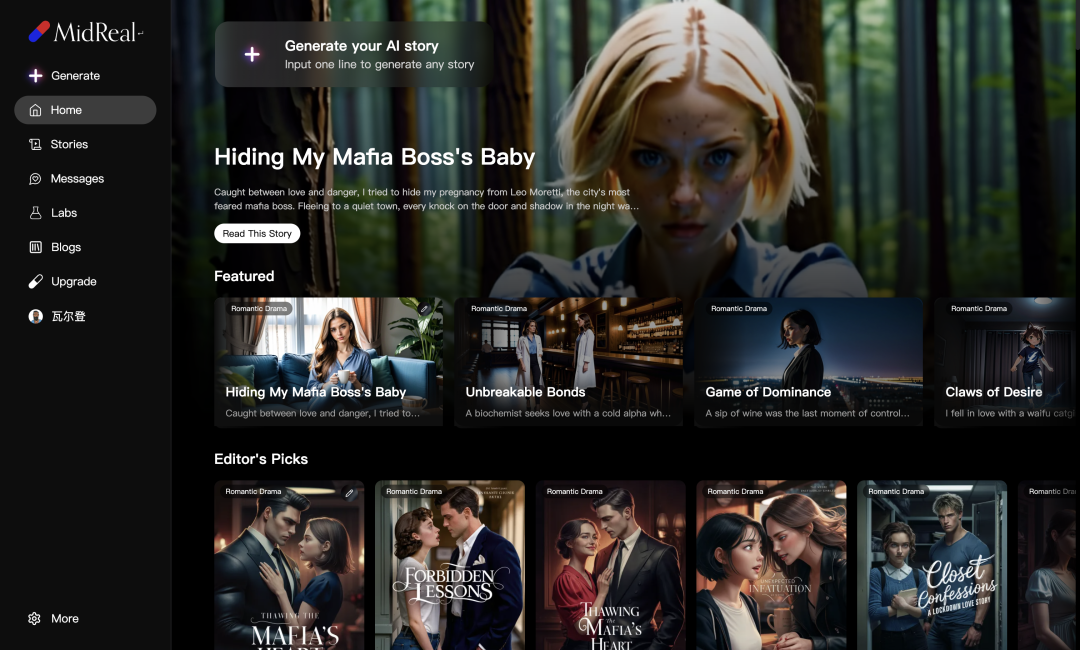
Image: MidReal homepage
2. Linear Capital: In your actual interactions with users, what characteristics have you noticed about them?
Kaijie Chen: The users we serve might be authors, might be hobbyists — people who already know how to write. On MidReal, they can use a simpler, more convenient method to produce their work through interacting with AI, somewhat like a painter using MidJourney.
Then there are users who weren't naturally skilled at writing but loved it. They consume different works, or have rich imaginations. These users tend to be younger. They might not have been able to write before, but with AI they can start creating. It's a bit like how early on Douyin, the people who could shoot videos weren't necessarily people who knew how to make films — they just had something they wanted to express, and video became their medium. So to sum it up, AI helps them accomplish things they couldn't do before.
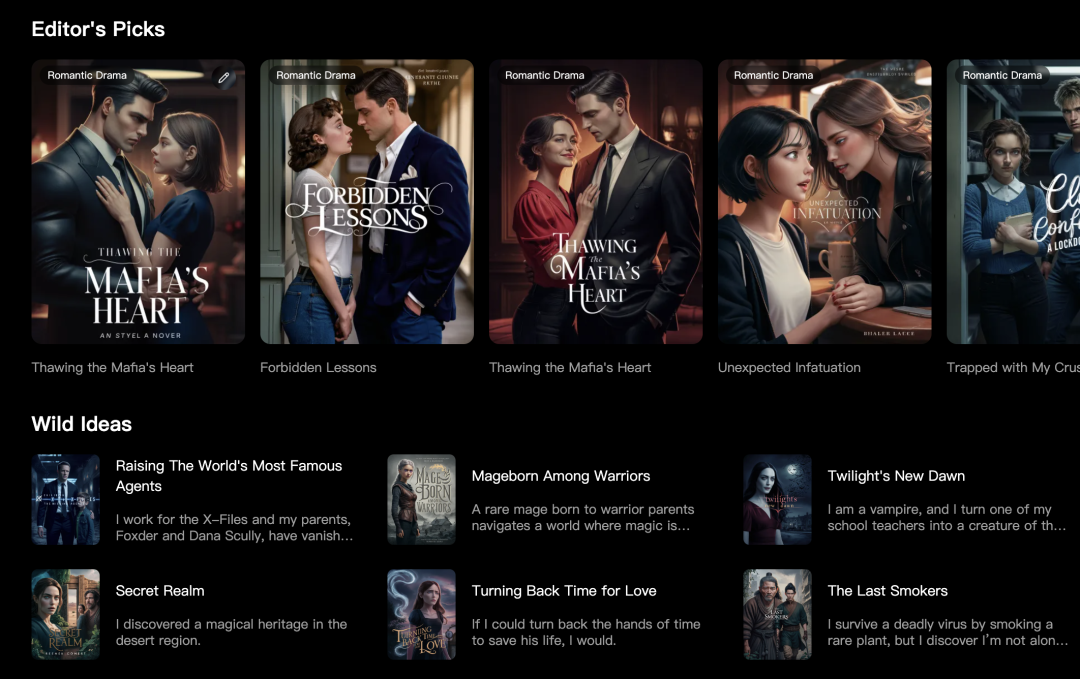
Image: MidReal editor's picks
3. Linear Capital: What's your entrepreneurial thinking? It sounds like quite a leap from home robotics to an AI interactive fiction platform. And your personal background is pretty rich too — what was the original intention behind each of your ventures, and how did you make those decisions?
Kaijie Chen: I think that last point is quite crucial — how a person decides to do different things. Many things don't happen in a continuous sequence. I feel life is full of coincidences. Cases where someone decides early on to become an astronaut and works toward it their whole life are rare.
What I pursue is doing something interesting and sufficiently large in scale. My first startup was the earliest exploration in this direction. My mentor asked if I wanted to apply our lab's results to some AI applications. I was still young then, and didn't think much about content or B2C versus B2B — I just wanted to apply the algorithms I had to concrete scenarios.
That first entrepreneurial experience helped me understand more clearly what I like and don't like. For example, I don't like B2B businesses. I'm fascinated by understanding people, imagining how someone uses a product, and designing a better experience for that process — in other words, I like being a product manager. At the same time, I found it hard to do something completely unrelated to technology, like pure operations or something else. So for my second startup, I chose AI agents for gaming applications, because I wanted to build a consumer-facing product centered on human thinking. Then with MidReal, I think my personal preferences were pushed to the extreme — I'm directly working on something content-related now. Overall, it's been a gradual discovery of what I'm good at and what interests me.
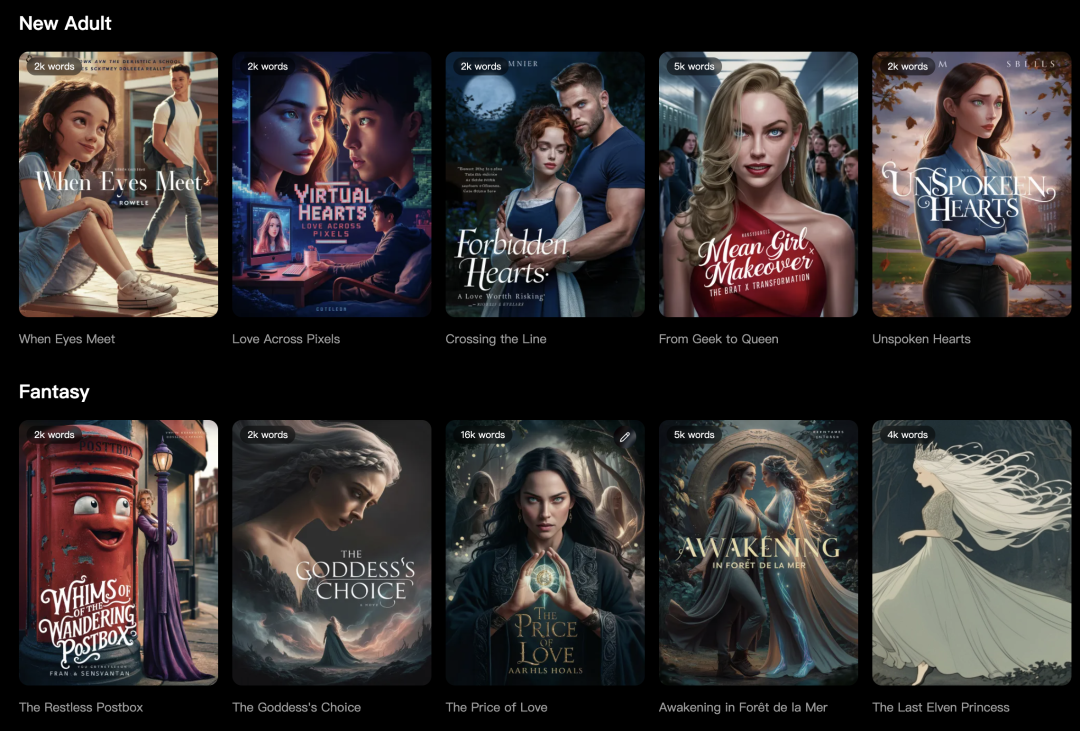
Image: MidReal Story
4. Linear Capital: In a podcast you appeared on previously, you mentioned that MidReal started from working on post-train agents, plus some inspiration from your previous entrepreneurial experiences, and that's how you settled on MidReal?
Kaijie Chen: Yes, there were actually many considerations at the time. The starting point was that we had strong agent training technology that could solve long-horizon reasoning and relatively complex logical inference problems. There were many industries we could choose from. People mentioned different directions, and after discussion, we came back to a few questions:
First, what do we ourselves most want to do?
Second, what can give us strong market positioning that won't be covered by competitors?
We ultimately chose AI story writing. I think it was a good choice. To this day, the number of teams still focused on getting AI to write good stories has dwindled significantly. There was a period when there were quite a few, but very few can continue investing in technology and training in this area. As far as I know, globally there are about five or so. So persistence in this direction has yielded pretty good results, and we've also seen increasing market possibilities ahead.
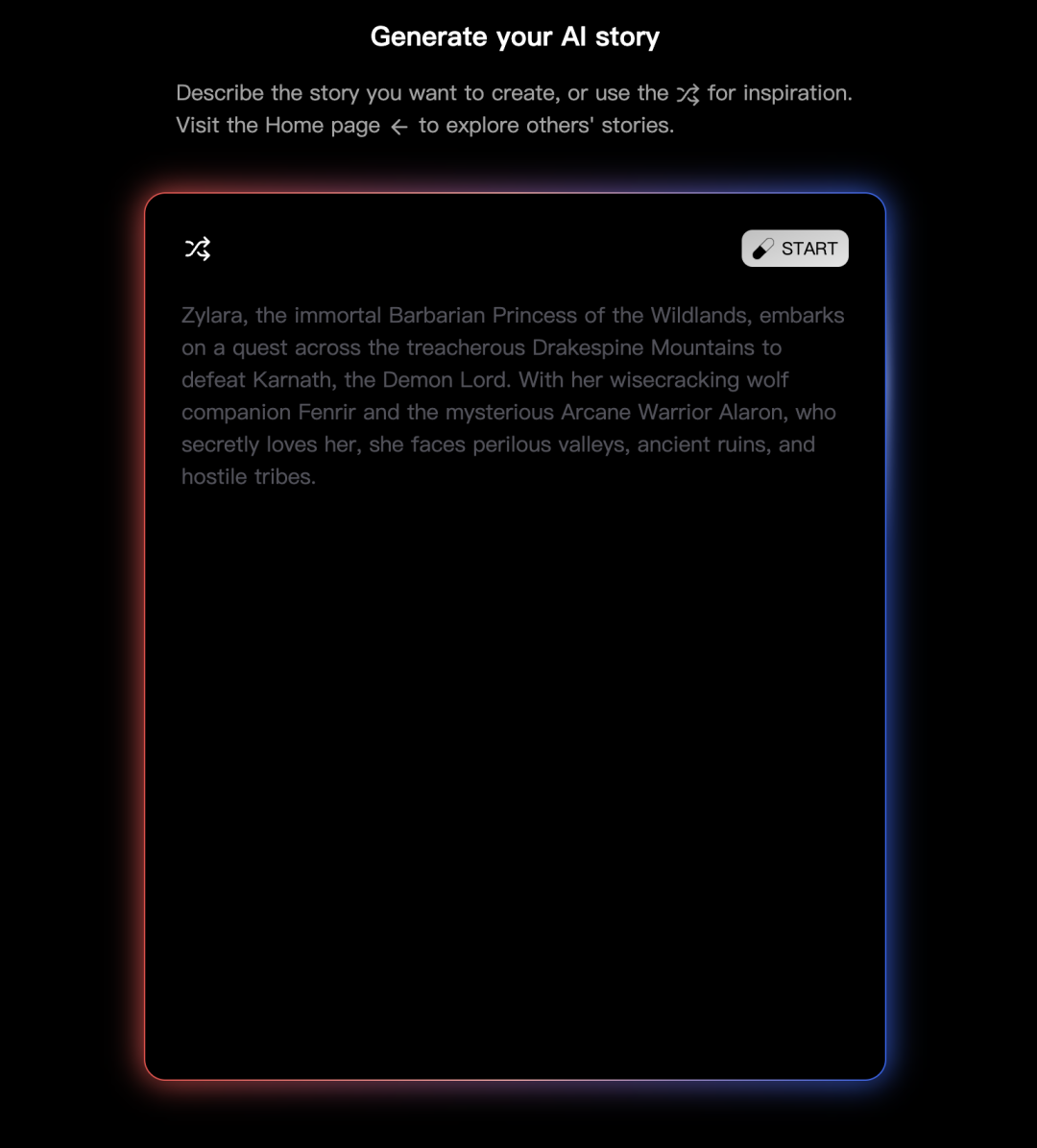
Image: MidReal story generation
5. Linear Capital: Why were there quite a few startups in this space initially, but fewer later on?
Kaijie Chen: There actually aren't that many technical teams that can truly do story writing well. Many teams rushed in because they saw that wrapping a layer of prompt engineering around LLMs could make a product, and they could taste some short-term success. But as models improved, users found that using the models directly worked pretty well too.
To sum it up, without sufficiently strong technical capabilities and product design skills, a product's competitive edge is relatively weak, and it will eventually be covered by competitors. And this gets increasingly difficult over time. As the models themselves write better and better stories, the demands on post-training keep rising. People are no longer satisfied with just getting a story out — they want something as good as what a human writer produces. We need to achieve this goal together with creators. That's why today, the players who can persist in doing this are fewer and fewer. In the end, teams that want to do content will all converge on the same path: AI-generated content, content that gets consumed — just with different emphases on this track. Some focus on generating great video, some on creating content through dialogue. Of these, we believe story carries the greatest value. Because regardless of the medium, you still need a good story in the end.
6. Linear Capital: When there are many voices telling you "you should do this" or "you should do that," how do you make choices?
Kaijie Chen: Why is making choices exhausting? Because we're running all kinds of simulations and reasoning in our heads — if I make this choice, how will the market change, how will our technical roadmap change, can we ultimately succeed? We try to reason our way to the right path.
Beyond this approach, we had another line of thinking at the time: build simple applications around our technology, which was relatively fast. For example, we put together the first version of MidReal in about 2-3 weeks. We also tried using it for research reports, for game agents, and so on. After trying these, we quickly found that when interacting with users, the feedback on content writing was the best. And once you've actually tried something, you can better reason what the short-term goals and endgame would look like if you continued in that direction. With this information, the decision actually becomes easier.
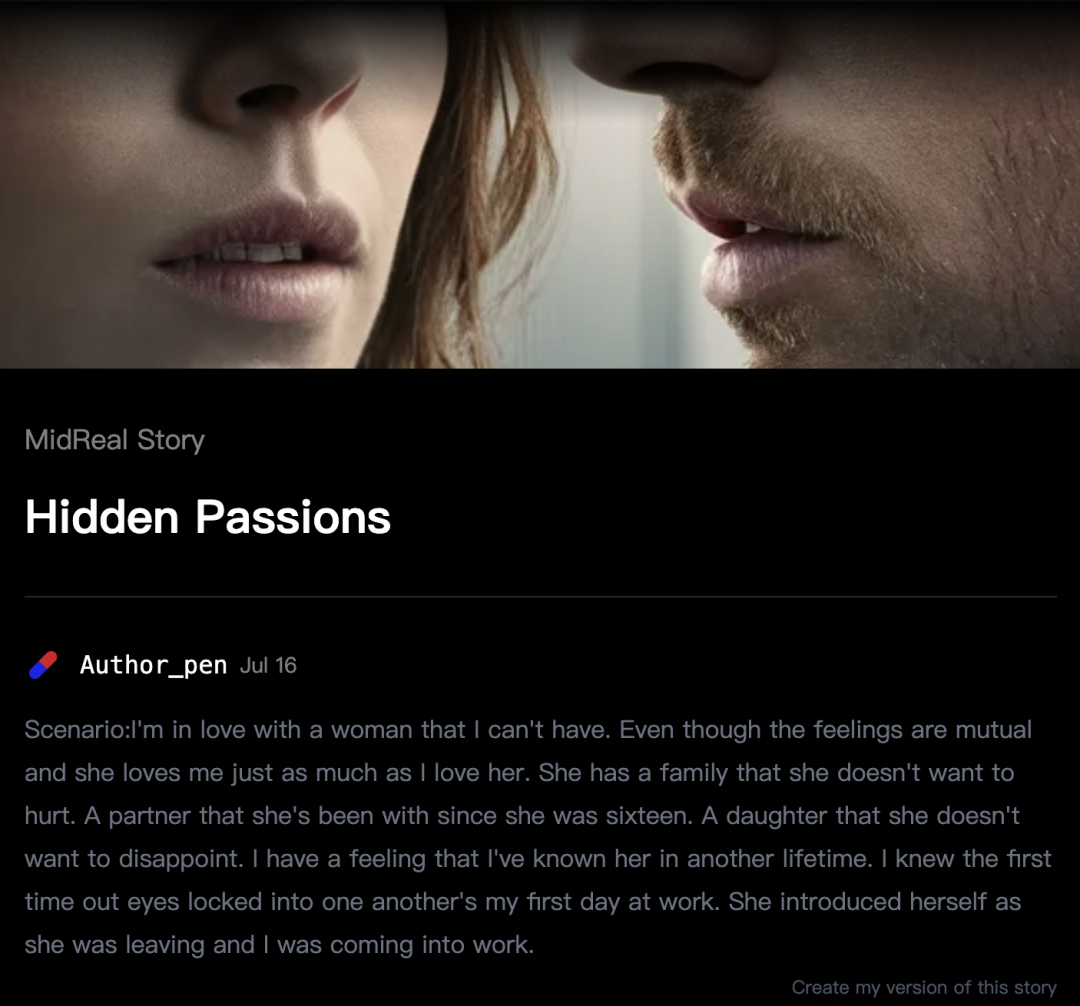
Image: MidReal story plot
7. Linear Capital: What have the different stages of building MidReal been like?
Kaijie Chen: The first stage was on Discord, from last December through this year's Spring Festival. We had 20,000 initial users there, interacting with them and understanding how they used the product. Many users反馈 that Discord wasn't very convenient. Because writing is different from image generation — image generation is one input and one or a few outputs, but writing is a process where you need to keep writing and constantly revising text. For writers, Discord isn't convenient.
So driven by this user need, we built a web version, giving users more freedom and a simpler interface. The web version has remained our main focus, with about 300,000 monthly active users now. Starting in October, we're shifting toward mobile, hoping to have a more stable presence, and also to make it easy for many creators or creative hobbyists to pull out their phones and create content anywhere.
From a technical perspective, in Discord and during the initial migration to web, the technical architecture used post-training — a method where I start with high-level conceptualization and then unfold increasingly detailed plot points downward. Later we found this approach wasn't ideal, because users often wanted to modify plot points in many places, constantly having new ideas and wanting to adjust. This core-to-periphery unfolding approach required enormous computation if adjusted. So after May, we began重构 to a new technical approach where we follow the user's intent and adjust based on their certainty — the more certain they are, the longer the reasoning chain. With this approach, user interaction with stories increased noticeably, because interaction became faster and controllability stronger.
Other important milestones: we initially trained on ChatGPT, then migrated to Llama 3 around April-May. We didn't invest heavily in images at first, but later found users increasingly wanted images, so we improved image training.
Next, I think the most important thing is content — whether we can help users create great content on the platform, content so good you can't find it anywhere else. The people who can create content like novels or films are few, but after short video emerged, many moments in people's lives are also wonderful and can be developed into stories or short fiction, greatly enriching the density of creative subject matter. So I think if good content can emerge here, with good creators, this ecosystem will keep growing. That's my bigger hope.

Image: MidReal story illustration
8. Linear Capital: You're building both tool and community — why not just a tool?
Kaijie Chen: Right. Douyin as a product is a good example. Before CapCut, the plus-button page had some special effects, filters, and small editing tools to help creators produce content. Today, we're essentially making that plus-button functionality more powerful, and also having creators interact here. New users can come in and directly consume content, see how others make things, and become part of the ecosystem — just with AI as the driving force. In such an ecosystem, the proportions of users at different levels may be quite different. On all content platforms today, content consumers are definitely the majority. So if AI can lower the barrier to creation, the proportion of creators will increase.
Compared to building community and platform, tools are relatively small in scope, and taking a cut from others' revenue isn't a great business.
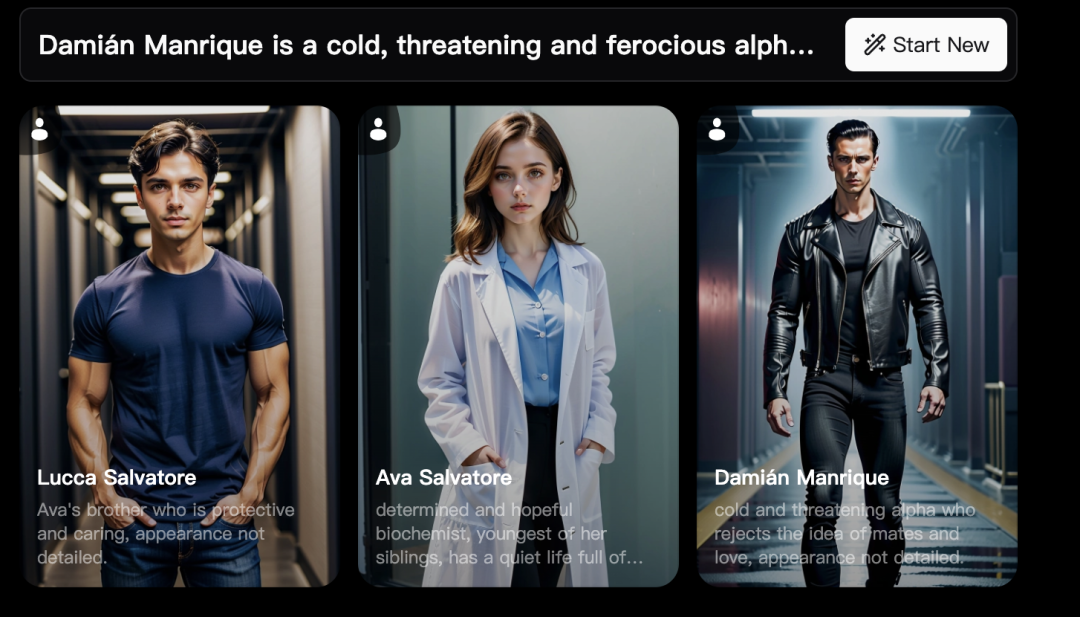
Image: MidReal story characters
9. Linear Capital: I heard you've done a lot of user research. What's the user profile roughly like, and what are their core needs? Before MidReal existed, what did they use to satisfy their writing hobby?
Kaijie Chen: Users are mainly in the US, in the English-speaking market — younger people interested in writing. Their biggest characteristic is having plenty of time. Whether students or people who just started working, after work they spend time watching videos, reading, and also want to express themselves and create.
If these people didn't already have a writing habit, then creation was just a passing thought in their lives — something they thought about and then let go. Some of them would want to record it, share it with friends, share it with community members, get more people's recognition. Previously they used various note-taking software. But there's an essential difference between having AI and not having AI, because writing is still quite difficult. There are some writing-assistance tools in English, but their emphases differ. Some don't want to become platforms, focusing on providing tools. An extreme example would be something like Google Docs — purely tool-like products where users have no sense of belonging, it's just a tool. On MidReal, we've put a lot of thought into letting users interact with AI, so that authors naturally feel this work was co-created with AI, published here, and seen and promoted by more people.
10. Linear Capital: Any memorable user stories?
Kaijie Chen: There was one user who studied philosophy and was a writer, ghostwriting books for others — many books. After getting COVID, his health wasn't great and he couldn't write anymore. His sensitivity to text seemed to suddenly disappear. He was in great pain, and it affected his family life. Later he discovered MidReal and started writing again, saying his life had been completely transformed. At the time he sent us a very, very long email thanking us, and video-called us, helping spread his story of interacting with MidReal in the community. Users and stories like that move me quite a bit.

Image: MidReal story content
11. Linear Capital: Content platforms often produce some branded content themselves to set an example for other creators. Do you need to do this?
Kaijie Chen: The similar part is that as a platform, you need to think about how to guide good content to emerge. For example, we consider whether to recruit creators for incentive programs, or build communities, or hire some creators ourselves to actively write good stories for us. Some guidance is definitely needed, whether through recommendations or through interacting with and encouraging creators.
12. Linear Capital: MidReal's biggest product highlight is interactive creation. Could you use 1-2 examples and the thinking behind them to explain the design logic of these interactions, and how they inspire/help users? How does the product better understand what users need while also fitting the thread of a good story?
Kaijie Chen: We have two interesting features. Initially, MidReal had the model write a segment, and then the user would make a choice after that segment, or write their own choice to let the story continue. But we quickly found that this couldn't satisfy users' creative desires. They often had some vision that the model didn't get right the first time, and they wanted to keep fine-tuning. So the first feature we built for interaction was allowing users to rewrite the story from any sentence — the story is essentially segmented by sentences. Every sentence can be clicked and modified, expressing a change in the direction they want the plot to develop next. After this feature launched, it received great user feedback. They could freely modify their work, and the quality of what they created improved accordingly.
The second is allowing interaction with and modification of others' content. Today when we send bullet comments under videos, or write comments under others' articles, these are all expressions of different ideas we have about the content. We watch a movie and never think it's perfect — we always have some thoughts and ideas about it. Now on MidReal, users can also make branching choices from any sentence in someone else's story. For example, I think in your story, Harry Potter shouldn't end up with Ginny, he should be with Hermione. Click that spot, enter the direction I want, and create a story like a branch of it — a branch of your story that develops the story world the way I want.

Image: MidReal story branches
13. Linear Capital: Any insights on promoting to English-speaking users? Many products are going global now, targeting English-speaking young people.
Kaijie Chen: Everyone says you need to build community, find precise user groups, and so on. Personally I think there are two points:
First, think about where your users themselves are active. Online, these people who write or have ideas about writing — what are they actually using, what products? Go to these places to find them. This is a relatively direct approach.
Second, paid promotion is still quite appropriate. It's relatively stable, and you have a lot of room for optimization. Because in the early stages you're constantly changing, trying, and making mistakes. If every time you try to find a user group or community, growth becomes very slow. You still need to find ways to quickly validate whether your ideas are right and get user feedback.
14. Linear Capital: In your attempts, which placements have gotten relatively good growth results?
Kaijie Chen: Actually it's just those few — Facebook, TikTok, and Google. All have been decent overall. The core of placement is still finding the right audience and content, and then producing good creative assets — this point alone can affect placement costs by 3-5x.

Image: MidReal-generated story cover
15. Linear Capital: What is MidReal's competitive moat? How do you avoid being made obsolete by model updates?
Kaijie Chen: At the application layer today, if you do even a little technology it's post-train approaches — fundamentally there's not much difference between players. What matters is the domain you choose. Like writing code or writing stories, there's no ceiling. People can keep creating better and better work, and these tasks are themselves sufficiently complex. But some tasks, like note organization — people may not necessarily need their notes organized better and better.
16. Linear Capital: What's been the biggest challenge since you started? Entrepreneurs face many challenges every day, but particularly significant ones are perhaps just a few key ones. Which challenges are strategic for you, and what do you need to judge correctly behind them?
Kaijie Chen: Right now the biggest challenge is how to produce good content. And because this is a relatively tightly coupled problem. Three things affect content: our model technology, product features, and creator state. These three interact with each other. Without product and technology, creators can still write on paper, it's just harder. With only technology and creators, if the product isn't good, it's also very difficult. The capabilities the product needs to provide include, for example, if the model doesn't write well the first time, the product needs features that let them revise a second time, or let them directly one-click rewrite parts that aren't good. Without these features, writing is painful. That is, product and model need to move in tandem, they need to match. But even with both model and product, given the current era and the state of AI technology, there also needs to be some inspiration and guidance for people — otherwise if they just write casually, they won't achieve writer-level quality content. So these three factors are important. They intertwine to determine our content quality today. This is what I care about most.
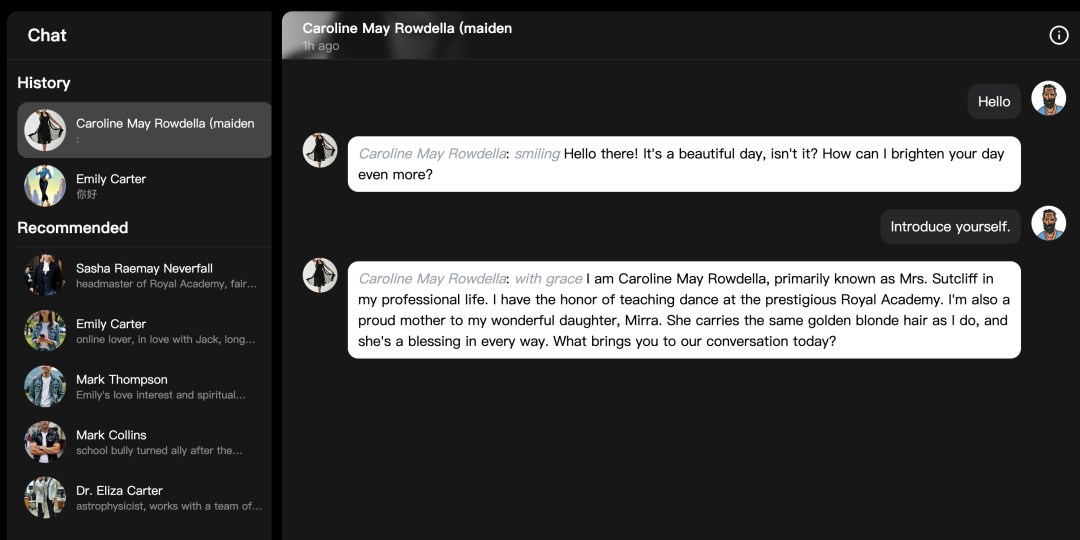
Image: MidReal novel character dialogue
17. Linear Capital: What solutions have you explored so far? Or what's the breakthrough point for solving this problem?
Kaijie Chen: It's about making all three aspects better and better. The solutions are quite concrete: how to find creators, encourage them to create, how to recommend their good content; technically how to train the model to solve specific problems one by one. For example, right now we feel there are too many parallel sentences, so in the next training round how to reduce parallel sentences a bit and increase descriptive language, and so on.
18. Linear Capital: Combining with your previous entrepreneurial experience, do you have a strong sense of contrast between the pre-AI era and the AI era?
Kaijie Chen: Yes, though my earlier entrepreneurial experience was relatively short. Simply put, the biggest difference is the team; the work itself is still okay. The pace of change in the AI era is too fast. It involves massive talent worldwide collectively pushing one technology forward, and keeping up with this technology's evolution is very difficult. The direct change and feeling this brings is that today's team works at a very fast pace.

Image: MidReal Labs
19. Linear Capital: You previously mentioned the next step is video — what does that mean? Becoming a video content platform?
Kaijie Chen: Right now stories are mostly text and images. Next, we hope to select good stories and directly generate video for them. Yes, turn stories into video, like short dramas. Our platform will have video content, and we hope to have more and more video content.
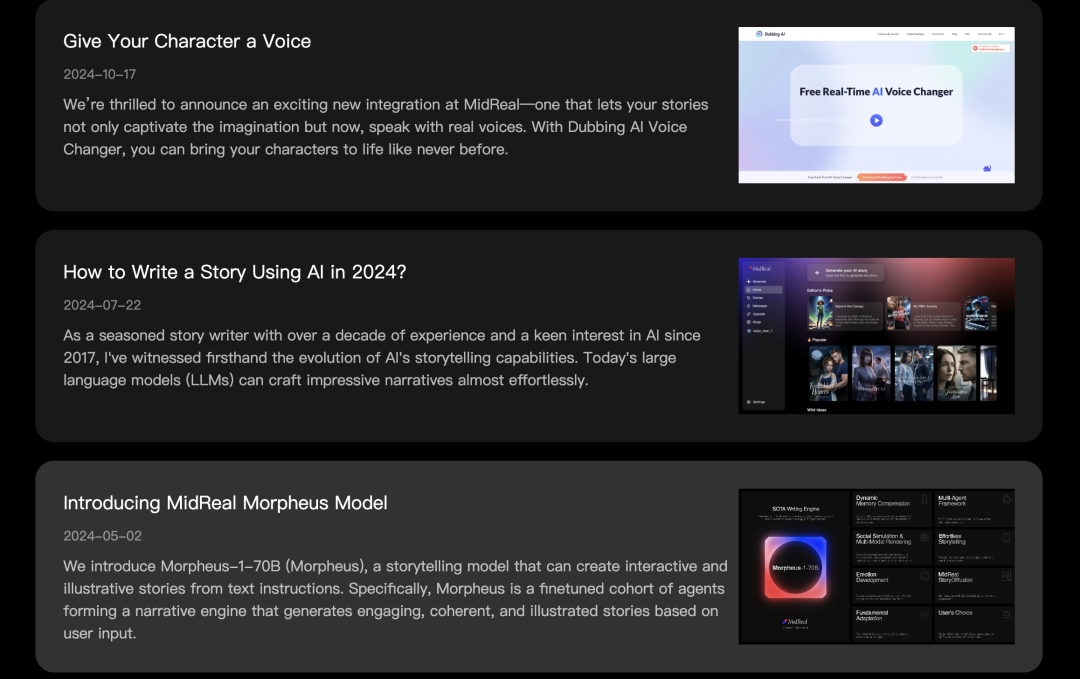
Image: MidReal Blogs
20. Linear Capital: What do AI application entrepreneurs you observe generally care about, and what do they generally feel anxious about?
Kaijie Chen: I don't really know about others. My general sense is that people care more about growth.
21. Linear Capital: These two years AI has had the biggest effect and impact in the content domain. What major changes do you think AI will next bring to the content industry?
Kaijie Chen: Without a doubt, AI will bring entirely new content platforms and content media. What's already happening is that humans used to be the sole producers of content, and now at the species level there's a new producer, and the quality isn't bad. It's just that society as a whole is still adapting. When each of us has Apple Intelligence or some other intelligent device in our phones producing meeting notes for us, helping us message our friends, everyone's way of thinking will change, and all content on content platforms will change. People just don't yet know what interactive form this new type of content will take, or how people will consume it — interacting while consuming, or as before.
At the same time, right now large companies and small companies are on the same starting line exploring this question. I think we'll see results in perhaps 3-5 years. From today's perspective, as mentioned earlier, people are exploring this question from different dimensions — some from media, some from content, some from tools, some from platform. If everyone survives, then in 3-5 years there may be a major battle, even conflict with traditional platforms. So often what I think about is: what should we be doing now to position ourselves to win in the competition 3-5 years from now.
Further Reading

Linear Bolt Bolt is Linear Capital's dedicated investment program for early-stage, globally-oriented AI applications. It upholds Linear's investment philosophy, focusing on projects driven by technological transformation, with the goal of helping founders find the shortest path to their objectives. Whether in speed of action or investment approach, Bolt's commitment is lighter, faster, and more flexible. In the first half of 2024, Bolt invested in seven AI application projects including Final Round, Xinguang (心光), Cathoven, Xbuddy, and Midreal.