Rhythm Dynamics Completes Tens of Millions of Yuan Seed Round to Build Self-Evolving AI4S Infra | Linear Portfolio

Let AI continuously learn from every piece of feedback in a real lab.

Today, 「Lvdong Zaowu」 announced it has closed a seed round in the tens of millions of yuan, led by Linear Capital, with participation from Innoangel Fund, Yuanqi Yicai, and the University of New South Wales (Wuxi) Industrial Innovation Center.
Founded in Shanghai in 2026, Lvdong Zaowu is an AI for Science Infra company pursuing scientific superintelligence. At its core is a self-evolving materials R&D system, paired with an AI-native automated Lab and underlying Infra, so that AI can not only design materials but also take part in real experiments and keep learning from experimental feedback.
Neil Zeng, Partner at Linear Capital, said: "The pain point in new materials R&D isn't inspiration — it's the cost of trial and error and the gap to mass production. Lvdong Zaowu has built a solid data-and-experiment loop that turns every feedback from the physical world into deterministic progress for the model, and it has already delivered a mass-production answer. Xie Tong is one of the rare founders who understands both the underlying logic of materials and has hands-on experience with large models. He isn't chasing one-off showmanship in the lab; he has the discipline to build the underlying Infra that supports scaling. David's deep experience in commercialization has pressed the accelerator on getting the technology deployed. We're glad to accompany the team at the early stage, and we believe they will reshape the R&D paradigm for new materials."
On November 27, 「Lvdong Zaowu」 announced it has closed a seed round in the tens of millions of yuan, led by Linear Capital, with participation from Innoangel Fund, Yuanqi Yicai, and the University of New South Wales (Wuxi) Industrial Innovation Center.
Founded in Shanghai in 2026, Lvdong Zaowu's goal is scientific superintelligence. In the company's view, models and automated Labs are just the two ends; what's truly scarce is the Infra that closes the dry-wet loop and lets AI keep learning from every feedback of a real Lab.
Founder Xie Tong has nearly six years of research behind him in AI-driven materials R&D. In 2020, during his doctoral research, he began studying how to use natural language processing to accelerate the discovery and synthesis of nanomaterials. His research has since unfolded along two tracks: scientific model development and experiment automation.
On the scientific model side, Xie Tong has been organizing materials research data with academic teams since 2021 and led the release of the scientific language model DARWIN, using AI to accelerate the discovery and design of new materials**; in 2025 he led the development of the chemical reasoning model Chemist, and along the way took part in the U.S. Department of Energy's scientific large-model research and a European chemical large-model training project. On the experiment automation side, he has been involved in building a perovskite automated Lab since 2021,** progressively replacing manual work with machines to run experiments, improve efficiency, and accumulate real materials experiment data**.
These research efforts form the technical foundation of Lvdong Zaowu.

In 2019, Xie Tong, then an undergraduate, was researching a perovskite material for solar cells. To make the material's performance more stable, he had to keep adjusting the raw-material ratios, preparing samples, and then verifying the results through experiments. He recalls going into the Lab at seven or eight every morning, spending the whole morning preparing reagents, then cleaning instruments in the afternoon — leaving only a few minutes to actually collect data.
This is the long-standing problem in materials R&D: discovering a new material requires researchers to experiment and fail repeatedly, with a time cost starting at months. AI can analyze existing data to predict the performance of different material formulations, helping researchers screen out more promising options and reducing blind trial and error. But just because AI can quickly design a formulation doesn't mean those materials can actually be made. Even if a sample is successfully prepared in the Lab, its performance must be repeatedly tested; and at the factory, cost, quality stability, and mass-production conditions all come into play.
Around these problems, Lvdong Zaowu has developed a materials R&D system made up of scientific models, an automated Lab, and underlying Infra. Its core product ByteScience is a self-evolving materials R&D system composed of a multimodal scientific large model and an Agent Harness. It doesn't just screen formulations and design experiment plans based on a client's performance and cost requirements — it takes over the step that only scientists could do before: reading experiment data and proposing the next scientific idea. Paired with it is ByteFactory, an AI-native automated Lab that, through robotic arms and materials synthesis and testing equipment, turns AI-designed formulations into real samples and verifies their performance.
Connecting the two is the system's foundation, Byte Infra. It handles scheduling of models and experiment equipment, and more importantly, turns the experiment results that come back over time into training signals the model can learn from — with the goal of making the model stronger with every experiment.
Through this system, what Lvdong Zaowu wants to set spinning is a self-evolving flywheel: the model proposes material solutions, the Lab completes preparation and verification, the materials move toward mass production and generate revenue; and the real synthesis and production data accumulated each round, along with the revenue, is fed back into model training. The stronger the model, the more materials it can make; the more materials it makes, the stronger the model.
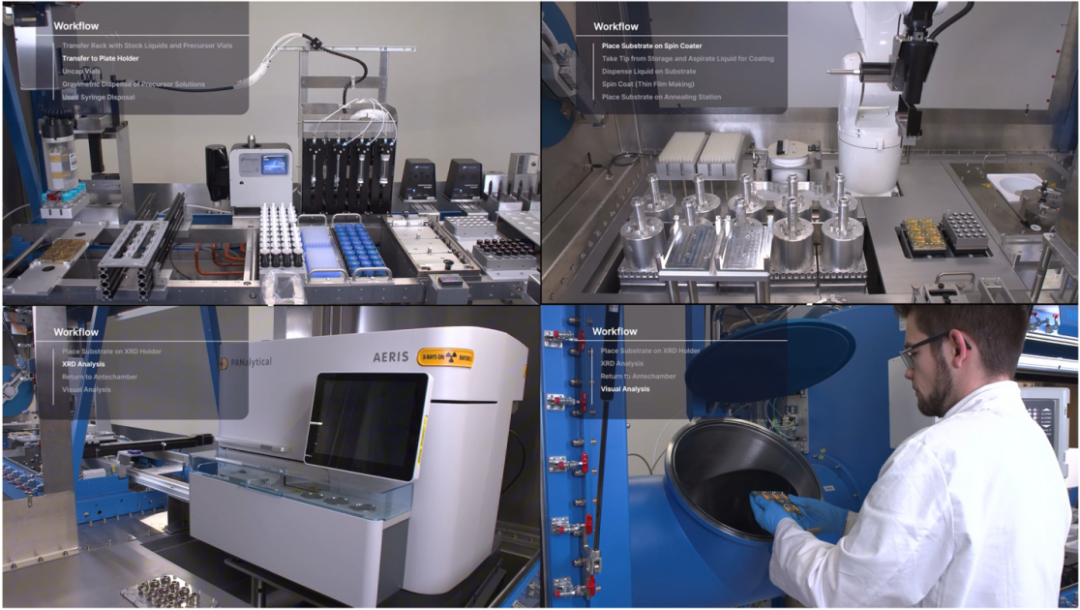
Caption: Perovskite automated laboratory

For a materials AI company, designing a material with excellent performance is only the first step. A material's economic value doesn't lie in the moment it's designed, but in the moment it's stably mass-produced and sold.
When a material moves from the Lab into the factory, production scale may go from a few grams to several tons, and the original experimental conditions — temperature, raw-material ratios, and so on — may not transfer directly. Even if it can be produced, you still have to consider cost, whether product quality is stable, and whether it can pass downstream customer validation. Xie Tong believes that research papers and theoretical calculations can help AI understand a material's properties, but they can't necessarily tell it how a material should actually be manufactured in a factory. Specific conditions such as equipment temperature, production scale, cost, and environmental requirements often only become clear once you're in a real industrial setting.
By working with materials companies and their upstream and downstream partners, Lvdong Zaowu gets into customers' real production lines and validates material solutions under production conditions. Customers can provide the standards for whether a material is usable, and can also help AI rule out, at the design stage, solutions that don't meet production requirements.
Through a business model of model services and joint R&D, the company has now established strategic partnerships with several leading international materials and chemicals companies. The first batch of partnerships has entered commercial acceptance, nearly 10 AI-natively developed materials have achieved mass production, and it has delivered commercial orders in the tens of millions of yuan to customers with ten-thousand-ton production lines.

As AI begins to take part in real experiments, a new problem emerges: AI designs materials far faster than the Lab can verify them.
Today's large-model training systems are mainly designed around tasks like coding and math, where AI can get feedback relatively quickly. But if what AI has designed is a new material, the result can only be known through a real experiment — and different materials require different experiment times, some finishing in minutes, others taking hours.
So for AI to truly keep learning from materials experiments, the underlying system needs reworking so the model can efficiently and stably use these experiment results as they come back.
Lvdong Zaowu has made targeted modifications to the training system and set up a dedicated Infra team. On one hand, they readjust task scheduling and compute allocation to reduce unnecessary waiting and resource conflicts; on the other, by filtering out anomalous training signals and controlling the magnitude of each round of parameter updates, they reduce the risk of drastic fluctuations during training. This work gradually became Lvdong Zaowu's technical foundation: Byte Infra.
In Xie Tong's view, as general-purpose large models keep advancing, it may become easier and easier for AI to propose a scientific hypothesis in the future. The real difficulty is how to verify it in the real world, and make every verification become experience that helps AI keep improving. This is also the direction Lvdong Zaowu hopes to invest in for the long term.