AI Tech Drives Down Enzymatic DNA Synthesis Costs, Enzymo Technology Raises Tens of Millions in Angel Round Led by Linear Capital

Achieve de novo DNA synthesis at one-tenth the cost of chemical methods.
De novo DNA synthesis at one-tenth the cost of chemical methods.
By Zeyu Chang, edited by Ruojing Hai
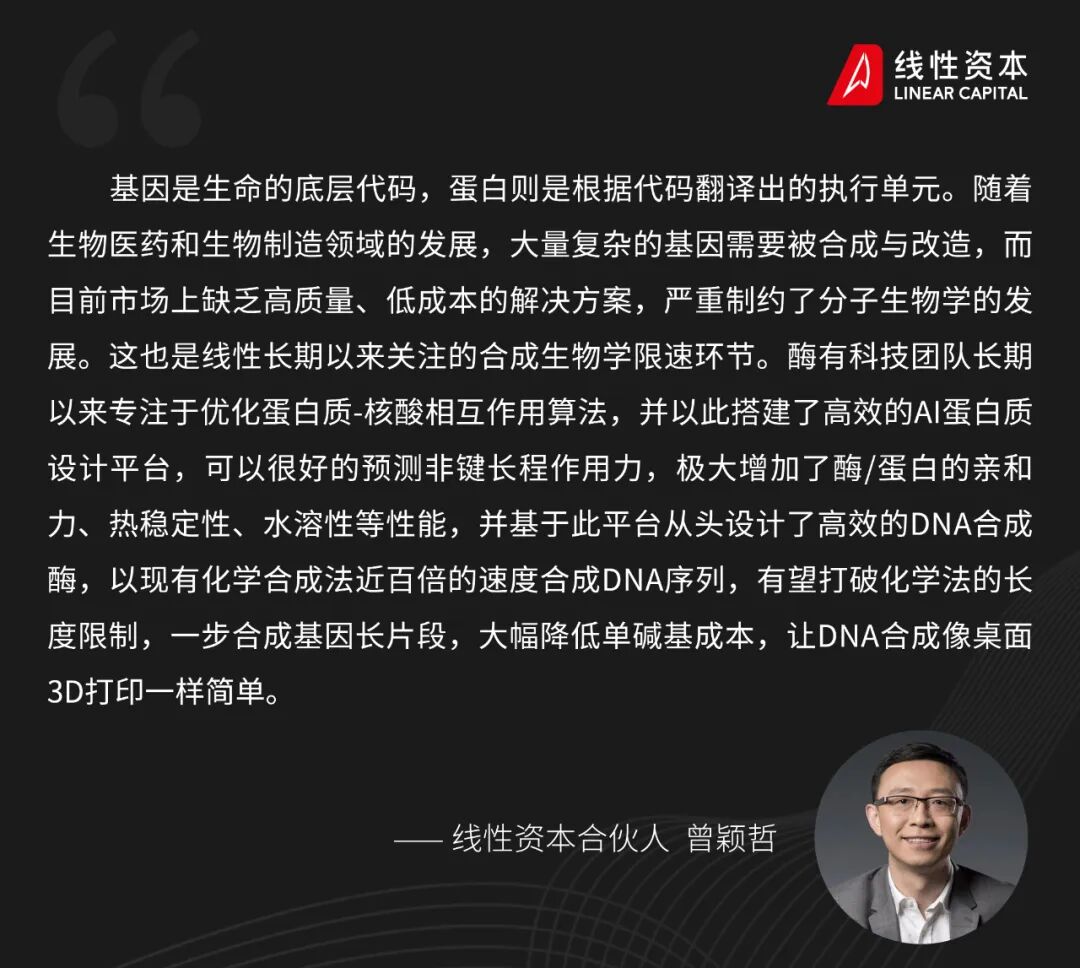
36Kr has learned that EnzymeTech recently completed a tens-of-millions-of-RMB angel round led by Linear Capital, with MiraclePlus and Danen Capital participating. The funding will primarily go toward experimental advancement of enzymatic DNA synthesis, instrument R&D, and team building.
Founded in March 2023, EnzymeTech is dedicated to designing enzyme molecular machines for efficient DNA synthesis through the development of protein-nucleic acid interaction algorithms. This enables low-cost, large-scale de novo gene synthesis, generating massive amounts of high-quality biomolecular data to bridge large AI models with the microscopic molecular world.
DNA synthesis is regarded as a foundational technology for synthetic biology. The field involves encoding and engineering genes to redesign and construct novel biological systems, with broad applications in medicine, agriculture, energy, and beyond. According to the 2024-2030 China Synthetic Biology Industry Market Deep Analysis and Investment Potential Forecast Report, the domestic synthetic biology market exceeded 8 billion RMB in 2023 and is projected to surpass 10 billion RMB in 2024.
The dominant DNA synthesis technology currently is chemical synthesis (solid-phase phosphoramidite triester synthesis). While this method adequately meets the needs for short DNA fragment synthesis, it holds no advantage for long-fragment or even chromosome-level DNA synthesis, and carries high costs.
"Right now, de novo gene synthesis using chemical methods still costs anywhere from several hundred to several thousand RMB per gene," EnzymeTech co-founder Yu Fan told 36Kr. "That means obtaining 1,000 de novo synthesized genes would run into the hundreds of thousands or even millions of RMB, creating a bottleneck for large-scale gene synthesis and de novo protein design."
Research into enzymatic DNA synthesis began accelerating around 2020. Leveraging enzymatic reactions, this approach promises to synthesize longer DNA molecules at lower cost, potentially breaking through the limitations of chemical synthesis.
Fan explained the principle of enzymatic DNA synthesis using "biomimicry" as an analogy: "The human body contains 3 billion base pairs and tens of thousands of genes, with DNA being synthesized every moment by exquisitely crafted enzyme molecular machines. From a biomimetic perspective, we're learning from nature's nanotechnology — getting enzymes to add nucleotides one by one according to a designed DNA base sequence."
Currently, enzymatic DNA synthesis companies on the global market primarily rely on TdT enzyme-dominated methods. However, persistently high synthesis material costs — such as expenses for modified nucleotides — have become a significant barrier to commercialization.
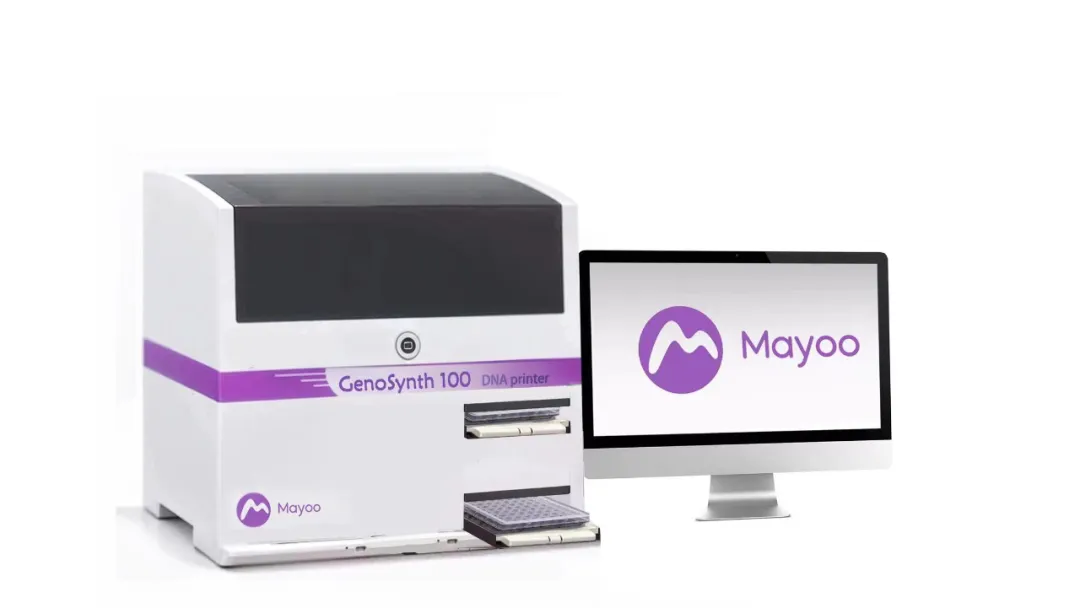
Image source: EnzymeTech
Unlike mainstream enzymatic DNA synthesis companies, EnzymeTech uses AI to design entirely new DNA synthesis enzymes from scratch, capable of catalyzing low-cost unmodified nucleotides — potentially slashing DNA synthesis costs dramatically. Fan told 36Kr: "In our currently validated technology, costs can be reduced to 10% of chemical methods. After many rounds of design and optimization, our synthesis accuracy has already reached application-ready levels."
Enzymatic DNA synthesis must address not just the synthesis method itself, but also requires developing equipment compatible with enzyme reaction systems — a highly challenging and moat-worthy domain. EnzymeTech is reportedly already in discussions with R&D personnel from chip and semiconductor companies regarding high-throughput enzymatic synthesis instruments.
Fan noted that EnzymeTech has not yet officially launched DNA synthesis services, but is conducting some small-scale collaborations: "We help some familiar clients with complex gene synthesis products. For instance, some clients have needs for ultra-long gene synthesis with very high GC content, which gets extremely expensive quotes on the market. We can use our technology to deliver at one-tenth the market price. Meanwhile, our nucleic acid-protein interaction algorithm is already serving downstream companies with nucleic acid enzyme modification and design needs." Large-scale commercialization is expected to push forward around mid-to-late 2025.
About Linear Capital
Linear Capital is an early-stage investment firm focused on "frontier technology + industry" — frontier technologies represented by data intelligence, digital new infrastructure, next-generation robotics, and new technological transformations in traditional sectors (such as biomedicine, materials, and energy), applied across vertical industries to dramatically improve industrial efficiency, empower solutions to pain points, and enable industrial upgrading. Through substantial increases in industrial value, the firm achieves outsized returns in commercial value. It currently manages ten funds with total AUM of approximately $2 billion.
Our investment stage focuses on leading angel to Series A rounds, with individual ticket sizes ranging from $1 million to $10 million (or RMB equivalent).
To date, we have made early-stage investments in over 120 teams, including Horizon Robotics, Kujiale, Sensors Data, Tezign, Rokid, Guandata, and Agile Robots. The combined valuation of Linear Capital's portfolio companies stands at approximately $20 billion.
In the near term, Linear Capital is working to become the premier "Data Intelligence Technology Fund," with a long-term vision of building the most influential "Frontier Technology Application Fund."