Linear Capital Portfolio Company | AIGC + RPA: Yunnatech Builds End-to-End Natural Language-Driven Automated Workflow Generator "Magic i"

The buzz around AIGC keeps building, and a new wave of AI is surging in.
The buzz around AIGC keeps building, and a new wave of AI is surging in.
Whether it's ChatGPT, which has taken the world by storm, or the large-model AI products being rolled out by tech giants — Baidu's "Ernie Bot," Microsoft's "Microsoft 365 Copilot," and others — all are becoming landmark events in the history of technological revolutions at a pace that exceeds expectations, driving profound transformation in productivity.
This also signals that the AIGC track is heading toward massive industrial expansion. Generative AI is rapidly spawning an entirely new technological revolution — a new system, structure, and ecosystem that is reshaping the very foundations of every industry.
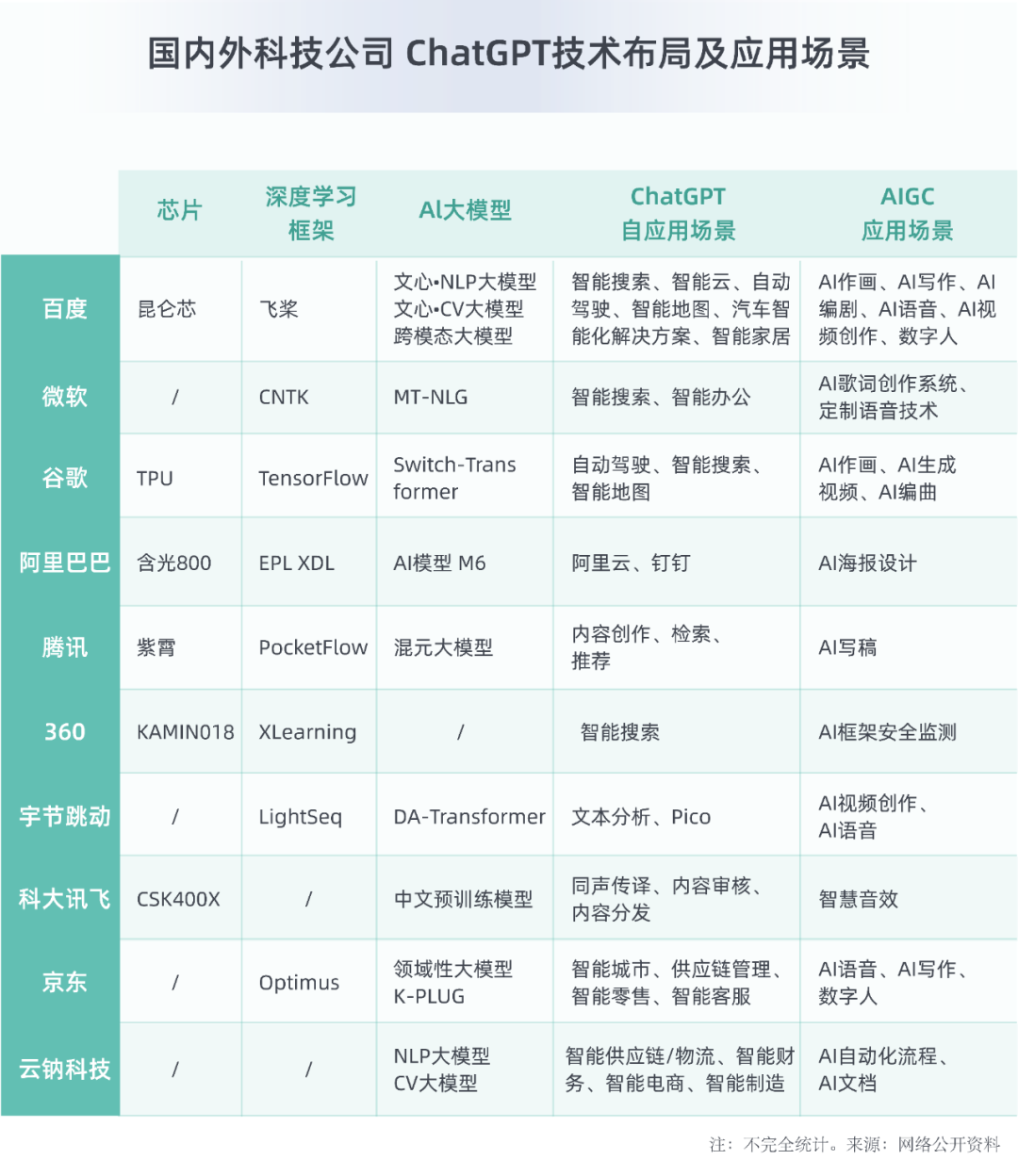
Riding this wave, Yunna Technology has integrated AIGC into its "loosely coupled Magic Image RPA product suite" and its "scenario-based industry workbench product suite," while also building an end-to-end, natural language-driven process auto-generation product called "Magic i" to explore more application scenarios. The goal is to achieve more efficient AI-driven automation and application building, helping enterprises achieve agile digital transformation at lower cost.

Why has AIGC caused such an industry sensation?
AIGC applications represented by ChatGPT may seem to have exploded overnight, but they are actually the result of years of technological accumulation.
Since the concept of artificial intelligence (AI) was first proposed in 1956, more than six decades have passed. Over these 60 years, AI has gone through cycles of boom, winter, and wild growth.
In the early days of AI development, computer vision technology centered on CNN (Convolutional Neural Network) models kicked off the era of AI perceptual intelligence. Machines began surpassing humans in areas like computer vision and natural language understanding. However, constrained by various factors, most algorithms relied on predefined rules or templates — far from true intelligence.
Today, the reason ChatGPT and GPT-4 have caused such a stir is that they can generate new content beyond fixed rules, producing something that approaches genuine artificial intelligence.
This stems primarily from the recent emergence of deep learning generative algorithms such as Generative Adversarial Networks (GAN), Transformer, and Diffusion Models, which have accumulated quantitative changes leading to qualitative transformation, thereby bringing about an entirely new world.
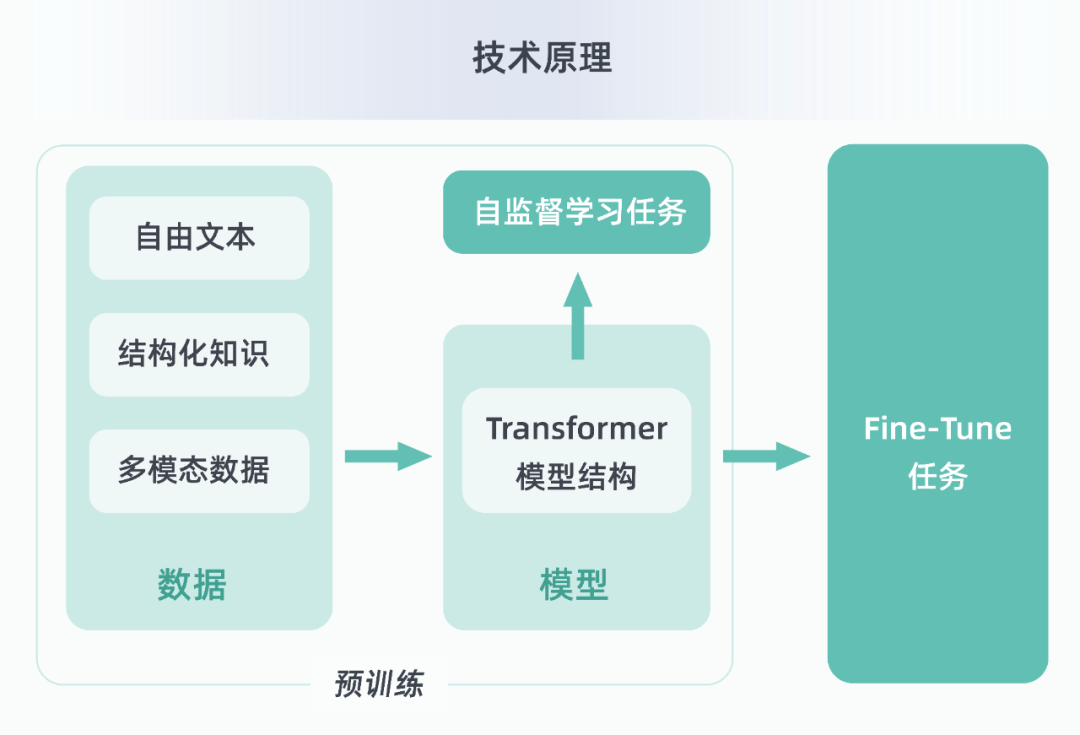
These generative AI technologies make AIGC applications like ChatGPT appear more like a thinking "child" — with rich expressive capabilities and logical reasoning abilities — capable of generating text, code, images, audio, video, and even cross-modal content, providing more humanized insights and interactions, and offering new solutions for human creative generation.
At the same time, through fine-tuning and other methods to adapt to and execute diverse tasks, they truly promise to achieve platform-level effects, thereby exploring opportunities for commercial application innovation.
Furthermore, they have significantly lowered the barrier to entry for users, moving from Artificial Narrow Intelligence (ANI) toward Artificial General Intelligence (AGI). In other words, the production relationship has shifted from "a small minority controlling the tools and channels of production" to "more people gaining access to low-cost tools and platforms, facilitating widespread content distribution and sharing." Content consumers have also transformed from "passive recipients" to "active participants and creators," achieving a dual revolution in both production and consumption.

AIGC + RPA
Yunna to Build Next-Generation Product "Magic i"
Technological updates often foreshadow opportunities for industrial upgrading. When a new technology or tool emerges, those who leverage it most effectively gain the upper hand. The beneficiaries of this productivity revolution may not only be the inventors of AIGC technology, but also the pioneers who push AIGC to its limits through model innovation.
Yunna Technology keeps pace with the times, achieving technical complementarity through integration and fully leveraging each technology's strengths to build more powerful hyper-automation solutions. Recently, it preliminarily integrated "Magic Image RPA" with ChatGPT (🔍Details: Magic Image RPA + ChatGPT | Building an RPA Workflow Is Just a Sentence Away), enabling RPA workflow development driven by natural language.
In fact, even before ChatGPT became a sensation, Yunna Technology had already explored and developed intelligent products integrated into RPA automation workflows, such as its IDP product "Magic Cube" and video intelligent recognition product "Magic Eye". Whether text, images, or video, all can be interacted with and understood while driving automated workflows — already pioneering innovation in RPA.
Beyond this, we will continue to deeply integrate with AIGC, building an end-to-end, natural language-driven process auto-generation product called "Magic i," opening a new chapter in de-structured interaction: through AIGC technology, it recognizes and understands the operational steps of a scenario to automatically form a unified PDD (Process Description Document), which users can customize, correct, and optimize. Based on machine learning, IDP, knowledge graphs, and other related technologies, it then automatically generates RPA workflows. After testing and debugging, these become deployable RPA digital robots.
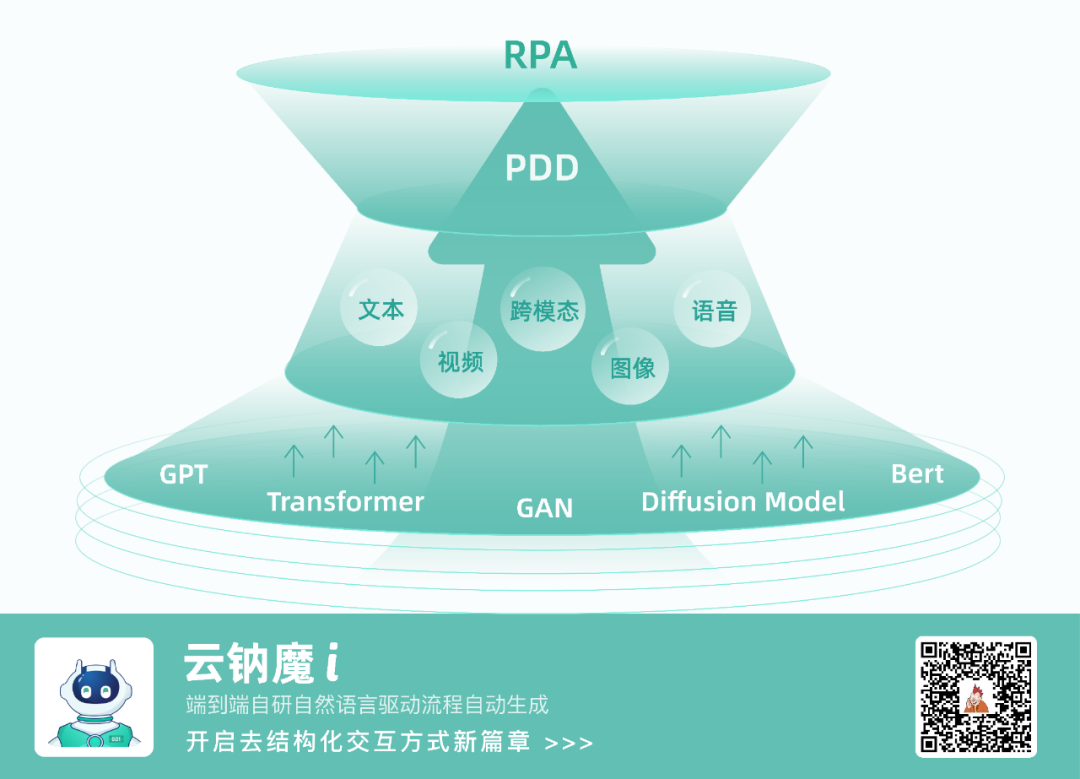
Compared to traditional RPA, the next-generation product "Magic i" offers advantages including shorter chains, higher efficiency, lower costs, greater intelligence, and CoE empowerment:
■ Shorter chains, higher efficiency. Traditional RPA requires process mapping — ROI evaluation — leadership approval — bidding and product selection, a lengthy chain. Integrated with AIGC technology, users only need to describe requirements in natural language to rapidly auto-build end-to-end process documents and auto-generate code, achieving RPA robot POC or deployment, quickly validating ROI and supporting decision-making. The entire chain is shorter and more efficient.
■ Lower costs. End-to-end natural language-driven process auto-generation can significantly reduce user access costs and decision costs.
■ Greater intelligence based on Yunna's proprietary domain data and algorithms. Users can customize descriptions and modify documents, making it more personalized and intelligent.
■ CoE empowerment. "Magic i" can more flexibly meet the needs of enterprises at different types and stages. In the future, business users themselves will be able to easily complete closed-loop automation scenario building, helping enterprises rapidly develop CoE capabilities (What is CoE? 🔍Details: Ignore This, and Your Enterprise Automation Could Go Off the Rails! (Part 1)/Ignore This, and Your Enterprise Automation Could Go Off the Rails! (Part 2)).
Currently, the product has moved from internal testing and pilot对接 to small-scale trial use, and will soon achieve the leap from 0 to 1.

Making AI Better Aligned with Customer Needs
Exploring More Scenario-Based Applications
There is no doubt that AIGC has kicked off a new round of AI technological transformation. With its efficient generative AI "magic," it is racing down the path to becoming a mainstream productivity tool.
For AI industrial deployment, through the "pre-trained large model + downstream task fine-tuning" paradigm, AI applications are knocking on the door of AGI, making technological equity within reach. On this foundation, existing AI application scenarios will be executed more deeply. At the same time, AI will penetrate more scenarios. But only by making AI better aligned with customer needs can true commercial deployment be achieved.
Yunna Technology consistently practices a customer-success-centric, user-first principle. This means we are guided by customer needs and accountable for results. Currently, we have served numerous clients including Deppon, COSCO Shipping, Kerry EAS, China Eastern Logistics, Geely, Chint, and Marssenger, accumulating rich service cases and experience. We are extracting vertical domain business processes and forging ahead in technology and product innovation. By integrating AIGC technology, we are actively exploring more scenario-based applications, hoping to deliver truly recognized落地 value for our customers. For example:
■ Supply chain/logistics: Using AI+RPA technology to optimize the entire supply chain, connecting multiple logistics business systems, achieving intelligent refined operations across multiple links, activating organizational momentum, and improving human efficiency. For instance, through natural language human-machine interaction, more conveniently completing data/document entry, statistics, organization, and more.
■ E-commerce: AI+RPA can improve customer experience and increase sales through personalized recommendations and customer service. For example, generating product copy, marketing content, and operational data.
■ Finance: AI+RPA can be used for auditing, analysis, reporting, and even decision-making. Examples include intelligent customer service for financial shared services, intelligent accounting transaction processing, financial digital employees, and financial analysis reports.
■ Manufacturing: Using AI+RPA technology for work-in-process workflow management and optimization, improving efficiency in connecting multiple processes including production, inventory, and logistics.
...
Perhaps the disruptive changes AIGC will bring to every industry are only just beginning. In the future, more killer applications, phenomenon-level products, and entirely new business models will emerge, containing enormous room for imagination. We will continue to lead trends and walk at the forefront of innovation...