Curing Your To-Do Anxiety with the World's Lightest, Thinnest AI Wearable Screen | Linear Voice

Redefining the relationship between people and information.
y'x

As AI enters everyday life and information multiplies, many of us have wondered: what actually deserves to be remembered, and what deserves to be carried through to completion?
In Shenzhen, a startup called NOOKLAB wants to answer that question. Its first product, the Moonphase Flip, is a 54-gram AI companion screen that magnetically attaches to the back of your phone, with always-on listening and more than two days of battery life. It unobtrusively records real-world conversations and surfaces what matters in a low-distraction way.
A few days ago, as an angel investor in NOOKLAB, Linear Capital sat down with founder Raymond Zhao at the company's office to talk about why — in an era already flooded with productivity apps — we still need a piece of hardware like this to free up our brains. And what design philosophy about people lies behind the product?
Thirty years ago, Mark Weiser and John Seely Brown of Xerox PARC introduced a concept in their essay Designing Calm Technology: calm technology — technology that provides information without demanding your focus and attention.
They divided attention into the "center" and the "periphery." Good technology moves between the two — entering the center when needed, and retreating to the periphery the rest of the time.
The essay offered an example called the "Dangling String." Artist Natalie Jeremijenko hung a roughly 2.4-meter plastic cord from a motor mounted on the ceiling, connected to the nearby Ethernet. When the network was busy, it spun quickly; when the network was quiet, it swayed only occasionally. It was placed in an unused corner of a hallway, visible and audible to many offices, without causing any disturbance.
You didn't have to stare at it to get a rough sense of whether the network was busy or idle.
But thirty years later, that vision remains hard to realize. Every app around us is fighting desperately for attention, and the front of our screens has almost no room left for the "periphery."
In Shenzhen, a startup called NOOKLAB wants to fill that gap.
NOOKLAB's first product is called the Moonphase Flip, a 54-gram AI companion screen — roughly the weight of a few credit cards in your hand. It magnetically attaches to the back of your phone, supports always-on listening, and lasts more than two days on a charge. It unobtrusively records real-world conversations, understands the people, events, and commitments within them, and then presents the results in a low-distraction way.
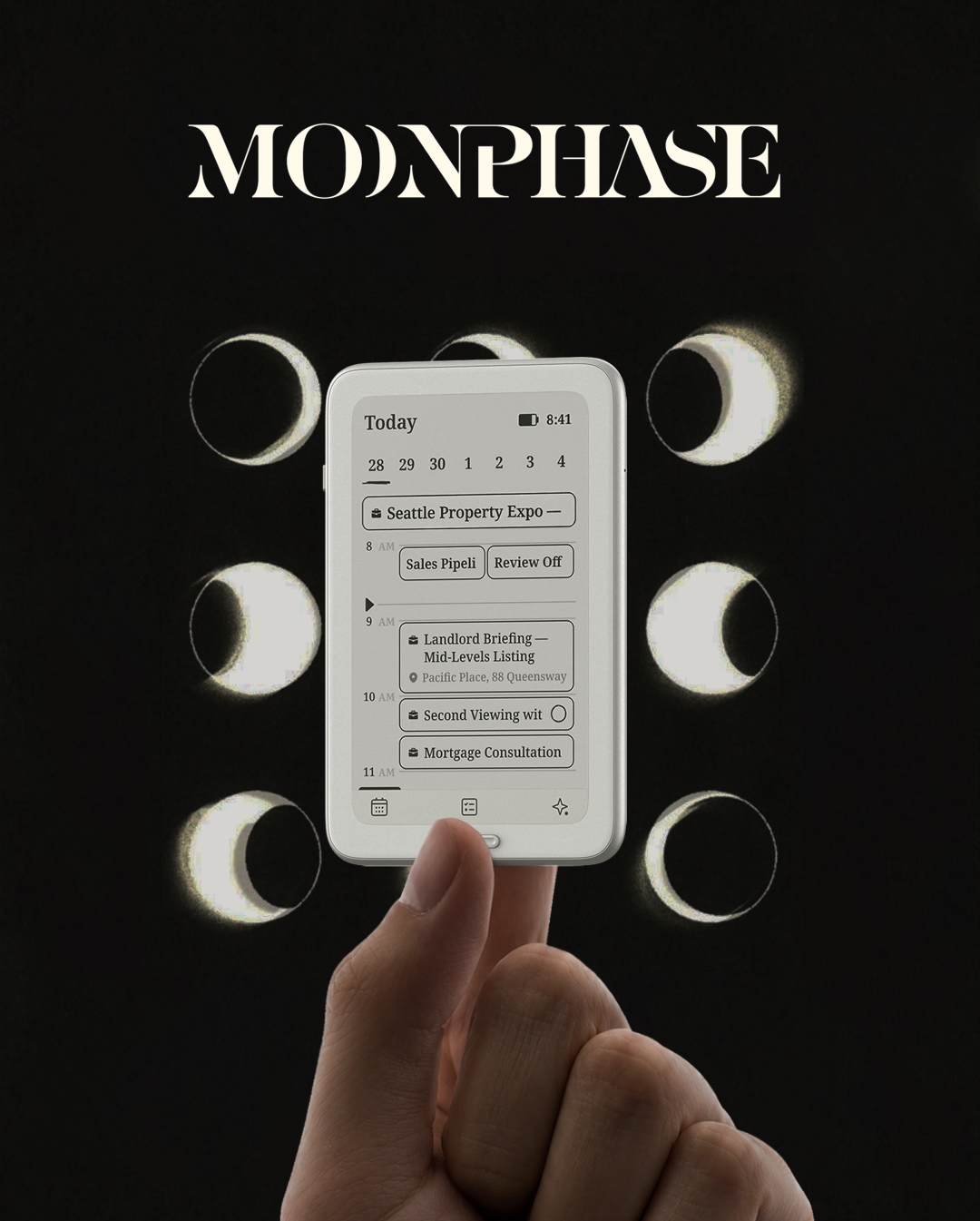
After an in-person conversation ends, the Moonphase Flip organizes the information into to-dos that stay persistently displayed on its screen. No push notifications, no reminders — just flip your phone over and it's there. The team calls it the world's lightest and thinnest AI companion screen**, with the first small batch expected to ship this December.
NOOKLAB founder Raymond defines it as "the world's first low-distraction AI companion screen." In the past, people had to actively accommodate their tools — recording, organizing, and managing information themselves. Now, NOOKLAB wants the tool to actively serve the person.
As an angel investor in the company, what drew us to NOOKLAB is that it takes on a problem that has been "solved" many times but never truly solved: as AI enters everyday life and information multiplies, what deserves to be remembered, and what deserves to be carried through to completion? Read on — enjoy:

As a hardware product manager with near-obsessive aesthetic standards, Raymond's team has led nine products into official Apple Store retail, with a design sensibility very close to the Apple ecosystem and a proven ability to shrink products to their absolute minimum. To this day, the industry's most compact three-in-one wireless charger is still their work.
Last October, Raymond left ByteDance, where he had been responsible for the second-generation AI glasses product. He is himself a heavy glasses user, with more than a dozen pairs at home that he rotates depending on the occasion.
When he set out to start his own company, Raymond's first idea was still to innovate on glasses. It wasn't until the ID designer produced a 3D-printed prototype that he began seriously considering how the product would actually be sold. Glasses need to fit different people's aesthetics and comfort, and they depend heavily on offline retail channels. Raymond realized the team would end up burning most of its energy on those issues, rather than using AI to create new value.
After working on it for over a month, he stopped and asked himself again: is there a position where the friction is low enough and the value high enough?
The first category Raymond ruled out was pure capture devices. "No matter where you put them on your body, they're just collectors. The actual service still has to come back to an app, and the experience has a gap." What Raymond was looking for wasn't another recording entry point, but a position where, after information is captured, the results can be handed directly back to the user.
The smartwatch, the fitness band, and the back of the phone made the final shortlist, and the team built designs and samples for all of them. But the watch and band were quickly eliminated too. That judgment came from Raymond's experience building the first smartwatch at OnePlus. At the time, the team had to choose between supporting third-party apps and delivering long battery life. User interviews showed that a week after buying an Apple Watch, most people stopped installing new apps — the only things they used long-term were health, fitness, and watch faces.
The problem wasn't the number of apps; it was where the screen sits. The posture of the wrist and the limited display area simply aren't suited to deep interaction. The OnePlus watch ultimately chose the long-battery-life approach and sold nearly 300,000 units, far exceeding the initial target of 100,000 to 150,000.
By contrast, the back of the phone is a ready-made, stable position. There, a companion screen can stay with the phone at all times without adding any wearing burden. As a standalone piece of hardware, it can listen continuously and provide a screen that no other app can occupy, keeping the AI-organized information always in view.
Raymond also noticed that many heavy users of AI coding tools install plugins at the notch area at the top of their Macs, letting the AI interact with them in stages there. These users were proactively carving out a spot for AI at the edge of their screens.
There's no room for that on the front of a phone — so Raymond chose to add a screen on the back.

Why does the information people generate in real life so often vanish before it ever becomes action? Perhaps because information management tools always require you to open your phone — and opening your phone may itself be the start of losing control of your information.
The first thing the Moonphase Flip solves is lowering the cost of the "recording" step. It supports always-on listening, so users don't have to repeatedly turn it on and off. When a conversation ends, a one-sentence summary appears on the screen, along with three to five system-identified to-dos, and the user decides which ones to keep.
That choice is itself feedback. If a user keeps items one and three and deletes item two, the system gradually learns to distinguish which things will actually get done and which just happened to come up in conversation. The more it's used, the closer the companion screen's ranking gets to the user's own judgment.
Most software never gets this kind of feedback. Once information is generated, it's filed back into an app. You save 100 meeting notes, but you might actually revisit two of them. Once information leaves your sight, the system doesn't know what matters — and the user finds it harder and harder to locate what matters.
As Raymond puts it: "All the information is like it's buried in a drawer. You save 100 meeting notes and maybe look at two. The content generated in there is far away from you, so it has no idea which parts are useful to you."
What the Moonphase Flip ultimately organizes is more than a checklist. It tries to build two threads: one around projects, grouping related information together over time; the other around people, recording who you've talked with recently, what you promised, and what the next step should be.
"A good founder, a good salesperson, a good professional manager — they all carry two maps in their head," Raymond believes. "One is a map of things. The other is a map of people."
The team interviewed many CEOs, founders, salespeople, lawyers, and real estate agents in North America. These people's work depends heavily on verbal communication, and a single omission can affect their income and reputation.
One real estate lawyer said he misheard information about a client's family where father and son shared the same name, causing errors throughout an entire document. Another, a concert promoter, was driving when a client asked him to book a flight; he thought he'd handle it after parking, forgot about it until the day before the event, and ended up paying three times the price. The money was secondary, he said — what really stung was that this kind of omission kept happening, and both his work and his life fell into disorder along with it.
In the interviews, the team asked one respondent directly: "Your phone can do all these things. Why do you think you need a piece of hardware?"
The user replied: "Every time I open my phone, information floods in and pulls me away. Five minutes later, I can't remember what I was about to do."
That is exactly the problem NOOKLAB wants to solve. AI assistants that depend on the user "opening" them to deliver value end up having to remind the user more and more frequently — and the more reminders there are, the lower the value of each one.
In the calm technology framework, the periphery is not the end point of information. What matters is whether a person can bring information back to the center of attention when needed, and act on it. The Moonphase Flip chooses to leave that move to the user. It doesn't ask you to keep coming back to look for information, and it doesn't try to drag you back into an app with one reminder after another. Once information is generated, it stays on the screen on the back of your phone; whether to actually act on it is up to you.
For that reason, the Moonphase Flip does almost no proactive pushing. It works more like a calendar sitting next to you, Raymond says — "you can see it out of the corner of your eye."
But a device that "doesn't disturb" first has to avoid becoming a new burden.
After testing, the team found that anything over 60 grams is hard for people to truly carry every day, so they shaved the weight down gram by gram starting from 60, finally landing at 54. For thickness, the team drew on the space-stacking methods used in foldable phones. They also didn't follow Apple's standard for the magnetic attachment, because 6 to 9 newtons of magnetic force comes with a corresponding thickness requirement — the team ultimately went with a fully non-standard solution. Battery life, not counting sleep time, reaches three days in real-world testing.
These numbers come from Raymond's past six years of hardware experience. He studied integrated circuit design as an undergraduate and joined OnePlus after graduation to work on phones and smartwatches. At OPPO, working on the "small foldable" phone, he built up experience in space stacking; and a year and a half at Anker working on wireless chargers taught him the engineering details of the MagSafe position inside and out.
It was also at Anker that he gradually formed his judgment about product value: "From the day AirPods launched until now, have they ever talked about their rich feature set or sound quality? No. They hammered one thing: eliminating the step where you have to untangle wires. But multiply that one step by countless uses, and it becomes an enormous difference."
For the Moonphase Flip, the step being eliminated is no longer untangling wires — it's repeatedly opening your phone, hunting for information, and trying to recall what you were just about to do.**

More than thirty years ago, that piece of string turned invisible network traffic into a kind of motion you could sense without ever having to pay it deliberate attention.
Now, the Moonphase Flip wants to handle another, more complex kind of "traffic": the intentions scattered across conversations, meetings, messages, and daily tasks.
The periphery is not a storage bin for information. With so much information generated in a day, what deserves to be seen? What deserves to be remembered? What deserves to be carried through to completion? Raymond calls this the "main thread."
Raymond once drew a diagram to explain where the Moonphase Flip sits: the model on one end, the person on the other. Given enough context, a model can produce stable output; people generate enormous amounts of information every day, yet the parts that truly matter are hard to identify consistently. Raymond placed the Moonphase Flip in between.
Over the past year or two, a wave of AI hardware has hit the market. Most of these products add senses to devices, letting them hear more and see more. But the Moonphase Flip chose not to add yet another collection entry point — instead, it keeps the AI-organized results in a position that is close enough, yet doesn't disturb.
During the most stressful period at his previous job, Raymond set up a whiteboard at home: principles at the top, goals in the middle, and progress on specific tasks below. Only when all of it was laid out together did he realize that many things that seemed urgent and important actually had nothing to do with the goals he most wanted to push forward.
"I used to think the information was just messy and overwhelming. In fact, it simply wasn't on my main thread."
That whiteboard is still in his home today. But a whiteboard requires active management and constant cross-checking. What the Moonphase Flip aims to be is its portable version: continuously taking in information, helping you judge what deserves to stay, and then putting the important things in front of your eyes.
"The internet solved how information reaches everyone," Raymond says. "AI will further lower the barrier to generating new information. In the future, everyone will face even more complex information and capabilities — but that doesn't mean our lives will get better. They could get messier."
"In the end, everyone has to answer one question: what actually matters to me. A lot of people will get lost. Some people will find their own main thread," Raymond says.