"AIVELA" Closes Tens of Millions in Angel Round Led by Linear Capital | Linear Portfolio

A Veteran Entrepreneur's Solo Hardware Experiment
Today, consumer smart hardware brand "AIVELA" announced it has raised several million dollars in angel funding, led by Linear Capital with participation from Fengling Capital and strategic investors including URTOPIA, to build an AI wearable brand for the global market.
Unlike traditional monitoring-focused smart rings, AIVELA adds contextual interaction capabilities, introducing optical fingertip interaction technology. To date, its first product, the AIVELA Ring Pro, has surpassed 10,000 units in global crowdfunding, raising over 10 million RMB, with plans to enter the mass market in the second half of this year.
As the lead investor in AIVELA, we at Linear Capital were drawn to founder Donghao Li as a battle-tested serial entrepreneur who single-handedly took the Ring Pro from product definition through crowdfunding to mass production — demonstrating the resilient, execution-oriented founder spirit, while maintaining thoughtful taste and aesthetic judgment in product and brand.
Recently, Donghao Li, former co-founder and CFO of URTOPIA, officially left to launch consumer smart hardware brand AIVELA, building an AI wearable brand for the global market. The company has completed several million dollars in angel funding, led by Linear Capital with participation from Fengling Capital and strategic investors including URTOPIA.
According to publicly available Kickstarter data, its first product, the AIVELA Ring Pro, raised $860,000 in crowdfunding, with concurrent campaigns in Japan, Taiwan, and other markets. To date, the product has surpassed 10,000 units in global crowdfunding, raising over 10 million RMB, with plans to enter the mass market in the second half of this year.
AIVELA's timing is particularly interesting, as the smart ring sector is currently approaching a critical inflection point for major players. On May 21, 2026, global smart ring leader Oura formally filed a confidential IPO application with the U.S. SEC. If successful, Oura would become the first smart ring company to go public, and the largest player in the space.

In the smart wearable industry, most smart rings center on all-day, frictionless physiological monitoring, emphasizing high-precision medical-grade data collection and professional monitoring services across sleep, exercise, and health. AIVELA is also positioned in this category.
On hardware specs, the AIVELA Ring Pro matches flagship industry configurations, with built-in PPG heart rate sensors, IMU inertial measurement units, and temperature sensors, enabling 24/7 heart rate, blood oxygen, body temperature, and sleep monitoring, with AI-powered intelligent health recommendations.
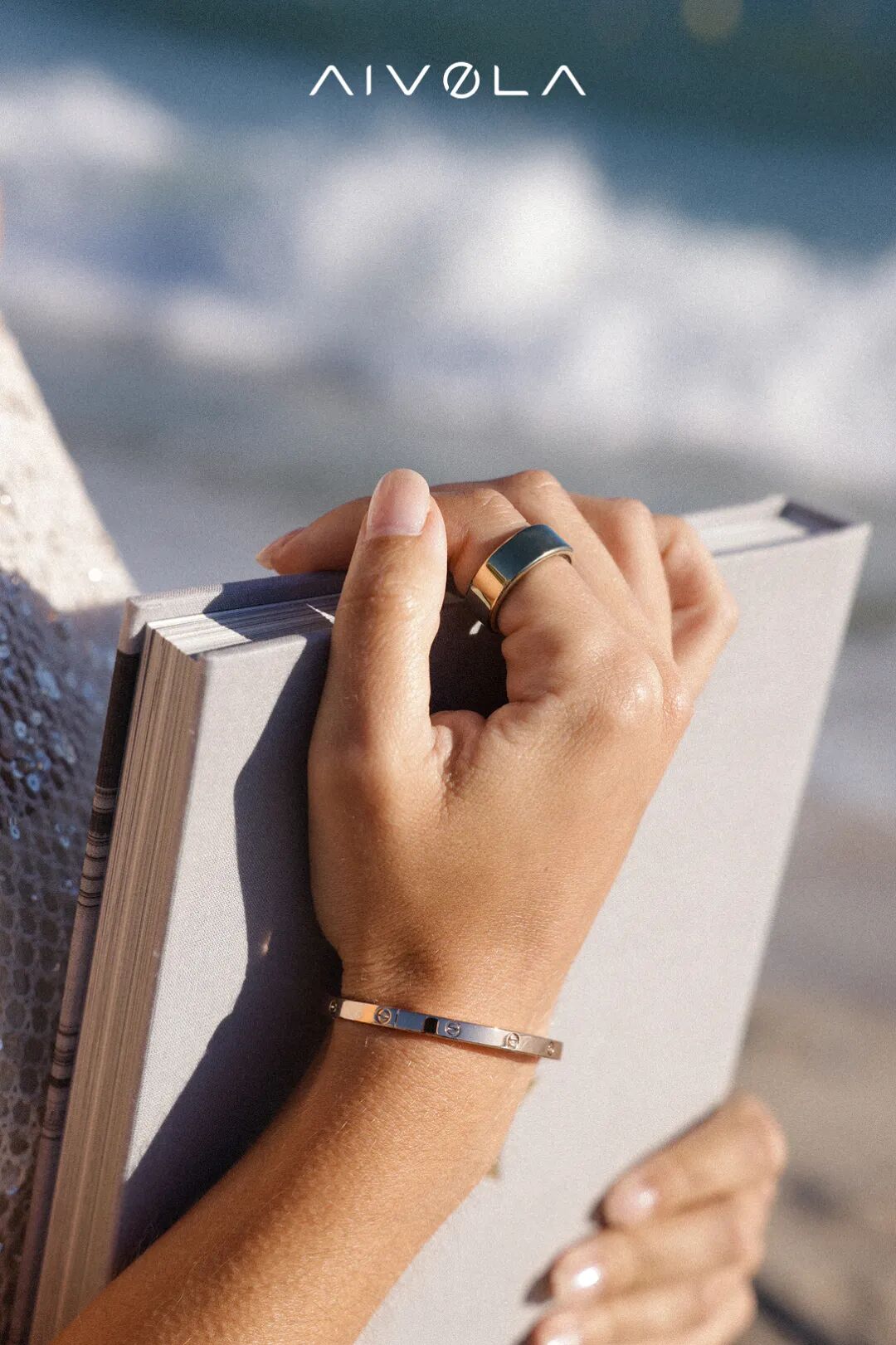
Unlike traditional monitoring-focused smart rings, AIVELA adds contextual interaction capabilities, introducing optical fingertip interaction technology. It supports eight touch commands and six air gestures, functioning as a "finger mouse" to control phones, computers, and smart devices via Bluetooth protocols — completing actions like page scrolling, short video browsing, volume adjustment, and camera shutter — expanding the utility of the smart ring beyond pure monitoring.
The AIVELA Ring Pro primarily targets overseas markets, with a target price band of $200–300. AIVELA is currently offering all basic features free to its first 10,000 seed users, and will later introduce a subscription model based on hardware algorithm optimization and AI Agent feature development, using continuous service iteration to improve user experience. Subscription pricing will reference Oura's $5.99 per month.

In 2023, Donghao Li developed severe insomnia due to entrepreneurial stress. A friend brought him an Oura from the United States. He had tried every watch before, but his wrists would always get irritated; Oura was the only sleep tracker he could wear long-term.
The problem was the experience. Oura measures three things: activity, readiness, and sleep. "I bought it because I had sleep problems, and every day it just criticized me," Li said. Every morning, Oura showed a low score saying he slept terribly.
"Once when I had insomnia, it was past 2 a.m. and I was already anxious. I had to secretly take off the Oura to fall asleep, because I didn't want to wake up to a terrible score."
Li characterizes Oura and WHOOP's style as "strict father" — harsh, clinical. "It really gives you a big red score saying you slept extremely poorly, with all subcategories marked red. For people who genuinely have sleep problems, that's a lot of pressure. If everything's red, what exactly am I supposed to improve?"
At the time, he was co-founder of URTOPIA, overseeing financing, strategy, operations, overseas after-sales, and U.S. offline channels. In 2025, URTOPIA's revenue was triple that of 2024; in 2026, U.S. sales grew 10x year-over-year, with stores expanding from 50 to 1,000. With the company entering a stable growth phase and having found partners to take over his responsibilities, this veteran entrepreneur finally freed up his hands to pursue something else interesting.

Li's move from URTOPIA into smart rings has received deep support from his former employer, including not just strategic investment but already-established offline distribution channels in Europe and the U.S. The two companies plan deeper collaboration when the timing is right.
"At 35, I was desperate for success, really wanted to prove myself," Li said. Now at 40, "URTOPIA is relatively successful, and pure ambition has been satisfied." He wants to create something between ages 40 and 50 that makes himself healthier, and can help people like him.
Li believes human health is fundamentally determined by behavior, and to influence behavior, you must first influence psychology.
What AIVELA aims to do is collect data and present facts to users in an emotionally intelligent, scientifically grounded way. He explains, "This is exactly the same as education. For a 'poor student,' don't tell them their test score — just tell them which areas to practice and correct. Once they start improving, selectively show them the progress: today 60, tomorrow 70, the day after 80... Under strong positive feedback, users naturally become 'good students.'"
Products like Oura lean clinical and harsh, a "dad energy" style that creates psychological pressure; the "mom energy" style offers caring reminders — noticing you stayed up late without scolding you, gently nudging you, asking with concern as bedtime approaches, using a softer, more caring approach to nudge users toward positive cycles.
AIVELA's AI Agent system, named "ARGO," he calls the "caring mother."

Li thought making a ring wouldn't be hard. Initially, his thinking was simple: isn't it just shrinking smartwatch sensors and stuffing them into a ring? How hard could it be? Only after diving into the supply chain did he discover that this thing under two centimeters in diameter is consumer electronics precision manufacturing's "hell difficulty level."
By late 2023, he had visited supply chains across China in his spare time, collecting over 20 proposals. The target markets for these solution providers were lower-tier markets in Southeast Asia, India, and Africa — unable to meet his expectations for a product experience "on par with Oura." Eventually Li found a top-tier consumer electronics manufacturer; the two sides hit it off immediately: Li's team would handle product definition and market strategy, while the partner managed engineering execution and supply chain, co-developing the product.
The project formally launched in mid-2024. Originally expected to take one year, it ended up taking a full 18 months.
Smart rings are deceptively simple — no screen, no interaction — so the evaluation criteria are equally simple: thin, light, narrow, comfortable. But meeting these seemingly basic requirements while ensuring sufficient battery life and accurate data is extraordinarily difficult.
The first problem was production yield. Smart rings are a new category, with extremely demanding requirements for component suppliers' tolerance control and ODM assembly precision. Li gives an example: "The curved battery consists of multiple stacked pieces with electrodes very close together, requiring laser spot welding. One second too short and it doesn't weld; one second too long and it burns through." Once problems occur, ring battery life degrades severely, and the device is not repairable.
Beyond yield, hardware design is riddled with hard constraints. The fingertip interaction component is an optical lens. To maintain the ring's aesthetic, the team needed to make the lens feel like a gemstone while ensuring a smooth, consistent surface. After major optical restructuring, the lens was ultimately shrunk to sesame-seed size. Additionally, cramming sensors, battery, motherboard, and optical modules into the ring's tiny interior space — with data precision, communication stability, and power consumption control — each element affects all the others. Li states that "this product's engineering difficulty is higher than Oura's."
Despite the difficulties, Li sees this as precisely the opportunity for Chinese players.
Oura's supply chain was originally based in Eastern Europe, with high costs and insufficient production flexibility. China has the world's most mature precision manufacturing supply chain. As long as a brand can articulate clear, correct product requirements, producing hardware quality on par with Oura is only a matter of time.
But this time, Li doesn't want to merely make a "Chinese Oura." In his view, matching Oura on hardware is just passing grade; what truly creates distance is understanding users, and the experience revolution brought by AI.
He believes a ring is first jewelry, then electronics. If it isn't attractive and comfortable enough, users won't even give it a chance to prove its accuracy. To this end, the first-generation AIVELA Ring Pro specifically enlisted German industrial design legend Hartmut Esslinger. The designer who created Apple's "Snow White" design language, known for his minimalist style, balanced functional structure and visual quality within the ring's tiny volume. The second-generation product currently in development has brought in a Bulgari designer to refine details, working on bevels and luster to make the ring "softer, more beautiful," with plans to use ceramic material for color variety and scratch resistance.
Meanwhile, AIVELA differentiates through its AI Agent experience. Rather than forcing users to fill out questionnaires, it collects information through casual daily conversation, completing a Big Five personality profile without users noticing, then matching one of 12 preset personalities to interact with the user long-term. Li gives an example of "emotional intelligence" —
If a user stays up late watching the World Cup, a "strict father" product like Oura would give a very low score the next morning. If their team also lost, the user might want to throw the ring away.
AIVELA's approach: noticing the user normally sleeps at midnight but recently shifted to 3 a.m., it doesn't rush to criticize. First it asks, "What's going on?" The user says they're watching the World Cup. Then it asks, "Which team do you support?" If the answer is Germany, it marks all Germany's match times, proactively relaxing scoring standards on match days rather than penalizing the user for staying up to watch.

When asked whether AIVELA will compete with Oura for market share, Li offered his assessment: "Smart rings could become the second major consumer electronics phenomenon after TWS earbuds. You're not really stealing Oura's users, because the users are everybody."
Oura's early core users were predominantly young women, roughly 70%, directly tied to the brand's positioning around women's health monitoring. Around August 2024, driven by Samsung's entry raising industry visibility, Oura accelerated its breakout, with user scale entering a sustained upward trajectory.
In Li's view, Oura has now completely broken out of the early adopter circle, successfully crossing the technology adoption chasm and formally entering the mass consumer market. In core U.S. cities like Los Angeles, San Francisco, and New York, Oura has achieved notably high visibility in everyday scenes.
He judges that when a consumer electronics category enters the mass market stage, user profile boundaries gradually dissolve, ultimately achieving full population coverage — identical to the TWS earbud adoption logic. Smart rings could become the second major consumer electronics phenomenon after TWS earbuds, with ample incremental market space where players aren't fighting over existing users but collectively opening up a broader mass market.
The primary market has responded swiftly. Over the past period, several smart ring companies averaging just one year since founding have also raised funding in quick succession.
The smart ring market base is small but growing at astonishing speed. Omdia data shows global smart ring shipments exceeded 850,000 units in 2023, grew to 1.8 million in 2024, and are projected to surpass 4 million for full-year 2025. Global Market Insights forecasts that the global smart ring market will grow from $1.01 billion in 2026 to $7.8 billion by 2035, a 25.4% compound annual growth rate.
From a product form perspective, smart rings closely resemble TWS earbuds: both are all-day, low-friction wearable devices solving the wearing pain points of traditional wearables. Compared against TWS earbud development trajectory, these numbers become more intriguing.
TWS earbuds originated in 2014 with German brand Bragi's Dash on crowdfunding platform Kickstarter, the world's first publicly available true wireless earbud, initially defining the TWS form factor. But limited by Bluetooth architecture flaws at the time, the product suffered from unstable connections, high latency, and short battery life — remaining in niche exploration without achieving scaled market formation.
The true inflection point pushing TWS to mass market was Apple's first-generation AirPods in 2016. From the 2016 AirPods launch to becoming a hundred-billion-dollar market, TWS earbuds took nearly a decade. Smart rings went from 850,000 units in 2023 to a projected 4 million in 2025 — nearly fivefold growth in two years.
Compared to mature TWS earbuds, smart rings remain in early stages and face even higher hardware manufacturing barriers.
On the hardware level, this ring under two centimeters in diameter still has yield rates stuck around 60%. Oura spent ten years fitting antennas into all-metal bodies and achieving week-long battery life. Any new player faces the same challenges.
The competitive landscape is equally brutal. Oura dominates with 74% market share; Samsung launched the Galaxy Ring in 2024; RingConn holds steady as the leading domestic smart ring player. AIVELA appears relatively young against these companies.
Li has his own logic: "Catching up to Oura on hardware is a high-probability event. But after catching up on hardware, how do you do better than Oura in other dimensions? Otherwise you're just a copycat, you don't become a brand."
AIVELA is betting on the experience differentiation brought by AI Agent: being the "caring mother" who doesn't scold you, rather than another "strict father."