Chinese Founders' Silicon Valley Chronicle: The Growth, Controversy, and Dreams Behind a Tens-of-Millions Dollar ARR | Linear Voice

It's not just an AI interview cheating tool.

Today, globalization has become the default strategy for nearly every Chinese AI application company trying to break out. For Chinese founders, how do you put down roots in Silicon Valley itself and jump straight onto the fast track of global growth? The story of Final Round AI might offer some pointers.
Founded by serial entrepreneur Michael Guan, born in 1997, the company went from zero to over 7 million global users in just one year, hitting eight-figure ARR last quarter. Recently, Michael appeared on the LateTalk podcast to share his thinking on product inspiration, navigating controversy, team building, and the future of AI-powered recruiting.
As Final Round AI's seed investor, Linear Capital is thrilled to see such a young team demonstrating rapid iteration capability amid Silicon Valley's startup boom. Final Round AI now has global teams in San Francisco, Shanghai, and Bangalore, and is actively recruiting top engineering talent worldwide.
Founded in 2023 and headquartered in San Francisco, Final Round AI is an AI job-search assistant startup co-founded by Michael Guan and Jay Ma. It closed a $6.88 million seed round in early 2025. Its flagship product, Interview Copilot, helps job candidates express themselves more confidently in interviews by providing real-time, AI-generated answers and insights. Currently, Final Round AI has over 7 million users globally and achieved $10 million ARR last quarter.
In a recent in-depth conversation with LateTalk, Michael shared his entrepreneurial journey: from initial product inspiration, to persevering through controversy, to building an agent-driven team culture. He discussed shifts in Silicon Valley's investment ecosystem, new opportunities for young founders, and outlined an initiative underway that could reshape the recruiting industry. Below are excerpts from Michael's insights and practical lessons from the conversation.

During the summer of 2023, I had just sold my previous startup and was exploring new directions. AI was white-hot at the time — GPT-3.5 had just come out, and the market was flooded with conversational AI apps. But we wanted to explore a more AI-native interaction paradigm: real-time conversational intelligence, which doesn't just respond to user voice and text inputs, but proactively offers help.
We were watching Iron Man, which features J.A.R.V.I.S., the AI butler that can see and hear everything through Tony Stark's helmet in real time, proactively offering support — that's what I imagined real AI should look like as a kid, and I wanted to build it.
In October 2023, we launched our first product, Meeting Copilot. It could connect to conference rooms, see the people in them, hear the conversations, and offer real-time prompts to help participants communicate and collaborate better.
This was meant as an experimental product, but soon a user asked if it could help with his interview in ten minutes, and whether he could pay to use it. I sensed this might unlock a massive use case opportunity, so I threw out a random number — $99 per month — and he paid without hesitation. That's when I realized interviews were a genuinely painful pain point.
Acting on this, we quickly built our first-generation UI: a real-time teleprompter for interviews. The launch generated considerable controversy. It could listen to interview conversations in real time and prompt answers without revealing its presence. Some people considered this "cheating."
But we believed all innovation challenges conventional thinking — if we didn't do it, someone else would — so we seized the opportunity quickly. AI needs to disrupt tradition, allowing young upstarts to punch above their weight. Young people like us with no background in recruiting could upend it entirely. Later, you saw products like Cluely emerge and grab market attention.
What we cared about more was whether our product could use AI to genuinely help users. One story that stuck with me: a paying user told me he'd been job searching for eight months before finding us. He was a fairly senior candidate, and prolonged unemployment had put enormous pressure on his family.
In Silicon Valley's job market right now, you have Meta spending hundreds of millions on hiring, while large numbers of talented people face structural unemployment. For him, on one hand, he wasn't encountering quality opportunities; on the other, the lengthy recruiting process made it easy to miss out for all kinds of reasons. After using our full product suite, we got him an interview within 7 days, and by day 17 he had landed an ideal job offer.

Speaking of ARR, I know there are plenty of exaggerated calculation methods out there. I've heard of things like "take your highest hourly revenue and multiply by 24 and then by 365." But for us, calculating ARR is about reflecting a company's growth momentum, so I wanted to be honest with ourselves and arrived at our current ARR through a very conservative methodology.
Actually, we hit our first $1 million ARR milestone pretty quickly after starting this project — not a crazy number. An advisor told us the simplest, most direct way to grow revenue was to raise prices. It was shocking, but when we bumped the monthly fee from $99 to $150, users were still willing to pay. That one small change instantly boosted revenue by 50%.
After that, we had to think more systematically about scaling acquisition. A turning point came last April when we joined the HF0 incubator. It's a San Francisco-based incubator in a large old house, providing three meals a day for teams to train in a closed environment.
During those 12 weeks at HF0, my co-founder and I were like we had entered special forces training. In just 12 weeks, our ARR grew from $1 million to $3 million. Silicon Valley culture emphasizes running massive experiments and growth hacking. We ran loads of counterintuitive experiments — killing the free trial, testing button colors and placements, even auto-generating four or five thousand SEO pages per week. A lot of growth hides in these 5%, 10% details, and when they compound, they create very long-term growth momentum.
Our team built an internal AI-native A/B testing platform. It doesn't just help test products; developers on the team can quickly launch whatever they want to test. We strongly encourage a culture of innovation and experimentation, hoping every colleague develops their own taste for the product — operations, marketing, and engineering colleagues all contribute to product development from every angle.
Everyone has their own vision for the product, so rather than letting only the product team drive things, we have everyone participate in the development process. We allocate a portion of traffic to people's new experiments; if results are good, we upgrade in that direction; if not, we stick with the original version. Good ideas can come from anyone.
To connect with more people in Silicon Valley, we also run a Hacker House, where we converted one floor into something like a music hall. My co-founder isn't just a professional CTO; in his spare time he's also an excellent DJ, so his music draws entrepreneurs, investors, developers, and academics to gather and connect. A single event can draw eight or nine hundred people. In this relaxed atmosphere, people naturally form more resource connections.
Final Round AI co-founders Michael Guan and Jay Ma
When we first raised funding, some investors initially looked down on application-layer companies, but came back after we proved ourselves — that was pretty amusing. Ultimately, 13 institutions participated in our seed round, plus many individual angel investors. The support of these hundred-plus people — the energy and future opportunities it brings — far exceeds what the money alone could provide.
We've partnered with over a hundred influencers globally. Our relationship with these influencers isn't just paying them an advertising fee to shoot content. We rented a large house in Las Vegas, turned it into a themed house, and invite five content creators to stay each week, covering flights and accommodation, letting them immerse themselves in creating content. This works far better than simply paying for a single video, and the relationships last longer. Or we'll bring influencers to offline events like F1 races and basketball games, letting them truly understand our team philosophy and company values, which generates more quality content.
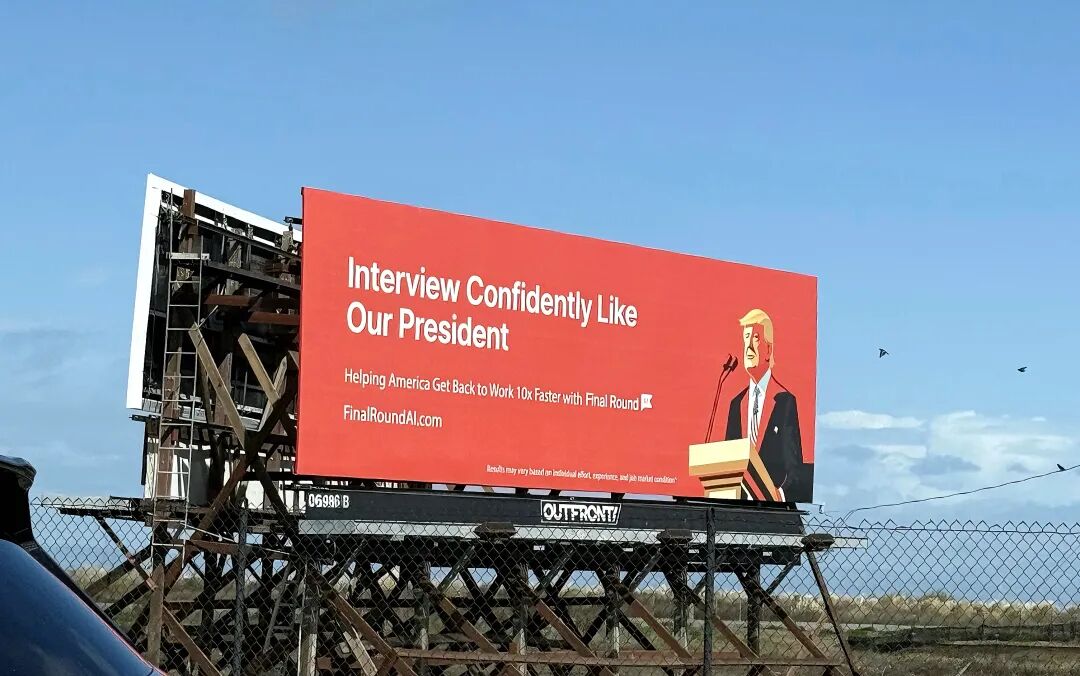
We've also tried offline ad placements at stations where commuters pass by, like a Trump-themed ad reading "Interview confidently like our president" — many people saw it on their commute and actually considered using our software to land a new job.
On automated SEO, we've also built many efficient AI mini-tools to help capture traffic by scraping real-time news events. For example, when Microsoft announced 20,000 layoffs, within ten minutes we could generate landing pages, blog content, and auto-deploy it, precisely reaching users urgently needing to find jobs.

People might wonder how our team maintains this kind of fighting spirit. Honestly, 996 culture is actually quite fashionable in Silicon Valley right now. In this atmosphere, everyone's competing to iterate on new products as fast as possible. High risk, high reward. I think traditionally, the biggest criticism of 996 is that teams don't receive outsized returns, instead spending more time on performative effort, working overtime for the sake of working overtime.
For us, that's not the case. We give all our colleagues outsized returns matching their contributions. When we looked for office space, we specifically found a 24-hour office with beds and showers. If people want, they sleep when tired and work when awake. This "996" isn't exploitation — it's the team's spontaneous passion to seize opportunities. Early colleagues all have substantial equity; everyone is passionately building the company together, working toward the shared goal of making it big.
At the same time, we offer unlimited PTO if needed. If a colleague says they're feeling burned out and need a two-week break to catch their breath, I immediately approve. For myself, my co-founder, and our team, I often ask "Does anyone need to take time off?" or "I think you've been working hard lately, why don't you take a break?" I believe a certain degree of rest and relaxation can bring a lot of inspiration.
Although we're in the recruiting business, I believe traditional interview methods will gradually be phased out in the future.
For example, our company no longer has so-called traditional "interviews." We invite suitable candidates to our office to work together for a period — maybe one day, maybe five days — and we can quickly understand and assess whether this person is suitable for long-term collaboration. Many problems surface directly during actual work; lots of people look excellent or terrible on paper but are completely different in practice.
Of course, we know this approach only works for small teams, so we found a way to productize it. We use AI to simulate the entire company's operations, then candidates can log in, interact with everyone at the company, and complete a simulated first day or first week of work, after which AI quickly generates signals — kind of like an AI version of The Offer assessment. What we want to do is help large-scale companies like JP Morgan, Google, and Microsoft systematically build this kind of new candidate evaluation system.
This September, we'll officially launch this new product, and many large enterprises have already become our design co-creators. We sense their attitude toward this is very positive, because they've found it genuinely difficult to find suitable talent now, and they need an entirely new way to screen talent and evaluate candidates' capabilities.
Honestly, we've carefully counted — there are at least forty or fifty companies globally copying our product. The most egregious copycat team even took our logo, changed the color, and launched. The reason we're willing to tell the market what we're doing is that we feel the market is far from zero-sum competition. We also warmly welcome more outstanding talent to join us in making this happen. (Join us: Hr@finalroundai.com)
When our team hires, we always ask one question: "Can you build an AI to replace yourself?" So far, every early colleague who has come in has answered "YES." That's why we're willing to hire them. Including myself — I'm also looking for ways to continuously empower myself, like cloning 10 of me, 20 of me, to improve my own work efficiency.
In the future world of recruiting, what matters probably won't be "what you know" — because AI knows everything — but how you use tools to solve problems. What we evaluate is a person's thinking and way of working. That's the real value in the AI era.
*This article is based on Michael's appearance on the LateTalk podcast.
Edited by Linear Capital. Scan the QR code to listen to the full episode.