"White Rhino" Closes New Funding Round with SF Holding's Third Investment in a Year, Total Series B Nears 500 Million RMB | Linear Portfolio

Accelerate the scaled deployment of White Rhino in last-mile logistics.

Today, L4 autonomous driving company "White Rhino" announced the completion of its Series B+ round, with existing shareholders SF Holding and Linear Capital investing for the third time in a year. To date, its total Series B funding has accumulated to nearly 500 million yuan.
White Rhino can reduce last-mile delivery costs by 30%-50% for clients across different scenarios. Currently, it has not only partnered with leading retailers such as Yonghui and Hema, but also serves major logistics companies including SF Express, ZTO, J&T Express, and China Post. Its campus delivery network in partnership with Ele.me will cover 100 universities next year. By 2026, White Rhino's active fleet will reach 5,000 vehicles.
Linear Capital led White Rhino's Pre-A round and has continued to invest in every subsequent round.
On August 21, L4 autonomous driving company "White Rhino" announced the completion of its Series B+ round. To date, White Rhino's total Series B funding has accumulated to nearly 500 million yuan. In this round, existing shareholders SF Holding and Linear Capital continued to follow on, with new investors including Yijun Capital, 360 Fund, and Huatai Zijin joining. Notably, this marks SF Holding's third investment within a year, following its initial investment in August 2024.
White Rhino founder and CEO Zhu Lei stated that the proceeds from this round will be primarily directed toward three areas: automotive-grade unmanned vehicle product development, continuous iteration of AI technology, and expansion of commercial scenarios, accelerating White Rhino's "large-scale deployment" in the last-mile logistics sector.
Founded in 2019, White Rhino's founding team hails from Baidu's autonomous driving division. Currently, core team members possess extensive industry experience in autonomous driving, automotive manufacturing, logistics, and internet operations, laying a solid foundation for technology commercialization.
The company initially started with supermarket delivery, partnering with leading retailers such as Yonghui and Hema. Beginning in 2023, it deepened its focus on express logistics scenarios, concentrating on the commercial deployment of depot-to-station delivery. Currently, White Rhino's active fleet has rapidly grown from nearly 100 vehicles at the end of 2024 to the current thousand-vehicle scale, covering 100+ cities nationwide and serving major logistics companies including SF Express, ZTO, J&T Express, and China Post.
Operational data shows that White Rhino's unmanned vehicles can reduce last-mile delivery costs by 30%-50% across different scenarios — after one express franchisee introduced unmanned vehicles, per-ticket delivery costs dropped from 0.2 yuan to 0.1 yuan; in express companies' directly operated networks, unmanned vehicles can free couriers from spending 4-5 hours daily shuttling between depots and transfer points, allowing them to focus more on end-point collection and delivery services, with business volume increasing by over 20%; additionally, unmanned vehicles can operate 24 hours a day, with remote dispatch executing delivery tasks even at night. "Unmanned vehicles don't simply replace people, but enable people to create greater value," said White Rhino president Huang Gang.
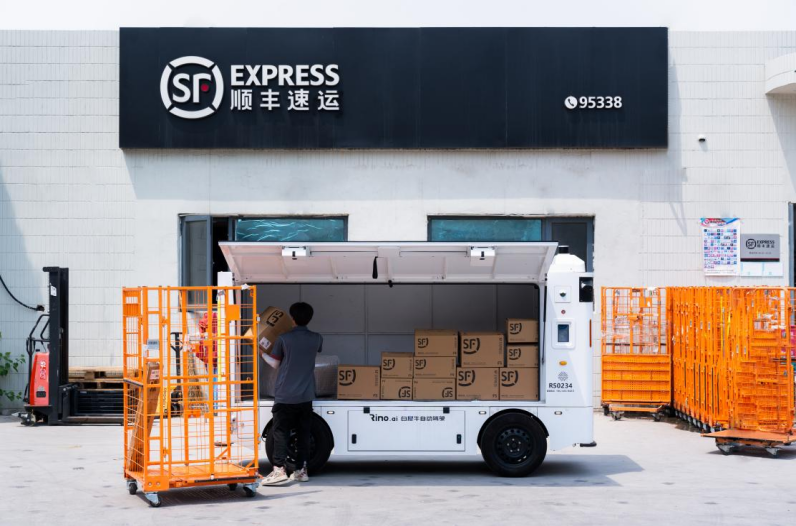
A core focus of this funding round is the development of automotive-grade unmanned vehicle products. Addressing current customer concerns about unmanned vehicle reliability and lifespan, White Rhino is developing automotive-grade products in accordance with automotive industry standards. From design and development, supply chain selection, to production and manufacturing, the entire process follows automotive-grade standards, with rigorous testing and validation to ensure safety, reliability, and durability, improving unmanned vehicle uptime and service life; it also provides clear benchmarks for regulatory oversight, facilitating the orderly opening of road rights.
In terms of scenarios, White Rhino is expanding from "express last-mile delivery" to broader urban unmanned delivery applications: its campus delivery network in partnership with Ele.me is expected to cover 100 universities next year. Additionally, it has achieved deployment in supermarket delivery, industrial logistics, and other scenarios.
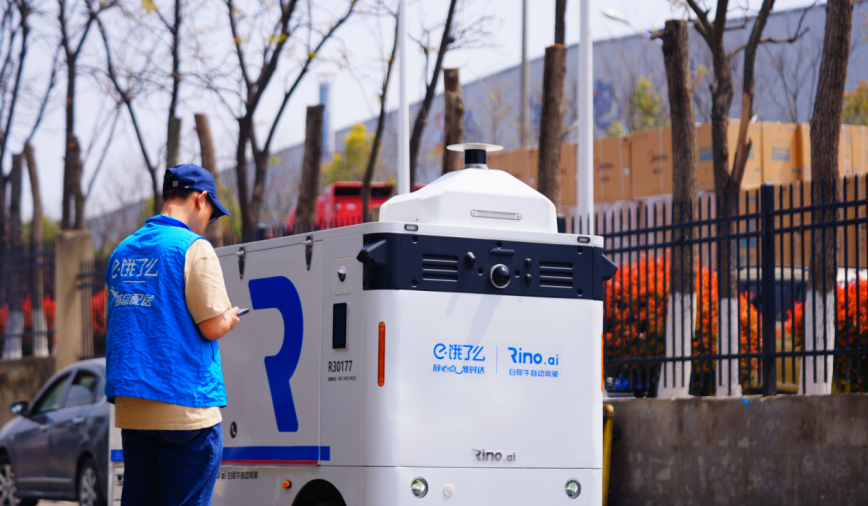
Going forward, White Rhino will continue to solidify its core express logistics business while simultaneously expanding into more scenarios such as retail replenishment and same-city freight. The R&D team is broadening its product line to accommodate clients' increasingly diverse and evolving needs. By 2026, White Rhino's active fleet is expected to reach 5,000 vehicles. In the long term, White Rhino will build on its foundation in China to develop unmanned vehicle products for the global market, continuously driving the large-scale deployment of unmanned vehicles.