Bloomberg Interview with Altman: Looking Back on Two Years of ChatGPT, His Take on AGI | Bolt Picks

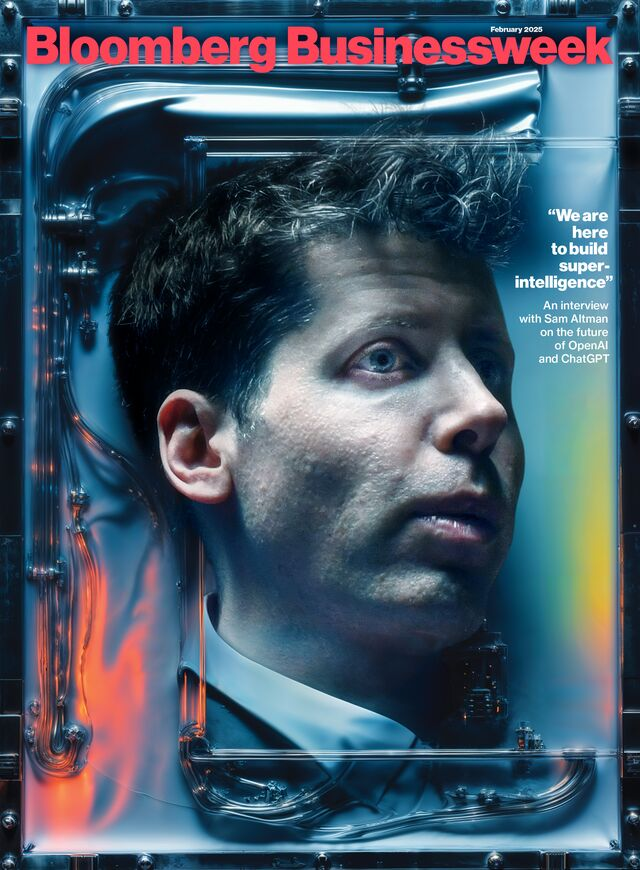
A recent interview with Sam Altman.

(This article is republished from Founder Park)
Altman published his year-end reflection today, but honestly, there's not much substance to it. Bloomberg's recent Altman profile is far better. In that interview, Altman recounts his widely publicized four-day firing saga, how he actually runs OpenAI, his plans for the Trump-Musk administration era, and his relentless pursuit of artificial general intelligence (AGI) — including his real assessment of where AGI stands.
All told, it's one of the more informative Altman interviews from the past six months.
Some interesting highlights:
- In 2015, there were at least 20 founding dinners like that one. Only one became legendary, the story everyone loves to retell. For me personally, the most important dinner was with Ilya at Counter in Mountain View, California.
- I did clash with multiple board members over behaviors I believed presented conflicts or other problems, and they were unhappy with how I wanted them off the board. I learned lessons from that.
- I believe the old board acted from a possibly misguided but genuine conviction about what was right. They may also have believed AGI was imminent and that we weren't being responsible about it. So while I completely disagreed with their specific actions, I respect that conviction.
- Our little product company is probably the fastest-growing tech company in history, or at least in recent memory. But product development can easily swallow the magic of research, and I didn't want that to happen.
- Honestly, since we added search to ChatGPT, I barely use Google anymore. Before we launched ChatGPT, when we just had an internal prototype, I didn't realize ChatGPT would replace my Google usage.
- Will Musk abuse whatever co-chair or other political power he has to go after business rivals? I don't think he will. I really don't.
01
Dinner with Ilya
The pivotal moment in OpenAI's founding
Q: Your team suggested now would be a good time to look back over the past two years, reflect on some events and decisions, and clarify a few things. But before we get started, could you tell the OpenAI founding dinner story one more time? Because that event only seems to grow in historical significance.
Everyone loves a clean story where things trace back to one specific moment. But honestly, I think there were at least 20 founding dinners like that in 2015, and only one became the canonical story that people love to tell. For me personally, the most important dinner was with Ilya at Counter in Mountain View, California — just the two of us.
Ilya Sutskever is a co-founder of OpenAI and one of the top researchers in artificial intelligence. As a board member, he participated in Altman's firing in November 2023 but publicly expressed regret for his decision days later. He left OpenAI in May 2024.
If you go back further, I'd always been very interested in AI — I took courses on it as an undergrad. Then I got distracted for a while, until Ilya and the others made AlexNet in 2012. I'd been following the field, thinking: "Deep learning actually seems to work, and it looks like it can scale. This is a big deal. Someone has to do something."
AlexNet, created by Alex Krizhevsky, Sutskever, and Geoffrey Hinton, used deep convolutional neural networks (CNNs) — a powerful new type of computer program — to identify images with far greater accuracy than before, sparking major advances in artificial intelligence.
So I started meeting with people, asking who would be right to do this with. In 2014, the concept of AGI was so niche it was unimaginable. People were afraid to talk to me about it because I was openly saying I wanted to start an AGI project — that was basically career suicide at the time, it would destroy your career. But many people told me I absolutely had to talk to Ilya. So I basically cornered him at a conference and talked to him in the hallway. I immediately thought, "This guy is really smart." I gave him a brief pitch, and we made a dinner plan. At that first dinner, he laid out our AGI-building strategy. The words may have been different from what we'd use now, but the substance was the same.
Q: What remains of that dinner's spirit in the company today?
I'd say all of it. There are other factors too, but our belief in deep learning, in this particular technical path to get there, and in combining research with engineering — I can't believe it actually worked this well. Usually these ideas don't work out completely, and obviously some parts of our original vision didn't work at all. The corporate structure, all of that. But [believing] that AGI was possible, that this was the right bet to make, and that if possible, it would have massive societal impact? That has proven to be incredibly correct.
OpenAI was founded in 2015 as a nonprofit with the mission to ensure AGI benefits all of humanity. That vision would later become complicated.
Q: The early OpenAI team had a major advantage in recruiting talent. You seemed to successfully attract a lot of top AI researchers, often while offering less compensation than competitors. What was your recruiting strategy?
Our pitch was simple: "Come build AGI with us." And it worked because claiming you were going to build AGI was so heretical at the time — I can't overstate how much. It was like a filter that screened out 99% of people and left only those who were genuinely talented and original thinkers. It was very effective.
If everyone's doing the same thing, like building the 10,000th photo-sharing app? It's really hard to recruit. But if I can convince you that no one else is doing this, and that it appeals to a small group of genuinely talented people? Then you can get all of them, and they'll all want to work together. So we had this recruiting pitch that sounded insane, almost laughable at the time. It scared away all the established veterans in the field but attracted this ragtag group of young, talented people who were right for starting from zero.
Q: How did you quickly settle into your respective roles?
Most people were working full-time. I still had another job at first, so I did very little, but over time I got more and more into it. By 2018, I was completely "brainwashed." We were a bit like Band of Brothers back then — Ilya and Greg handled the big picture, but everyone was doing what they were good at.
Q: You seem to have a romantic view of those early years.
Well, those were definitely the happiest times in OpenAI's history. I mean, it's fun now too, but getting to participate in what I think will be one of the greatest periods of scientific discovery, relative to its impact on the world — that's a once-in-a-lifetime thing. If you're very lucky.
02
Nobody thought ChatGPT would succeed at the time
Q: In 2019, you became CEO. How did that happen?
I was trying to do both OpenAI and Y Combinator, and it was really hard. I was completely obsessed with the idea that "we're actually going to build AGI." What's funny is I remember telling myself we'd achieve AGI by 2025, but that date was completely arbitrary — just ten years out from when we started. People used to joke that the only thing I would do was walk into a meeting and say: "Scale it up!" That wasn't true, of course, but that was definitely the theme of that era.
Q: ChatGPT officially launched on November 30, 2022. Does that feel like a million years ago or a week ago?
[Laughs] I'm turning 40 next year. For my 30th birthday, I wrote a blog post titled "The Days Are Long But the Decades Are Short." Someone emailed me this morning saying: "This is my favorite blog post, I read it every year. Are you going to update it when you turn 40?" I laughed because I definitely won't — I don't have time. But if I did, the title might be: "The days are long, and the decades are fucking long too." So yeah, it feels like a very, very long time ago.
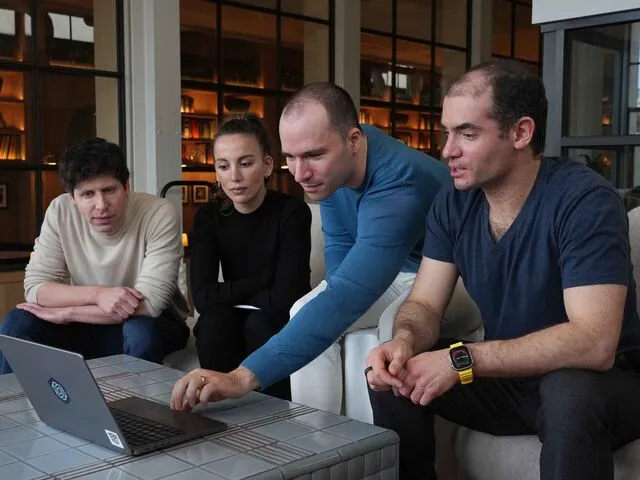
Several OpenAI executives at the company's San Francisco headquarters on March 13, 2023, from left to right: CEO Sam Altman; CTO Mira Murati; President Greg Brockman; Chief Scientist Ilya Sutskever. Photographer: Jim Wilson/The New York Times
Q: When the first users started showing up and it became clear this was going to be huge, was there a "holy shit" moment for you?
Well, okay, a few things. First, I actually thought it would be popular! But everyone else at the company was saying: "Why are you making us launch this? This is a terrible decision, it's not ready." I'm not someone who often makes "we're just going to do this" decisions, but this was one of them.
YC has a famous chart that Paul Graham used to draw all the time. It shows the wave of potential, then the wave of novelty wearing off, then the long trough of sorrow, and finally the wave of actual product-market fit and explosive growth. It's a well-known trope inside YC.
In the first few days after ChatGPT launched, usage was higher during the day and lower at night. Team members would joke: "Haha, it's already declining." But one thing I learned at YC is that if each new trough is higher than the previous peak, something very different is happening. And that's exactly what happened during ChatGPT's first five days. So I thought: "We may have created something we don't even understand yet."
Paul Graham, co-founder of Y Combinator and philosopher of startups and technology.
Immediately after that, we started scrambling for massive amounts of compute, because we didn't have it. We had launched the product without any business model or concept of one. I remember saying at a meeting in December: "I'm willing to consider anything that makes us money to stay afloat, but we can't keep going like this." There were a lot of bad ideas floated at that meeting, nothing good. So we said: "Alright, let's try subscriptions and figure it out later." And that's the model that stuck.
We had initially launched with GPT-3.5, and we knew GPT-4 was coming, so we knew it would get better. When I started talking to people who were using it, understanding what they were doing with it, I thought: "I know we can make all of this much better." We kept improving it rapidly, and then it just ignited global media attention, whatever you want to call it.
Q: Are you someone who enjoys success? Can you accept all of this, or are you already worrying about the next phase of scaling?
There's a very strange phenomenon with me, or with my career. Normally, people run a big successful company first, then in their fifties or sixties get tired of working so hard and become venture capitalists. But doing VC first, and having a long VC career, and then running a company — that's highly unusual. I think it's disadvantageous in many ways, but one benefit for me was that I knew what I was getting into, because I had watched and guided many people through this path.
I knew I was both deeply grateful and also kind of thinking: "Fuck, I'm being strapped to a rocket, my life is going to be completely different and not as fun." I approached it with a kind of dark humor. My husband* often tells stories from that period, saying I'd come home and he'd say: "This is amazing!" And I'd say: "This is terrible, and it's terrible for you too, you just don't realize it yet." [laughs]
Altman married his long-term partner, Australian software engineer Oliver Mulherin, in early 2024. They are expecting a child in March 2025.
Q: You've been well-known in Silicon Valley for a long time, but one consequence of GPT is that you've become globally famous at Hollywood-star speed. Has this made managing your workforce more complicated?
It's made my life more complicated. But inside the company, whether you're a famous CEO or an unknown one, people just ask: "Where the hell are my GPUs?"
In other parts of my life, I can feel this distance, which is strange. When I'm with old friends or new friends, I can feel it — everyone except those closest to me. If I work with people I don't normally interact with, I can feel it. If I'm in a meeting with someone I barely know, I can feel it. But most of my time is spent with researchers, and I assure you, if you came with me to a research meeting after this interview, you'd see that nobody goes easy on me at all, and that feels great.
03
Debriefing the Firing:
Probably Just Philosophical Differences
Q: Do you remember when you first realized that a for-profit company with billions in outside investment, reporting to a nonprofit board, might be problematic?
There were certainly many such moments. But from November 2022 to November 2023, that year was so insane that I can barely remember what happened. It felt like we were building a complete company from nearly zero in 12 months, and doing it completely in public. Looking back, one lesson I learned is that everyone says they won't mess up the prioritization of important versus urgent*, but everyone ends up getting dragged around by the urgent. So if there's a moment when I first calmly faced reality — this isn't working — it was probably around 12:05 PM that Friday afternoon*.
-
Dwight D. Eisenhower apparently said "what is important is seldom urgent and what is urgent is seldom important" so often that it spawned the Eisenhower Matrix, a time management tool that divides tasks into four quadrants:
- Urgent and important: Do immediately.
- Important but not urgent: Schedule for later.
- Urgent but not important: Delegate.
- Not urgent and not important: Eliminate.
Understanding the wisdom of the Eisenhower Matrix — then ignoring it when things get chaotic — is a startup tradition.
-
On November 17, 2023, at approximately noon California time, OpenAI's board notified Altman that he was immediately removed as CEO. He was informed via Google Meet while watching the Las Vegas Grand Prix, roughly 5 to 10 minutes before the public announcement.
Q: When news of your firing by the board broke, everyone was shocked. But you seem emotionally intelligent — did you sense any tension? Did you realize you were the source of it?
I don't think I'm particularly emotionally intelligent, but even with my level of EQ, I could feel the tension. You know, we had been arguing about safety versus capabilities, the board's role, how to balance all these issues. So I knew the atmosphere was tense, and with my limited EQ, there was probably even more I didn't pick up on.
A lot of frustrating things happened that first weekend. My memory may be off — they fired me Friday at noon. Friday evening, a bunch of people resigned. By late Friday night, I was thinking: "Let's just restart an AGI project." Later Friday night, some senior team members said: "Well, we think this might be reversible, calm down, wait and see."
Saturday morning, two board members called me to talk about coming back. I was angry at first and refused. Then I thought: "Alright, I'll go back." I really cared about OpenAI. But I also said: "I'm not going back unless the entire board resigns." I wish I had taken a different tactical approach, but at the time I genuinely thought that was a reasonable ask. Then we argued about the board for a while. We were trying to negotiate a new board. They had some ideas that seemed absurd to me, and I had some ideas that seemed absurd to them. But I felt like we had basically reached agreement. Then Sunday — the angriest I was during this whole period — they kept saying: "Almost there, we're waiting for legal advice, the board consent is being drafted." I said: "I'm trying to keep the company stable. You hold all the power. Are you sure you're telling me the truth?" They said: "Yes, you're coming back, you're definitely coming back."
Then Sunday night, they suddenly announced Emmett Shear as the new CEO. I thought: "Alright, I'm really leaving now," because this was complete deception. Monday morning, everyone threatened to resign, and they said: "Alright, we need to change direction."
OpenAI's San Francisco office, photographed March 10, 2023. Photographer: Jim Wilson/The New York Times
Q: The board said an internal investigation concluded you were not "consistently candid" in your communications with them. That's a specific claim — that they thought you were lying or hiding something — but also vague because it didn't specify what you weren't being candid about. Do you know now what they were referring to?
I've heard different things. There was this narrative: "Sam didn't even tell the board he was launching ChatGPT." But my memory and understanding of that is different. The truth is, I didn't say: "We're going to launch something that will have massive impact." And I think characterizations of many similar things were unfair. What I've become more clear about is that I did have disputes with multiple board members about behaviors I thought presented conflicts or other issues, and they were unhappy with how I wanted them off the board. I learned a lesson there.
Q: Can I offer a theory?
Sure.
Q: At some point you realized that OpenAI's organizational structure would hinder the company's growth, maybe even kill it. Because a mission-driven nonprofit could never compete on compute, and could never make the rapid adjustments that OpenAI needed to thrive. The board members were "fundamentalists" who put purity above survival. So you started making decisions that would let OpenAI compete, which required you to be a little "sneaky," and the board felt —
I don't think what I was doing was "sneaky." What I can say is that to move fast, the board wasn't fully in the loop on everything. One thing that happened was about "Sam has this startup fund but didn't tell us." The reason was our complicated structure: OpenAI itself couldn't own it, and anyone with equity in OpenAI couldn't own it. And I happened to be someone without equity in OpenAI. So I temporarily became the owner or general partner* of this fund, until we built structures to transfer it. I had a different view on whether the board should have known about this.
But should things like this, which could make people feel I might be operating behind their backs, have been communicated more clearly? Fine, I'll take that feedback. But it wasn't "sneaky." It was an insane year, wasn't it? This was a company moving at an unbelievable pace. I suggest you ask any current board member* whether they think I did anything "sneaky," because I've always avoided that kind of thing.
-
General Partner. According to a filing with the Securities and Exchange Commission on March 29, 2024, the new general partner of the OpenAI Startup Fund is Ian Hathaway. The fund has approximately $175 million available to invest in AI-focused startups.
-
OpenAI's current board consists of Altman and the following members:
- Bret Taylor (Chair): Former co-CEO of Salesforce Inc. and co-founder of FriendFeed.
- Adam D'Angelo: Co-founder and CEO of Quora Inc.
- Lawrence Summers: Treasury Secretary under Bill Clinton and former president of Harvard University.
- Sue Desmond-Hellmann: Former CEO of the Bill & Melinda Gates Foundation.
- Nicole Seligman: Former Executive Vice President and General Counsel of Sony Corporation.
- Fidji Simo: CEO and Chair of Instacart.
- Paul Nakasone: Former Director of the National Security Agency (2018-24).
- Zico Kolter: Computer scientist specializing in machine learning and AI safety.
I believe the former board members' beliefs and concerns about AGI going wrong were genuine. During that weekend, one of the board members said something* to our team that was somewhat ridiculed at the time — she said that destroying the company might actually be consistent with the nonprofit board's mission. I think that shows the power of genuine conviction. I believe she truly meant it. While I completely disagreed with all of her specific conclusions and actions, I respect that conviction.
I believe the old board acted out of a possibly misguided but sincere conviction about what was right. And they may have also believed that AGI was imminent and that we weren't handling it responsibly. So while I completely disagreed with their specific actions, I respect that conviction.
According to reports, former OpenAI board member Helen Toner said that in certain circumstances, destroying the company would "actually be consistent with the board's mission." Altman had previously confronted Toner about a paper she wrote criticizing OpenAI for releasing ChatGPT too quickly. She also praised one of its competitors, Anthropic, for waiting to release a chatbot rather than "fanning the flames of AI hype."
Q: Obviously, you won, since you're sitting here. But put yourself in that position — didn't all of this leave you traumatized?
Of course I was traumatized. The hardest part wasn't going through it, because you can do a lot when your adrenaline is pumping. Seeing the company and community rally around me was incredibly heartwarming. But then it all ended quickly, and I had to face the wreckage. And things kept getting worse every day — like another government investigation, another former board member leaking false information to the press.
All these people who I felt had "screwed" me and "screwed" the company were gone, and I had to clean up the mess they left behind. It was around December, getting dark at 4:45, cold and rainy. I'd be walking home alone at night, feeling depressed and exhausted. And I felt it was all so unfair. Going through it was crazy enough, but I had no time to recover because "the house was still on fire."
Q: When you returned to the company, did you feel uncomfortable about major decisions or announcements because you worried about how people would perceive you? Actually, let me put this more simply. Did you feel that some people might think you were bad, and you needed to convince them you were good?
It was worse than that. After everything settled down, it was fine, but in those first few days, everyone was in the dark. So I'd walk down the hallway and people would avert their eyes. It was like I'd been diagnosed with terminal cancer. People felt sympathy, understanding, but nobody knew what to say to me. Those days were really hard. But I told myself at the time: "We still have complex work to do, and I'll keep at it."
04
Don't Let Product Development Disrupt Research's Rhythm
Q: Can you describe how you actually run the company? How do you spend your days? For example, do you talk to individual engineers? Do you have walking-around time?
Let me check my calendar. We have a three-hour executive team meeting every Monday, and then, well, yesterday and today, I did one-on-ones with six engineers. After this interview, I'll go to a research meeting. Tomorrow there are several major partnership meetings, and many meetings about compute — five of them about how to increase compute. I also have three product brainstorming sessions tomorrow, and then dinner with a major hardware partner. That's roughly it. There are some fixed things each week, and the rest is fluid.
Q: How much time do you spend on internal versus external communication?
Much more internal. I don't write inspirational emails often, but I do a lot of one-on-ones, small group meetings, and tons of Slack.
Q: Oh, so you also go deep into the details?
I'm a heavy Slack user. You can get a lot of data from the details. I mean, nothing beats sitting in a meeting with a small research team for getting deep into something. But for breadth, you can get a lot there too.
Q: You've said before that you have very strong opinions about ChatGPT's look and user experience. Do you feel that in some ways, your capabilities require you to be more of a "player" than a "coach"?
At this level? Not really. I had dinner with the Sora team last night, and I had several pages of written, fairly detailed suggestions for improvements. But that's not common. Or in the upcoming meeting, I made a very specific suggestion to the research team about what I think they should do in the next three months, with very specific details, but that's also not common.
Q: We've talked about how scientific research sometimes conflicts with corporate structure. You put the research department in a different building from the rest of the company, several miles away. Is there symbolism behind this?
Uh, no, it's purely logistical and space-planning considerations. We'll eventually build a large campus, and the research department will still have a separate area. Protecting the core of research is critically important to us.
Q: Protecting it from what?
The typical trajectory of Silicon Valley companies is that you start as a product company, get really good at it, and gradually scale to large-scale operations. As you get bigger, revenue growth naturally slows as a percentage, usually. At some point, the CEO gets the idea to build a research lab to generate lots of new ideas and drive further growth. This has happened a few times in history. Bell Labs and Xerox PARC are famous examples. But typically, you just end up with a very good product company and a very bad research lab. We're very fortunate that our "attached" little product company is probably the fastest-growing tech company in history, or at least in recent years. But product development can easily swallow the magic of research, and I don't want that to happen.
We're here to build AGI and superintelligence, and everything that comes from that. Along the way, we may encounter many wonderful things, any one of which could distract us from our ultimate goal. So maintaining focus is very important.
05
ChatGPT Search
Actually Driven by User Demand
Q: As a company, you've stopped talking about AGI publicly. You started talking about AI and levels, but you personally still talk about AGI.
I think the term "AGI" has become very muddled. If you look at our levels, our five levels, you'll see that some people would call each level AGI, right? The reason we created the levels was to be more specific about where we are and what progress looks like, rather than just debating "is it AGI or not AGI."
Q: When would you say, "Okay, we've achieved AGI now"?
My rough understanding is that when an AI system can do the work that highly skilled humans do in important roles, I'd call that AGI. Then there are follow-up questions: does it mean the full job, or just part of it? Can it start as a computer program and decide to become a doctor? Can it do what the best person in the field can do, or just the 98th percentile? How autonomous is it? I haven't found clear answers to these questions. But if we can hire an AI as a remote employee, and it can be a great software engineer, I think many people would say: "Okay, that probably counts as AGI."
Now, we're always moving the goalposts, so this is hard to answer, but I'll stick with that. And when I think about superintelligence, the key question is: can this system rapidly accelerate the pace of scientific discovery on Earth?
Q: You now have over 300 million users. What have you learned from their behavior that changed your understanding of ChatGPT?
Talking to people about what they do and don't use ChatGPT for has been very illuminating for our product planning. One thing that came up a lot in the past was that obviously many people were trying to use ChatGPT for search, which we hadn't really considered when we first launched it. But honestly, that wasn't what we originally designed it for, and it was pretty terrible at it. But this made us realize that building search was really important. Honestly, since we added search to ChatGPT, I barely use Google anymore. Before we launched ChatGPT, when we just had an internal prototype, I didn't realize that ChatGPT would replace my use of Google.
Another thing we learned from users: many people are relying on it for medical advice. Many people at OpenAI receive moving emails from users saying: "I've been sick for years, and no doctor could tell me what I had. Finally I put all my symptoms and test results into ChatGPT, and it said I had a rare disease. I went to the doctor, they prescribed medication, and I recovered." That's certainly an extreme example, but things like this happen frequently, and it made us understand that users need this capability, and we should invest more in it.
Q: Your products have many price points, from $0 to $20 to $200 — Bloomberg reported the possibility of $2,000. How do you price technology that has never existed before? Market research? Or just guessing?
We launched ChatGPT for free at first, and then a lot of people started using it, so we had to find some way to keep the lights on. I remember we tested two price points: $20 and $42. People felt $42 was a bit too expensive, but $20 was acceptable, so we went with $20. This was around late December 2022 or early January 2023. We didn't do rigorous pricing research.
We're still considering other options. Many customers tell us they want usage-based pricing. They say: "Some months I might need to spend $1,000 on compute, other months I might need very little." I'm old enough to remember the dial-up era, when AOL would give you 10 hours or 5 hours a month, or whatever package. I hated that feeling. I don't like being constrained by time, so I don't want users to feel that way. But I think there are other reasonable ways to structure usage-based pricing.
06
OpenAI Actually Has Three Safety Committees
Q: What does your safety committee look like now? How has it changed over the past year or 18 months?
One thing that probably confuses people, including some of us internally, is that we have many different safety bodies. We have an internal-only Safety Advisory Group [SAG] that does technical research on systems and offers opinions. We have an SSC [Safety and Security Committee], which is part of the board. And we have a DSB* in partnership with Microsoft. So we have an internal body, a board body, and a joint board with Microsoft. We're trying to streamline this.
The Deployment Safety Board, composed of members from OpenAI and Microsoft, approves the deployment of any model that exceeds a certain capability threshold.
Q: Do you serve on all three bodies?
That's a good question. So SAG sends their reports to me, but I don't think I'm formally on it. But the procedure is: they produce one, send it to me. I say, "Okay, I agree with this" or I don't, and then it goes to the board. I'm not on the SSC. I am on the DSB. Now that we have a better understanding of our safety processes, I want to find a way to simplify this.
Q: Have your views on the actual dangers changed?
My assessment of short-, medium-, and long-term risks has basically not changed. I still think we'll face serious, or potentially serious, short-term issues around cybersecurity and biosecurity*. In the long term, when you think about a system with powerful capabilities, there are risks that are difficult to accurately imagine and predict. But I also think these risks are real, and I think the only right way to address them is to ship products and learn from them.
In September 2024, OpenAI acknowledged that its latest AI models increased the risk of misuse for creating biological weapons. In May 2023, Altman joined hundreds of other signatories in signing a statement highlighting the existential risk posed by AI.
07
Bullish on Fusion as a New Energy Source
Q: When it comes to the near-term future, the industry seems to have coalesced around three potential bottlenecks to progress: scaling models, chip shortages, and energy shortages. I know they're interconnected, but can you rank them by how much they worry you?
On all three, we have a plan that makes me feel quite reassured. On scaling models, we're making continuous progress on technology, capability, and safety. I think 2025 is going to be an incredible year. Do you know that thing called the ARC-AGI challenge? Five years ago, this organization set up this prize hoping to point the way toward AGI development. They wanted to establish an extremely difficult benchmark. And our new model that we'll release on Friday* has passed this benchmark. This benchmark has sat idle for five years, unsolved. They said if you can score 85% on it, you're considered to have "passed." And our system scored 87.5% out of the box, with no customization work whatsoever*. And we have fantastic research and even better models coming.
- OpenAI launched Model o3 on December 20. It should become available to users in early 2025. The previous model was o1, but The Information reported that OpenAI skipped o2 to avoid potential conflicts with UK telecom operator O2.
- According to ARC-AGI: "OpenAI's new o3 system — trained on the ARC-AGI-1 public training set — achieved a breakthrough 75.7% score on the semi-private eval set under our public leaderboard $10K compute limit. A high-compute (172x) o3 configuration scored 87.5%."
We've been working hard on the entire chip supply chain, coordinating with all our partners. We have people building data centers and manufacturing chips for us. We're also working hard on our own chip R&D. We have a great relationship with NVIDIA, which is absolutely an incredible company. We'll talk more about these issues next year, but it's time to scale up chip production.
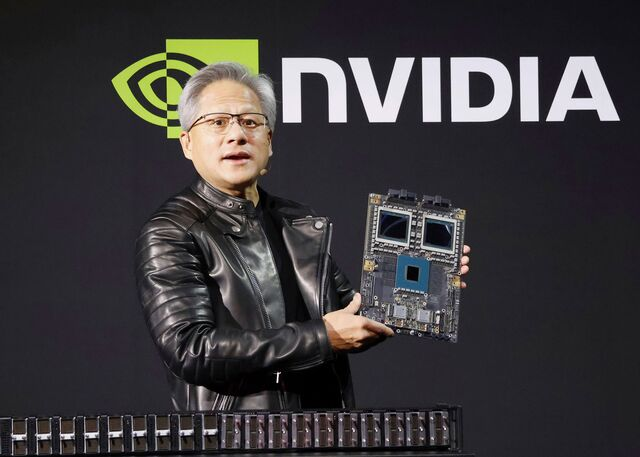
NVIDIA CEO Jensen Huang speaks at an event in Tokyo on November 13, 2024. Photographer: Kyodo/AP Images
Q: So energy...
Fusion is going to work.
Q: Fusion is going to work. Hmm. On what timeframe?
Soon. Well, soon there will be a net-energy-gain fusion demonstration. Then, you need to build a system that doesn't break, need to scale it, need to figure out how to build factories — lots of them — and need to get regulatory approval. That whole process will take years, right? But I expect [Helion 20]* will show you soon that fusion is viable.
Helion is a clean energy startup co-founded by Altman, Dustin Moskovitz, and Reid Hoffman, focused on developing nuclear fusion.
Q: In the short term, is there any way to sustain AI development without backsliding on climate goals?
Yes, but I don't think there's anything better than rapidly approving fusion reactors. I think our particular approach to fusion is excellent, and we should go all-out in that direction and get it done.
08
"I Don't Support Presidents, But I Love My Country"
Q: A lot of what you just said involves the government. We have a new president about to take office. You personally donated $1 million to the inauguration fund. Why?
He's the President of the United States. I support any president.
Q: I understand why OpenAI would publicly support a president known for holding grudges, but this was your personal donation. Donald Trump opposes many things you previously supported. Am I wrong to think this donation looks more like an act of fealty than an act of patriotism?
I don't support everything Trump does, says, or thinks. I also didn't support everything Biden said, did, or thought. But I support the United States of America, and I will do everything I can to work with any president for the good of the country. Especially for what I think is this transcendent moment beyond any political issue.
I think AGI will likely be developed during this presidential term, and it's very important to get this right. Supporting the inauguration, I think, is a relatively small thing. I don't think it's a major decision. But I do think we should all wish the president success.
Q: He says he hates the CHIPS Act. You support the CHIPS Act.
I actually don't. The CHIPS Act is better than nothing, but it's not what we should have done. I think we have an opportunity to do something better as a follow-up. The CHIPS Act hasn't worked out as well as we hoped.
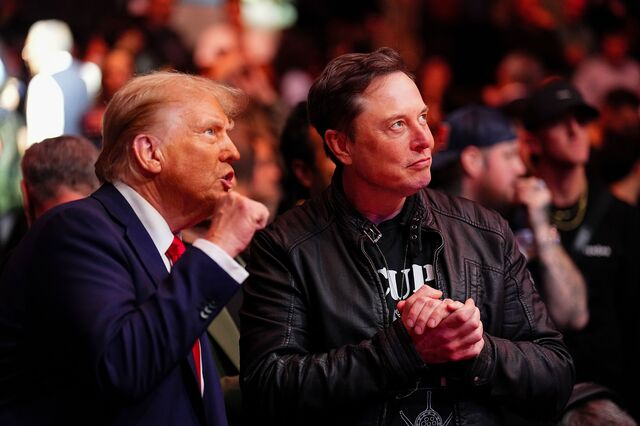
Trump and Musk talk on the sidelines during UFC 309 at Madison Square Garden in New York on November 16. Photographer: Chris Unger/Zuffa LLC
Q: Musk is obviously going to play some role in this administration. He's suing you while also competing with you. I saw your comments at DealBook, where you said you don't think he would use his position to engage in unfair business competition in AI.
I really don't think so.
Q: But with respect: over the past few years, he bought Twitter and then sued to get out of the deal. He reinstated Alex Jones's show. He challenged Zuckerberg to a cage fight. And that's just the tip of the iceberg of his antics. So you really believe he would —
Oh, I think he'll do all kinds of bad things. I think he'll continue to sue us, drop the suit, file new lawsuits, and so on. He hasn't challenged me to a cage fight, but it turns out he wasn't that serious about Zuck either. As you said, he's always saying things, starting things, canceling them, getting sued, suing others, clashing with the government, getting investigated by the government. That's just Elon's style.
The question is, will he abuse his so-called co-chair or whatever political power to go after business competitors? I don't think he'll do that. I really don't. Maybe I'll turn out to be wrong.
Q: When you two collaborated at your best, how would you describe what each of you brought to that relationship?
Maybe a complementary spirit. We weren't sure what it would be, or what we would do, or how things would unfold, but we shared a belief that this thing was important, and this was the general direction to push, and how to course-correct.
Q: I'm curious what the actual working relationship was like.
I don't recall having any big argument with Elon until the conflict that led to his departure. But before that, despite all the rumors — people talk about how he berates people, throws tantrums, and so on — I didn't experience that.
Q: Were you surprised that he was able to raise so much money for xAI, particularly from the Middle East?
No. No. They have a lot of money. And this is an industry everyone wants to get into. Elon is Elon.
Q: Let's assume you're right, and both Elon and the government have positive intentions. What's the most helpful thing the Trump administration could do for AI in 2025?
Build infrastructure in America, and build a lot of it. I deeply share the president's frustration with how incredibly difficult it has become to build things in this country — whether it's power plants, data centers, or anything of that nature.
I understand how bureaucratic red tape accumulates, but it serves no one well. This becomes especially damaging when you consider what the US needs to do to take the lead in AI. And the US really does need to take the lead in AI.
📮 Further Reading


Linear Bolt Bolt is an investment initiative established by Linear Capital specifically for early-stage, globally oriented AI applications. It upholds Linear's investment philosophy, focusing on projects where technology drives transformative change, with the goal of helping founders find the shortest path to achieving their objectives — whether in execution speed or investment approach. Bolt's commitment is to be lighter, faster, and more flexible. In the first half of 2024, Bolt invested in seven AI application projects including Final Round, Xin Guang, Cathoven, Xbuddy, and Midreal.