Why Founder-Led Sales Works Best for Startups | Bolt's Picks
Sales Playbooks and Battle-Tested Strategies for Early-Stage Founders

Building products and selling them — these two activities sit at the core of every company's growth. Many startup methodologies stress the importance of keeping customer needs and sales thinking front-of-mind during product development, but putting this into practice is genuinely challenging. Jen Abel, founder of JJELLYFISH, recently appeared on Lenny's Podcast, a well-known Silicon Valley show, where she argued that early-stage startups should have founders lead sales rather than adopting approaches used by more mature companies.
In this episode, Abel — who has provided sales advisory to over 300 startup founders — broke down in detail how founder-led sales should work. Her granular analysis offers valuable insights for companies expanding overseas who want to understand how enterprise sales works in international markets. We've distilled key portions into 17 questions, hoping to provide a useful reference. You can listen to the original podcast via the "Read More" link at the bottom.
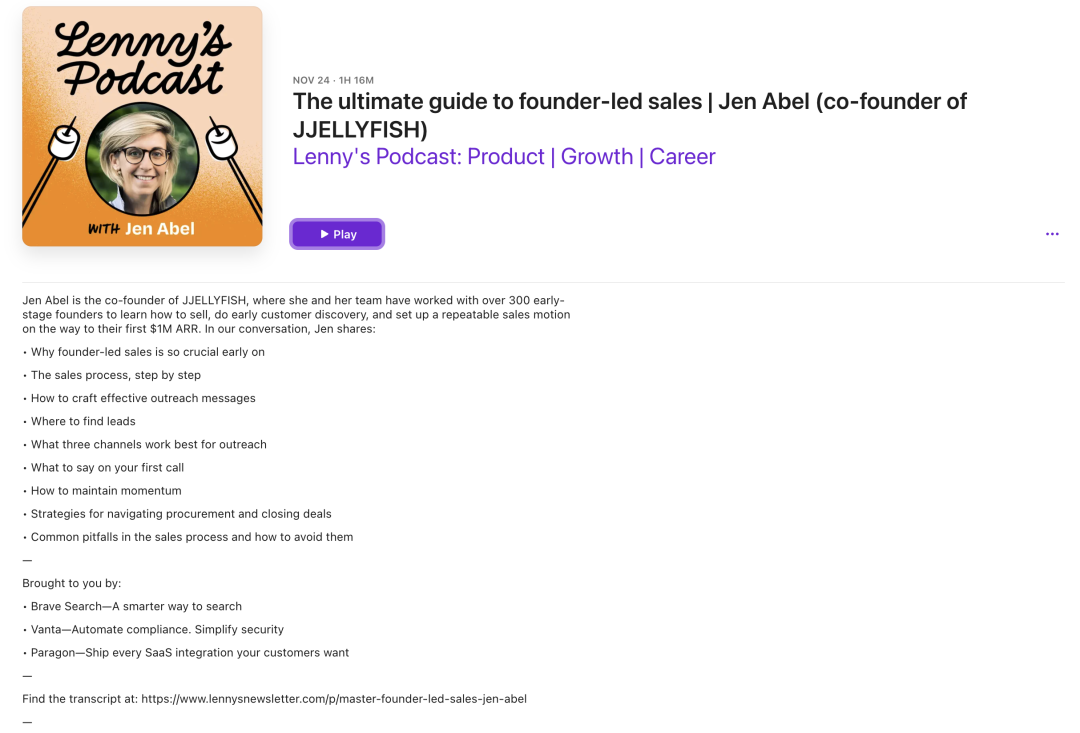
Image | Podcast Shownotes
📝 Summary
1. Early-stage sales model: Founders should personally immerse themselves in market needs and customer pain points, spotting opportunities in conversations that salespeople would miss, providing the most direct input for product positioning and direction.
2. Customer follow-up: Proactively engage with customers, responding promptly to their needs and questions so they feel valued. Mine their feedback for actionable insights to improve the product and refine sales strategy.
3. Linking sales and product: Gather customer feedback to improve the product, keeping sales strategy aligned with product vision. Ensure sales approaches match the product vision and avoid overpromising or misleading customers.
4. Sales tactics: Through customer conversations and market research, understand customer pain points, leverage product strengths, actively drive toward closing, and provide tailored solutions.
5. Customer success and retention: Help customers achieve their business goals with quality products and services, reducing customer acquisition costs. Develop effective retention strategies to boost satisfaction and loyalty.
Why Founder-Led Sales Is Essential
01 What's the fundamental difference between early-stage and mature company sales?
1). The key distinction between early-stage and late-stage (mature) sales
Late-stage sales typically rely on mature products and well-defined sales processes, while early-stage startups depend more on founder-led sales, emphasizing relationship-building, vision-selling, and using feedback to refine the product. Many early founders mistakenly apply late-stage sales strategies to their early-stage context, making selling far harder than it needs to be.
2). Avoiding the trap of late-stage sales advice
Many early founders take advice from investors or experienced salespeople — advice typically geared toward mature markets and mature products. Yet early-stage startups cannot rely on these established sales models. Early sales prioritizes building trust with customers, communicating vision and a preliminary framework for solutions, rather than simply pitching a finished product.
02 What competitive advantage does founder-led sales offer?
1). Founders are the vision carriers
Founders can articulate company vision with precision that no one else on the sales team can match. Their direct involvement enables unfiltered market communication and the transmission of the most insightful messages.
2). Founders are the ultimate decision-makers
Markets are generally willing to speak with founders because founders hold key information the market doesn't yet know. People want to learn from founders and understand the strategic direction behind the company.
3). Founders spot potential in conversations that salespeople miss
Founders are better than salespeople at identifying opportunities through deep dialogue. By engaging in substantive conversations, they can recognize latent needs and further refine sales strategy.
It's worth noting that a founder's initial market vision often differs from the vision at the point of achieving product-market fit. Continuous dialogue with the market, feedback loops, and deep engagement reveal new opportunities and market needs, allowing sales strategy to be adjusted and sharpened.
03 How should founders craft compelling outbound messages?
1). High relevance
The message must be highly relevant to the target customer's role and needs, not just superficially personalized. Rather than "I saw you on this podcast," directly clarify why this message matters to them. Relevance trumps personalization — personalization has become so common that overdoing it feels unnatural and even intrusive.
2). Counterintuitive, curiosity-sparking perspectives
Founders should express distinctive or counterintuitive viewpoints that spark curiosity. The goal is to make prospects think: "Is this true?" or "I've never thought about it this way." The key is provoking thought and leaving them wanting more.
3). Concise, mobile-optimized
Since most people check email on their phones, sales messages need to be extremely concise — no more than three to four sentences. Get straight to the point and deliver the core idea quickly. Long blocks of text cause prospects to lose interest; brevity and clarity are essential.
4). Lead with the problem, not the solution
Most importantly, don't rush to discuss your solution. Focus on articulating the customer's problem, why it matters critically, and why existing approaches fall short. Emphasizing the problem's importance generates interest and makes prospects eager to learn more.
04 How do you get prospects to genuinely engage and care about your solution during conversations?
1). Show vulnerability — be genuinely humble about market knowledge
As an early-stage startup, you need to show vulnerability and authenticity. Most buyers in the market are extremely smart and likely know more than you do. Don't assume you understand the market or product better than they do. Approach their knowledge with humility. Honestly tell them you're an early-stage startup still learning, and deeply focused on problems that haven't been adequately solved.
2). Openly discuss problems and invite feedback
Expressing concern about a problem and seeking feedback gets customers talking about the problem itself. Saying "we're an early company still building experience" elicits more honest feedback than "we have a fully built product." This openness encourages customers to share how they see the problem manifesting in their own situations.
3). Avoid presenting a "finished" product too early
If you emphasize that your product is completely ready, customers may not offer genuine feedback. Even if the product is fully formed, signal that you're still iterating — this makes customers more willing to share their true perspectives.
Aligning Sales and Product Development
05 How do you determine if your product fits the market?
1). The problem must be widely felt and unsolved
First, this needs to be a problem that more and more people in the market are facing, with expanding scope and impact, to indicate genuine market demand. No one wants to pay to solve a problem that already has relatively mature solutions.
2). Whether customers have sought solutions and how mature those attempts are
Understanding whether customers have already tried to solve this problem is critical. Have they attempted to address it by adding headcount, using other tools, or has it remained unsolved because no adequate solution exists? This information reveals how seriously customers take the problem and how mature the market is.
3). Customer psychological shift: from observation to action
During early sales, when customers start discussing your solution and proactively invite colleagues to join conversations, this marks significant progress. It means they've shifted from "this is a nice idea" to "we need to take action" — they'll bring in more team members to evaluate the solution. This indicates genuine interest and recognition that the solution needs to move toward actual implementation.
06 Why is the buying process more challenging than the selling process?
High risk and high cost in purchase decisions
Purchase decisions become extraordinarily difficult because customers must weigh not just the risks of buying, but also switching costs. Especially with technology products and services, customers struggle to judge whether risking a new product is worthwhile. A wrong decision brings both disappointment and potentially prohibitive switching costs, making purchase decisions far more complex and cautious.
07 How do you use specific services to guide customers toward partnership and build relationships early on?
1). Make the product feel tailor-made
In the early stages, a key strategy for attracting customers is making them feel your product or service is customized specifically for them. This sense of "customization" sparks interest and generates strong engagement with your solution.
2). Convert customers to partners through collaborative scoping
Inviting customers into the work process gives them ownership and transforms them into partners. Collaboratively defining scope of work helps you deeply understand their buying needs and intent. If customers lack existing solutions or strategies to address their problem, they may not be ready to buy a technology product directly. In this case, you need to sell services first, not product.
3). The significance of services revenue
While services revenue is typically not viewed as an ideal income source, it demonstrates genuine buying intent. Through services revenue, you earn customer trust and begin building long-term relationships. Additionally, services revenue provides a platform to help customers design solution workflows, paving the way for subsequent technology product sales.
Sales Strategy and Execution
08 Why not demo the product in the first meeting, and instead have a broad discussion first?
1). Product demos are the "bait" in your sales process
In sales, the product demo is often the only "bait" you control. Once customers see the demo, like investors who've seen the product, their interest cools rapidly. They've seen everything; the mystery is gone.
2). Reveal product advantages gradually
Even during product demos, don't show everything. Leave some questions and unresolved elements to explore in a follow-up meeting.
3). Avoid rushing to demo
Many people rush to demo during sales, especially in lower-price markets where salespeople often try to "show the product quickly" to accelerate deals. But in high-price markets, especially with large transactions, the sales process needs to slow down. You need to ensure all relevant stakeholders are involved, with multiple deep conversations, so customers feel this is a shared team objective rather than one person's decision.
09 How do you handle procurement department challenges during sales?
1). Avoid overcomplicating — simplify communication
Ensure communication with procurement is clear and concise, avoiding industry jargon. Make your product and service sound intuitive and easy to understand. This prevents them from defaulting to familiar incumbent suppliers and makes them more willing to consider your offering.
2). Differentiate from other market suppliers
Procurement typically has multiple existing suppliers to choose from; you need to provide a "why you and only you" rationale. Ensure you're genuinely different from competitors, with clear uniqueness in specific dimensions.
3). Help procurement reduce their workload
Do everything possible to simplify processes for procurement, providing all required documents pre-filled to reduce their effort. They're more likely to be satisfied with your service and move contracts forward faster.
4). Define your scope clearly, avoid ambiguity
If procurement can't clearly understand your product and service, they'll classify you as "high risk" and demand extensive guarantees or more complex contract terms. By clearly defining what your service includes and excludes, help procurement properly categorize your offering and avoid unnecessary legal or financial obstacles.
5). Simplify contracting
Consider separating technology contracts from services contracts, using a services contract to move the project forward first, which then supports the technology contract signing. This not only helps customers start using services faster but also generates more support during technology deployment.
10 How do you ensure smooth passage through procurement to final signing?
1). Understand the customer's procurement process and timeline
Make sure you understand the customer's procurement process and potential delays, such as IT due diligence queue times. Understanding these steps helps you anticipate obstacles and take advance action to accelerate the process.
2). Provide upfront education and support
During the services contract phase, provide necessary training and education to prepare the customer's team for the technology solution. This not only addresses customer concerns but increases likelihood of smooth contract signing, since you've already provided necessary support ensuring their team can transition smoothly to technology implementation.
3). Flexibly respond to different role requirements
Procurement departments sometimes make various additional demands, especially with smaller suppliers. Flexibly adjust contract terms to avoid being classified as excessively high-risk, ensuring rapid sales progression while guaranteeing your product and service meets their needs.
11 What should you watch for once you're deep in procurement?
1). Know who signs
Before going deep into procurement, you must know who the ultimate decision-maker is. Is it the CFO, Chief Legal Officer, procurement head, or business unit leader? These different decision-makers care about fundamentally different things. Knowing this in advance helps you tailor your proposal and documentation to their concerns.
2). Anticipate signatory needs
Once you've identified who signs, you can prepare targeted materials. If it's the CFO, they'll care about ROI, cost-benefit, and financial impact. If it's the legal head, they're more concerned with contract terms, legal language, and risk management. Procurement heads focus on implementation technical and logistical details, while business unit leaders concentrate on solving problems they've already identified.
3). Proactively support procurement leads
Knowing who signs lets you proactively offer help to procurement leads. For example, you might reach out: "I want to ensure when this goes to [CFO, CPO, etc.], they have sufficient materials to review efficiently. Is there anything I can provide to make their review easier?" This lets you offer key points, summaries, or even FAQs so signatories can understand more clearly.
4). Learn from mistakes: be specific and explicit
If a CFO can't understand what they're signing or why it's necessary, delays easily occur, pushing you to the bottom of their priority list. If you'd prepared specific talking points summarizing key contract contents and concisely explaining their importance, you might have avoided this.
12 Should you offer discounts during sales?
1). Discounts need clear justification
Offering discounts simply to close a deal means you're negotiating against yourself — not a rational strategy. Unless the customer actively requests a discount, and even then, ask them to provide reasonable justification.
For small business markets, you might build in some pricing flexibility since they may be using personal funds. In mid-market and enterprise, you must have legitimate grounds to offer a discount. Here, you can ask the customer to justify the discount: "If I give you 30% off, can we reduce 30% of the value?" This lets you balance the discount by adjusting service scope.
2). Discounts are for customers who provide extra value
If a customer is a design partner, or willing to provide long-term reference support, or delivers value far beyond technology usage itself, then offering a discount is reasonable. But discounts shouldn't be a primary transaction strategy.
13 What determines sales cycle length?
1). Salesperson's project management capability
Tight meeting scheduling can compress the sales cycle.
2). Organizational complexity
If you're working with a highly regulated industry, sales cycles may extend significantly, sometimes 20% to 30% longer than expected.
For highly regulated industries, conservatively estimate 9 to 12 month sales cycles.
3). Customer budget and needs
Is there a defined budget item supporting the purchase? Or do you need to help them create budget?
How severe is the pain point? Has it been escalated to senior leadership (SVP or C-level), or is it still with middle management?
-
Senior leadership typically handles complex processes better, reducing internal missteps.
-
Middle management may lack experience and easily make mistakes during purchasing.
14 How long do enterprise sales cycles typically take?
1). Generally, enterprise sales cycles run 6 to 12 months, depending on customer internal process complexity.
2). Faster closes sometimes happen, such as deals completed within 90 days, though this is relatively rare.
3). The time cost of the entire sales process often exceeds the technology cost itself.
15 How do you handle price negotiation for large deals?
1). Don't negotiate against yourself without cause
Understand the value you deliver and ensure you don't undervalue your product during negotiation.
2). Avoid underpricing
Some enterprises require that contract amounts not exceed 20% of existing revenue. In such cases, ask whether this is a hard rule or adjustable. If they insist, be cautious — lowering price may strip the deal of its value.
3). Deal amounts can shift dramatically
Enterprise deal amounts can fluctuate significantly in short periods. For example, a $600,000 deal might become $280,000 four months later. That said, successful deals typically deliver exponential returns.
Customer Success and Retention
16 How do you overcome discomfort during sales?
1). Believe in what you're selling
Selling something you don't believe in yourself is extremely difficult.
If your product solves customer problems, you can communicate with confidence. This is the core of sales — you're offering a solution that effectively addresses customer pain points.
2). Authenticity and honesty are paramount
Being honest with customers is crucial; don't downplay actual product capabilities just to close deals. Don't make promises solely to land a big account — ensure your solution genuinely solves the customer's actual problems.
You should honestly assess and communicate whether your product fits the customer's needs, even if this means potentially losing a prospect.
17 How do you build customer trust?
1). Be candid when it's not a fit
If you feel your product or service isn't right for a customer, tell them directly. Express your position genuinely.
When customers see you're not pushing for a sale, they'll trust you more, actively seek collaboration possibilities, and may even ask to adjust their requirements to work with you.
2). Trust is the core of sales
Trust is the most important currency in the sales process. If you're a trustworthy salesperson, customers will refer you continuously.
As a founder, trust generates word-of-mouth and ongoing market referrals, which become a crucial source of potential customers.
3). Don't rush deals just to prove yourself
Don't close deals hastily just to prove to investors that you can — it will backfire. Once customers discover you're dishonest or your product can't meet their needs, they'll churn quickly.
📮 Further Reading


Linear Bolt Bolt is an investment initiative established by Linear Capital specifically for early-stage, global-market-facing AI applications. It upholds Linear's investment philosophy, focusing on projects where technology-driven transformation is occurring, aiming to help founders find the shortest path to their goals. Whether in speed of action or investment approach, Bolt's commitment is lighter, faster, and more flexible. In the first half of 2024, Bolt invested in seven AI application projects including Final Round, XinGuang, Cathoven, Xbuddy, and Midreal.