How Can I Stay Motivated as an Indie Developer? | Bolt Recommends
Sometimes you need to do nothing.
Staying motivated is one of the biggest challenges every indie developer faces. Marcus Buffett, formerly a software engineer at Apple and OpenSea, quit his full-time job about a year ago to focus on building Chessbook — a tool that helps chess players construct and optimize their openings. The product has gained some traction on social media and posted solid metrics.
In a blog post, Marcus shared some of his battle-tested methods for keeping his motivation alive. We've compiled and translated his article below, hoping it offers some food for thought. You can read the original via the link at the end.
Part.01
Turn External Rewards Into Internal Drive
I've always known that my motivation tends to come from external sources, so I've designed systems to feed myself a steady stream of small external rewards. Take this "revenue bot," for instance — it pings me with a notification every time someone subscribes.
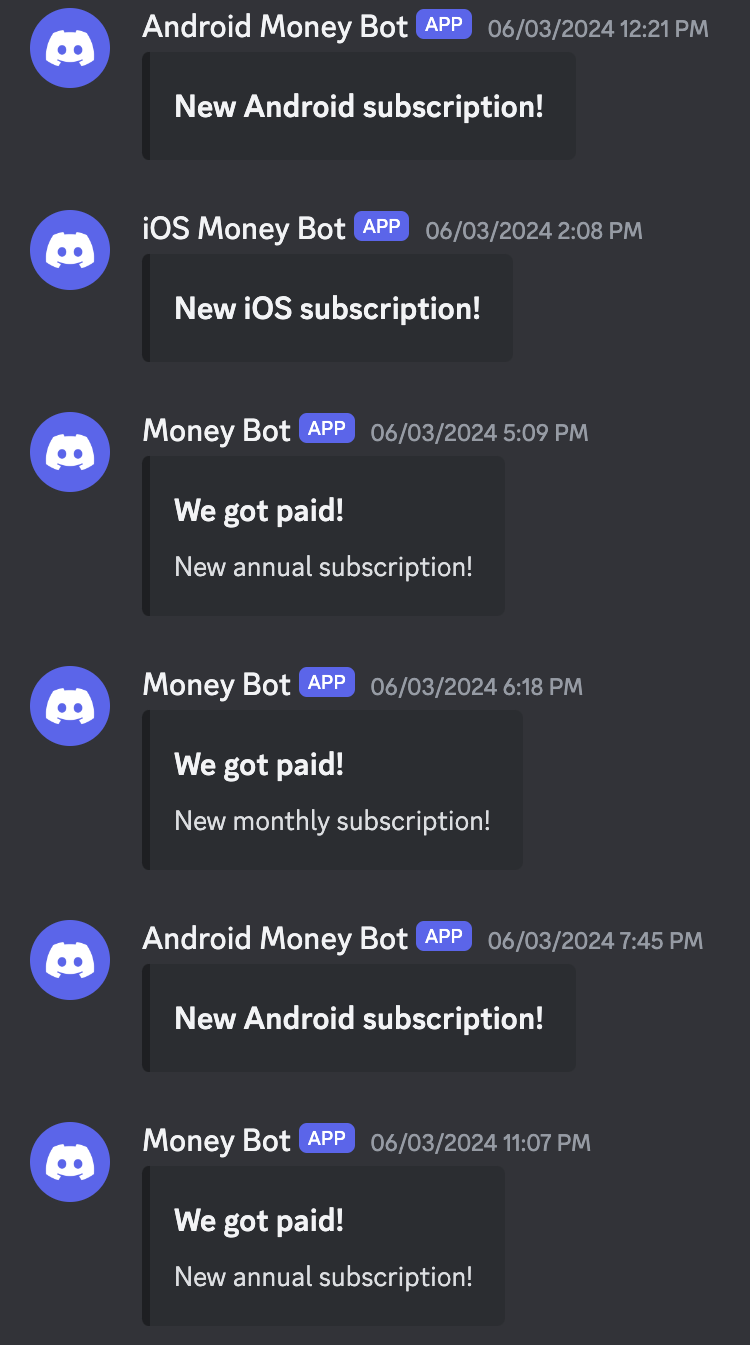
Image: Revenue bot subscription notification
I've turned off almost all push notifications, but I let the "money bot" through directly to my home screen. Every time I see one of these messages, a small wave of motivation hits. It's a bit like the hedonic treadmill — at first, each new subscriber was thrilling, but over time the excitement faded. Still, these pings keep me going.
I also signed up for a service that alerts me whenever someone mentions my product "Chessbook." This is useful for social media marketing, but it also gives me a boost every time I see people talking about something I built (hopefully in positive terms).
Beyond that, I created a "#pump-up" channel to log milestones we hit — MRR reaching a certain figure, Discord users crossing 2,000, churn dropping below 6%, and so on. These wins keep me charged up.
Part.02
Leave Something Unfinished
This one has helped me enormously. At the end of each day, I deliberately leave one task incomplete — usually around 90% done. It feels slightly uncomfortable not to tie up the loose end, but it makes starting the next day ten times easier. Knocking out a quick win right after sitting down gives me a huge motivational lift and rapidly pulls me into flow.
The unfinished task can't be too trivial, though. If all that's left is a git commit, that defeats the purpose. Ideally, I know exactly what needs to happen next, and it can be wrapped up in five to ten minutes.
Part.03
Use Your Own Product as Much as Possible
I try to use what I build as often as I can. When someone files a bug report saying something feels clunky, I sometimes shrug it off. But when I run into the issue myself, I immediately grasp how badly it hurts the user experience — and I fix it right away. Pain I feel firsthand lands very differently than pain described by others.
This habit also generates better product ideas. My best features never came from sitting down and brainstorming. They emerged from using the product and noticing what I actually wished it could do.
Part.04
Turn Friction Into Fuel
Development always involves some painful bits: neglected codebases, third-party integrations, shipping new native app versions — you name it. If I know a task contains one of these dreaded pieces, it's hard to muster the energy to start.
The trick is: almost all of these pain points can be alleviated.
Recently, for example, I felt heavy resistance starting a new task because it required building four or more new endpoints, which usually means mountains of boilerplate. Type definitions on the backend, matching type definitions on the frontend, making sure payloads and paths line up — and without type checking, nothing works on the first run anyway.
To reduce the pain, before starting the task I found a remote procedure call library called RSPC (a TypeScript- and Rust-based RPC library designed to simplify frontend-backend communication). It generates the types for me and makes calling a new backend function from the frontend as simple as calling another async frontend function — all while staying type-safe.
But it didn't just reduce pain. It made me genuinely excited about the new system. I turned a point of friction into a force multiplier.
If you've worked at a big company, this is easy to overlook. There, you get used to living with daily development annoyances because you're racing against deadlines, need approvals, or have to write a technical spec before trying anything. As an indie developer, you can fix and improve whatever you want, whenever you want. That's one of the biggest upsides of going indie. Remind yourself constantly: you can use this freedom anytime.
Part.05
Sometimes You Need to Do Nothing
I often fall into high-tech Skinner boxes — Reddit, Twitter, YouTube — these platforms are designed to be addictive. The best fix I've found is switching from these addictive feeds not to work, but to doing absolutely nothing. Then I can start working.
Going straight from scrolling Twitter to deep focus is brutally hard. Switching to "do nothing" is relatively easy. Just sit quietly in front of the screen for a few minutes, let the mind settle, and the dopamine-overload fog from excessive information consumption slowly lifts. The excitement for creating and problem-solving returns.
I mean literally nothing. I stare at the screen for a few minutes, and like magic, my attention comes back, and so does my motivation.
Part.06
Report Progress to Your Users
Updating users is a twofer: it keeps them in the loop, and reviewing your own output motivates you. At the end of each month, I often ask myself, "What did I actually do this month?" But when I sit down to write the monthly update, I realize I got plenty done.
There's a flip side, of course. If you truly didn't do much, the review forces you to face reality. But confronting the truth — recognizing you're not operating efficiently enough — can itself become motivation.
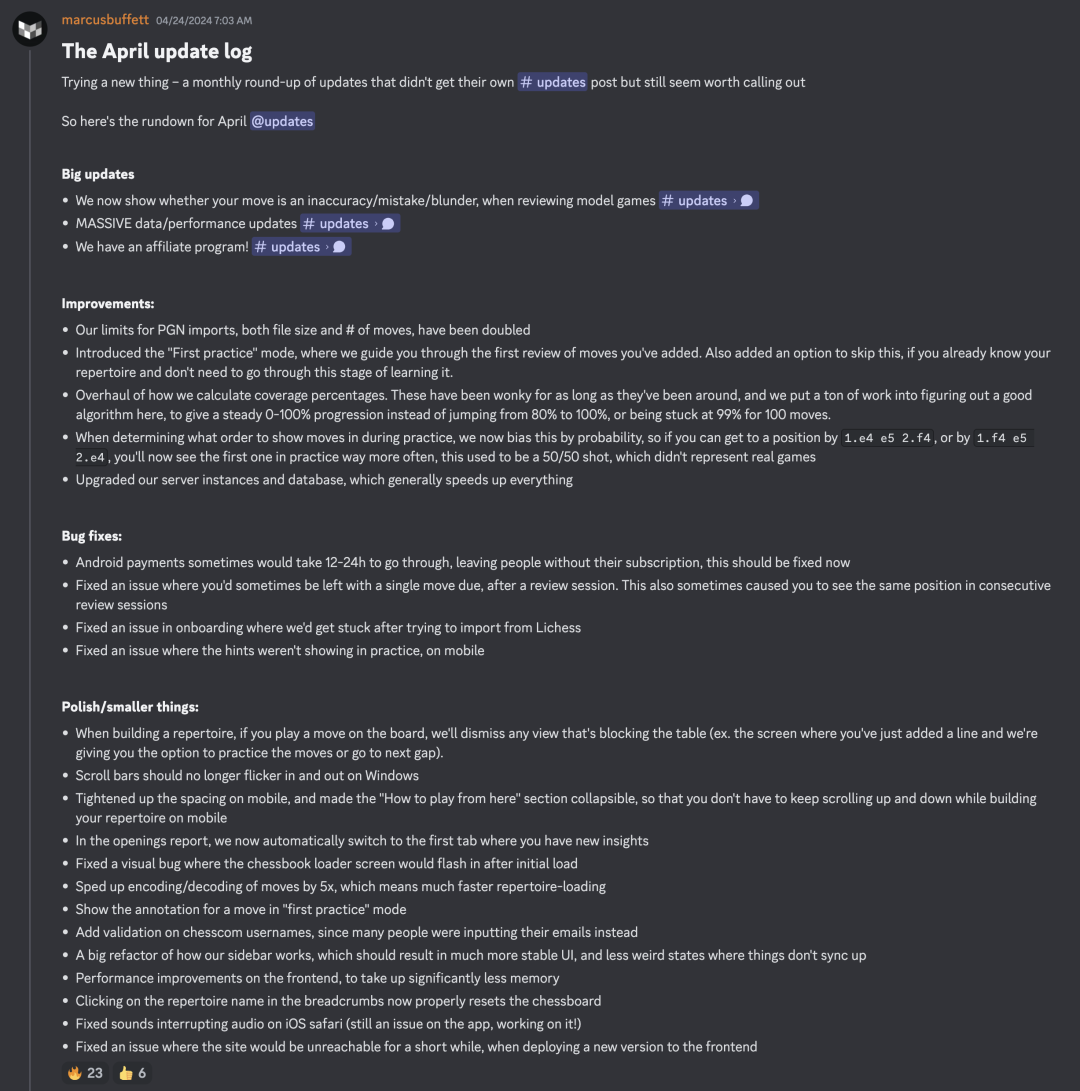
Image: Product changelog
Part.07
Find a Partner
This might seem to contradict the "indie developer" framing, but I'm indie, not partnerless. I have a collaborator who's far stronger than me at product design, copywriting, and more.
I won't enumerate every benefit of having a partner here, but I've come to believe they're essential. For any future project, I'll make sure to find someone who complements my skill gaps and shares my goals.
The motivational payoff comes mainly from accountability. It's like having a gym buddy — simply knowing someone expects you to show up creates powerful momentum. Plus, if you have weekly syncs and find yourself with nothing to report, that's a clear signal you haven't done enough.
Another advantage: your motivation cycles won't perfectly overlap. When you're burned out on the project, your partner might be fired up. That complementarity is incredibly useful.
Part.08
Avoid the Guilt of Idleness
Sometimes, when I've done nothing, a nagging guilt creeps in — "today was a zero-output day." This feeling prevents me from actually enjoying whatever I'm doing. I've tried giving myself permission to relax, telling myself I'm recharging, but it never works. On the surface I'm resting; underneath I'm white-knuckling it. This creates a negative spiral: I keep attempting to rest and only get more depleted.
The only fix I've found is to get some meaningful work done first, then enjoy whatever entertainment I want. Only then can I fully immerse myself without guilt.
Part.09
Seize Motivation When It Strikes
Sometimes I'll stumble on a solution to a problem right before bed and suddenly feel energized. I could jot it down and tackle it tomorrow, but more often than not, I'll just get up and work until 4 a.m.
That's another perk of being indie. I don't need to be online on Slack at 9 a.m., so I can ride spontaneous bursts of motivation whenever they hit — even in the middle of the night.
This approach won't suit everyone. But as I said at the start, this reads more like a diary-turned-blog-post than universal advice. My personal experience is that flexible working patterns let me perform at my best.
📮 More Reading

**


Linear Bolt Bolt is an investment initiative by Linear Capital focused on early-stage, global-facing AI applications. It carries forward Linear's investment philosophy, targeting projects driven by technological transformation, and aims to help founders find the shortest path to their goals. In both speed of action and investment approach, Bolt's commitment is lighter, faster, and more flexible. In the first half of 2024, Bolt invested in seven AI application projects including Final Round, XinGuang, Cathoven, Xbuddy, and Midreal.