Bill Gates Podcast Interview: How AI Will Change Our World | Bolt Picks

AI Applications and Impact in Healthcare, Education, and Global Health
Possible is a podcast hosted by Reid Hoffman (co-founder of LinkedIn) and Aria Finger (entrepreneur and CEO of DoSomething.org). It invites founders to share insights and experiences, with conversations typically spanning artificial intelligence, technology, design, business, and culture.
In a recent episode, hosts Reid Hoffman and Aria Finger welcomed Bill Gates to explore how AI will reshape the world over the next decade. As one of the most influential figures globally, Gates shared his perspectives on climate change, energy, global health, and education — and the transformations AI could bring to each.
We've selected and translated excerpts from the podcast. The original episode can be accessed via the "Read More" link at the end.
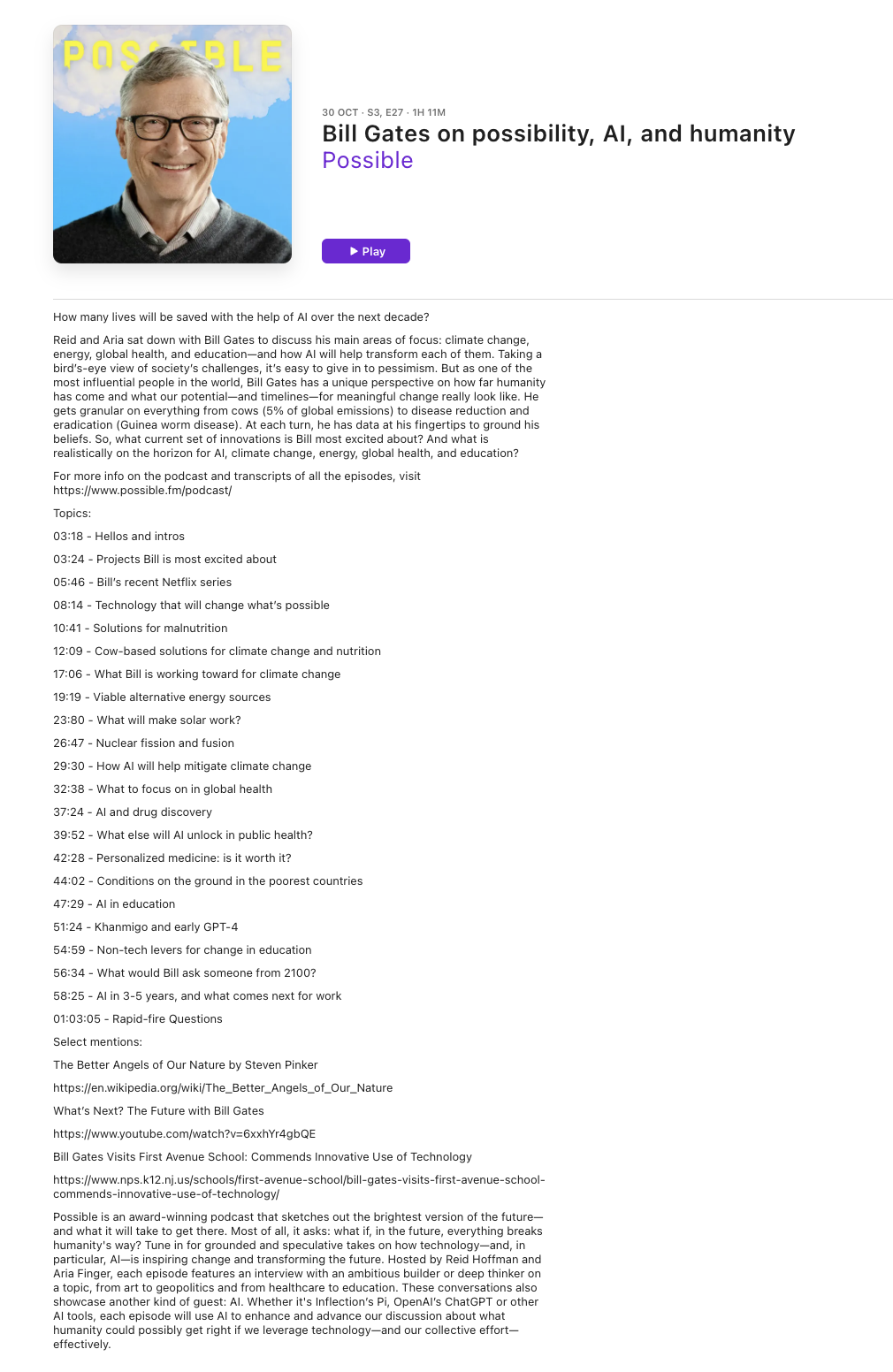
Image: Podcast shownotes
📝 Summary
-
AI in Global Health: AI excels at understanding proteins and molecular structures, accelerating medical discovery, particularly in drug development. Advances in AI have enhanced our ability to understand and treat complex diseases, especially in neurology — such as Alzheimer's.
-
AI at Work: AI significantly augments white-collar workers' capabilities, boosting efficiency and quality through automation and intelligent tools. In healthcare, AI can interpret complex medical reports and demonstrates remarkable creativity and fluency.
-
Limits of Personalized Medicine: Gates remains skeptical about personalized medicine, arguing that global resources are finite and should prioritize more universal health challenges rather than rare diseases.
-
AI's Potential in Education: AI can elevate educational quality through personalization and instant feedback — tools like Khanmigo help students grasp concepts more effectively. AI can also provide individualized tutoring in classrooms to improve learning outcomes.
-
Future AI Challenges and Opportunities: AI's development introduces new risks, including nuclear weapons, bioweapons, and societal polarization. Gates hopes we can address these challenges while harnessing AI's opportunities to improve quality of life.
-
AI's Impact on Everyday Life: AI will transform how we interact with data, enhance business operations, and potentially redefine the software market. Future technological advances may require us to rethink how we allocate time and resources, and how we maintain human connection.
Part.01
Global Health and AI
1. Reid Hoffman: In AI-driven drug discovery, what are you most focused on right now, and what kind of change do you think this can bring to global health?
Bill Gates: Understanding protein and molecular shape space is one of the problems AI is best suited for. We have the Protein Data Bank with about 150,000 molecules whose shapes we already know. So training AI on that data to predict protein shapes, and thereby predict druggable sites within those proteins, dramatically accelerates medical discovery. Actually, a company called Schrödinger was doing this work even before AI. But now there are probably 20 times as many people working on it, and progress is faster, because AI is so well-suited to this task. Eventually, AI won't just model shapes at the molecular level, but will model cells, organs, and entire organisms. The dynamics of complex disease progression exceed human comprehension, but AI models — with data being the limiting factor — can help us better understand issues like overnutrition and undernutrition. So I think significant medical breakthroughs are possible on most problems within 10 to 20 years. Even in neurology, things like Alzheimer's may be cracked. I love discussing the problems these companies are tackling.
2. Aria Finger: There's a popular narrative now: "The world is getting worse, society is a dumpster fire, the last 30 years were terrible, and the next 20 won't be any better." But if you actually look at the data, global health has improved over the past 30 years, and largely because of AI advances — we just touched on some. Maybe AI can bring us something even better. Is there anything or any innovation where AI could make a difference in tedious administrative work? Or can AI provide more help to healthcare workers, not just at the cutting edge of technology, but in other ways that could advance public health?
Bill Gates: The microcomputer revolution got me thinking when I was young: "If computing becomes free, what can individuals do with free computing?" Older people would say "computers are too expensive," and when we said computers were being used for spreadsheets or word processing, they'd think you were joking because it seemed "too luxurious." What's even more striking is how much AI can amplify white-collar workers' capabilities. Robotics remains limited to specialized domains for now, but eventually blue-collar work will become very cheap too. For example, I took a friend's MRI diagnosis and asked ChatGPT to explain it — not only did it interpret it well, it clearly cited its sources. AI's creativity and fluency are genuinely astonishing.
We can all rely on AI now. Before, if you wanted to know what fertilizer was, Wikipedia sufficed. But if you want to know what a four-day trip to Italy in August with a 16-year-old on a $4,000 budget would look like, no one has written that. Yet if AI is connected properly, its performance on these kinds of queries will blow you away. We're already benefiting in daily life — writing poems, drafting speeches, understanding complex materials, summarizing content. Much white-collar work can become more efficient, even quality-enhancing.
3. Reid Hoffman: Over the past decade, personalized medicine has attracted significant attention. Where do we stand on this now? Has there been improvement? What does its future look like?
Bill Gates: I'm skeptical of "n=1" medical solutions — precision medicine tailored to the individual. Consider that 500,000 children die of malaria every year, and millions are diagnosed with Alzheimer's annually. The world doesn't have enough resources to support n=1 solutions. If ultra-wealthy individuals want to fund such research, it might advance scientific discovery. But I can't participate myself, because diverting limited resources would be unfair. Understanding everyone's genes and saying "because of this, your medication is different" — this may sound provocative. The science under this research umbrella is excellent, and the researchers have good intentions. But the problem is we're overly focused on rare diseases, even creating incentive structures for them, while neglecting more prevalent common diseases. This isn't actually efficient resource allocation, especially for diseases widespread in poor countries.
4. Aria Finger: You've recently traveled to Africa, Asia, and other places. Can you talk about the working conditions of local healthcare workers? What did you see there, and how can we help improve their situation?
Bill Gates: Many people may not realize that most people in sub-Saharan Africa never see a doctor — not at birth, not when ill, not at death. So healthcare there looks very different from what we typically associate with doctor-patient interactions. Local care relies mainly on primary health services delivered by workers with basic training, including some antibiotics, bed nets, vaccines, and critically, prenatal care for pregnant women. Now they can use ultrasound screening to identify which pregnant women have, say, a 10% risk of complications, helping those women reach professionals who can perform C-sections. So through this AI-trained ultrasound technology, we can accurately predict whether complex problems will arise, avoiding costly comprehensive screening for all pregnancies.
That's the most doctor-scarce place on Earth. Providing health advice in local languages via smartphones — though not everyone has one. But even in poor countries, this trend is gradually growing. Many diagnostic tools are also becoming available at point of care, like the COVID tests many people experienced. These "rapid tests" are evolving toward more convenient "point-of-care" formats, including molecular tests that are more sensitive and accurate, with costs coming down. Local healthcare budgets are about $100 per person per year, compared to $15,000 in the US — a 150-fold gap. So treatments must be carefully selected. For issues like blood pressure, cholesterol, and obesity, I hope not only that treatment costs will fall, but that we'll convert them to annual dosing. In 10 to 15 years, we'll be able to offer GLP-1 to all Africans.
Part.02
The Significance of AI in Education
5. Reid Hoffman: Beyond improving human welfare through various forms of healthcare, healthcare education is also a field you and your foundation care deeply about. Clearly, AI has attracted significant attention in this area. What does AI actually mean for education? What are some unexpected or particularly interesting applications? For example, among global online tutoring systems or other types of AI education tools, which applications have caught your attention?
Bill Gates: I must first acknowledge that tech enthusiasts like myself have spent entire careers talking about technology's benefits for education. But for the average student, the actual benefits have been quite limited. If you're a motivated student, you could spend two hours nightly on Khan Academy or watch YouTube videos about photosynthesis, learning in unprecedented ways. For instance, I love watching The Great Courses on my treadmill — there are many excellent resources. Yet American high school graduates' math proficiency hasn't significantly improved from a century ago.
We've tried many things. I still believe in technology's potential, and the fluency and personalization AI brings let us hold very high expectations. For example, how to combine interactive classroom experiences, teacher expertise, and students' own work. AI can correct pronunciation while students read aloud, or immediately prompt them when they make math errors — students don't have to wait two days for graded homework to discover mistakes, but get instant feedback. Khanmigo (an AI-powered teaching assistant launched by Khan Academy) and other tools like CK-12 Mini are exemplary in this regard, helping students understand the root of problems.
AI can also learn how to encourage students like a tutor would, using familiar domains like sports, health, or construction to make content more relevant to students' interests. Education is severely underfunded globally, and the "secret" to helping countries improve themselves lies in providing good health and education services — leading to economic growth, increased tax revenue, and self-sufficiency. This is why we help poor countries escape poverty traps: not just out of moral obligation, but because it enables economic stability and more positive effects. Education remains a very underdeveloped field globally, but with AI's arrival, I encourage philanthropists to get involved. For example, structured pedagogy gives teachers clearer teaching methods, and we've already seen good results in some regions.
6. Aria Finger: I strongly agree with your view. I think some people might see this as a "boy who cried wolf" situation — 20 years ago people said MOOCs would transform education, yet many remain skeptical today.
Bill Gates: That skepticism is warranted.
7. Aria Finger: So, has education actually been transformed? Can you talk about First Avenue Elementary School in Newark? Clearly you care deeply about equity. Is this a replicable and scalable model?
Bill Gates: I love Khan Academy, but it primarily serves motivated students. For the past eight years, they've been thinking about how to enter classrooms, how to complement teachers' work. Yes, computer and internet access has improved — the pandemic actually accelerated this. Sal Khan (founder of Khan Academy) and I were among the first two people OpenAI invited to use ChatGPT-4. Many interesting features, like writing poems and composing songs, Sal actually taught me about. I didn't even know it could write like Shakespeare — astonishing. So he invested heavily, with support from the Gates Foundation and other organizations, to develop Khanmigo.
In the last school year, Sal deployed Khanmigo in a handful of schools, including First Avenue Elementary in Newark, New Jersey. I went there to meet with teachers and students and saw its effects firsthand. You'll encounter obviously advanced children who, in traditional "factory model" classrooms with 30 students, often need help catching others up while feeling uncomfortable themselves because they're ahead and may lose motivation, among other issues. The personalized tutor function lets these students work independently sometimes, and help classmates other times. Additionally, Khanmigo works with Khan's dashboard feature: when teachers enter the classroom in the morning, instead of collecting homework, they check the dashboard to see who logged in last night, who encountered problems, and their learning progress.
Teachers can provide instant feedback to each student and connect parents to the system. Even homework submission changes — instead of paper assignments, students submit AI conversations. Teachers can ask the AI: "How much did the student complete? What suggestions can help them improve their draft, grammar, or logic?"
Seeing this system in action strengthened my conviction in bringing it to classrooms. Typically, with new tools, about 10% of teachers adopt them and achieve significant results. But when the remaining 90% are forced to use them, the effects often vanish. So the key is how to scale such systems. Despite rapid AI progress, we must remain humble because much improvement is still needed. But what I've seen makes me more optimistic about the future.
8. Reid Hoffman: Sometimes people overlook that your and your foundation's problem-solving approach isn't just metrics like "cost per life saved," but also systems thinking. So in education, what are some non-technology-related levers for change? For example, what policies should we (America or the world) consider to improve education?
Bill Gates: There's good data on prohibiting cell phone use in schools, with some excellent work in this area. Also, data suggests boys might benefit from starting school later, and school start times should be pushed back generally. Charter school practices show that extended school days and years are extremely beneficial. Additionally, strengthening parent engagement — understanding children's learning difficulties and communicating with parents — is very important. While digital tools make it easier for willing parents to participate, in communities with charter schools, even when most children remain in public schools, those public schools face competitive pressure: they either adopt these practices or find their own approaches. In places like New Orleans, Washington D.C., and Austin, school performance has improved. So as we try to integrate AI into education, we should also ensure we absorb these existing proven practices.
Part.03
AI's Future Challenges and Opportunities
9. Aria Finger: "Borrowing" a question of your own — if you had the chance to meet someone from 2100, what would you ask them?
Bill Gates: I'd ask how they navigated the challenges and opportunities AI brought. You mentioned earlier that I believe life is improving, which is objectively true. Of course, there are always disruptions — nuclear weapons, bioweapons, and now AI joins that list. Still, over the past 50 years, life has generally improved, especially for women, LGBTQ people, and others. In a way, it's somewhat sad that we're so problem-oriented; we don't reflect enough.
So I'd arrive with the perspective that "the world is actually pretty good," but I'd want to hear from 2100 how they avoided what I call the four "historical disruptions": AI, nuclear weapons, bioweapons, and polarization. This includes how people coexist and cooperate, and how governments adapted under AI's influence, adopting different approaches to taxation and regulation.
10. Reid Hoffman: What changes do you think people should expect from AI in the next three to five years?
Bill Gates: It's truly incredible, sometimes hard to fully grasp. No one expected that AI would break through in white-collar work before blue-collar work. For example, in Life 3.0, the author describes a "task difficulty mountain": computers would solve simple tasks first, while blue-collar tasks like warehouse work remained in the "lowlands," not yet automated. Complex tasks like diagnostic assistance, legal document drafting, and programming sat at the "summit," seemingly harder to crack. So this sequence of development was genuinely surprising. However, future "blue-collar robots" will be able to receive instructions — go help at a construction site, or clean rooms at restaurants and hotels. Even if initially they can only work briefly in homes, not reside there permanently, I believe this technology will easily be achieved within the next decade.
11. Reid Hoffman: Returning to your original vision — a computer on every desk helping people work and live. Now AI's development has made natural language (like English) the most widely used programming language, and everyone will have a coding assistant, not just a computer. How do you think this change will transform the world?
Bill Gates: Now we can access data effortlessly, which previously required IT personnel — setting report headers and footers, using specific modules in RPG (Report Program Generator) or COBOL (Common Business-Oriented Language). These operations are already so outdated that thinking about them makes you laugh. Today, being able to converse with data in rich ways means we'll operate businesses more efficiently, identify bottlenecks, adapt to changes, and no longer need custom software. In fact, the entire software market landscape will shift — the number of applications will change, and we'll see many applications incorporating AI features.
12. Aria Finger: Alright, one last question. Can you share what goals we might achieve if everything goes well in the next 15 years? What's the first step?
Bill Gates: The positive vision of the future is so bright that we'll need to rethink how we use our time. You might call it a new "faith" or "philosophy": in a world of highly advanced technology, how do we maintain human connection? If things go well, problems of disease, food, and climate will be largely solved. The next generation will have the opportunity to think: "Since resources that were once scarce are no longer scarce, how should we use these new advantages?"
For example, should we restrict AI in certain domains to preserve unique human experiences? You might not want robots playing baseball because they'd be too dominant — they might be "banned from the field." So how broadly should such restrictions apply? We've grown accustomed to a world of resource scarcity, and I hope to see more people begin rethinking these profound questions of meaning.
📮 Further Reading



Linear Bolt Bolt is an investment initiative established by Linear Capital specifically for early-stage, globally-oriented AI applications. It upholds Linear's investment philosophy, focusing on projects driven by technological transformation, with the goal of helping founders find the shortest path to their objectives. Whether in speed of action or investment approach, Bolt's commitment is to be lighter, faster, and more flexible. In the first half of 2024, Bolt invested in seven AI application projects including Final Round, Xinguang, Cathoven, Xbuddy, and Midreal.