Bolt Picks | Three Reflections on "Founder Mode"

We all love a gripping hero's journey, but that's not the whole story.

By Kent Beck
Translated by Linear Capital
Recently, Y Combinator founder Paul Graham's essay "Founder Mode" has generated significant attention not only in Silicon Valley but also in China. The piece begins with a speech by Airbnb co-founder and CEO Brian Chesky, using his experience to illustrate how founders are constantly told to manage their companies like professional managers — advice that proves ineffective, even harmful, for founders. Graham goes on to discuss two distinct approaches to running a company: Founder Mode and Manager Mode, arguing that while Founder Mode is more complex, it is also more effective.
We came across a thoughtful response from Kent Beck that offers further reflection and clarification on Graham's essay. We recommend it as supplementary reading and are sharing it here.
Kent Beck is a well-known engineer based in San Francisco, the creator of Extreme Programming, and a former Facebook employee. In 2019, he joined Gusto as Software Fellow and Coach. The following article is from his newsletter (click "read more" for the original English version).
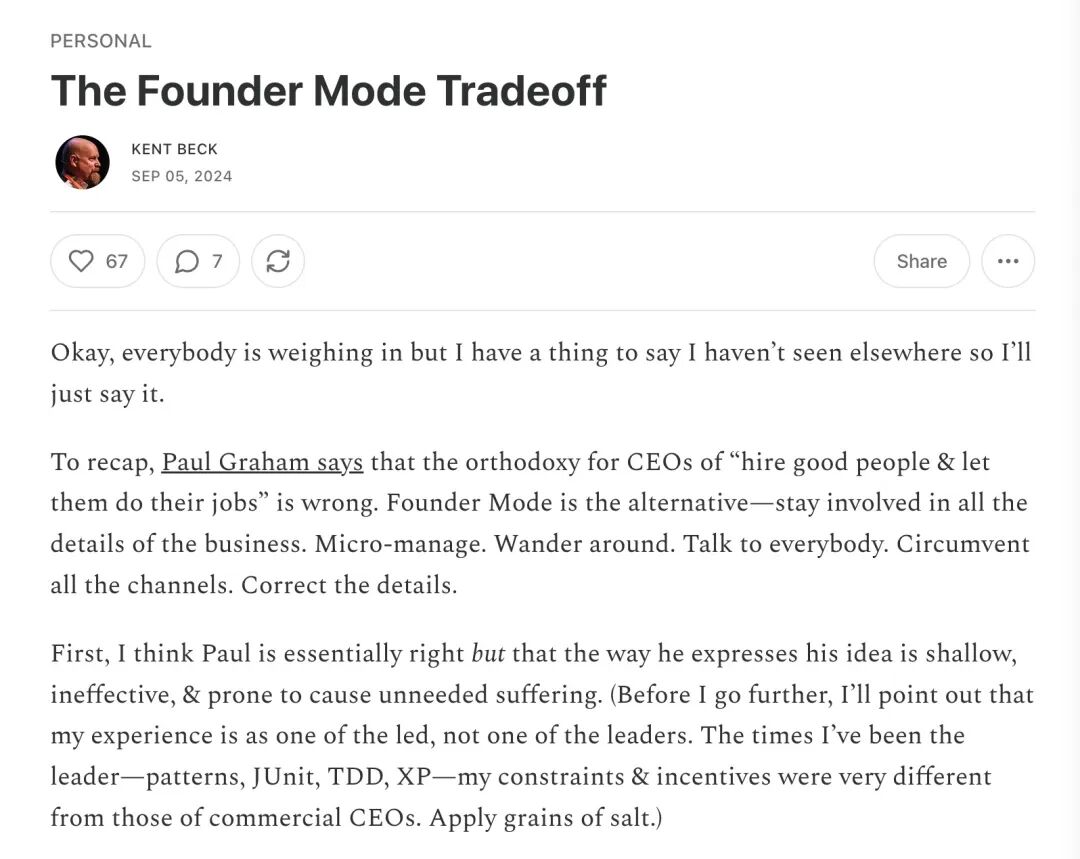
The Trade-offs of Founder Mode
There's been a lot of recent discussion about company management models. I'd like to share some perspectives that may not have been raised elsewhere.
Y Combinator founder Paul Graham has put forward a view that challenges conventional CEO management wisdom. He argues that the traditional approach of "hire excellent people and let them do their jobs well" is flawed, and proposes a new management model — "Founder Mode" — in which the CEO stays deeply involved in company details, practices micromanagement, communicates directly with employees at any time, and can bypass normal channels to correct specific issues.
I believe Paul Graham's core argument is essentially correct, but incompletely expressed, which may lead readers to misunderstand its true meaning. (Before proceeding, I should note that my experience comes primarily from being led, not from leading. I have led some projects — Patterns, JUnit, TDD, and XP — but the implicit conditions and incentive structures of these projects differ significantly from those of a real business CEO. Readers should approach this with critical thinking.)
01 Survival First
First, the management model Paul Graham discusses is primarily aimed at ensuring the company's continued survival — everything else must yield to survival. As I've said before, game over means losing all future returns.
Business survival is difficult. Many things can cause a company to fail, while the paths to success are few. And these rare successful paths are typically forged by avoiding a chain of bad decisions.
So what behaviors increase a company's odds of survival? I speculate that fatal decisions usually result from the interaction of two seemingly harmless decisions, rather than from one massive blunder. If this hypothesis holds, then the CEO does have a unique and critical task — detecting these combinations before they collide.
It's worth noting that Paul is not encouraging founders to participate in all decisions. Excessive involvement in organizational decisions would actually reduce a founder's ability to spot potential dangers. Rather, what truly matters for a CEO is cultivating acute sensitivity to potentially dangerous decisions — this is what improves the odds of survival.
02 Iteration
Business is an iterative game. A CEO doesn't simply call "Heads!" to determine the outcome. In fact, every decision a CEO makes produces at least two effects:
- The consequences of the decision itself.
- A new organization capable of making better or worse decisions.
I believe Paul Graham's argument neglects discussion of this second effect. When a CEO jumps in to change an employee's domain-specific decision, even if the CEO is right, it creates certain negative effects on the people in the organization and the organization as a whole. These effects need to be promptly repaired so the organization can iterate and continue building its capacity to make the next better decision.
03 Multi-dimensional Connections
A founder serving as CEO possesses at least three unique advantages that improve organizational survival odds:
- Social capital: A founder-CEO commands more social resources, enabling them to transcend others' imaginative limitations and help the organization find new solutions or paths to success.
- Breadth and depth: A founder-CEO maintains working knowledge of the entire business and its people, enabling them to identify and avoid decision combinations that threaten survival.
- Incentive alignment: A founder-CEO is more willing to devote themselves fully to the current venture, whereas professional managers focus more on whether their current performance will pave the way for their next job.
In summary, the Founder Mode approach to decision-making has its advantages, but also negative consequences. If these downsides are ignored, CEOs may find themselves having to intervene more and more frequently in decisions. As the number and complexity of decisions grows, the game will inevitably collapse.
We all love a good hero story. But that's not the whole story.
Linear Bolt
Bolt is Linear Capital's dedicated investment program for early-stage, global-market-facing AI applications. It upholds Linear's investment philosophy, focusing on technology-driven transformative projects and helping founders find the shortest path to their goals — whether in speed of action or investment approach. Bolt's commitment is to be lighter, faster, and more flexible. In the first half of 2024, Bolt invested in seven AI application projects including Final Round, Xinguang, Cathoven, Xbuddy, and Midreal.