Bolt Reading Notes | Perseverance vs. Pivoting Early — On the Art of the Pivot

**Pivot is a term from Silicon Valley that refers to the strategy of shifting market direction and product form during the startup process.** For many entrepreneurs, Pivot is a concept that feels familiar yet foreign. Familiar because we constantly see those jaw-dropping Pivot cases (such as Slack's transformation), and today many outstanding AI application startups have gone through the Pivot process (such as HeyGen). But despite
"Pivot" is Silicon Valley jargon for the strategy of shifting market direction and product form during the startup process. For many founders, pivoting is a concept that feels both familiar and foreign. Familiar because we constantly see spectacular pivot stories (like Slack's transformation), and many excellent AI application startups today have gone through pivots themselves (like HeyGen). But despite the enormous impact and transformation it brings to founding teams, systematic analysis of pivoting is surprisingly rare. Entrepreneurs often feel lost when it comes to deciding whether to pivot, when to pivot, and how to pivot — myself included.
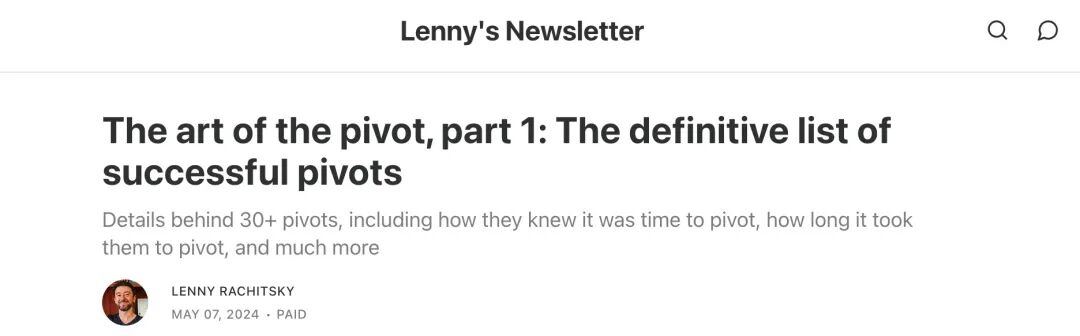
I recently came across a series by well-known newsletter writer Lenny Rachitsky on exactly this topic, "The art of the pivot." He interviewed founders from more than 30 companies that successfully pivoted, documenting their processes in detail and distilling practical pivot methodologies. I'm sharing his findings here. If you want more details (the founder interviews are particularly vivid and engaging — it feels like you're living through these product pivots yourself), I encourage you to subscribe to his newsletter (click "read more" at the end).
Why Pivot
Pivoting is an agonizing decision for entrepreneurs because it means abandoning an idea you've already poured enormous time and resources into. At its core, though, it's a question of opportunity cost. Giving up on a less promising direction frees you to keep searching for product-market fit. But not all pivots are the same. Based on product stage and timing, they fall roughly into two categories:
-
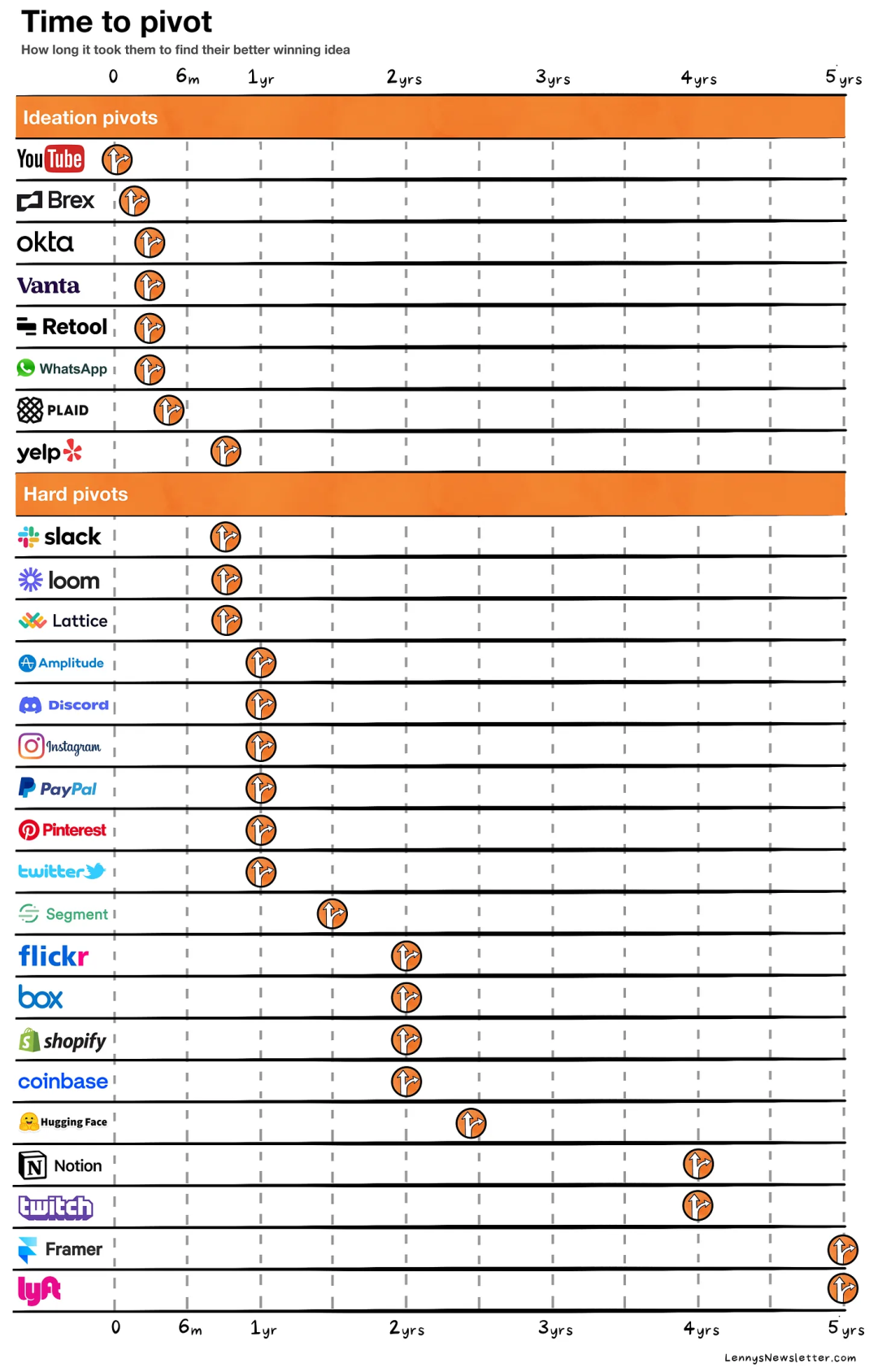
Ideation Pivots: These occur at early-stage startups before the product has taken shape or gained significant market traction. The pivot typically happens within months of the initial launch, and the new idea is usually completely unrelated to the original. YouTube's shift from a dating site to a video streaming platform is the classic example. These usually happen within three months of launching the original idea.
-
Hard Pivots: These are undertaken by companies with actual products and users. In this case, the company typically retains some element of the previous idea and doubles down on that part. Slack's evolution from an internal chat tool to a team communication platform is the textbook case. These typically happen within two years of launch, most around the one-year mark.
Based on Rachitsky's data analysis, he recommends that founders have a serious conversation with their founding team around the three-month mark after product launch, and schedule an annual review thereafter. If things are going well, full speed ahead. But if things feel mediocre or you're hitting roadblocks (more on this below), spend at least a few days discussing alternative directions.
Whether to Pivot
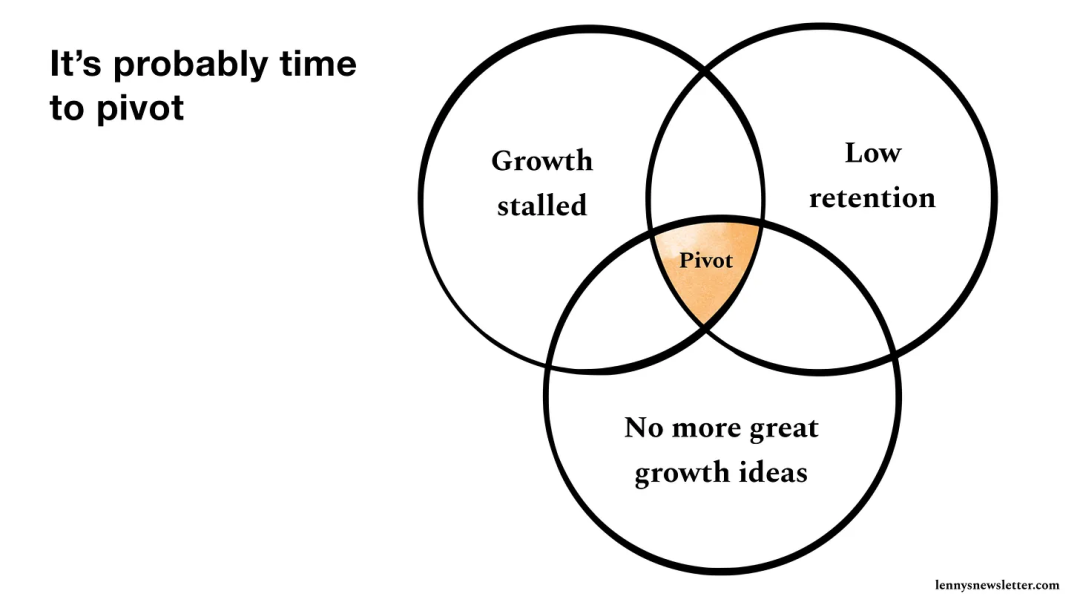
Two signals can help you decide if it's time:
- Sustained user indifference: This shows up especially as low retention, stagnant growth, and no effective growth levers. It suggests users simply aren't that into your product, and it may be time to consider a change. Spenser Skates, co-founder and CEO of Amplitude, noted that their early product Sonalight "had hundreds of thousands of downloads and some paying customers, but retention was very low."
- Realizing the project's potential is limited: Sometimes, as time passes and you deepen your understanding of the project, you discover your idea simply doesn't have the potential you originally believed. Stewart Butterfield, founder of Slack, said their early game project Glitch "could never become a business that would justify the $17.2 million in venture capital we'd raised."
How to Pivot
-
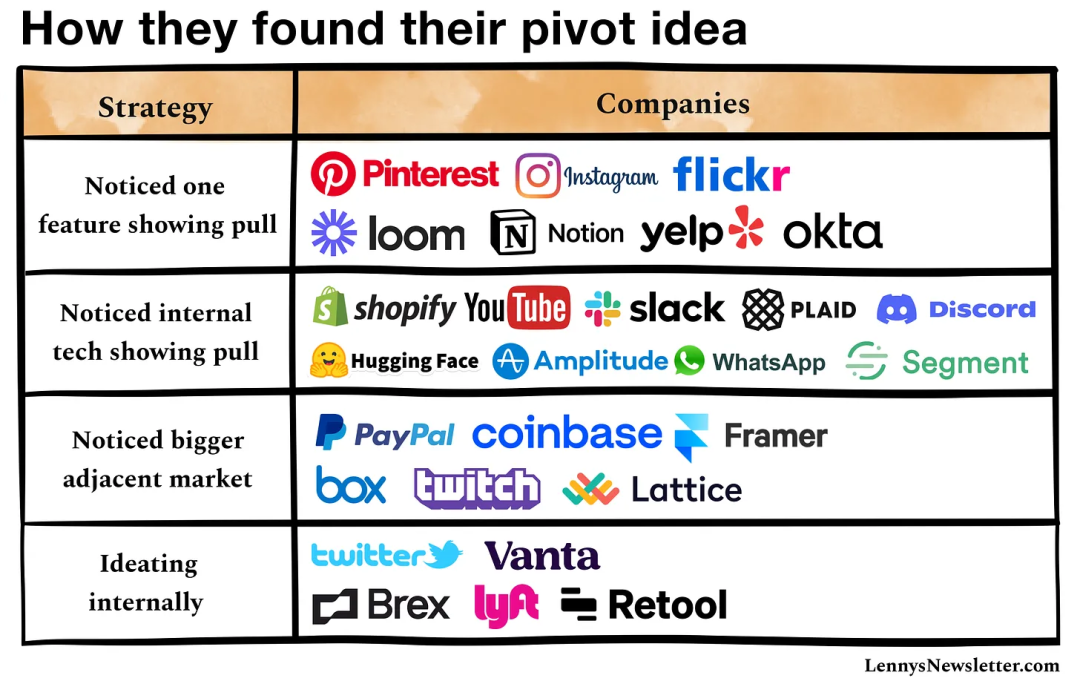
Double down on a standout feature: Many successful companies found their new direction by focusing on one feature users particularly loved. Instagram co-founder Kevin Systrom recalled: "We noticed users kept posting photos, and those photos got the most likes and comments. So we decided to delete every other feature, keep only photos, build in filters, and allow likes and comments. On the first day after that change, 25,000 users signed up."
-
Productize an internal tool or technology: Some companies discovered that tools built for internal use had significant external demand. Amplitude grew out of its own internal analytics tool; Discord evolved from in-game chat functionality into the communication platform it is today.
-
Expand into an adjacent, larger market: Some companies find new direction by moving into a neighboring but bigger market. Coinbase shifted from a Bitcoin wallet to Bitcoin trading. Founder Brian Armstrong explained: "During Y Combinator, we contacted registered users and found they weren't using the app because they didn't have Bitcoin. When we launched the feature to buy Bitcoin, user numbers started growing rapidly."
-
Internal innovation: Generate new ideas through internal brainstorming and experimentation. Twitter's founding team came up with the status update concept during an internal hackathon, which evolved into the Twitter we know today.
Final Thoughts
The art of the pivot is that, done well, it can bring a team back from the brink. But for all the celebrated success stories, we can't deny that pivoting is no panacea — it's not even reliably effective. The vast majority of pivots still fail. On this topic, I want to emphasize three points in particular:
-
Only consider pivoting when necessary; don't treat it as a default mindset. This mentality subtly pushes you to pivot more frequently, causing you to miss opportunities that would have proven correct. We've seen too many painful cases of pivoting away from directions that would later be vindicated. As for what constitutes "necessary," I think the deep dive this post is based on will help you find clarity.
-
If you decide to pivot, move fast and commit fully. Have the resolve to let go. Avoid draining energy between old and new directions, or worse, juggling multiple directions at once. The essence of pivoting is to reduce opportunity cost, not to accumulate more seemingly promising paths. Don't let strategic paralysis defeat the purpose.
-
Pivoting and focus are not contradictory. Every appropriate pivot should happen only after "you have tried your best to prove that's wrong" — in other words, you've exhausted every effort before concluding the direction is wrong. And high-quality pivot ideas themselves tend to emerge only under conditions of deep focus. So focus may actually be the true essence of the art of the pivot. If you're also focused on building AI products, I'd love to chat — find me on WeChat at bluesbaiLcz.
Bolt Community
If you're an explorer of the AI wave who resonates with Bolt's perspective, and you'd like to discuss with like-minded peers, scan the QR code below to briefly introduce yourself. After review, you'll be invited to join the discussion.

Linear Bolt Bolt is Linear Capital's dedicated investment program for early-stage, global-market-facing AI applications. It upholds Linear's investment philosophy, focusing on projects where technology drives transformative change, and aims to help founders find the shortest path to their goals. Whether in speed of action or investment approach, Bolt's commitment is lighter, faster, and more flexible.
Bolt8
Bolt · Contents
Previous: Bolt Perspectives | The Stage Beyond Product Hunt