Bolt Picks | AI's Core Lies in Solving Real Problems and Continuously Optimizing User Experience
Product-Led AI is a new podcast from Seth Rosenberg, a partner at Greylock, the renowned Silicon Valley venture capital firm (link: https://productledaipod.com). Each episode features either an AI-native company (such as Adept, Perplexity) or a vertical player that has gone deep into its application scenario and actively embraced GenAI in its workflow.
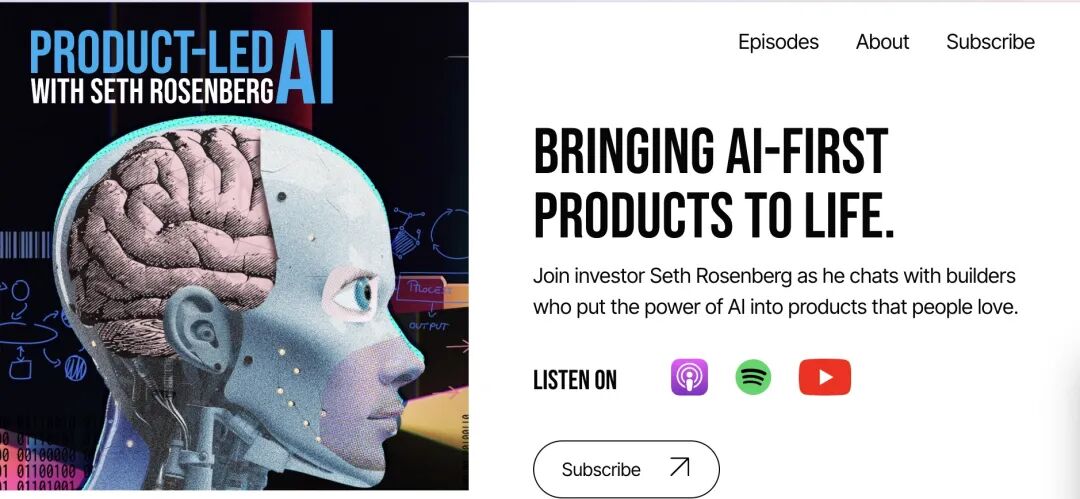
Product-Led AI is a new podcast from Seth Rosenberg, partner at the well-known Silicon Valley venture firm Greylock (link). Each episode features an AI-native company (like Adept or Perplexity) or a product that has gone deep in a vertical use case and actively embraced GenAI in its workflow (like Ramp or Fermat). The podcast grew out of an article Rosenberg published in September 2023 under the same title. Bolt Note: Greylock has been one of the most active investors in application-layer projects during this GenAI wave, backing large model companies like Adept and Inflection before the market frenzy, and was also among the earliest supporters of application-layer projects like Tome and Cresta.
In his Product-Led AI article, Seth identified three major opportunities for AI-first companies — also the three earliest scenarios to materialize in the global GenAI wave:
- AI-first networks and marketplaces
- Redefining enterprise software categories
- Copilots for various services
Building on the article through deeper research and case studies, each podcast episode explores one of these three themes through a conversation with a company founder. I listened to a recent episode featuring Rishabh Jain, founder of Fermat, a company using AI to redefine distributed e-commerce. He discussed how optimizing the post-click user experience can improve ad conversion rates and sales. I'm sharing some of my notes and takeaways here, and I'd recommend checking out other episodes too. When the "shovel" (large models) appears, Bolt also hopes to support and empower those who take these shovels to go gold prospecting — the risk-takers willing to build ventures that use AI to transform how humans work and live.
What's Interesting
-
In the latest episode, Fermat founder Rishabh Jain noted that the most important role AI can play in customer-facing scenarios is creating delightful moments.
-
The most important thing for a startup is its problem statement — defining and articulating what problem it is solving: The best validation is when users nod along frequently as you describe the problem. Once you've found that problem statement, the important thing becomes continuously using user feedback to make the experience more efficient.
-
Ramp founder Eric Glyman made a similar point in "Building The AI Platform For Finance Team." Ramp provides corporate credit cards and spend management solutions for company finance departments, helping businesses save money and streamline financial operations. From day one, the entire product design centered on two things: saving time and saving money, enabling finance teams to "do more with less." Good products often peel away layers to solve users' most core and fundamental needs. So even though Ramp began exploring and applying language models in its product workflows back in 2019, the founders see Ramp more as a productivity company rather than leaning heavily into an AI narrative.
-
Strong user engagement — building stickiness — operates on two levels. One is delivering a great user experience; the other, which people often overlook, is closing the loop. By tracking the data chain between user intent and final purchase behavior, it's easier to generate more data at every step, which can create compounding effects for AI down the road. Any product currently designing AI-driven features needs to think about how AI a few years from now can leverage the data being accumulated today as fuel. This is perhaps the biggest difference from previous waves of traditional AI, which typically solved one fixed, specific problem.
Bolt Thoughts
-
Whether it's Fermat's emphasis on user delight or Ramp's focus on productivity gains, the core of AI lies in solving real problems and continuously optimizing user experience. Real user scenarios matter more than flashy tools. As Apple's June 10 event put it: "AI for the rest of us." Partnering with OpenAI, Apple finally launched on-device personal intelligence systems. From a pure technology standpoint, this event didn't deliver the same surprise moments that OpenAI's GPT-4o release did in terms of model capability breakthroughs. But from a practical implementation angle, we look forward to AI-enabled Siri bringing tangible utility to life's specific, mundane moments. When GPT-4 launched, we half-joked that large models could already handle many complex creative tasks, yet the experience of turning your bedroom lights on or off when you got home might not be as smooth as imagined. We're looking forward to the small surprises that iOS developers can deliver a quarter from now, with more seamless access to on-device and server models in their development.
-
This is also the core philosophy of the companies featured in the Product-Led AI podcast series. AI is now like an intelligent magician, offering creators infinite tools and potential. Yet the real magic lies in clarifying user needs, identifying core problems, and solving them. Through closed-loop data feedback, AI can continuously optimize user experience — like an ever-learning, ever-growing intelligent entity — helping businesses achieve "more with less." The key is harnessing AI's power to transform user needs into tangible product value.
Bolt Community
If you're an explorer of the AI wave who resonates with Bolt's perspective and wants to discuss with like-minded peers, welcome to scan the QR code below to briefly introduce yourself. After review, we'll invite you to join the conversation.

Linear Bolt Bolt is an investment initiative established by Linear Capital specifically for early-stage, global-market-facing AI applications. It upholds Linear Capital's investment philosophy and principles, focusing on projects where technology drives transformative change, with the goal of helping founders find the shortest path to their objectives. Whether in speed of action or investment approach, Bolt's commitment is lighter, faster, and more flexible.