Bolt Perspective: Should Your AI Product Actually Be Called an Agent

Since ChatGPT's launch, frameworks like BabyAGI and AutoGPT quickly emerged. These agents allow LLMs to autonomously plan and make decisions, tackling complex problems that single-prompt engineering struggles to solve. Soon after, an ever-growing number of intricately designed frameworks appeared — many specialized for particular scenarios. The agent space flourished so rapidly that I
Since ChatGPT's release, frameworks like BabyAGI and AutoGPT quickly emerged. By letting LLMs plan and decide autonomously, we could tackle complex problems that single-shot prompt engineering struggled with. Soon after, increasingly elaborate frameworks proliferated — many specialized for specific scenarios. The Agent field flourished so rapidly that in our own investment observations, nearly every AI application company claims their product is Agent-driven or built on Agent architecture at its core, even when they're merely doing simple prompt orchestration. As a previous Bolt article, A Thousand People, a Thousand Definitions of Agent, put it: "Talk to enough practitioners and you'll find a whole spectrum of different concepts, all called Agent."
Yet serious discussion of what actually qualifies as an Agent, and how different Agents differ, seems surprisingly scarce.
Recently, Andrew Ng (the deep learning instructor who introduced many of us to the field) shared his perspective in an article (linked at the end). He introduced the concept of the Agentic System, arguing that the adjective "Agentic" serves us better than the noun "Agent" for grasping the essence of these systems. It prompts us to consider to what degree a system can be agentic — much as autonomous vehicles possess varying levels (L1-L4) of self-driving capability, we can view agentic intelligence as a spectrum. Harrison Chase, CEO of LangChain, offered a similar framework in his recent piece What is an agent?:
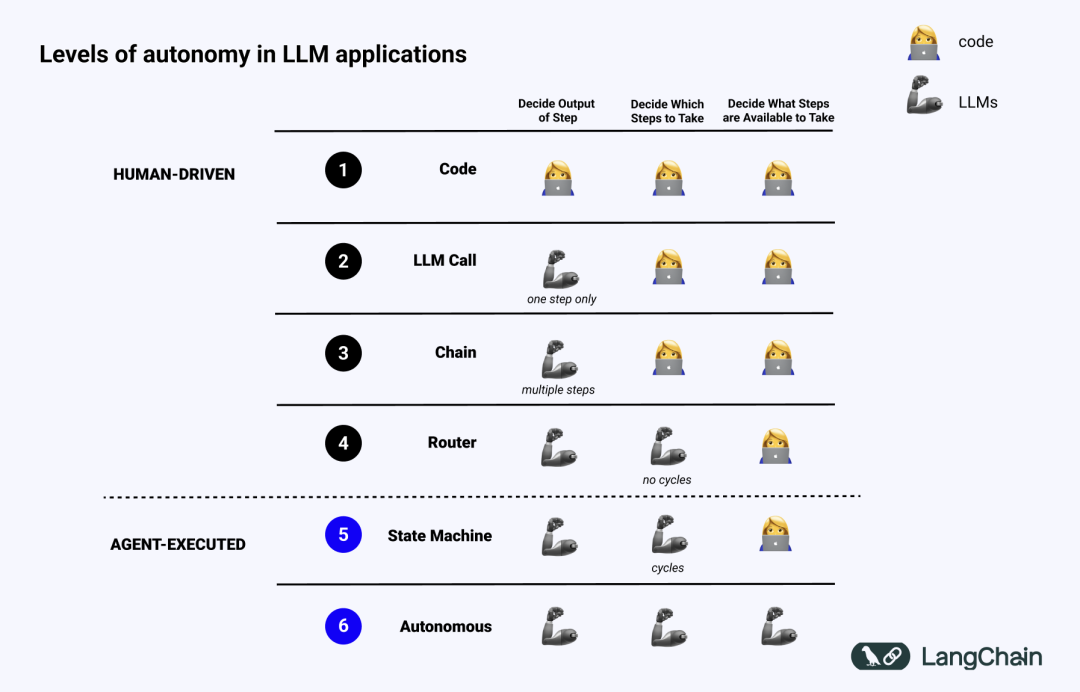
Broadly, we can classify an application's intelligence level into six tiers based on LLM involvement in output generation, planning, and decision-making. The more an LLM determines a system's behavior, the more "highly Agentic" we can call it. Most Agent applications we hear about today fall into tiers 4-6. Router systems, for instance, use an LLM to direct inputs to specific downstream workflows — modestly Agentic. State Machine systems employ multiple LLMs across multiple routing steps, with the ability to determine whether to continue or conclude each step — considerably Agentic. Autonomous systems go further still, using tools and even creating appropriate tools to advance subsequent decisions — fully Agentic.
We're seeing early frameworks for judging Agent intelligence, but the field remains nascent. As frameworks multiply and mature, new methodologies for capability assessment will emerge. The reason I'm raising these questions now: rather than emphasizing your product's Agent credentials in this era where everyone claims the label, try answering "How agentic is my system?" This prompts three product considerations:
- What creates my product's current degree of Agentic capability? How much human involvement remains, and is that irreplaceable in the near term?
- Given present realities, what defensible moat can I build? This might mean data at the model layer, know-how at the human layer, or simply better scenario-fit and experience in human-AI collaboration.
- Is greater Agentic evolution possible? If so, what should I do today — perhaps ensuring sufficient architectural modularity to adapt to future foundation models with stronger reasoning capabilities?
Of course, regardless of whether your AI product currently carries the Agent label or where it sits on the Agentic spectrum, the ultimate question founders must answer is: does the product effectively solve user problems? More precisely, can you today leverage your technical understanding and available frameworks to quickly identify a suitable entry point and build an equally precious competitive moat — timing. (My WeChat: bluesbaiLcz)
Bolt Community
If you're an explorer of the AI wave who resonates with Bolt's perspective, and you'd like to discuss with like-minded peers, scan the QR code below to briefly introduce yourself. We'll invite you to join after review.

Linear Bolt
Bolt is Linear Capital's dedicated investment program for early-stage, globally-oriented AI applications. It carries forward Linear's investment philosophy, focusing on technology-driven transformation, with the goal of helping founders find the shortest path to their objectives. Whether in speed of action or investment approach, Bolt's commitment is lighter, faster, and more flexible.