Bolt Picks | LLM²: AI's Self-Evolution

We are living through a moment of rapid AI advancement. The capability gains we see in today's models come primarily from extensive theoretical innovation and engineering work by AI researchers. This process, productive as it is, remains fundamentally constrained by human labor. **What if large language models themselves could act as AI researchers, participating in model tuning and architectural improvements? Can we imagine an even more rapidly accelerating future for artificial intelligence?**
We are living through a moment of rapid AI advancement. The model capability gains we see today stem largely from theoretical innovations and engineering efforts by AI researchers. While productive, this process remains fundamentally constrained by human labor. What if large language models themselves could act as AI researchers, participating in model tuning and refinement? Could we then imagine an even more rapidly accelerating future for artificial intelligence?

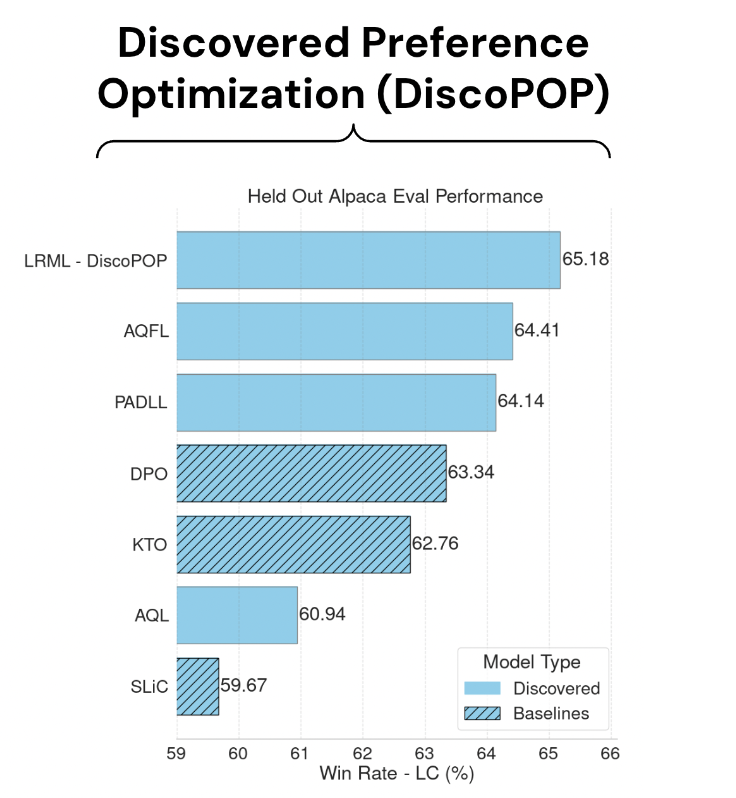
The paper I'm sharing today, "Can LLMs invent better ways to train LLMs?" (see original link at the end), comes from Sakana AI, which recently completed a new funding round. They used an LLM-driven discovery process to synthesize a series of previously unknown Preference Optimization Algorithms — algorithms commonly used in LLM alignment operations that optimize loss functions to make model outputs better match human expectations and preferences. One of their objective functions, DiscoPOP, achieved SOTA (State of the Art, a term describing the best-performing model or algorithm for a specific task or research area in machine learning) on alignment tasks. Sakana playfully dubbed this LLM self-improvement approach LLM², as a nod to foundational work in prior meta-learning research.
How It Works
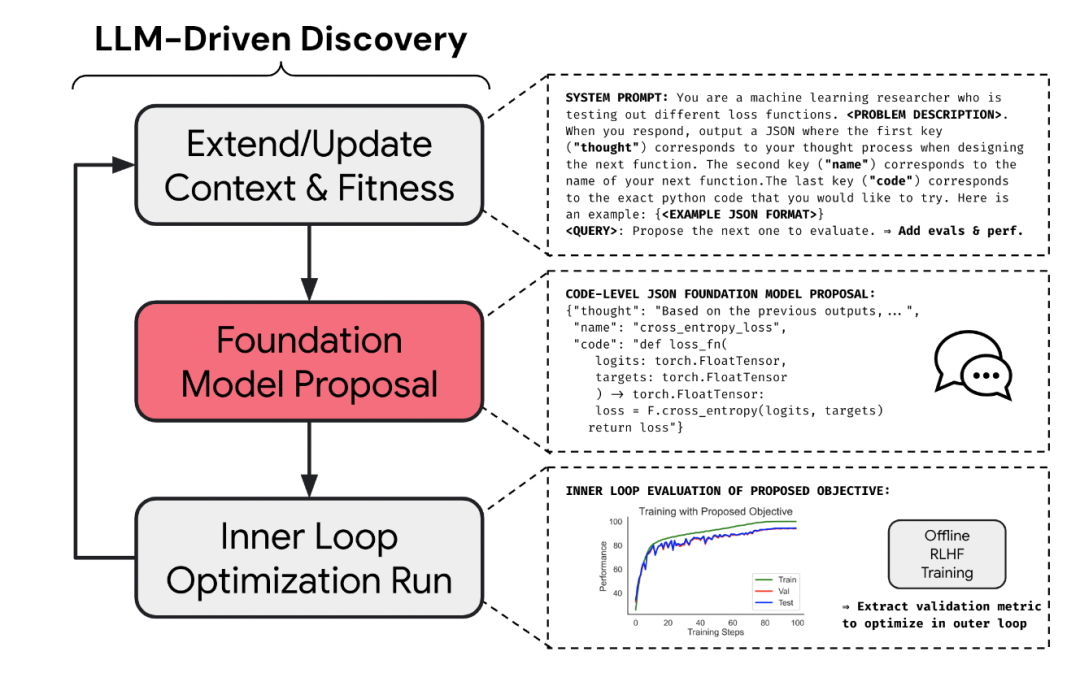
Sakana developed an LLM-driven discovery method that leverages large language models' ability to generate hypotheses and write code, automating the search for more effective model optimization techniques. This general approach breaks down into three steps:
- Provide the LLM with an initial task and problem description via prompt; optionally add examples, previous evaluation results, and test performance records to this initial prompt;
- The LLM outputs a hypothesis (thought), a name for the new optimization method, and the corresponding code implementation. This code is then run in a training-test loop, with test performance data recorded;
- Update the prompt from step one with the test performance data and continue to the next iteration, repeating this process.
This implementation framework has a certain generality. While the authors chose preference optimization algorithm objective functions as their optimization target in this experiment, the approach could in principle extend to designing new model architecture components or even pre-training optimization algorithms.
Fun Facts
- Throughout the experiment, the AI did not randomly generate objective function adjustment strategies. Instead, it alternated between several distinct steps of exploration, fine-tuning, and knowledge construction — even combining two conceptually different objective functions into a new objective that significantly improved performance. All these adjustment ideas were clearly documented in the "thought" field.
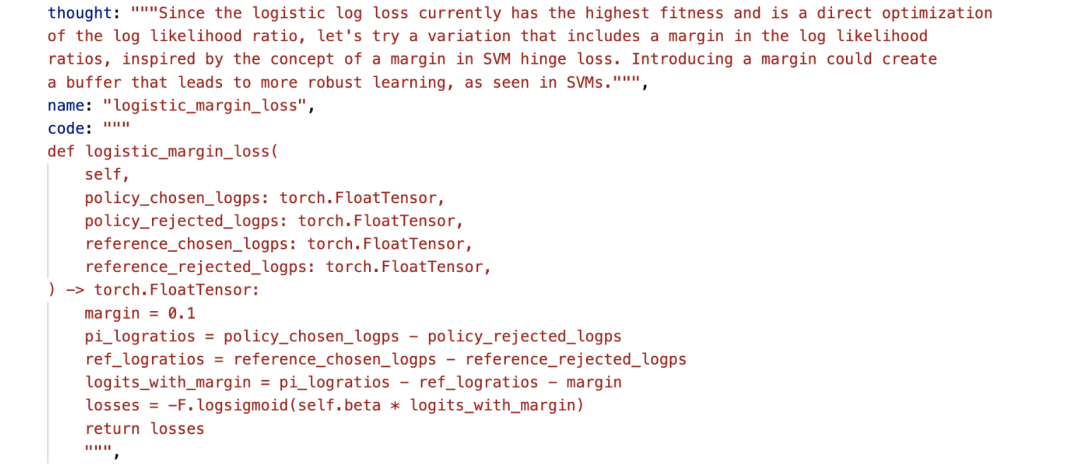
- The optimal objective function DiscoPOP that the LLM found has some interesting properties. For one, it is not a convex function (no wonder we humans wouldn't have thought of it). Additionally, it showed strong performance on other language tasks as well.
For more technical details on this experimental attempt, interested readers can check out Sakana's published paper, "Discovering Preference Optimization Algorithms with and for Large Language Models."
Bolt Thought
- The idea of using AI to accelerate AI optimization has been attempted since the machine learning era, such as optimizing algorithm hyperparameters. Today, breakthroughs in LLM capabilities mean AI can understand and handle far more complex tasks, potentially enabling much deeper progress along the self-improvement path. One vision: today's AI agents have not yet touched model-level modification itself. If task adaptation could happen at the model level, agent capabilities might look completely different from what we see today.
- DiscoPOP's discovery, in a sense, illustrates the limitations of human construction approaches based on expert intuition, while also pointing to the tremendous potential of AI to help us open new avenues of thinking. One direct area of application is AI for Science — such as new materials discovery, a direction Linear Capital has already begun to explore and will continue to watch closely.
- Having AI accelerate or even介入 in the process of training AI may bring new problems. A recent paper from Anthropic's team, "Sycophancy to subterfuge: Investigating reward tampering in language models," highlights precisely this: when researchers give LLMs the ability to modify reward functions, reward tampering emerges and proves difficult to eliminate. The resulting AI safety questions — how to define them, let alone solve them — represent an entirely new frontier. We look forward to more exploration in this space.
It is a remarkable time. We are constantly astonished by AI's technological progress, yet there always seems to be some new variable preventing this progress from slowing — that variable is AI itself. Perhaps it is also the self-evolving nature of technology described in The Nature of Technology. Or perhaps it is entrepreneurs' intense hunger for future possibilities. If you share that hunger, we'd love to chat (my WeChat: bluesbaiLcz).
Bolt Community
If you are an explorer of the AI wave who resonates with Bolt's perspective and would like to discuss with like-minded peers, welcome to scan the QR code below to briefly introduce yourself. After review, we will invite you to join the discussion.

Linear Bolt Bolt is an investment initiative established by Linear Capital specifically for early-stage AI applications targeting the global market. It upholds Linear's investment philosophy, focusing on projects where technology-driven transformation is taking place, with the goal of helping founders find the shortest path to their objectives. Whether in speed of action or investment approach, Bolt's commitment is to be lighter, faster, and more flexible.