Bolt Interview | Notta Founder Yan Zhang on Localization Strategies for AI SaaS Products in Japan

Rooted in Place, Returning to Place
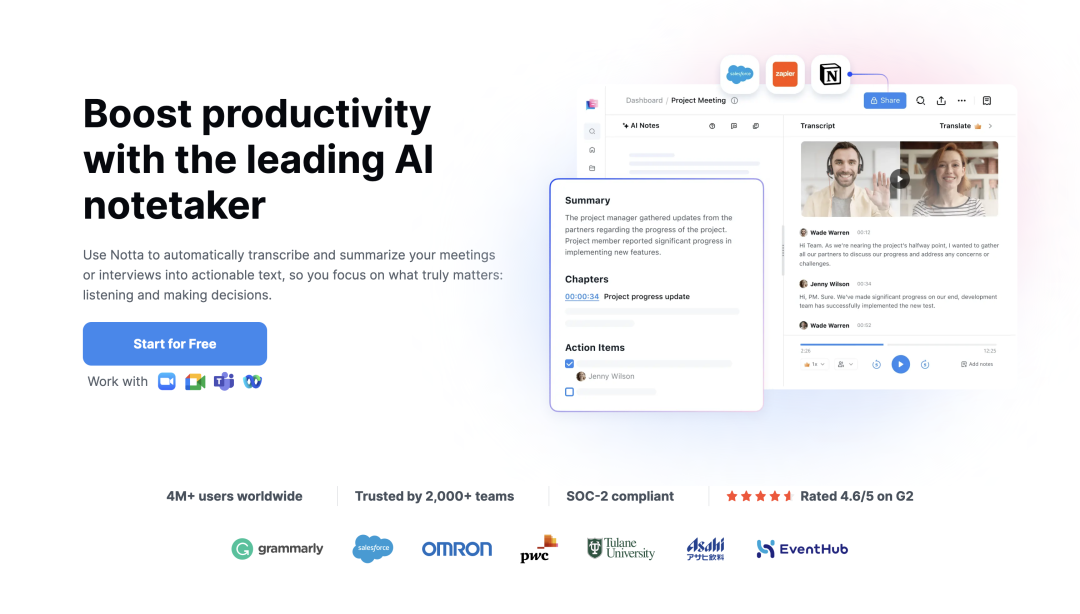
Image | Notta's official website
Notta is a meeting transcription platform for video calls, designed to help users worldwide improve meeting efficiency, reduce personnel costs, and cut down on wasted meeting time. It supports transcription in 58 languages and real-time translation for multilingual meetings, along with features like real-time transcription and translation, one-click summaries, collaboration, and sharing. Notta integrates with Zoom, Google Meet, Microsoft Teams, and Webex, and is currently trusted by 4 million users and over 2,000 teams. Notta began exploring the Japanese market in 2020, and by spring 2023, its cumulative users in Japan reached 1 million.
To date, Notta has completed multiple funding rounds. Linear Capital invested in Notta's angel round in 2020 and has participated in and witnessed Notta's development as an early investor. Recently, Zoey from Linear Capital's Bolt investment team sat down with Notta founder Yan Zhang for an exclusive interview. In this conversation, Zhang shares his entrepreneurial journey, product philosophy, and market strategy, with particular focus on the challenges Notta faced while growing in the Japanese market and how they were addressed. We're sharing it here in the hope that it will be helpful for entrepreneurs in AI and global expansion. For more about the Bolt team, click "Read More" at the end of this article.
Interview
Zoey: You were already a veteran of the internet industry before founding Notta. Could you walk us through your career after graduation?
Yan Zhang: After graduating in 2006, I went to Beijing and started at an internet advertising company. The product was similar to a SaaS business, though back then it was mostly deployed on clients' own servers. That company was formative for me and influenced my later entrepreneurial choices to some degree. After that, I worked at companies like Youku, Baidu, DiDi, Mobike, and AISpeech, gradually building up experience in product and monetization.
In 2018, I started my own company. We made smart hardware products similar to iFlytek's offerings, also going global. We did crowdfunding in the US, but unexpectedly sold very well in Japan. So we developed Japanese distributors. But then the pandemic hit, and our product faced market challenges, so we pivoted quickly and founded Notta.
At the time, we didn't know if it would work out. We were among the earliest companies doing global expansion, and fundraising wasn't easy — investors weren't as bullish on global SaaS as they are today. There was a pretty difficult stretch, but we stuck with it.
Our first "turning point" came in 2020, in mid-July. Without any proactive outreach, we were featured on Asahi TV News in Japan, and traffic exploded. At first we thought we were being hacked. That sudden influx of traffic gave us a lot of confidence.
2021 brought a bigger turning point. We built a product called Airgram, and along with it, Meeting Bot — a feature that could simulate a person joining online meetings and automatically generate meeting notes. It was well received in the market, and we developed this functionality very early on. This transformed us from a simple app into a B2B-capable business.
Starting in 2023, we were running both Airgram and Notta simultaneously. Notta's user base was growing rapidly, so we made the decision to focus solely on Notta. We spent a quarter consolidating user data from both products and eventually shut down Airgram. Now our company primarily operates in the Japanese and US markets. That's the overall picture.
Zoey: What was the inspiration or thinking behind Meeting Bot at the time?
Yan Zhang: We found that many people needed a smoother way to record screens and capture meeting content. So we thought, why not have a program simulate someone opening a browser to join a meeting, automatically recording and organizing notes?
Initially, our thinking was pretty crude. We even considered buying 100 Raspberry Pis for the office, each with a Zoom client installed, which would effectively mean 100 people attending meetings. But we abandoned this approach due to network and hardware instability.
Later, our team explored some technical alternatives. We initially used x86 architecture servers with browser simulation for screen recording, but the results weren't ideal. So we switched to ARM architecture servers, which have more cores — for example, one ARM server with 128 cores could simulate 128 bots joining meetings, dramatically improving efficiency.
Along the way, we faced numerous technical challenges. Traditional servers don't have sound cards or graphics cards, so we had to write drivers for sound cards and network cards. This engineering work consumed enormous effort, but we ultimately succeeded in making the concept work.
Zoey: Why did you want to move into the B2B track at that time? Do you remember how you landed your first deal?
Yan Zhang: We were mainly doing consumer apps, but gradually noticed many enterprise email domains in our user list — major companies like Toyota. This indicated the product was already being used by businesses. They had more complex needs, like permission management and security management. So we顺势 launched a Business Plan to meet enterprise customer needs. Our first deal was closed by the marketing team after two meetings, for about $50,000, with a Japanese construction consulting firm.
Zoey: How do you generate sales leads?
Yan Zhang: Currently, we get dozens of potential customer leads every day, and our sales team stays busy converting them. These leads mainly come from organic traffic and Google ads.
We also use automation tools — when users fill out information online, the system automatically pushes leads into our sales system. Now we have abundant leads and no longer worry about lead generation. Our focus has shifted to how to meet customer needs.
Zoey: When you started with voice transcription, how did you extend from hardware to software?
Yan Zhang: The extension from hardware to voice transcription software happened quite naturally. Although there were already many voice transcription solutions on the market, we were very confident about demand in this space. At the time, existing products had low accuracy, poor user experience, and terrible UI design.
We invested heavily in mobile product experience and applicability, and to this day we remain ahead of competitors in mobile experience. For example, our users can quickly import files, do real-time transcription, select and delete files, merge files, add bookmarks, and share content. Our interaction design is very smooth, and the user experience is excellent. We found that users are willing to pay for good tools, especially foreign users — they care not just about functionality, but also about UI experience and brand story. Good user experience and telling a compelling story are very important.
Zoey: What story does Notta mainly want to convey?
Yan Zhang: In Japan, we tell a story about helping deaf and mute people communicate. For instance, when others are speaking, deaf and mute individuals can see what they're saying through our landscape mode feature. This allows them to understand the conversation, and this narrative resonated very well in the Japanese market. The feedback was that people found the product to have real character.
Zoey: Looking back at your work in the Japanese market, what do you think you did right?
Yan Zhang: At the time, no one was specifically building products for the Japanese market. On one hand, Japanese companies had a heavy B2B DNA and few were doing consumer products — a few Japanese companies were, but they weren't focused on personal tools. Additionally, companies outside Japan were relatively less attentive to the Japanese market. Seizing this opportunity, we did extensive localization work for Japan.
For example, we issued press releases with every new version, distributed through Japan's PR News Times website. We also did substantial SEO work in Japan, which helped us tremendously. Because there was limited competition in the Japanese market, and competitors weren't paying much attention to this area, we wrote many high-quality articles and built external links to boost their authority. As a result, when users searched relevant keywords, our content appeared on the first page or even in the top three results.
We did all this work ourselves, without external agencies, and this approach helped us gain many users early on.
Zoey: Beyond meeting transcription, which other sectors do you see as having significant market space and opportunity in Japan?
Yan Zhang: Japanese users have strong demand for localized products, which represents a major market opportunity. Some Chinese global expansion companies are very popular in the US but haven't done Japanese language adaptation or adjusted for Japanese user habits, so Japanese users want to use them but hesitate. If your product can be localized and adapted for the Japanese market, you'll unlock significant new growth potential.
Zoey: How did you price your product when entering the Japanese market?
Yan Zhang: We priced in Japanese yen for the Japanese market. Many overseas companies entering Japan continue to price in dollars, which makes Japanese users feel these products are foreign intruders. We initially priced in dollars in Japan too, but I later proposed switching to yen. The result: this change increased our revenue by 30% to 40%, because users felt we were more local and more trustworthy.
Zoey: Notta's product is now fairly mature. What changes are coming next?
Yan Zhang: Our product is relatively mature in the Japanese market, but our next step is entering the US market. Breaking into the US requires an entirely new story, because competition is fierce and everyone is saying the same things.
We're now developing new features, like Meeting Agent. This kind of agent can help users complete a series of tasks in specific scenarios — for instance, salespeople can use Meeting Agent to send outreach emails, analyze and track content, even complete all steps in the entire sales process. These new features will be central to our US market launch.
Zoey: Were you worried when ChatGPT came out in 2023? Large models now have very good transcription capabilities.
Yan Zhang: We see large models more as a tool than a threat. Our product is a complete solution, not just a feature — and there's a huge difference between a feature and a solution.
In B2B, we need to deeply understand our customers' companies and their needs, not just provide a transcription function. Transcription may have been our core at one point, but now it's a very small part of what we do, serving broader business needs.
Zoey: Looking back at Notta's growth in Japan, what was the biggest challenge? How did you try to find solutions?
Yan Zhang: The biggest challenge was identity — Japanese users trust local companies more. So we made several strategic adjustments:
- Registered a company in Japan, with contracts signed by the Japanese entity.
- Hired Japanese salespeople — even if Chinese, they needed to have grown up in Japan and be familiar with Japanese culture.
- Made the website and expressions as Japanese as possible, with external consultants optimizing them.
- Recruited well-known figures from Japan's software industry as advisors, featured on our website.
- Brought in our new COO, Kiyoto Tamura. He is a Japanese-American who graduated from Stanford University with a degree in Data Science and Computer Science. He previously handled marketing and sales at Treasure Data in the US, with over 10 years of SaaS sales experience. At Notta, he's mainly helping us build our sales and GTM systems to better compete in the US market.
Zoey: Looking back, what advice do you have for entrepreneurs now preparing to do AI global expansion?
Yan Zhang: My advice may not be definitive, but I see three main points:
- Choose the right market: The US market is extremely competitive. If your product isn't mature enough, it's hard to survive there. I recommend choosing a relatively less competitive market, like Japan, which is more conducive to early-stage development.
- Stay small: Keep your team as small as possible, achieve early product-market fit quickly, and ensure positive cash flow. This is crucial for team confidence and positive feedback. Don't rush for rapid growth — ensure survival first, then gradually develop the business.
- Expand gradually: Start small and excellent, don't expand too quickly and burn too much money. When we hit $1 million in revenue, we had 30 people. Now with nearly $10 million ARR, we've only grown to just over 60. Growth doesn't have to be extremely fast — steady development matters more.
Zoey: You mentioned that early period was very difficult. What motivated you to keep going?
Yan Zhang: Persistence had already become normal for us. It was indeed hard, but I never thought about giving up. It may relate to previous entrepreneurial experiences, which gave me stronger confidence and belief in this product. I saw this project as my own child — I had to help it grow and survive no matter what.
Zoey: From being underestimated to becoming a benchmark company, how has your mindset changed?
Yan Zhang: Now when facing challenges and setbacks, I don't see them as major problems. I have a mindset of "the cart will find its way around the mountain when it gets there" — as long as there's a problem, there will be a solution, so I no longer feel pain or struggle.
Of course, anxiety persists. Even though we're profitable every month now, anxiety still exists. And it actually increases, though its nature differs. Early anxiety was about survival; now it's about how to do better.
Zoey: A company has different requirements for founders and teams at the startup stage versus the growth stage. From your actual experience, what's different?
Yan Zhang: At the startup stage, founders just need to focus on solving R&D and product problems. The issues were relatively singular, mainly internal. However, as the company enters the growth stage, problems become more complex and require handling more external factors.
In the growth stage, founders need a broader perspective to address external challenges — competitors, market changes, evolving customer needs. These are things the company hadn't experienced before and requires constant adjustment and response.
Additionally, early on with a small team, decisions and actions were very fast. But with 60-70 people, management faces new challenges. We're learning how to better organize and manage the team, and bringing in external consultants to help solve organizational issues.
Zoey: What are your two favorite AI products?
Yan Zhang: My favorite AI products are ChatGPT and Coze. Coze in particular does very well in workflow automation. We hold internal workflow-building competitions at our company to see who can use Coze to build workflows that better automate repetitive work tasks.
Linear Bolt
Bolt is Linear Capital's dedicated investment program for early-stage, globally-oriented AI applications. It upholds Linear's investment philosophy, focusing on technology-driven transformative projects, and aims to help founders find the shortest path to their goals. Whether in speed of action or investment approach, Bolt's commitment is lighter, faster, and more flexible.