The Singularity for Fully Driverless Trucking Is Nearing: Bot Auto Completes Real-World Road Test | Linear Portfolio

Will complete intercity unmanned commercial freight operations in the coming months.

An empty truck, weaving through busy highways. No one in the driver's seat. No one in the back. No one behind a remote control joystick. No escort vehicles clearing the path ahead or behind.
Yesterday, Bot Auto announced it had completed the first real-world road test where a truck handled the entire run entirely on its own. This came just two years after the company was founded.
Linear Capital co-led Bot Auto's earliest funding round and doubled down in subsequent rounds. In the coming months, Bot Auto will also complete its first fully unmanned commercial freight run between the Houston and San Antonio hubs.
A driverless truck, cruising down Texas highways. It set off at dusk, traveling through the night like a "rich man in fine clothes on a secret journey" — politely yielding to smaller cars, cautiously maneuvering around broken-down vehicles, merging on its own terms on highways where cars kept cutting in, even handling multiple scenarios where fire trucks suddenly appeared. Every driving task across day and night transitions was completed by the truck itself.
No one in the driver's seat. No one in the back. No one behind a remote control joystick. No escort vehicles clearing the path ahead or behind. This truck, weaving through busy highways, belongs to Bot Auto — the company Xiaodi Hou founded just two years ago.
And it achieved this at a cost orders of magnitude lower than other "near-unmanned" companies.
"Success is simple: autonomous driving must surpass human cost per mile, and do so consistently and safely," Hou wrote in his blog.
"This validation run is significant, but it's a milestone, not the finish line."

In an era where people are bombarded daily with AI breakthroughs, you might be surprised that "driverless trucking" hasn't actually been achieved yet. But that's the reality. On one hand, the word "unmanned" has been defined down for various reasons to include safety operators and other discounted arrangements. More fundamentally, it requires an entirely new system to solve.
Before Bot Auto, the industry's mainstream "unmanned" models fell into roughly three categories:
First, "someone in the vehicle": the most common approach, with a safety operator always sitting in the driver's seat, hands hovering near the wheel, ready to take over when the system can't handle a situation — or sometimes sitting elsewhere in the cab. This is more like public beta testing for advanced driver assistance, a necessary stage for technical validation, but not true autonomous driving;
Or "escort convoys": in some tests, unmanned trucks are accompanied by one or more human-driven chase cars ahead or behind, serving to clear the road, warn other traffic, or provide immediate support; and "remote operation": no one in the vehicle, but operators in a control center monitoring real-time feeds on screens, intervening through remote control devices (similar to a simulator cockpit) when necessary. This removes the in-cab safety operator but still relies on humans as backup for edge cases, with extreme demands on network latency.
The fundamental reason past "unmanned" approaches needed these "crutches" was that their technical architectures were designed from the ground up assuming a human would be the final safety redundancy. Every technology built from that premise couldn't break through the inherent limitations this created.
Getting a heavy truck to remove all forms of human monitoring and complete complex tasks on real roads clearly requires a fundamentally different technical approach.
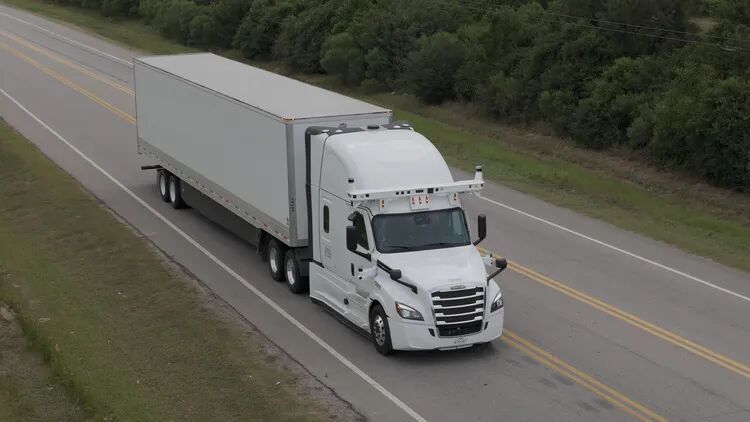
Founded in 2023, Bot Auto chose a more "radical" method. In Hou's words, "At Bot Auto, unmanned means completely unmanned — no one in the driver's seat, no one in the back, no one behind a remote control joystick."
This became the starting point for everything at the company, and fundamentally determined that everything would be different.
For example, when the goal is no longer "having someone who can take over at any moment" but "the system must be its own backup," the entire technology stack must be rebuilt.
"At Bot Auto, we emphasize the importance of foundation models," Hou told Jiqizhixin. In Bot Auto's launch announcement, they publicly stated their "technical conviction" — combining next-generation AI technology with efficient execution.
Behind this truly unmanned test, this approach offers a glimpse of what that looks like.
The term foundation model here doesn't point to a specific model, but rather represents a foundational philosophy: how to squeeze every drop of potential from computing power and algorithms to circumvent the persistent shortcomings of human "backup" approaches, letting an AI truck driver "foundation model" built from an integrated hardware-software system make all judgments itself, rather than periodically needing human supplementation.
In Bot Auto's architecture, it takes raw data directly from multi-modal sensors — cameras, LiDAR, millimeter-wave radar — for end-to-end scene understanding, future prediction, and driving decision-making. Humans don't drive with just their eyes, but with experience-based intuition. According to Bot Auto CTO Lei Wang, Bot Auto makes the algorithm the brain, then builds an entire pipeline — "It can perceive the world, understand scenes, reason, and execute decisions. All these functions must work in coordination. The system can't miss anything, and must have redundancy. Every subsystem has backups, often more than one. If one component fails, another backup immediately takes over."
This design gives the system "anticipatory" capability, not just passive "reactive" ability. "The hardest thing for humans is foreseeing what might happen at any given moment," Wang wrote in Bot Auto's technical blog. "The system can anticipate because it learns not only from integrated data across all components, but from every run on this route, and from massive simulations beyond human comprehension."
This means the new system requires more perfect redundancy — redundancy as a key component of the "foundation model," not merely a "spare tire" for backup as past autonomous driving approaches often treated it.
"Redundancy focuses on the most critical parts — sensing, computation, actuation, and power — while sharing components and software to keep the design simple, efficient, and economical, without sacrificing safety," explained Bot Auto hardware lead Xiaoling Han.
Bot Auto's redundancy isn't "activate when broken" but "always running." They gave a braking example in their technical blog: "In traffic jams we often need to brake; we alternate between the two brake controllers to prevent the pneumatic subsystem from overheating. This isn't just backup — it's actually using the redundancy."
This design philosophy runs throughout. Data from 15 cameras, 8 LiDAR units, and 3 millimeter-wave radars cross-validate each other, ensuring single-sensor failures don't compromise overall perception. "Our system has two brains. If the primary 'brain' has issues, the backup 'brain' immediately and seamlessly takes over steering, braking, or perception, and begins executing a Minimum Risk Condition (MRC), safely pulling over."
In one test, as a Bot Auto truck was traveling at 65 mph and actively changing lanes, technicians first deliberately shut down the main server; the truck smoothly switched to the backup server and continued operating. Then the backup server was also shut down, and the Vehicle Control Unit (VCU) immediately took over, safely stopping the truck on the emergency lane.
"This isn't for show — it's part of our routine validation."

The new technical approach doesn't just liberate itself from past patchwork "ornamentation," it also creates an entirely different cost curve. Human driver costs are fixed, while machine computing costs follow Moore's Law and keep declining.
The test data confirmed this: according to Jiqizhixin, Bot Auto's small team, just two years old, completed this truly unmanned task with efficiency orders of magnitude higher than industry norms of hundreds of people, hundreds of millions of dollars, and hundreds of vehicles.
"If there's still a paid CDL (Commercial Driver's License) driver in the seat, we wouldn't call it autonomous driving. It's a bit like ordering a diet meal with a side of fried chicken appetizer. True Level 4 (per SAE standards) is about engineering, not theatrics: the system must be able to perform the complete driving task and handle all emergencies on its own, without relying on human safety measures in the cabin," Hou recently stated on social media.
"Our path is a driverless cab, truly achieving driver-out-of-the-loop, built on diverse sensors, redundant compute/actuation/power systems, hot-standby failover mechanisms, continuous health monitoring, and a rigorously low-risk operational hierarchy."
Using a unified, powerful system to replace layered modules and human-dependent monitoring redundancy, shifting marginal costs from labor to computing and data with greater scale effects — this is clearly a unique and clever approach, and this milestone represents something of a concentrated demonstration of Bot Auto's distinctive character.
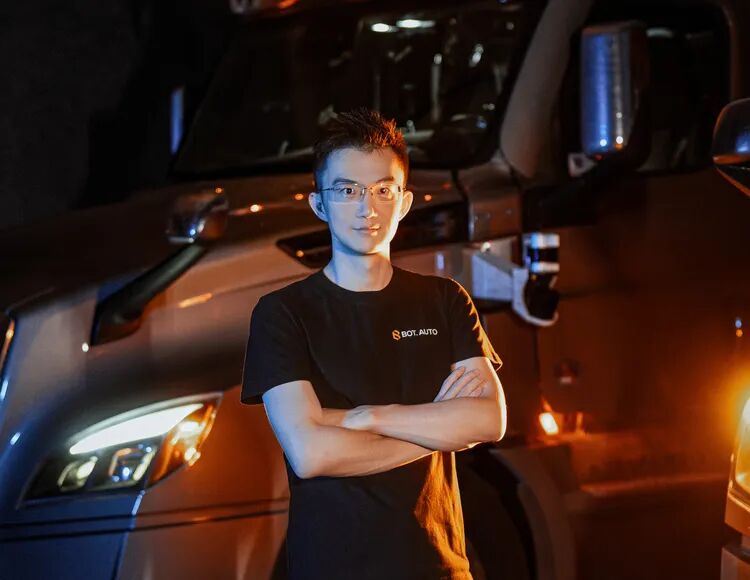
Bot Auto was founded by Dr. Xiaodi Hou, a battle-tested veteran of the autonomous driving field. CTO Dr. Lei Wang previously held key technical roles at Facebook/Instagram, WeRide, and TuSimple, deeply involved in and leading the development of core autonomous driving technologies including perception, localization, planning, and control.
Bot Auto wasn't locked into early technical approaches, nor did it lose organizational agility in a bloated structure. From day one, they directly targeted "complete unmanned operation" as the end goal, reverse-engineering the entire system. This makes it the company most likely to achieve today's truly unmanned truck road test, and future truly unmanned commercial trucking operations.
Over the past several months, Bot Auto has been conducting fully automated commercial operations between Houston and San Antonio, but with safety drivers in the vehicle. After this milestone, Bot Auto continues its "Continuous Validation" phase. When Hou officially unveiled the company from stealth mode last September, he explicitly stated what Bot Auto sought to avoid, including "blindly scaling operations before the product is ready; unnecessary hiring before operations mature; distracting overexpansion and partnership debt."
"Continuous Validation" is about avoiding the "demo loop" and instead entering a state of genuinely rapid technical and operational advancement around high efficiency — software iterates quickly rather than being content with one version then showing off in flashy but wasteful ways. After this zero-to-one breakthrough, they won't linger at this stage but will continue pushing toward the next version, the next more important milestone.
As planned, Bot Auto will complete its first fully unmanned commercial freight run between the Houston and San Antonio hubs in the coming months. When that happens, autonomous driving will take another major step forward.