Linear Capital Portfolio | Whales CEO Sheldon Ye's Chuan Talk: AGI Through Silicon Valley's Eyes, Chinese Companies' Long March

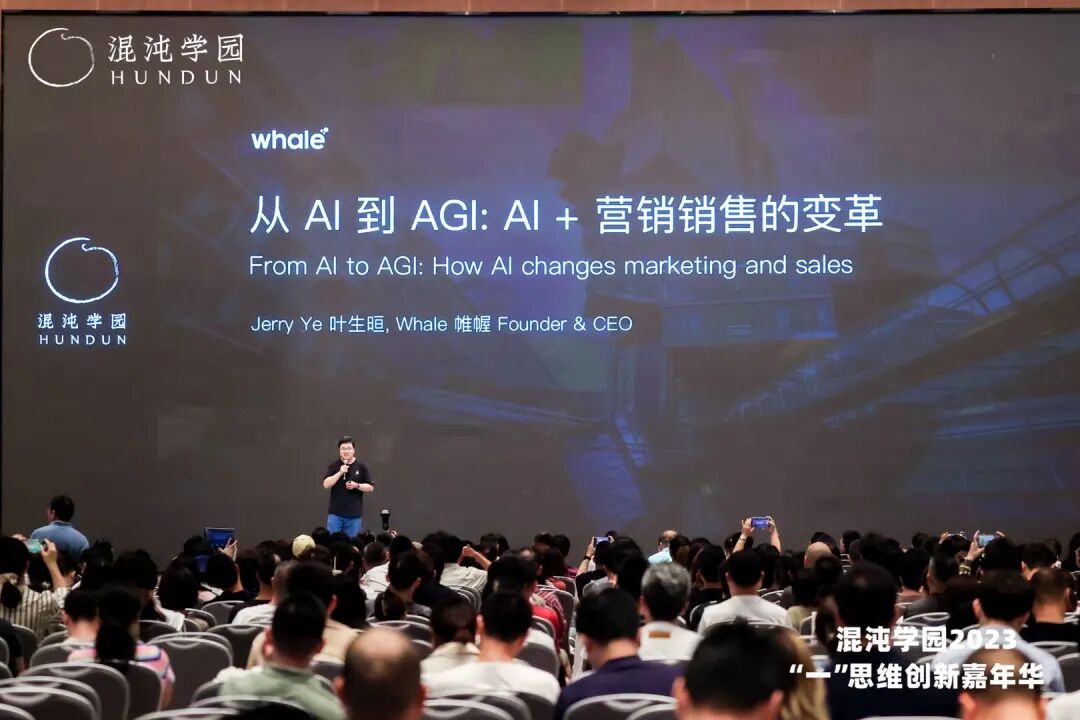
Last week, the Chuang Xue Yuan (Hundun Academy) 2023 "One" Thinking Innovation Carnival brought together "half of the AI circle." Jerry Ye, founder & CEO of Whale, was invited to speak, joining guests and attendees for a wide-ranging discussion on the application prospects of AGI.

Last week, the Hundun Academy 2023 "One" Thinking Innovation Carnival brought in "half of AI circles." Whale's founder & CEO Jerry Ye was invited to speak, joining guests and attendees to discuss the application prospects of AGI.
For years, Whale has pursued a "two-way street" between technology and brand marketing scenarios. Based in China, it serves thousands of global benchmark brands in digital marketing operations. At the same time, Whale is actively expanding overseas, leading the future of MarTech with a global perspective.

This article excerpts highlights from Jerry's speech, covering:
- Behind the marketing mantra of "people, goods, place," two things matter most;
- Where AGI is headed in the eyes of Silicon Valley companies and investors;
- The real reasons behind Chinese companies' gap in large models — and the massive opportunities hidden in the problem;
- How many brands have already innovated stunning marketing plays with AGI, but why there's no need for anxiety — learning to befriend time matters more.
01 Brand Marketing's "People, Goods, Place" Ultimately Boils Down to Two Things
Many brands believe digitalization is the key, even the only reason, for their success. So breaking digitalization down into "people, goods, place," what are the key terms?
People
For users, the keyword we need to grasp is: Engagement. Broken down further, this means Acquisition and Retention — customer acquisition and retention. The relevant technology platform is the CDP (Customer Data Platform).
In CDP systems, we store massive amounts of user tags. Some brands have over 2,000 tags to segment users.
Place
The underlying keyword for place is Standardization. For example, many well-known coffee and tea brands deliver completely consistent experiences across all stores — that's standardization.
The platform for offline place standardization is called the SDP (Space Data Platform).
Goods
For goods, another word we need to pay attention to is "content."
Why? Because when we shop, we consume content first, then the product.
For instance, we watch a video on Douyin first, then purchase the corresponding product. Between goods and content, there's a bridging relationship.
From marketing content production to distribution, efficiency is paramount. The platform that carries this function is called DAM (Digital Asset Management).
These platforms together form a brand's digital system. And the digital system ultimately comes down to two things:
First, Actionable Insights — making data visually tiered and commercially insightful.
Second, Operational Automation — making many operational execution systems more automated, reducing costs and increasing efficiency.
From the customer's perspective, all marketing and sales work boils down to one thing: defining the customer journey and improving conversion rates.
Take coffee and tea brands as an example. Many customer journeys start on Xiaohongshu, then move to Douyin livestreams for coupon distribution. When customers arrive at the store, they have a good experience, see new products on advertising displays and purchase. Later, this customer posts their consumption experience on Xiaohongshu.
Once this series of user journeys is defined, brands can correspondingly collect data, formulate strategies, and improve conversion rates at each step.
Based on the user journey, Whale has summarized the J-shaped omnichannel experience flow to help brands build more valuable digital systems.
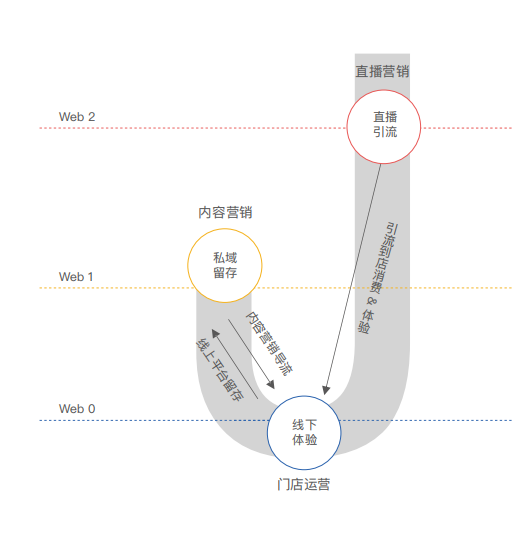
This model shows the standard paradigm for most marketing: starting with livestream traffic acquisition, then transitioning to offline user experience, and after completion, moving into private domains for conversion and retention. This corresponds to Whale's three core products:
"Whale SpaceSight," applied to digital offline store operations;
"Whale Harbor," applied to digital content marketing;
"Whale Cast," applied to digital livestream operations.
02 Four Major Investment Directions for AGI in Silicon Valley's Eyes
This March, after talking with many Silicon Valley companies and investors, I found the main investment directions can be divided into four areas:
1. At the most fundamental level, large models. Of course, not limited to language models — they could also be image or even video models.
2. Above that is the platform layer, such as Graph Engine and others. What they do is connect various large models with existing GUIs or APIs.
3. Above that are vertical domain large models, more controllable and personalized.
4. Finally, the application layer. Currently the two biggest applications for large models are marketing and gaming.
However, after finding the direction, figuring out what needs to be done well is another important topic. Going forward, difficulties and opportunities coexist.
For large models, the hardest part is still data.
Why haven't many Chinese large models been done well? It's not because we lack models. Models are open knowledge — everyone will grasp them soon enough.
The difficulty lies in obtaining good corpora and spending time training.
OpenAI previously spent five years annotating data to produce today's high-quality GPT model. And Chinese itself is harder than English, with more ambiguity, adding to the difficulty of Chinese language model training.
Moreover, the Chinese internet is flooded with low-quality marketing fluff, making the acquisition of quality corpora even worse.
The second difficulty is computing resources.
This is widely known — the US is "choking" China on chips. The chip shortage has created huge disparities in model training efficiency.
The third pain point is talent.
Previously, quite a few people were camping outside OpenAI's doors to poach talent. But this phenomenon no longer exists, because talent flows quickly in Silicon Valley — OpenAI employees might be at Meta or Google six months later.
In other words, knowledge is rapidly reaching equilibrium. How you trained your model — the industry knows within months. So we can see numerous open models gradually surpassing GPT-4.
The real difficulty is actually training a model. This work often requires precise intuition that can't be fully explained through reason or language.
Training models is enormously costly. Once problems are discovered, they need to be stopped and parameters adjusted in time. If you only discover the problem two days later, that's often a huge cost loss. Therefore the truly scarce, important talent is those who can intuitively sense problems in the model training curve at a glance and stop and correct them in time.
As for the models themselves, there are already many open-source models readily available, so the difficulty actually ranks below data, computing resources, and talent.
Many friends are extremely anxious: Will I miss out on the great AI era?
Digitalization has been around for about 10 years, but to say it's fully implemented still requires a long wait.
AGI implementation is the same. It won't happen overnight; vertical domain implementation may take 5 years, 10 years.
03 In the Future, Every Enterprise Will Need Privatized Model Deployment
Why do I say every enterprise will need privatized model deployment in the future?
For example, when an automaker writes copy, its style will certainly differ from Apple or Pop Mart. Different industries, different companies each have their unique marketing language and norms.
The sole purpose of marketing and sales is to make more money, so we care deeply about GMV. The two aspects that determine GMV are content breadth and content conversion depth.
Content breadth corresponds to infinite quantity of content needs; conversion depth corresponds to infinite scenario-based content needs.
AGI has truly given technical support to thousand-person-thousand-face marketing. For example, a brand may have 2,000 user tags, but in the past could only produce single-digit poster images; through AGI, it can produce infinite marketing content corresponding to infinite user tags and scenarios.
This has brought massive disruption to e-commerce.
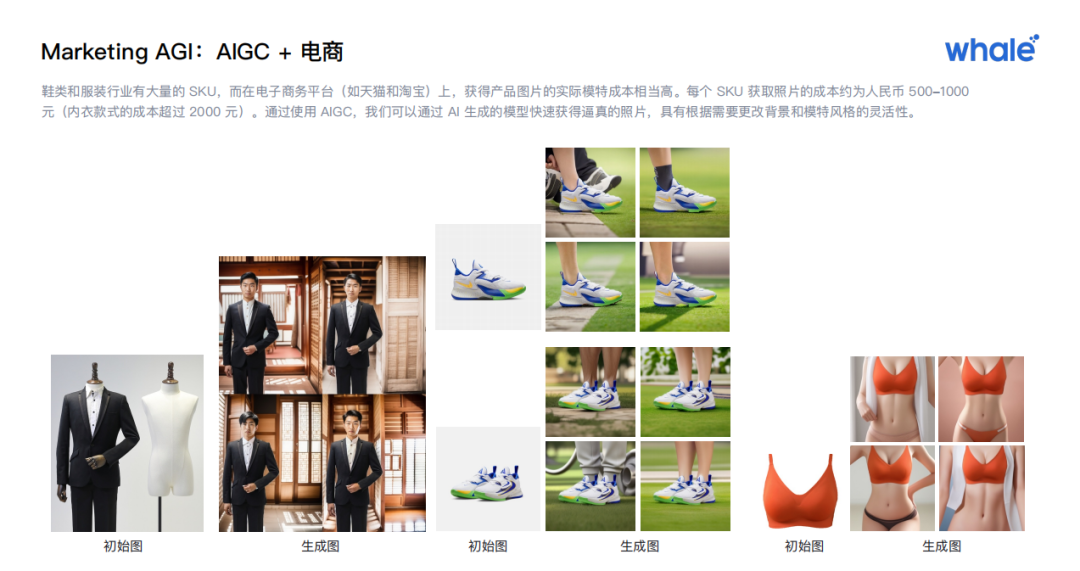
For example, e-commerce image production previously required models and photographers, with one set of images often costing 500 to 1,000 RMB or more. Now through AGI technology, it can be done at just 1% of the previous cost, with results realistic enough to fool the eye.

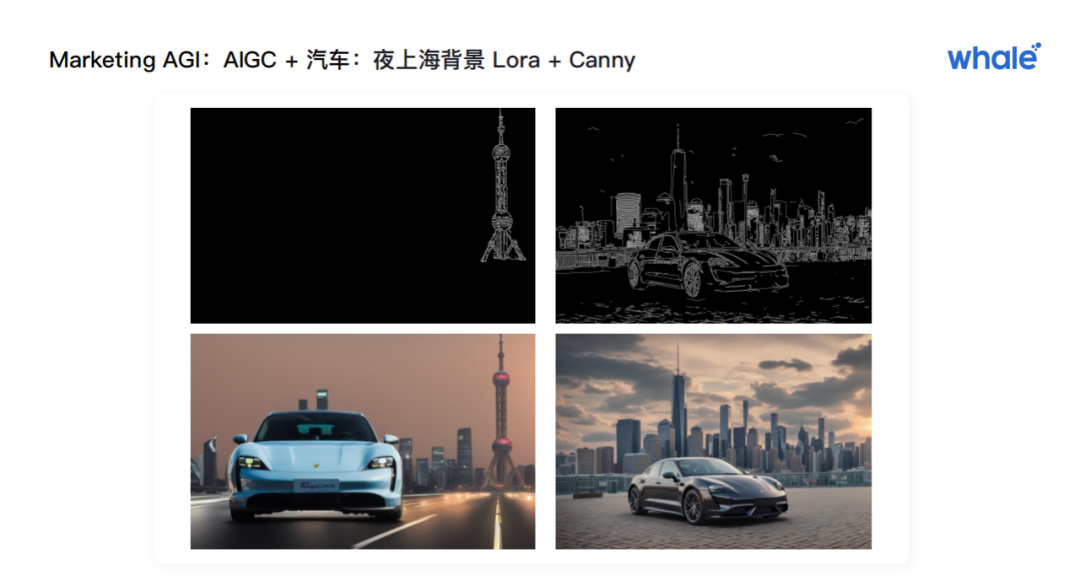
Another example is the automotive industry. With customer consent, sales record conversations through voice badges, then use AI to convert these into customer CDP data. These data can then generate more personalized content for that customer. If the customer likes camping, the test drive report can emphasize grassland environments more; if they prefer urban life, it can emphasize city landmarks more.
This initiative can improve CTR (Click Through Rate) by 30-40% for test drive reports. In the automotive sales conversion system, this number is remarkable.
AIGC's application possibilities are extremely rich. For example, we transformed Whale's IP from 2D to 3D.
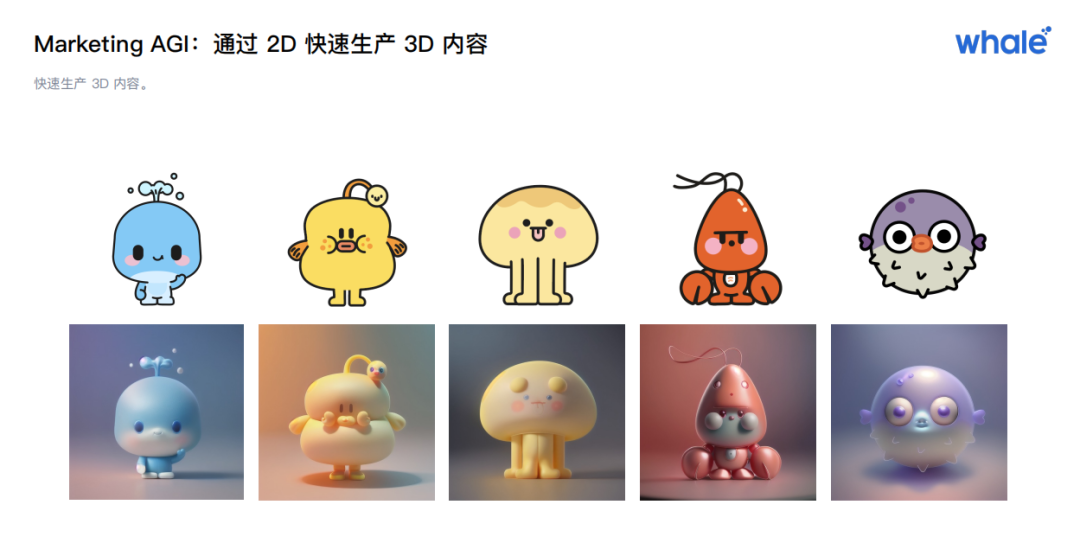
AGI has also influenced the C2M model. For example, in jewelry production, designers use AI to generate unlimited product options for customers, who then select based on preference and enter factory production. This process can also help brands discover potential hit products.

Finally, content production needs to be placed within the entire content management process to achieve full-process improvement.
For example, a brand needs to distribute tens of thousands of marketing content pieces across platforms daily. The first thing brands must do is content review, avoiding violations of advertising law or other non-compliant situations.
Additionally, brands need to establish robust tagging systems, avoiding pushing personalized content to completely mismatched audiences.
Third, they need to establish content quality scoring systems. After different content is deployed, which pieces become hits? Through data feedback, this informs the scoring system and optimizes content production.
Some benchmark brands are able to truly produce high-quality content with AI precisely because they've spent massive time building systems and accumulating the above data.
And this system building — from online collaborative content production, to enterprise-level content asset management, to content review, distribution, and data insights — is precisely what "Whale Harbor" does.
Conclusion
AGI implementation is still in its early exploratory stages; this is a feast of technology and application. Whale actively discusses more good ideas with our brand partners. Going forward, we look forward to discovering more practical implementation solutions, bringing more efficient conversion to brand marketing chains, and powering brand business growth.