Microsoft CEO Satya Nadella: From Leading Microsoft's Transformation to His Analysis of the Future of AI Agents | Bolt Picks

From "knowing everything" to "learning everything."

Microsoft CEO Satya Nadella recently appeared on the podcast BG2Pod, where he discussed his journey to becoming CEO, advice for fellow leaders, Microsoft's investment in OpenAI, the evolution of traditional search, and the future of AI agents. We've compiled and translated excerpts from the interview; you can click the "read more" link at the bottom to listen to the full episode.
🔍 Key Takeaways
1. Reviving Microsoft's Glory: Satya Nadella emphasizes a "growth mindset" and cultural transformation, guiding Microsoft away from complacency to redefine its mission and strategy. Consistency and sustained effort drove the company's turnaround and ongoing success.
2. Investing in OpenAI: Microsoft's continued investment in OpenAI reflects its conviction in large-scale models and AI compute potential. This isn't merely a technology partnership — it's a long-term strategy to strengthen Microsoft's competitiveness in cloud computing and AI products.
3. Challenges to Traditional Search and Consumer AI: Traditional search is stateless, but AI's "stateful" capabilities enable more complex, multi-turn interactive queries, dramatically improving information retrieval efficiency and precision — redefining the core value of search engines.
4. The Future of AI Agents: Future agents must not only possess memory and complex task execution abilities, but also meet user and regulatory demands around data security, privacy protection, and transparent governance to achieve true mass adoption.
5. Agent Potential on Windows and Open Platforms: Windows' openness gives users more control, but requires enhanced security measures (such as permission management) to mitigate risks.
6. Key Breakthroughs for Agents: Achieving memory functionality, optimizing task execution efficiency, and refining permission management are critical to the future development of AI agents — these will determine whether they can succeed across broader application scenarios.
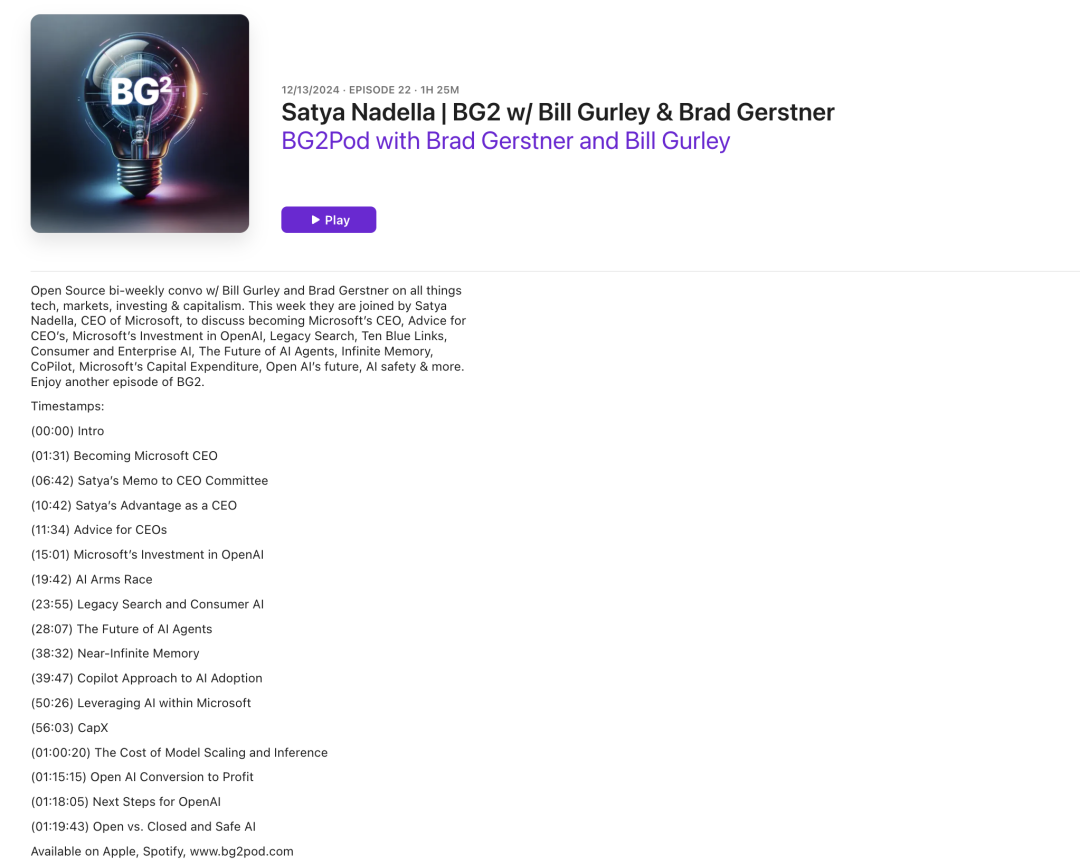
Image | Podcast Shownotes
Part.01
Microsoft's Transformation
1) Brad Gerstner: You joined Microsoft in 1992; took over the online business in 2007; launched Bing in 2009; led the server business starting in 2011 and launched Azure (Microsoft's cloud computing platform); became CEO in 2014. Under your leadership, Azure revenue grew from $1 billion to $66 billion, driving total company revenue up 2.5x, total profit growth exceeding 3x, and the stock price nearly 10x — adding nearly $3 trillion to Microsoft's market cap.
Looking back over the past decade, what key changes helped unlock the company's potential, shifted Microsoft's direction, and produced such extraordinary success?
Satya Nadella: For me, this has been a journey that continues from 1992 to today, though 2014 marked an important inflection point where I took on greater responsibility. My core philosophy is simple: observe when we succeed and when we fail, then do more of what works and less of what doesn't.
In 1992, I joined Microsoft just as Windows 3.1 launched. I was working at Sun Microsystems, planning to attend business school, but accepted Microsoft's offer — one of the smartest decisions I've ever made. At the time, Windows NT (the operating system family launched in 1993) and x86 (Intel's processor architecture introduced in 1978) made me realize that changes on the client side would ripple to the server side. Microsoft, as a platform and partner company, would thrive riding this wave.
Then the internet brought a new transformation. We achieved some success in browsers but missed "search" — the core organizing layer of the internet. Microsoft didn't recognize search's importance at the time. The same happened with mobile; we participated but failed to seize the opportunity, and the iPhone changed everything. Fortunately, we made the right call on cloud computing.
Now we're facing a fourth transformation driven by AI. Looking back, one crucial lesson I've learned is: don't blindly follow competitors' moves. Fast-follower strategies sometimes work, but you can't succeed if you're just imitating out of envy. The key is whether what you're doing aligns with the company's interests and brand identity — and knowing where you can genuinely do better.
For example, Jeffrey Moore (renowned author, speaker, and consultant) once told me: "Do what customers expect you to do." I strongly agree. Take cloud computing: when I first engaged with Azure, many people told me it was a winner-take-all market and Amazon had already won. I disagreed, because my experience competing against Oracle and IBM in the server space taught me that infrastructure could never be winner-take-all.
The key is identifying your structural advantages, understanding what partners and customers expect from you, and acting accordingly. I believe this is the core of strategy, and one reason we've succeeded. Of course, culture, sense of mission, and purpose are also necessary conditions for success. But from a strategic perspective, identifying and leveraging structural advantages and customer "permission" is where I think I've been relatively successful.
2) Bill Gurley: Some people believed Microsoft's golden age had passed. So as the new CEO, what specifically did you do to reshape the culture and push the company in a new direction? What advice would you give other new CEOs?
Satya Nadella: I think my greatest advantage was being a complete "insider." Almost my entire career has been at Microsoft. So when I criticized the company culture, I was really criticizing myself. In a sense, this helped me avoid the adversarial dynamic that can occur when outsiders judge insiders. More often, I was reflecting on my own behavior because I was part of this culture myself. This background allowed me to point out problems more naturally when driving cultural change, without seeming like I was judging the company from an external perspective.
I remember when Microsoft first became the most valuable company by market cap. Walking through the campus, I deeply felt that we — myself included — had a sense of complacency, as if our success was due to our sheer brilliance. But that feeling reminded me: this is exactly the kind of culture we must avoid. As I often say, from ancient Greece to modern Silicon Valley, the only thing that brings down civilizations, nations, and companies is hubris.
In my early years as CEO, my wife recommended Carol Dweck's Mindset to me. I initially read it for my children's education, but later discovered that the "growth mindset" concept was not only helpful for education but entirely applicable to work and life. In fact, this concept became the core of Microsoft's cultural transformation. It's not just a management theory — it permeates every aspect of life: you can become a better parent, partner, friend, neighbor, manager, even leader.
I often summarize this with one phrase: shifting from "know-it-all" to "learn-it-all." But this isn't a destination you can arrive at, because the moment you feel you've achieved a growth mindset, you've actually violated its essence.
Driving cultural change takes time, patience, and combined top-down and bottom-up effort. Whether in company-wide meetings or my executive team meetings, I always begin and end with mission and culture. For nearly 11 years now, I've maintained this framework: mission, culture, and then specific strategy and product direction. Every word is carefully chosen. I've repeated these core ideas so often that even I find it somewhat tedious, but it's this consistency that has made the cultural transformation take root.
Part.02
Investing in OpenAI
3) Brad Gerstner: Microsoft missed search and mobile, but caught the tail end of cloud computing. When you started thinking about the next phase of transformation, you seemed to recognize early that Google might take the lead in AI through DeepMind. So you decided to invest in OpenAI. What convinced you of this direction rather than continuing to focus on Microsoft's internal AI research?
Satya Nadella: Microsoft has been investing in AI for a very long time. In 1995, Bill Gates founded Microsoft Research (MSR), and one of its early research directions was Natural User Interface (NUI) — enabling users to interact with devices through natural, intuitive methods. He was deeply interested in this; the first research team focused on speech technology, with Rick Rashid (Microsoft's former Chief Research Officer) and Kai-Fu Lee (former head of Microsoft Research Asia) both involved. We were always committed to cracking NUI, investing heavily especially in language processing. In fact, Geoffrey Hinton (the "Godfather of Deep Learning") worked on deep neural networks (DNN) during his early time at MSR before being hired by Google.
However, in the early 2010s, we missed some key opportunities to invest as aggressively as Google did in projects like DeepMind. I regretted this, but I was always looking for breakthroughs — Skype Translate was one of my early focal projects. In this project, we first discovered the potential of transfer learning: training a model on one language pair could improve performance on other language pairs. This made me deeply interested in language processing technology and led me and Kevin Scott (Microsoft's Chief Technology Officer) to continue following this space.
My first contact with OpenAI came because Elon Musk and Sam Altman wanted to use Microsoft's Azure resources (a cloud computing platform service Microsoft provides). At the time, they were mainly focused on reinforcement learning (RL) and projects like Dota 2. Later, they approached us again to discuss language processing technology, especially Transformers and natural language models. This was a critical moment because it touched on our core business.
It also connected to my thinking about Microsoft's strategic positioning — what is Microsoft's structural position in the information management space? Finding non-linear growth breakthroughs within existing model structures is, as you always say Bill (Bill refers to podcast host Bill Gurley, partner at venture firm Benchmark), about information management in the digital world. We organize and express the digital world. So Microsoft had tried to pattern all information through projects like WinFS, but practice proved this was nearly impossible. The breakthrough lay in how to achieve this through language and reasoning.
These factors led me to choose partnership with OpenAI. I was impressed by their team's ambition, especially their research on Scaling Laws. I read Dario's (former OpenAI VP of Research, now founder and CEO of Anthropic) research on Scaling Laws at the time; Ilya was still at OpenAI then too. We decided to make the bet, and it proved to be the right call. Success stories like GitHub Copilot further strengthened our confidence to go deeper in this field.
Part.03
Traditional Search and Consumer AI
4) Brad Gerstner: From an application perspective, consumer AI is posing massive challenges to traditional search engines. Consumers increasingly prefer getting direct answers rather than finding information through search engines. How do you view this shift? In the "answer era," can Google and Bing continue developing traditional search? What measures should they take to compete with ChatGPT?
Satya Nadella: The combination of "chat and answers" is what makes ChatGPT unique. Whether as a brand or product, it's like a stateful agent — stateful. Traditional search, despite having search history, remains essentially stateless. I've been trying to reach a search deal with Apple for ten years. When Tim Cook finally partnered with Sam, I was the happiest person. I'd rather ChatGPT got this opportunity, given the commercial and investment relationship between Microsoft and OpenAI.
Distribution capability is particularly important in this space — this is Google's massive advantage. They're the default search engine on Apple devices and Android systems, giving them reach to broad user populations. And once user habits form, they're hard to change. For example, many people still type questions directly into the browser address bar; even though I prefer using Copilot (Microsoft's AI assistant), for navigational searches I still choose Bing. But for most other queries, I've shifted to Copilot. This shift in user behavior is happening more and more.
In some areas, like shopping and travel, we're just one or two powerful AI agents away from complete transformation. This could become the tipping point where traditional search gets disrupted. Enterprise search hasn't fully migrated to chat interfaces yet, but once that change begins, the shift will be very rapid.
Mustafa (one of DeepMind's co-founders) has three core products on his team: Bing, MSN (Microsoft's portal and news service), and Copilot. These three form an ecosystem: information feeds, traditional search, and the new agent interface. They've all established social contracts with content providers — around traffic, supporting paywalls, advertising models, and so on. Additionally, Microsoft has distribution advantages like Windows, which has always been our strength.
Although we lost to Chrome in browsers, through Edge and Copilot we now have a chance to fight back for market share. Even new players like Gemini have to work hard to win users. In any case, Windows is an open system, and on this platform, Gemini has opportunity, and so does ChatGPT.
The Future of AI Agents
5) Bill Gurley: Everyone's discussing the future of agents, especially the problem of operating across apps or system data. Microsoft controls the Windows ecosystem while also launching apps on iPhone and Android. So would Apple allow Microsoft to control other apps on iOS? Would Microsoft allow ChatGPT to launch apps on Windows and access app data? If you consider the relationship between search and monetization, you can extend this question further — for example, would Booking allow Gemini to execute transactions without permission or knowledge?
Satya Nadella: We can't yet predict how all this will unfold. But we can look at traditional practices, like how early business applications achieved interoperability through connectors and connector licensing, thereby forming a business model. SAP (Service Access Point) is a classic case: with the right connector, you could access SAP data. I think similar patterns may emerge with agents as interfaces between them appear.
In the consumer space, things are more uncertain. In the enterprise space, rules may be clearer. If you want to perform tasks within my "operating space," or extract data from my "data model," you may need to go through some kind of licensed interface. Take Microsoft's Copilot: currently I can access Adobe, SAP, even CRM (Customer Relationship Management) systems through connectors.
We subscribe to numerous SaaS applications, but rarely use them directly — more often someone on the team inputs data. In the AI era, data usage intensity increases dramatically because all data becomes accessible at your fingertips. A simple query can call upon all data sources. For example, I can make a request: "Tell me about all companies Benchmark (the renowned Silicon Valley venture capital firm) has invested in." The system can integrate data from the web and CRM databases to generate a detailed note. So to some extent, all of this can be commercialized.
6) Bill Gurley: Would you allow ChatGPT to freely open various apps on the Windows operating system?
Satya Nadella: Regarding this kind of "over-the-top computing" behavior, who ultimately holds the control — the user, or the operating system? This is worth exploring. On an open platform like Windows, control ultimately lies more with the user. Beyond setting some guardrails, we don't have many ways to prevent users from autonomously choosing these behaviors. What concerns me most is security risk. If malware gets downloaded and starts executing operations automatically, the consequences could be severe. So we need to add more protective measures at the OS level, such as enhanced access permission management and clearly defined privileges to regulate these computing behaviors.
As for Apple and Google, their platforms are obviously more closed, giving them greater control. They probably wouldn't allow this to happen at all. In a sense, this is their advantage, but it also depends on how future antitrust regulations rule. This is a space worth watching closely.
7) Bill Gurley: Would you allow Android AI, or iOS AI, to access email on phones through Microsoft clients?
Satya Nadella: We once licensed Apple Mail to sync with Outlook. On the surface, this practice seemed to leak value (opening certain core functions might weaken our competitive advantage). But in the long run, this was actually key to maintaining Exchange's market share. If we hadn't done that, the impact might have been more severe.
We need to build a trust framework around Microsoft 365. This trust framework has two core principles:
1. Data ownership and customer authorization: This data belongs to customers, not Microsoft. Any agent requires customer consent, and also needs approval from the customer's IT department. This isn't some universal permission Microsoft can set with one click, but requires an explicit customer authorization process.
2. Establishing trust boundaries: In the process of connecting agents, we must define clear trust boundaries. This mechanism resembles the trust system Apple has built in its ecosystem. For example, Apple Intelligence sets strict rules around user privacy and data protection. We'll take a similar approach around Microsoft 365, through establishing highly transparent permission management and compliance systems, ensuring every data call and operation completes within the trust framework.
8) Brad Gerstner: Mustafa said 2025 will be the year of "infinite memory," and we think the next 10x breakthrough may come from combining persistent memory with task execution capability. We've seen some early prototypes, and I believe the memory problem will be largely solved by 2025.
So when can I tell ChatGPT: "Book me the lowest-priced room at the Four Seasons in Seattle for next Tuesday"? Do you think computer operation will be an early test case? Do you think achieving this goal will be difficult?
Satya Nadella: Yes, the most open-ended task execution domain still faces enormous challenges. However, beyond improving the model itself and its foundational capabilities, there are two or three directions worth focusing on:
1. Memory: Giving models more persistent memory capabilities and contextual awareness.
2. Tool use or task execution: Enabling agents to perform more complex operations.
3. Permission management: Taking Microsoft's internal Purview product as an example (a data governance and compliance solution), permission management is becoming increasingly important in ensuring users access content securely while having governance capabilities.
If these three directions can be integrated together — building agents with management capabilities, verifiability, and memory — the field of autonomous work will enter an entirely new stage.
Even so, I still believe Co-pilot is key to AI interface design. Even in a fully autonomous future, certain exceptional cases will still require handling through permission requests or confirmation calls. Therefore, the UI layer will play a central role in organizing work, presenting results, and process management.
Currently, the GPT-4.0 model already performs well on function calling. In B2B scenarios, it's more fully developed, but still faces greater challenges in consumer applications. The reason is that open-ended web function calling is more difficult. For example, completing function calls across multiple websites is relatively straightforward, but when tasks involve scenarios like booking tickets, changes in backend architecture can cause the model to error.
I think the O1 version might advance further. If it can achieve verifiability and adaptivity, it would be more breakthrough. However, to truly achieve large-scale automated task execution, it may still take one to two more years.
That said, from an enterprise perspective, we can already achieve some autonomous tasks through the Dynamics system (Microsoft's enterprise resource planning and customer relationship management system). For example, sales agents, marketing agents, and supply chain agents can automatically complete supplier communications, database updates, inventory adjustments, and other tasks. In certain specific scenarios, these functions are already operating effectively.
AI Reshaping Work and Applications
9) Brad Gerstner: Many people are now discussing how to measure return on investment (ROI). Microsoft has over 225,000 employees — are you using AI to boost productivity, reduce costs, and increase revenue? If so, what's the biggest example?
When I asked Jensen Huang how he's achieving 2 to 3x revenue growth, he expects headcount to only increase 25%, because 100,000 AI Agents are helping complete the work. If Azure is to achieve 2 to 3x revenue growth, do you also expect a similar leverage effect on employee numbers?
Satya Nadella: This question is a focus not just for Microsoft but for our customers as well. I view it as "lean production" for knowledge work. In industry, "lean" achieves growth by increasing value and reducing waste. AI can be seen as "lean" for knowledge work, driving end-to-end process optimization, automation, and efficiency gains.
Specific applications include:
1. Customer service: We invest approximately $4 billion annually in customer service, from Xbox (Microsoft's gaming console) to Azure. By improving front-end deflection rates, we reduce costs while improving agent efficiency and customer satisfaction.
2. GitHub Copilot: Copilot has completely changed the developer workflow, from issue to plan to multi-file editing — the process is far more efficient.
3. Microsoft 365 Copilot: This is one of the most broadly deployed applications. For example, every time I prepare for a customer meeting, Copilot integrates everything from CRM, email, Teams meeting records, and web information to generate a dynamic report shared in real-time with the team. The CEO briefing process that used to require manual preparation is now simplified directly into a single search query.
Additionally, supply chains typically lag behind real-time data, while AI can provide real-time decision support, changing traditional lagging processes. The overall goal is to achieve operational leverage through AI — reducing total labor costs, improving per-person output efficiency, and increasing researchers' GPU utilization rates.
📮 Further Reading



**
Linear Bolt Bolt is an investment initiative established by Linear Capital specifically for early-stage, globally-oriented AI applications. It upholds Linear's investment philosophy, focusing on projects driven by technological transformation. Bolt aims to help founders find the shortest path to their goals — whether in speed of action or investment approach, Bolt's commitment is lighter, faster, and more flexible. In the first half of 2024, Bolt has already invested in seven AI application projects including Final Round, Xinguang, Cathoven, Xbuddy, and Midreal.