The ChatGPT Tsunami: Mindverse, an AGI Startup Riding the Wave

In the span of roughly a month, AI giants have staged one blockbuster showdown after another, transforming many overnight from "having a vague sense of what AI is" to "harboring vivid imaginings of AGI" (artificial general intelligence). The spectacle traces back to ChatGPT, launched by OpenAI in early December 2022. Even OpenAI, the architect of this explosion, didn't anticipate hitting 100 million monthly active users in 60 days — a milestone that caught CEO Sam A
Over the past month, AI heavyweights have staged one epic showdown after another, overnight transforming many people from "having a vague sense of what AI is" to "having a vivid imagination of AGI (artificial general intelligence)." This spectacle traces back to ChatGPT, launched by OpenAI in early December 2022. Even OpenAI, the architect of this explosion, hadn't anticipated hitting 100 million monthly active users in 60 days. CEO Sam Altman admitted, "I was a little bit surprised by the scale of the reaction."
For some time now, much attention has focused on the clash of giants, big-name entrants, and technical logic — but few have heard from the startups that entered earlier, and what thinking, struggle, and decisions they face at the leading edge of this wave.
"We realized ChatGPT was fundamentally different from all the flash-in-the-pan technologies of recent years."
The moment ChatGPT launched, Fangbo Tao, founder of Mindverse, shared internally: "First, after nearly 30 years, a potential Google replacement has finally emerged. Second, many applications will be rebuilt or have their interactive experiences enhanced by large model capabilities — just as we're seeing ChatGPT augment search today. Third, ChatGPT and similar models will become a kind of infrastructure for the digital world, serving as a 'cognitive' foundation."
Mindverse, founded by Tao in January 2022, is an artificial general intelligence company that has independently developed a brain-inspired AI model built on large models (Unified Mind Model). It simulates the brain's macro architecture to give AI the capacity for thought, emotion, memory, and service.
When asked how he viewed the sudden emergence of this behemoth, Tao told his team: "This is an epochal opportunity for the AI ecosystem. Just as the mobile internet era didn't only need a computing platform like the iPhone — it also needed countless applications to deliver services across mobile scenarios large and small. We must build the fastest, most comprehensive, and most user-friendly AGI application platform."
This judgment paralleled a view OpenAI founder Sam Altman would later express in interviews: large models as a new technology platform offer startups enormous opportunity in the middle layer to build their own data flywheels — "they'll be very successful and very different."
But Tao's confidence didn't stem solely from Altman's perspective. It came from customer demand. "Large models are powerful but hard to control — using one for customer service still makes us nervous. What if it hallucinates?" "How do we customize it for our industry scenarios, like livestreaming?" After visiting nearly a hundred clients, COO Songqi Lin and her team identified the core pain point: controllability and flexibility — content must be controllable, business integration and deployment must be flexible.
"We want to use AI to rebuild every piece of software."
"Every distribution channel can be rebuilt with AI. Every UI can be rebuilt with natural language. Every app deserves to be rebuilt with virtual characters." This is Lin's frequent refrain, and the origin of the MindOS name a year ago. Before starting the company, she believed phases two and three were three to five years out. Just one year into the venture, ChatGPT smashed open the era's door.
"This confirms our original direction was right. First-mover advantage gives us a time window, but Chinese AI entrepreneurs today need the consciousness to compete globally. We're at the hundred-meter sprint — we need to productize, commercialize, and deeply integrate with scenarios faster." This is how the once-fervent AGI scientist has changed since becoming a founder.
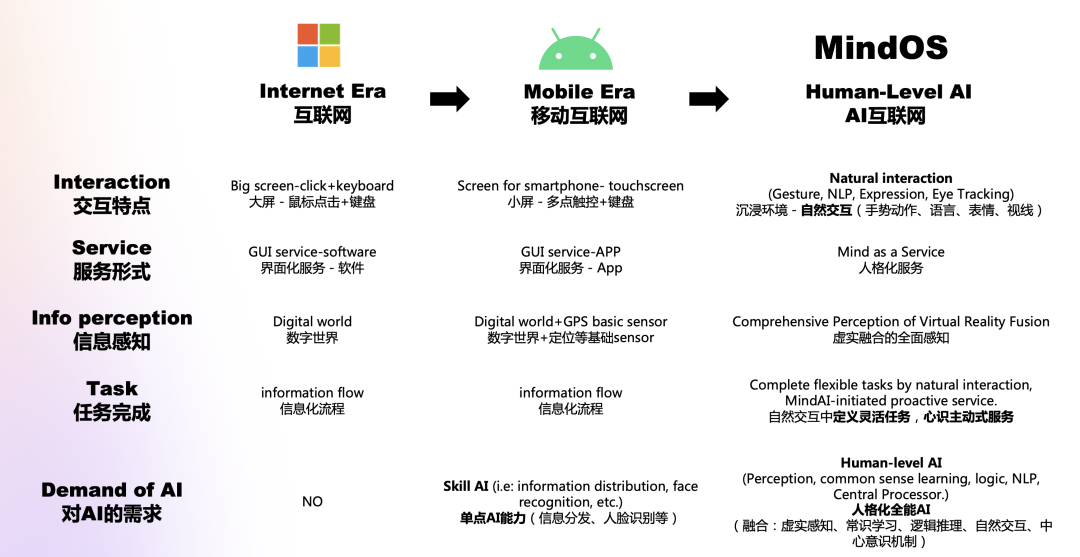
Pitch deck from January 2022, when the company was founded
"AI is flattening the world. Production tools and productivity once reserved for large companies are now accessible to small ones," Lin said in a talk. "For example, an e-commerce client can upload a few product descriptions and have a character recommend the most suitable products to users in a mini-program like a real salesperson. Or a banking user can choose whether virtual Warren Buffett assists with long-term investing, or virtual Ray Dalio teaches hedging. We want to help small companies and even individuals more seamlessly create their own AI interactive services."
Mindverse's product MindOS launched its beta in early November 2022, piloting with select B2B clients. It is an AI character generation engine: through simple form-filling, configuration, and drag-and-drop uploads, users can create an AI character with professional knowledge, memory, and personality — dramatically improving application interaction. In January 2023 alone, MindOS secured million-yuan orders. VBS Human (with its hyper-realistic virtual humans), Chuangyi Technology (creator of top virtual IP Liu Yexi), and several media companies have established deep strategic partnerships. Multiple overseas enterprises have also come seeking commercial collaboration.
Liang Zikang, co-founder and CEO of Chuangyi Technology, explained: "Mindverse has forward-looking advantages and cutting-edge technology; Chuangyi has strong 'content + tech.' Digital humans + AIGC will be an entirely new experiment for the digital human industry. Liu Yexi's birth as a phenomenon-level digital human was an intersection of technology and art. How to strengthen that interaction — or make it more dynamic — is the original intention of our collaboration. We both look forward to what digital humans with genuine personality will create in terms of new content, new art, and new futures."
In March 2023, MindOS will undergo a major revamp. Beyond deeper scenario integration, the new version brings enhanced AI capabilities:
- Stronger conversational controllability — allowing scenarios and brands to upload multimodal information with one click, including product images, text, video details, web links, enterprise knowledge bases, even e-books, which the AI rapidly learns and digests.
- Deep integration of "action capability" — beyond "learning and speaking," AI characters can truly "execute" for users amid complex scenario demands, creating entirely new service experiences.
- Cross-domain user insight — in the large model era, user insight transcends traditional behavioral data to achieve genuine "emotional understanding" of users. This anthropomorphic comprehension lets AI feel like an "old friend," forging powerful connections, while enabling brands to form more comprehensive, granular insights into their users.
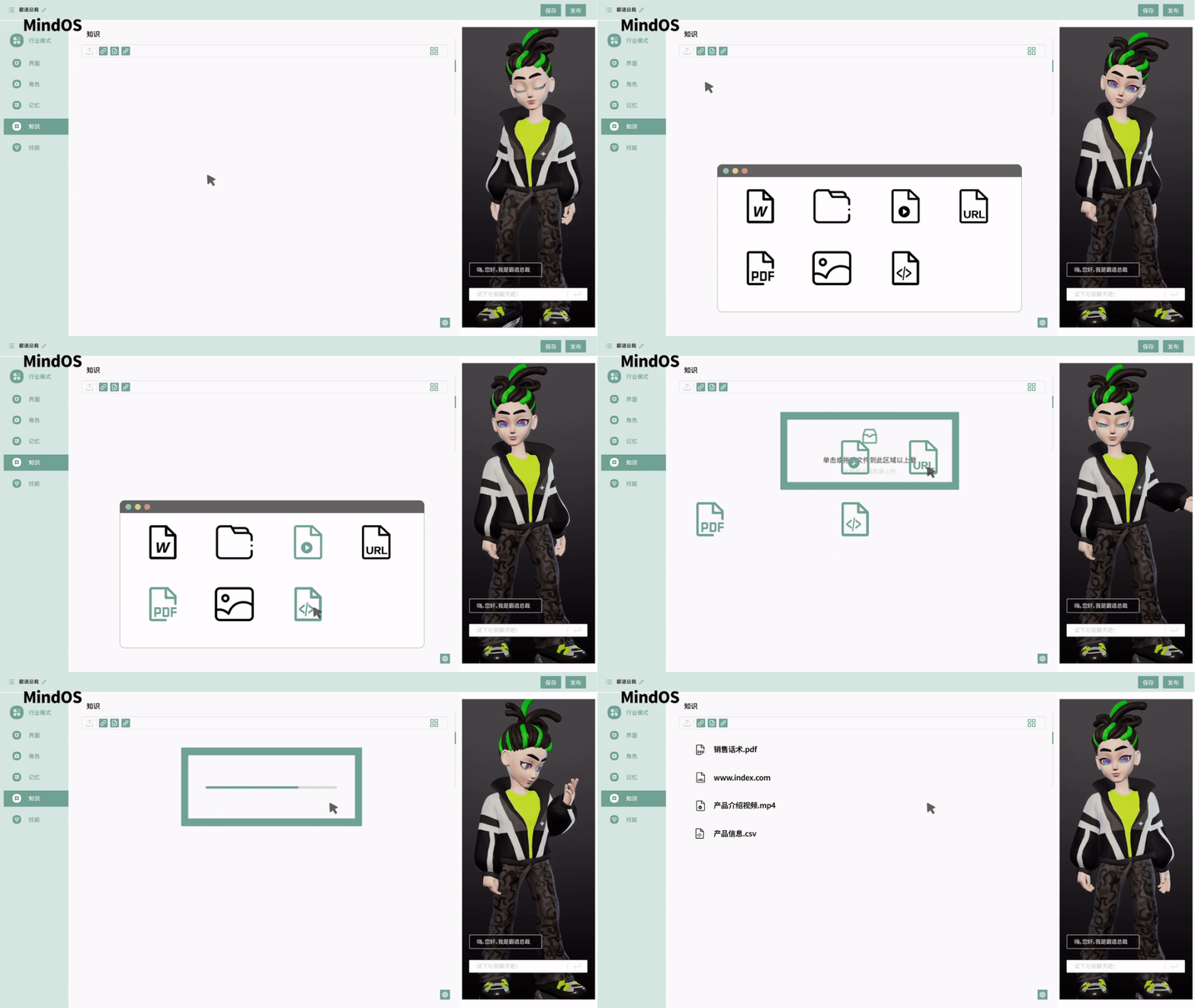
On the MindOS platform: inject knowledge, configure skills, and publish with one click for brand managers (VBS Human avatars also available)
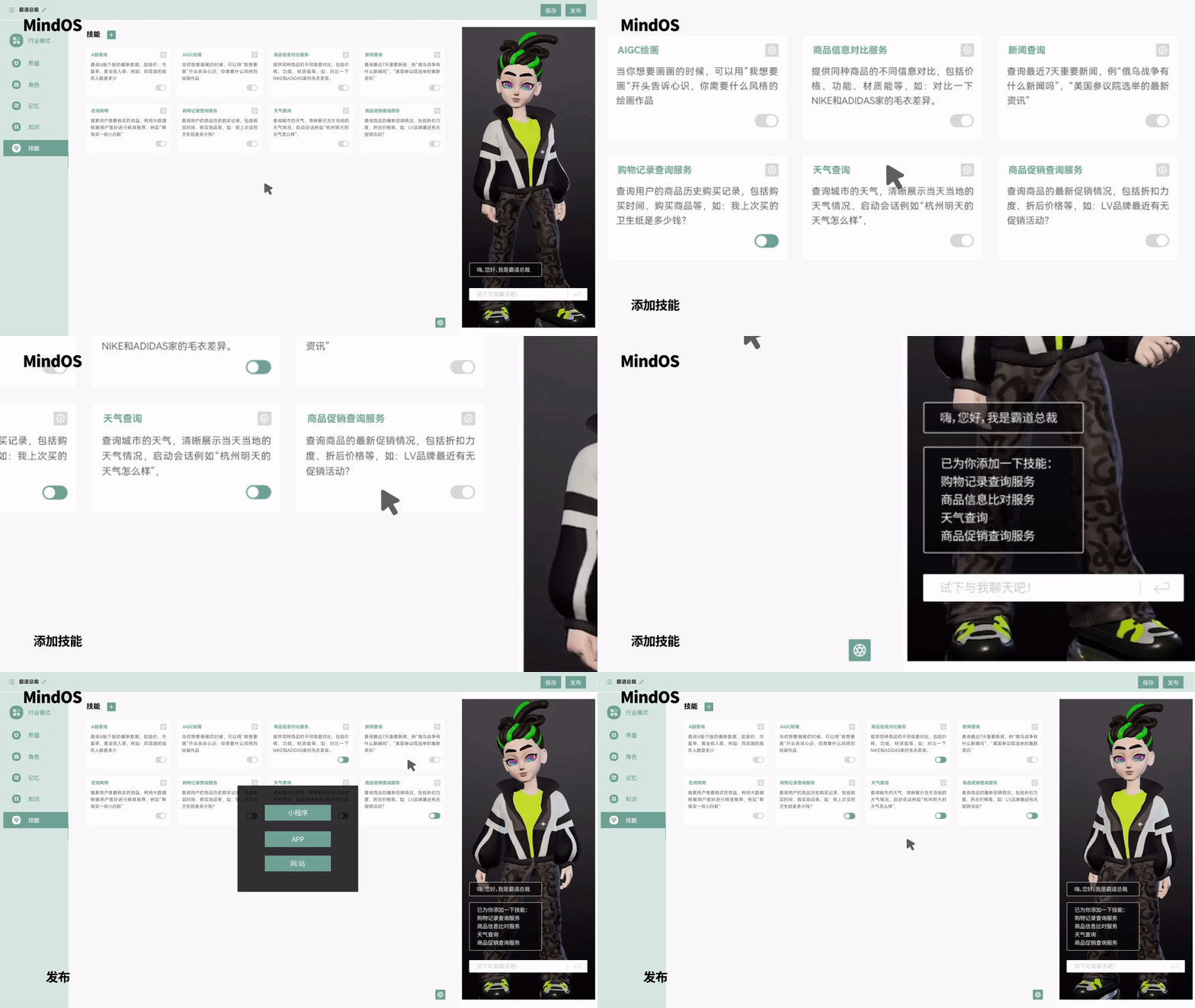
On the MindOS platform: inject knowledge, configure skills, and publish with one click for brand managers (VBS Human avatars also available)

AI characters interacting with users and calling skills in a brand environment
It wasn't just Mindverse caught off-guard by how fast the wind shifted — capital markets were too. "When we first started, many investors thought AGI was distant. But many also supported us firmly from Day 1, believing AGI and large models were 'hard but right,'" Tao said.
For a one-year-old company, Mindverse's shareholder roster is top-tier. As of November 2022, its investors include Sequoia Seed, K2VC, Linear Capital, Yinxingu Capital, and Plug and Play China. Beyond belief in the team, long-term conviction and firm commitment to the sector were key factors.
Qingsheng Zheng, partner at HSG, said: "AI has entered another golden age of development. Every industry will embrace AI just as it embraced the internet and cloud services. Beyond large models themselves, the application layer holds vast opportunities. We continue to watch for who can perceive earliest, deliver fastest, iterate, and let the market validate. Mindverse is a company with such potential."
Dr. Xiangming Chen, founder of Yinxingu Capital, expressed: "A new wave of AI is surging forth. China's industries contain enormous market momentum and rich landing scenarios. From large model R&D to faster, more flexible deployment, meeting constantly evolving scenario demands requires joint effort from tech giants and startups. The Mindverse team combines both judgment on new technologies and execution power on scenario implementation. They laid deep groundwork before AGI became consensus. We have high expectations for such a far-sighted team."
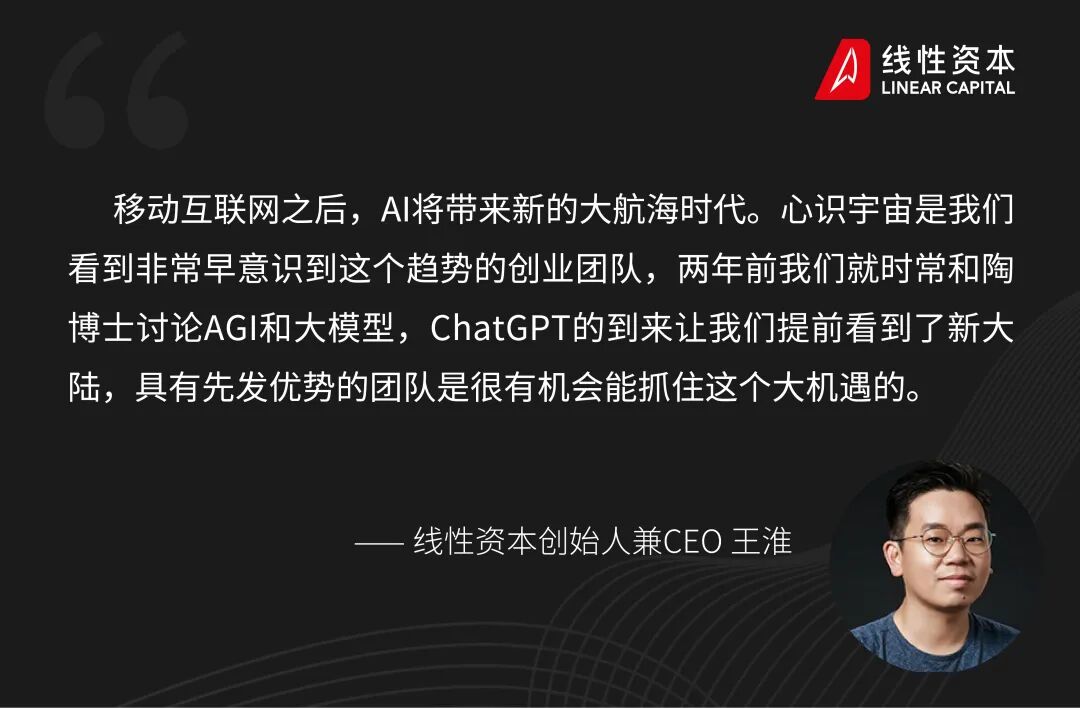
Harry Wang, founding partner of Linear Capital, said: "After mobile internet, AI will bring a new Age of Exploration. Mindverse was among the very earliest teams we saw recognize this trend. Two years ago we frequently discussed AGI and large models with Dr. Tao. ChatGPT's arrival let us glimpse the new continent ahead of time. Teams with first-mover advantage stand a strong chance of seizing this enormous opportunity."
About Linear Capital
We are hiring for our investment team. Multiple positions are open — details here.
Linear Capital is an early-stage investment firm focused on "frontier technology + industry" — frontier technologies including data intelligence, digital new infrastructure, next-generation robotics, and technological transformation of traditional domains (biotech, materials, energy, etc.), applied across vertical industries to dramatically improve efficiency, solve pain points, and complete industrial upgrading. Through substantial industrial value creation, we achieve outsized commercial returns. We currently manage ten funds with approximately $2 billion in total AUM.
Our investment stage focuses on angel to Series A lead investments, with typical check sizes of $3–8 million or RMB equivalent.
To date, we have made early investments in over 120 teams including Horizon Robotics, Kujiale, Sensors Data, Tezign, Rokid, Guandata, and Agile Robots. The combined valuation of Linear's portfolio companies is approximately $20 billion.
In the near term, Linear Capital is working to become the premier "Data Intelligence Technology Fund." Over the long term, we aim to build the most influential "Frontier Technology Application Fund."