Why "Copy to China" Is Hard to Replicate, and Where China's LLM Opportunity Lies

Recently, Bai Zeren, Senior Investment Director at Linear Capital, sat down with *Jazzyear* to share his views on the entrepreneurial opportunities brought by ChatGPT. When it comes to the domestic market for large language model startups, Linear Capital remains optimistic. "While the engineering detours and challenges will take time to work through, the probability of Chinese companies producing something with 80% of ChatGPT's capabilities within two to three years is quite high — even if surpassing what OpenAI has already built will be difficult."
Recently, Zeren Bai, Senior Investment Director at Linear Capital, sat down with Jazzyear to share his thoughts on the entrepreneurial opportunities sparked by ChatGPT. When it comes to the domestic market's prospects for large language model startups, Linear Capital remains optimistic. "While the specific engineering detours and challenges will take time to work through, the probability of Chinese teams building something with 80% of ChatGPT's capabilities within two to three years is quite high. Even if it's difficult to surpass OpenAI's established advantage of 100 million users and data scale, as long as domestic teams can produce a初步可用的产品, a massive wave of developer opportunities will follow." Linear is more focused on future applications of true intelligence. Bai believes AGI-native applications represent an entirely new direction — "for instance, analyzing and processing data directly through natural language, or providing enterprise decision-making services. Moreover, China's software ecosystem differs from abroad. Many applications aren't deployed on the cloud, creating data accessibility issues that will give rise to new approaches and applications."
A few days ago, GPT-4 saved a pet dog.
Here's what happened. One day, a netizen named Cooper noticed his puppy acting strangely, showing symptoms of anemia, and took it to a clinic. The vet diagnosed the dog with a tick-borne disease, and Cooper followed the prescribed care at home.
A few days later, the puppy's condition worsened — its gums turned pale, and the anemia became more severe than before. Cooper returned to the clinic, but the veterinarian admitted he didn't know what was wrong and suggested waiting to see how things developed. Unsatisfied with this response, Cooper frantically sought out other clinics for advice.
Meanwhile, he remembered that GPT-4 had mentioned its proficiency in medical diagnosis and decided to give it a try — Cooper described the puppy's condition in detail and provided GPT-4 with multiple blood test results, asking for a diagnostic opinion.
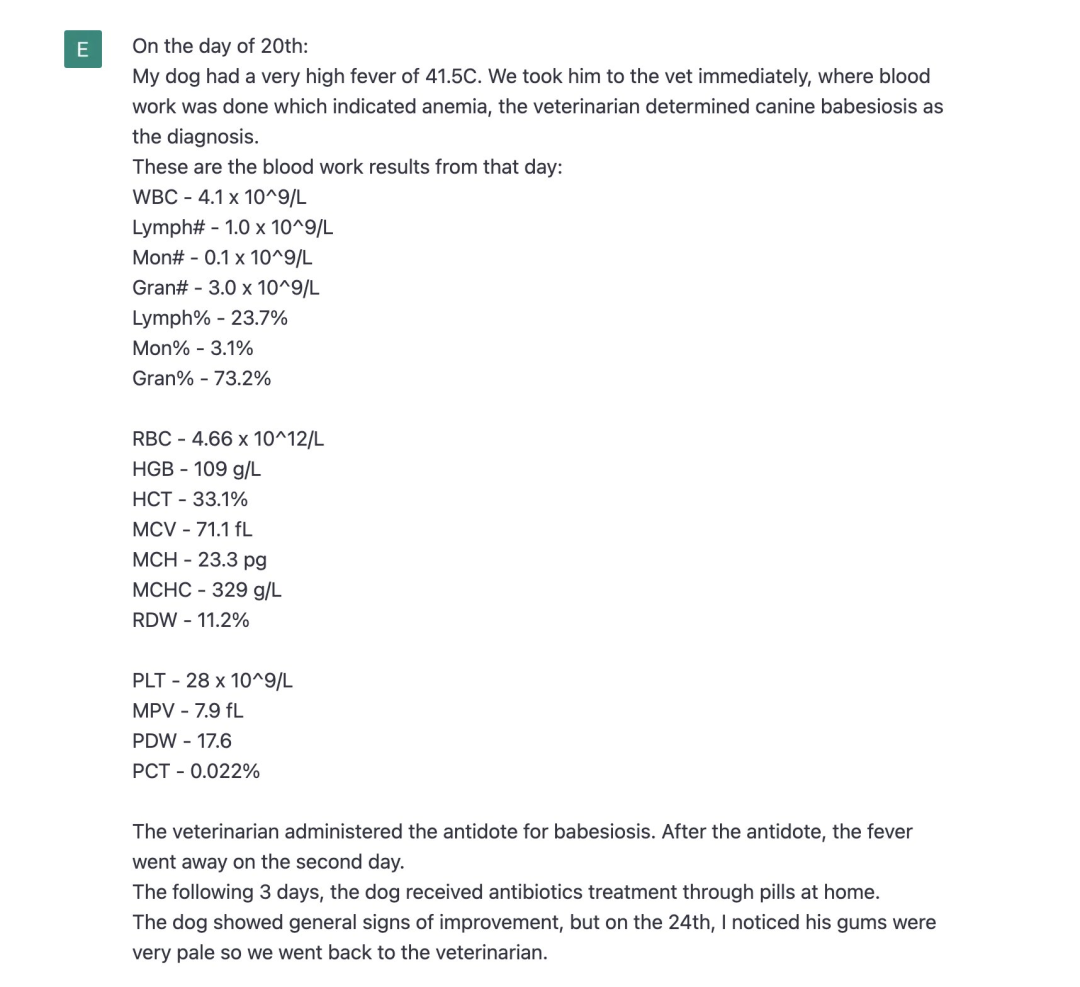
Part of Cooper's query
After issuing a disclaimer — "I am not a veterinarian..." — GPT-4 listed multiple potential causes for the puppy's anemia and provided a list of possible underlying conditions. Combining this with previous test results, Cooper eliminated other possibilities and arrived at the diagnosis that best fit the current situation: IMHA (Immune-Mediated Hemolytic Anemia).
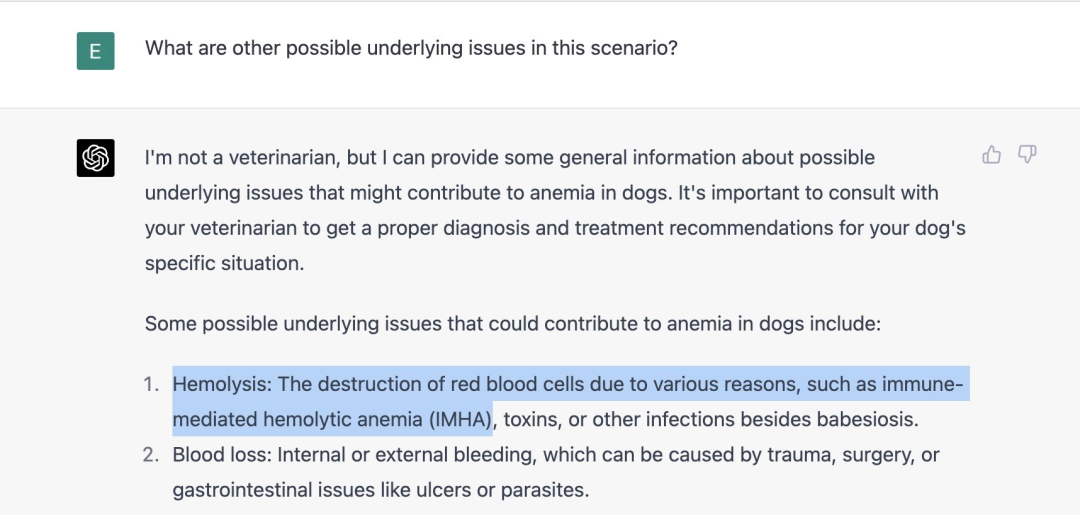
GPT-4's response to one of Cooper's questions
Cooper shared this diagnosis with the second clinic treating his puppy. The vet agreed and conducted blood tests. Ultimately, the puppy was confirmed to have IMHA and received targeted treatment.

The puppy was successfully saved, and Cooper excitedly shared the good news on Twitter. "Of course, this doesn't mean GPT-4 is a good doctor, but without question, it should become a tool for professionals to help them save more lives," Cooper said.
Cooper wasn't the first person to benefit from new technology. From ChatGPT to GPT-4, AI has demonstrated astonishing comprehension and generation capabilities, along with powerful knowledge and skill reserves, enabling more ordinary people to enjoy the convenience of new technology — with next-generation AI, people can not only have chatbots "write personalized fairy tales to heal themselves," "write code for specific tasks," or "serve as their own English teachers," but also have them directly book flights and retrieve information from personal knowledge bases. Previously, people either handled these tasks themselves or relied on professionals in specific fields.
The era of AGI (Artificial General Intelligence) has arrived. Last week, Microsoft released a report signaling this shift. The report stated that GPT-4 has clearly surpassed ChatGPT and can be regarded as an early (though still incomplete) version of AGI. It has mastered not just language but can also solve difficult tasks spanning mathematics, programming, vision, medicine, law, and psychology without any special prompting — and its capabilities are very close to human level.
Even technological optimists were surprised by how quickly AGI has come, exclaiming: "We knew AGI would definitely arrive, thought it would be a few years, or more than ten years — never imagined it would be now."
The fever crossed the ocean to China. Under the successive product "bombardment" from OpenAI and Microsoft, the domestic market exploded — investors stayed up late poring over papers, entrepreneurs rushed abroad to learn, tech giants urgently developed competing products, ordinary people busily studied guides, and the AI industry, which had been busy "focusing," "going downstream," and "staying silent," became lively once again.
"The iPhone moment for AI," "The arrival of the AI 2.0 era," "Disruptive entrepreneurial opportunities," "The next-generation operating system" — people have endowed this moment with various grand names signifying epochal change. The large model technology behind GPT-4 and its related applications have become an unmissable new风口 in the eyes of investors and entrepreneurs.
Where exactly lie the ecosystem opportunities brought by large model technology? And how should we seize this wave of new technology? For this story, Jazzyear interviewed several investors and entrepreneurs in the industry, attempting to reconstruct how different people understand large model ecosystem opportunities and where they're placing their bets, seeking to map out possible future directions for China's AI industry.
1. A Platform Opportunity More Disruptive Than Mobile Internet?

"This is absolutely a more disruptive opportunity than mobile internet," one investor said.
This view, if expressed after ChatGPT's release last November, would have struck many as hyperbolic. But now, more people feel their imagination can't keep pace with OpenAI's day-by-day evolution.
After releasing ChatGPT last year, OpenAI itself didn't realize it would trigger such massive industry shockwaves months later. It was originally a rushed "test product" thrown together in two weeks, mainly to collect feedback and lay groundwork for the subsequent GPT-4 launch.
To some, this hardly qualified as revolutionary innovation. Turing Award winner Yann LeCun even said publicly: "ChatGPT isn't a technological innovation, it's just well-combined." In fact, many of ChatGPT's core technologies did originate from others — Transformer was proposed by Google in 2017, self-supervised learning algorithms had long been advocated, and reinforcement learning was pioneered by DeepMind. This is why many initially viewed ChatGPT as merely a product rather than a transformative platform.
But some glimpsed the dawn of AGI in ChatGPT. Through usage, people discovered that ChatGPT could not only chat and write articles but also summarize meetings, conduct industry research analysis, and write programs — for the first time, large language models demonstrated such powerful generality.
University of Edinburgh PhD student Yao Fu stated bluntly in an article: "In the international academic community, ChatGPT / GPT-3.5 is regarded as an epoch-making product. The difference between it and previously common language models (Bert/ Bart/ T5) is almost like the difference between missiles and bows and arrows — it must be treated with the highest degree of seriousness."
UCL Computer Science Professor and Director of Shanghai Digital Brain Research Institute Jun Wang told Jazzyear: "ChatGPT's stunning natural language generation capability has transformative impact on human-machine interaction. It enables machines to fully understand human language expression, thereby establishing the most convenient human-machine connection pathway and creating the foundational prerequisite for machines to perform generalized tasks afterward."
"Make friends with super intelligent AI for just $20 a month," one netizen quipped.
Today, this generality is sparking new commercial visions. In recent weeks, OpenAI successively released GPT-4, ChatGPT plugins, and opened API interfaces, allowing many developers and enterprises to directly tap into the large model capabilities behind OpenAI. Various tools and products have emerged — ChatPDF, ChatExcel, new note-taking software... In Silicon Valley, dozens of new OpenAI-based products launch almost daily.
One Silicon Valley engineer even used GPT-4, Whisper, and Monocle AR glasses to build RizzGPT, helping people escape awkward dating and interview situations. RizzGPT provides "Charisma as a Service (CaaS)" — it listens to conversations and accurately tells the person what to say next.
One prevailing view: ChatGPT is the operating system of the AI era. "If ChatGPT's debut was the 'iPhone event,' then ChatGPT plugins bring the 'iOS App Store event,'" exclaimed Kesi on Twitter from the US. "OpenAI might run their App Store using proprietary models to cross-compile various plugins (applications). Even open-source platforms can't compete with them, just as Android phones can't get the full iOS experience."
OpenAI founder Sam Altman prefers to define large models as a new technology platform, where everyone becomes a developer. He said: "New technology unlocks how people build applications. This is an opportunity not seen since mobile internet, and all industries will benefit." In his view, based on this new technology platform, everyone can have a tailored assistant in their pocket to help with learning, work, and medical advice — and people only need to say one sentence to activate this personal machine assistant.
Microsoft Azure has become the most direct beneficiary of this developer feast. This March, Azure launched Azure OpenAI Service for B-end customers and updated ChatGPT coding features, allowing users to directly call OpenAI's large model capabilities through Azure. This means every new developer and enterprise using ChatGPT or GPT-4 becomes another user for Microsoft Cloud.
Beyond cloud computing, Microsoft's ambitions also target search engines, SaaS products, and other directions. Previously, Microsoft had integrated ChatGPT into Bing search to directly compete with Google. Additionally, Microsoft Cloud is intensifying integration with a series of OpenAI products. A new chapter opens in the office software market. The day after GPT-4's release, Microsoft announced it would integrate GPT-4 into the Office suite, launching a new AI feature called Copilot to directly write project proposals, create data visualizations, generate PPT summaries, draft emails, summarize meetings, and enable business chat.
"A hundred years from now, we will look back at this moment and say: That was the true beginning of the digital age," said Microsoft VP Jared Spataro. At this new starting point, Microsoft has already captured the "lead time."
2. Reinventing the Wheel?
While the large model ecosystem entrepreneurship scene in the US market is in full swing, China's tech industry has also been galvanized.
"Finding or becoming China's OpenAI" has become the paramount question.
The first major tech company to rapidly follow with product moves was Baidu. On March 16, Baidu released its ChatGPT-competing product Ernie Bot, and opened Ernie Bot API interface services to enterprise customers. On March 27, Baidu launched the Ernie Qianfan large model platform for enterprise developers, with inference cloud call pricing $0.0003 cheaper than ChatGPT per unit. "Ernie Bot and ChatGPT might differ by at most two months," Robin Li said in a 36Kr interview.
Robin Li stated bluntly: "China's OpenAI is not an opportunity for startups; there's no need to reinvent the wheel."
Clearly, many disagree with his view. Currently, Meituan co-founder Huiwen Wang, Sinovation Ventures CEO Kai-Fu Lee, former Sogou CEO Xiaochuan Wang, former JD.com AI chief Bown Zhou, and Mobvoi founder Zhifei Li have all announced their intentions to start companies building large models. "AI 2.0 has arrived, and it will give birth to platform opportunities ten times larger than mobile internet," Kai-Fu Lee declared. On March 19, he posted on WeChat Moments that he would personally organize Project AI 2.0 — a global company dedicated to building an AI 2.0 new platform and AI-first productivity applications.
More startups that had previously anchored their direction in large models have also surfaced. Shanghai Digital Brain Research Institute, focused on decision intelligence; MiniMax, working on multimodal AI large models; Westlake Xinchen, focused on large model research and applications; and LangBoat, a cognitive intelligence company — all were established before this wave of fever.
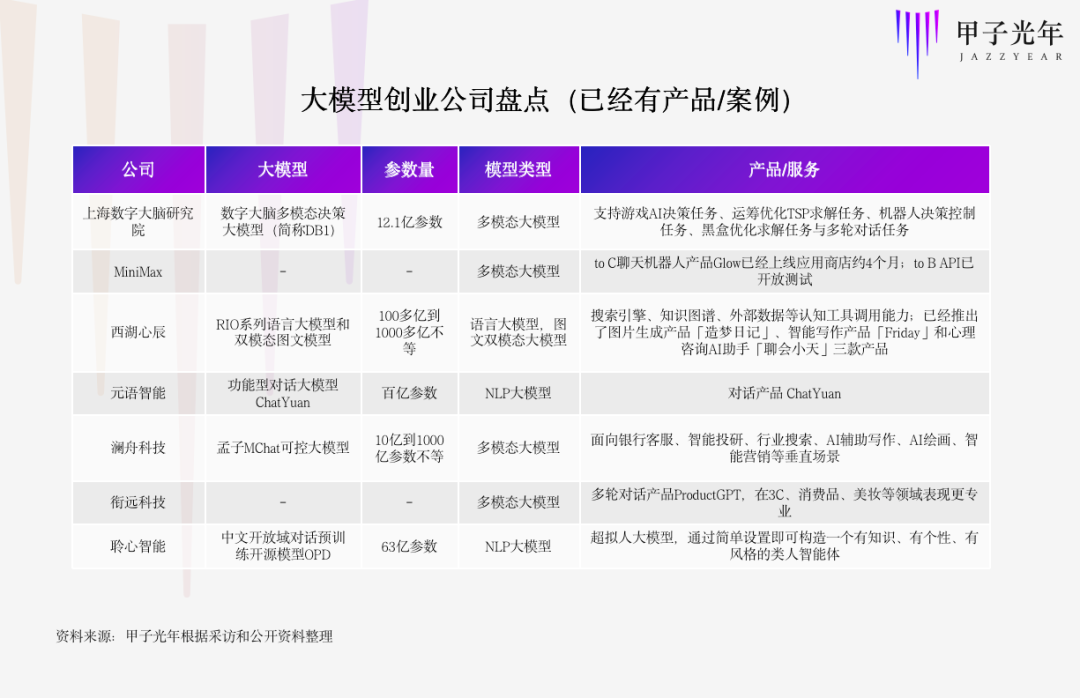
AI large models are becoming the darling of the venture capital world. The latest news is that Lightyears Away, the new project founded by Huiwen Wang, has reached a preliminary acquisition agreement with AI architecture startup OneFlow.
The flip side of this excitement is realistic concern.
"It's not going to be easy for large model startups to raise big money anymore," Yunqi Capital partner Yu Chen told Jazzyear. He noted that when Yunqi invested in MiniMax's angel round at the end of 2021, this was still a niche field with few players domestically. But because they had known MiniMax's founding team for a long time, Yunqi chose to believe in their technical conviction and ambition to build AGI.
In Chen's view, the domestic market is currently overheated, with many people following trends, and some projects are simply passing off fish eyes as pearls.
For companies truly wanting to deeply cultivate large model technology, this is also destined to be an arduous battle — funding, computing power, data, talent, and more unknown engineering methods present challenges everywhere. "Without computing power, without data, it's impossible to produce high-quality large models in just a few months," Chen said.
Money is the most basic entry condition for large model entrepreneurship. In 2022, OpenAI spent $544 million with revenue of only $36 million. "If you can't raise one or two hundred million dollars a year, you can't even get in the door," said Zeren Bai, Senior Director at Linear Capital.
Computing power is also a critical element. A research report from Zheshang Securities pointed out that supporting ChatGPT's computing infrastructure requires at least tens of thousands of NVIDIA GPU A100s (AlphaGo only needed 8 GPUs). Purchasing one top-tier NVIDIA GPU costs 80,000 yuan, GPU server costs typically exceed 400,000 yuan, and a single model training session costs over $12 million. These are visible investments. "Computing power is a challenge, but it can be solved through model acceleration or designing chips specialized for Transformer — domestic companies are already exploring this," Bai said optimistically on this issue.
Bai believes that in data and scenarios, how large model startups face competitive pressure from major tech companies is also a key question. Currently, Baidu, Tencent, Alibaba, ByteDance, and Huawei have all announced their own large model technologies. "Major tech companies have their own data and scenarios. For large model infrastructure layer startups, beyond engineering implementation capabilities, they also need to accumulate sufficient high-quality data and applicable scenarios to compete with the giants."
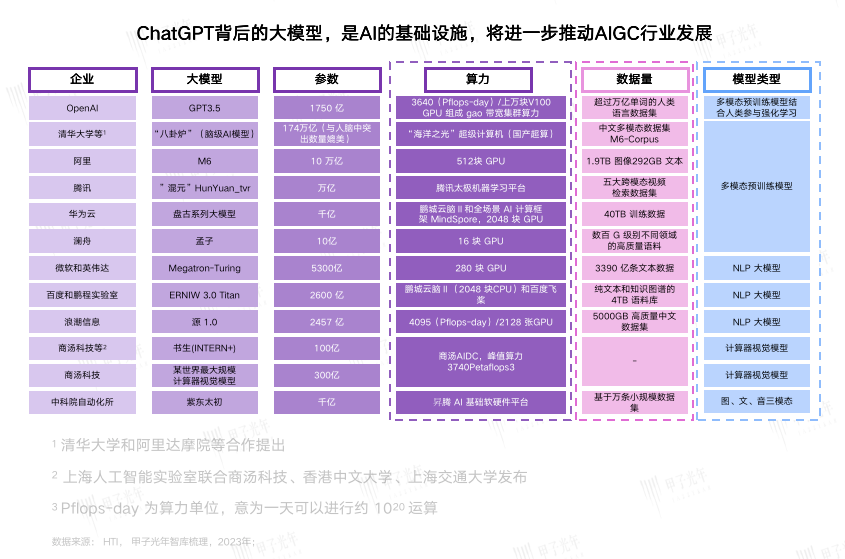
More scarce than computing power and data is talent. Yunqi Capital partner Yu Chen told Jazzyear: "Large model platforms have strong technical attributes and require top-tier engineers to steer direction. Currently, such talent is relatively scarce domestically — even with money, you might not find suitable people in a short time."
Judging from Huiwen Wang's situation of not finding a chief scientist more than a month after posting his hero recruitment list, finding people is indeed a major challenge.
"This is destined to be a game for a select few. Ultimately, the large model infrastructure platform layer will be left with three or four startups," Chen said.
3. Build Foundation Models First or Upper-Layer Applications First?
While major tech companies and startups race to compete for large model platform opportunities, China's large model ecosystem has gradually developed a picture distinctly different from the US market.
The most significant difference is the prioritization between technology and applications for large model companies.
OpenAI has consistently focused its main efforts on achieving generality in large model technology, using this general capability to solve problems in vertical domains. So in the US market, we see the large model ecosystem opportunities forming a division of labor across the infrastructure layer, middleware layer, and application layer. Among these, OpenAI's positioning is to become new infrastructure, building large model platforms, upon which middleware and application layer companies are responsible for delivering technology to vertical scenarios.
For example, companies like Notion and Salesforce choose to directly call ChatGPT's capabilities to serve users. Previously, SaaS company Jasper was based on GPT-3's open API, helping enterprises and individual users write marketing copy and AI-generated art. In October 2022, Jasper reached a valuation of $1.5 billion.
Baidu is also advocating this "layered" large model ecosystem opportunity. Robin Li shared at the Ernie Bot launch:
- The first category is new cloud computing companies, where the mainstream business model will shift from IaaS to MaaS.
- The second category is companies conducting industry model fine-tuning, serving as middleware between general large models and enterprises. These companies can leverage industry insights to call general large model capabilities and provide solutions for industry clients.
- The third category is application layer enterprises, developing application services based on general large language models — this may be where the real opportunity lies.
More Chinese startups believe that China's path to large models differs from the US market. They have explored a "walking on two legs" approach, simultaneously developing large model infrastructure platforms while directly targeting vertical industry scenario落地.
LangBoat, incubated by Sinovation Ventures, is one such company. Founded in June 2021, LangBoat's main products are a series of capability platforms and vertical scenario applications based on its "Mencius Large Model" core technology. The company's newly launched Mencius MChat controllable large model includes machine translation platforms, financial NLP, AIGC intelligent creation, and other enterprise-level solutions.
"While embracing large models, Chinese companies must assess the situation, focus on落地, especially B-end落地," said LangBoat founder Ming Zhou.
Bown Zhou, former JD.com AI chief who founded Xianyuan Technology in 2021, also chose this path: vertical integration from proprietary foundation large models to applications and full user scenario闭环. Its product ProductGPT resembles ChatGPT — a multi-turn conversational AI product. In 3C, consumer goods, and beauty domains, ProductGPT provides more professional responses than ChatGPT. This path is closer to vertical large models.
"China's situation is completely different from the US. China's OpenAI needs to explore a new path," Zhou said.
This "walking on two legs" development is also no easy feat. "Startup resources are limited. Just as cloud vendors find it difficult to do SaaS all the way through, for startups, prioritizing large model technology development versus directly cutting into细分行业 to do scenarios is a single-choice question, not a multiple-choice one," Yunqi Capital partner Yu Chen told Jazzyear.
But Chinese tech companies do need to consider realistic commercial落地 issues early on — this is a dilemma.
Some are still lamenting, how did China's AI industry fall behind? Others are more concerned with the answer going forward: Can Chinese large model companies catch up to OpenAI?
Some are optimistic. Linear Capital Senior Director Zeren Bai believes that while specific engineering detours and challenges need time to overcome, the probability of domestic teams producing something with 80% of ChatGPT's capabilities within two to three years is quite high. Even if it's difficult to surpass OpenAI's established advantage of 100 million users and data scale, as long as domestic entrepreneurial teams can produce初步可用的产品, massive developer opportunities will follow.
Others believe latecomers may not be without opportunity: "Large models do present engineering challenges, but the moat isn't as deep as chips. As parameter scales increase, they may encounter scaling bottlenecks. Once model capabilities slow down, latecomers will have opportunities."
More people are calling for a return to technical essence. "The domestic market needs to accept companies focused on technical tools to truly achieve general artificial intelligence, but this requires long time and firm technical conviction," UCL Computer Science Professor and Shanghai Digital Brain Research Institute Director Jun Wang told Jazzyear.
"On this path, time isn't the issue — confidence and determination matter more," Wang said.
4. Application Layer Opportunities: Domestic Market Values B-End More
Regardless of how the ultimate large model platform competition turns out, it won't affect the relentless forward march of application layer companies. Robin Li is very optimistic about the百花齐放 of large model application layer companies, saying: "The real opportunity lies in the application layer — more killer apps, phenomenon-level products will emerge."
Currently, many domestic investors have already shifted focus from large model infrastructure platforms to broader application layer opportunities. "China will have its own large models, but Linear is more focused on future truly intelligent scenario applications," said Linear Capital Senior Director Zeren Bai.
This is a game all companies can participate in. UCL Computer Science Professor and Shanghai Digital Brain Research Institute Director Jun Wang told Jazzyear: "Under the Model As A Service model, various applications developed based on large model technology can serve all industries. For instance, after synchronizing large model capabilities with databases, robots, and smart car commands, chatbots can directly operate this software and hardware through natural language."
In Yunqi Capital partner Yu Chen's view, among application layer opportunities, 80% are consistent with those in 2018 and 2019 — "it's just that due to large models' general capabilities, the technical paths of these applications have changed. 20% of applications are newly born under large model platform opportunities, such as automatically generating code through natural language capabilities — this is revolutionary for developers."
For many B-end companies, large model platform capabilities bring a new efficiency revolution, also enabling customized services previously unattainable. For example, for MeFlow, an AI legal company in the intelligent contract赛道, the company's technical path and products will undergo全新变化 in this large model platform opportunity.
MeFlow founder Cunchao Tu told Jazzyear that previously, the company's path for contract review was: organize knowledge → data annotation → train models. Going forward, the company can use chatbots for information extraction, "equivalent to eliminating the data annotation and model training process, which was previously costly and time-consuming." He also candidly noted that in some particularly specialized knowledge areas, there are still problems that general large language models can't solve well, requiring continuation of previous technical paths.
Tu noted that large language models' general capabilities also enable the company to do products and projects that previously had very low input-output ratios. "In contract review business, previously due to high costs, we couldn't respond to clients' personalized contract review needs in a low-cost, efficient manner. For example, in contract ledger retrieval scenarios, facing questions like 'What contracts over 500,000 yuan did the company have in Q1, and what were the payment terms with a certain company' — previously requiring search and filtering, now you can directly ask the robot."
Tu revealed that the company's commercialization path has also changed accordingly. "Currently main clients are medium and large enterprises; now we're also beginning to explore providing contract-related legal services to small and micro enterprises through ChatGPT capabilities." Reportedly, MeFlow is jointly with Tsinghua University AI Research Institute, Zhipu AI, ModelBest, and OpenBMB, about to release a legal ChatGPT based on a Chinese hundred-billion-parameter large model.
Like MeFlow, many B-end companies will forge new commercial landscapes under the加持 of large model technology platforms. Linear Capital Senior Director Zeren Bai believes that we have evolved from usable in specific scenarios (AI +) to好用 in generalized scenarios (AGI x). AIGC will bring paradigm-level innovation and may bring new trillion-dollar opportunities in the coming decade.
Amid variables, entirely new applications for the AGI era will also emerge. Bai noted that AGI-native applications are an entirely new direction — "for instance, analyzing and processing data directly through natural language, or providing enterprise decision-making services. Moreover, China has a different software ecosystem from abroad — many applications aren't deployed on the cloud, creating data accessibility issues that will give rise to new approaches and applications."
In his view, this AGI wave will accelerate Chinese enterprises' embrace of digital tools, and the enterprise services赛道 will welcome new opportunities.
While AGI + B-end application prospects are widely favored, AGI + C-end applications are also becoming hot. Domestic companies have already begun trying — for instance, startup Lingxin Intelligence is building scenario-based, personified ChatGPT. The company's "hyper-personified large model" core technology is controllable, configurable, and anthropomorphic. Through simple settings, one can construct a human-like intelligent agent. "In the AGI era, besides 'being able to assist,' every AI agent should have personality, persona, emotion, and style, and be able to establish deep emotional and social connections with people — this is the core of human-AI symbiosis," Lingxin Intelligence founder Minlie Huang told Jazzyear.
Although AGI + C-end opportunities appear larger, they also face more realistic challenges domestically.
This directly relates to domestic C-end users' willingness to pay for digital products. A tech sector investor told Jazzyear: "C-end companies have higher ceilings than B-end companies, but payment willingness in Chinese and US markets is vastly different. Midjourney can achieve 10 million users and $100 million annual revenue — this might not work in China. So domestic B-end opportunities are actually more普遍."
Another concern about future application layer opportunities is that as scaling capabilities strengthen, will large model AGI directly swallow many application layer opportunities?
Judging from GPT-4's demonstrated capabilities, its general capabilities are stronger than ChatGPT's. If GPT-5's capabilities rise another level in the future, many application layer products could potentially be directly replaced.
"It's somewhat like a race between application development speed and large model iteration speed," one practitioner said on the podcast Tech Buzz.
Some believe the speed won't be that fast. Because B-end products and services test vertical industry认知能力, sales capabilities, and service capabilities — accumulated over time, experiential advantage becomes a moat. And C-end products, if they've already established brand effect and user recognition, are also difficult to directly replace. Others believe machine evolution speed has already exceeded imagination, and in the future, anything is possible.
New ideas and perspectives continue to emerge, and consensus on large model ecosystem opportunities is still forming. For practitioners, perhaps more important than making judgments is listening to more different voices.
(Article header image source: Wenxin Yige, input term: Artificial General Intelligence, style: Surrealism)
END.