Taking Smart Swim Goggles Global Was the Most Viable Choice from His Day-One Vision | Linear Voice

You can't build a castle on a desert — so you turn the desert into an oasis first.

The entry of internet giants and aggressive new moves by industry veterans have reignited discussions around AR and AI glasses. Unlike smart glasses built for general-purpose scenarios, one low-profile tech company has carved out a niche in swimming — and already earned genuine word-of-mouth buzz in professional sports circles and online through solid product technology. That company is Holoswim.
This year, Holoswim's AR smart swim goggles have landed in Decathlon's brick-and-mortar stores, and have begun selling in France, Germany, Italy, Russia, the US, Brazil, Australia, Japan, South Korea, and other countries. On the product front, the company is also expanding into new categories suited for cycling, trail running, and other outdoor scenarios.
Recently, founder and CEO Zhuopeng Zhang sat down with 36Kr to share his thinking on product and the AR industry. Linear Capital was Holoswim's exclusive angel investor and has continued to back the company in subsequent rounds.
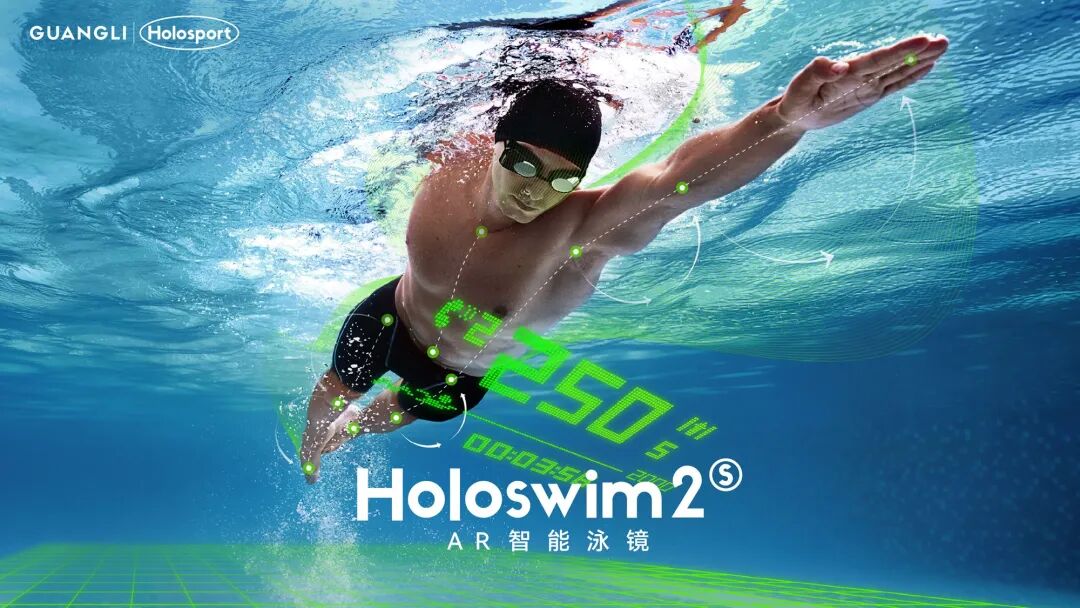
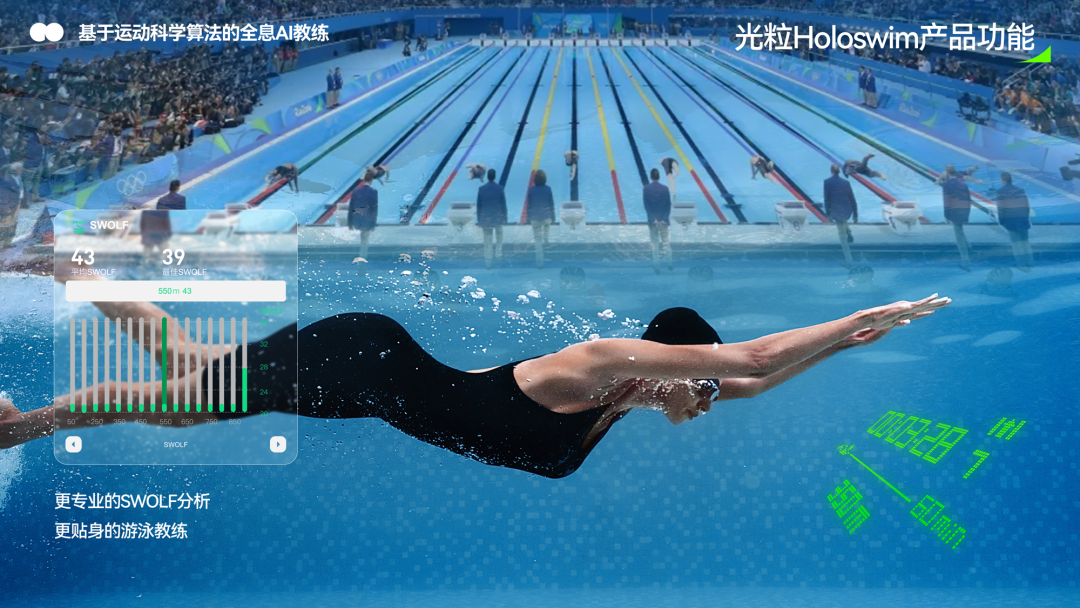
Picture this: you're swimming with goggles on, and a set of green numbers floats before your eyes — real-time distance, lap count, duration, pace, progress toward your goal, all crisp and clear at a glance. Your hands stay free, and you've got full command of your entire swim.
Over the past few months, the smart goggles that make this possible, "Holoswim," have been popping up everywhere around us. A primary-market investor mentioned in a WeChat post that "the user experience on this product is excellent." Employees at internet companies have brought it up when describing novel recent athletic experiences. Currently, the "Holoswim 2s" has appeared on Decathlon shelves in Beijing, Shanghai, Guangzhou, Shenzhen, Hangzhou, and other cities, with many users posting on Xiaohongshu praising its "amazing anti-fog performance."
Internationally, Holoswim's products are already on sale in France, Germany, Italy, Spain, Poland, Russia, the US, Mexico, Brazil, Australia, Japan, South Korea, Singapore, and other countries. Starting from the swim goggle category, they are also developing new products for cycling, running, hiking, trail running, skiing, and diving scenarios.
As the product reaches mainstream consumers, Holoswim's parent company Holoswim Technology and its founder Zhuopeng Zhang have kept a notably low profile compared to many emerging AR and AI glasses manufacturers.
Zhang graduated from the Department of Optoelectronic Science and the Chu Kochen Honors College's Engineering Elite Class at Zhejiang University, then went to the US for graduate school, earning a PhD in ECE and a master's in finance from the University of Delaware. In 2017, he recruited his Zhejiang classmate Yizhen Wei to co-found Holoswim Technology.
When Holoswim released its first-generation AR holographic smart swim goggles, it was the only company globally to have mass-produced pure resin waveguide technology and brought a finished consumer product to market.
That year, sentiment in the AR glasses industry was riding high. Meta, Apple, Microsoft, and other major players were making aggressive moves. More than ten AR glasses startups including Magic Leap, Liangfengtai, and Nreal had secured fresh funding rounds. Holoswim, which had raised over 100 million RMB, was among them. Enthusiasm and consensus arrived together, with media outlets declaring "AR glasses have really arrived," and Yonghao Luo's "Thin Red Line" would be founded the following year.
Four years later, "consensus" has drifted toward "non-consensus." AR glasses manufacturers have largely abandoned the costly, difficult optical display component for the time being. AI glasses have become the new hot thing — Meta's Ray-Ban smart glasses collaboration saw 300% sales growth in the first half of this year.
36Kr: "Has the exit, pivot, or collapse of peers affected your confidence?"
Zhang: "No."
Throughout the conversation, faced with similar true-or-false and multiple-choice questions, Zhang would first answer directly without hesitation, then patiently explain why the question arises, why he has always believed AR will arrive, and what logic and considerations underpin Holoswim's path. His thinking typically carries a strong "begin with the end in mind" quality and rational optimism.
For instance, from "day one" of the company, Holoswim firmly targeted a "consumer-grade" positioning. At the time, the founder of a well-known industry company met with Zhang and advised him to take a closer look at "Birdbath" (BB for short, another mature optical display solution for AR glasses whose drawback is bulky lenses).
Though this route offered more mature commercialization conditions, Zhang viewed it as merely a transitional form of AR glasses that would inevitably be phased out, and insisted on the holographic waveguide path. "We put ourselves in consumers' shoes — they definitely want something beautiful and comfortable. Only the waveguide solution can make the lenses thin enough."
Similarly, industry enthusiasm for AR glasses has been declining, largely because current sales have fallen short of expectations and "once a product launches, there are problems here, problems there." But the existence of problems doesn't mean the demand is fake — "Very few people would consider this a fake need, bullshit. People have enthusiasm and expectations; it's just that the product engineering isn't there yet, the solution isn't极致 enough," Zhang said.
Looking at the present, the currently hot AI glasses generally focus on audio interaction, rarely incorporating AR display functionality. But Zhang believes AR and AI will achieve major convergence very soon. His "very soon" is not a vague concept — "Within next year, the form factor of smart glasses will switch from pure audio to display-enabled."
According to 36Kr, Holoswim plans to release new products in the Holoswim series this fall and is developing new products for additional scenarios. Before a mature general-purpose content ecosystem for AR truly emerges, Holoswim will continue to focus on the niche of sports AR glasses, aiming to deliver "real-time athletic assistance." Zhang says, "First, you have to do the right thing; difficulty comes second. If we can do sports and health well, that's valuable."
Below is 36Kr's conversation with Holoswim Technology founder Zhuopeng Zhang:

Q: When you exhibited in 2019, you were making general-purpose AR glasses, and your 2021 first-half release was too. Then in the second half of 2021, you launched smart swim goggles and have focused on swimming and sports ever since. What happened in between?
Zhang: At the start, most of the smart glasses industry used Birdbath technology, producing basically miniaturized helmets — they had the form of glasses but not the soul, and the lenses were heavy. Globally, Holoswim was among the more complete and earlier entrants into waveguide smart glasses solutions. The initial products were technically workable, but the size and pricing were far from what would let consumers buy easily, so the following years were mainly about deepening the technology.
When it came time to actually attempt commercialization, the industry's content ecosystem hadn't matured yet, and for a startup to build a content ecosystem wasn't something that could happen overnight, so we thought to first pick a vertical scenario. After a period of thinking and research, and based on the natural advantages of our technology — pure resin waveguide offers quite good eye protection — we settled on sports scenarios.
Q: How much did your initial general-purpose glasses sell for?
Zhang: If we had actually sold them, probably 8,000 to 10,000 yuan, which really isn't consumer-grade.
Q: So 2021 was a commercial turning point.
Zhang: Yes.
Q: What advice did investors give you then?
Zhang: "Consumer" means ordinary people paying out of their own pocket for themselves — comfort and looks both need to improve. So from our founding, we targeted the broad direction of waveguide, consumer-grade, and investors endorsed that. As for drilling deeper, which scenario to切入 first, that was left for our team to judge.
Q: After committing to the waveguide route, what were the key milestones in your cost reduction and commercialization process?
Zhang: Waveguide actually has several problems to solve. The first challenge: what we make is called "holographic grating resin waveguide," and to efficiently design and verify its micro-nano structures, you need to build a design simulation system. We had our first version of this system roughly ready by 2018, with continuous refinement since.
The second challenge: to manufacture the product, you need a machine called a "holographic lithography machine." This kind of high-end manufacturing equipment isn't available on the market, and the technology is mainly held by US and European companies that have been fully acquired or strategically invested in by giants like Apple, Samsung, and Meta. Naturally, they want to sell end products, not production equipment to you. So any domestic company that wants to crack this nut has to build holographic lithography machines and other high-end manufacturing equipment itself. We produced our first set at the end of 2018, continuously improved it after 2019, and only reached a relatively more automated mass production process stage by 2021.
The third challenge: a very important material in manufacturing is "holographic photoresist," a new material that affects the autonomy and cost of mass production. Its formulation is complex and constantly evolving. We're also continuously developing and iterating it, so that large-scale mass production in the future won't get choked by overseas materials and chemicals giants.

Q: "Singularity Near" made AR glasses for cycling and folded in the first half of this year. How did you feel when you heard?
Zhang: Quite a pity. Everyone making AR glasses is aiming for general scenarios, the biggest pie. We also chose sports scenarios out of practical commercial considerations. After working in this space for a while with no one else around, we later discovered Singularity Near was making cycling glasses based on glass waveguide, and it felt a bit like seeing a fellow traveler.
Actually, before Singularity Near, "Li Weike" was also doing it, but they actively killed that direction to go all-in on AI glasses.
Q: What do you think was their core problem?
Zhang: Frankly, using glass waveguide for sports scenarios violates the nature of the industry. After all, this is the sports goggle category — sports goggles should be pure resin material to ensure safety. Since all kinds of things can happen during sports, if what you're wearing has glass lenses, isn't that more dangerous and less "eye-protecting"?
Moreover, if glass waveguide is built into sports protective structures, the volume becomes larger, and the center of gravity becomes unstable when shaking or turning your head — especially in bumpy scenarios like mountain biking. If weight goes up, wearing comfort drops significantly and athletic performance suffers.
Q: Peers pivoting to AI or folding — did that affect your confidence?
Zhang: No. It's not that their direction was wrong, or that users don't recognize this direction. Every time a new product launches, in tech bloggers' review posts, user comments are actually quite enthusiastic.
Q: By "enthusiastic," you mean people have high expectations for this?
Zhang: Yes, very few people say this is fake innovation, something unnecessary, bullshit. It's just that the small batch of users who first try new products find problems here and there. But behind the problems is insufficient product engineering. If the solution were more极致, users would go experience and purchase it.
Q: Some companies that originally made AR glasses have pivoted to AI glasses, and some practitioners say doing AR now is a waste of time. What do you think?
Zhang: Technology always precedes ecosystem — without technology, what ecosystem is there to speak of? Before Apple made the iPhone, it first solved some important technologies, and only then came the first batch of app developers. Smart glasses are the same — if you divorce yourself from engineering problems and technical problems, it's like building a castle in the desert, it won't stand, and of course it's "a waste of time."
What we're doing is "turning the desert into an oasis." Other peers toiling away at display chip technology are doing the same — first make the desert habitable for humans. Building applications and scenarios looks glamorous, but before that, some relatively hard roads need to be paved first. Everyone's smart; easy opportunities occur to no one exclusively.
Q: Is this persistence difficult?
Zhang: Personally, I think first you have to do the right thing; difficulty is a secondary consideration. Through trade-offs and choices, doing things correctly matters more.
Q: Having solved core issues like waveguide lenses, could Holoswim become an important supply chain player in the industry?
Zhang: That depends on opportunity and how the industry evolves.
Q: Once supply chain technology fully matures and becomes shelf-ready components, will there be a major opportunity for consumer operators in the industry?
Zhang: Yes. We need that too — if you know such people, introductions welcome.

Q: Do you pay attention to product feedback? Some users seem to feel Holoswim's goggles aren't light enough yet.
Zhang: Yes, so it needs continuous iteration. Our internal product scoring system is quite strict. Without holographic resin waveguide technology, AR smart swim goggles wouldn't even pass及格, but with this technology, in our own minds it has just crossed the及格 line. I think it's still a ways from full marks, from 80 or 90 out of 100.
Q: What does that road look like?
Zhang: First, we want to further iterate based on waveguide technology, pushing weight, thickness, and other metrics toward theoretical limits.
Second, an evolving product depends on all industry participants. As display chips advance, the form factor and looks of these glasses can rise another level.
Q: Can you describe what a perfect smart swim goggle product would look like?
Zhang: The shape and volume would be infinitely close to traditional fashion swim goggles. It necessarily has to add some display components and circuit boards and batteries, so some weight sacrifice is inevitable, but it can get very close. Also, if its price range could approach mid-to-high-end goggle products from ANTA, Li-Ning, Speedo, or Arena, that would be a milestone. If you can achieve intelligence at a similar price point, the substitution effect for quality-of-life-conscious consumers becomes very obvious.
Q: How far from that form factor? As you said, it's not one company's thing.
Zhang: Within a year.
Q: That fast?
Zhang: This industry develops quickly, and our own iteration speed is very fast too.
Q: Holoswim's current products are all different configurations of the Holoswim 2. What's this year's product plan?
Zhang: We'll launch two new swim goggles. One continues the current product line, called Holoswim 3. The other is an entirely new independent product line, trying a new experience. Beyond swimming, we also have multi-function outdoor sports products, and we feel it's time to expand the scenarios outward a bit.
Q: What do you want the company's ultimate product line to look like? Will you return to that original general-purpose product?
Zhang: We're not a company that's good at telling stories. Whether we'll go back — let's leave that悬念. At least what we're doing now, AI/AR + sports, we'll do it thoroughly.
Q: At what point will AR glasses become a truly mainstream consumer product?
Zhang: Everyone talks about needing an "iPhone moment" or whatever. Actually, I don't think there's any AR vs. AI distinction — smart glasses will ultimately move toward "with display." Now with large models rapidly proliferating, we have so-called "AI glasses," which by default means pure audio. But going forward, whether it's AI intelligence or AR display, consumers won't distinguish in detail — they'll just assume you need both.
I believe AR is not a waste of time; it will definitely arrive, and it's far less distant than people say. Next year, either first half or second half, the industry wind for smart glasses will switch from pure audio to display-enabled.
Q: You're very certain?
Zhang: Very certain. Because real-time display itself is highly related to interaction. For sports users, only with good display can an AI coach become possible. Some say my smartwatch satisfies display needs, but when you're doing dumbbell curls, you can't exactly release one hand mid-lift to check your watch. Smart glasses are still the best entry point, freeing your hands and your ears.
Beyond AI coaches, smart glasses can also be your workout buddy, chatting with you, providing emotional value. All of these depend on display — your buddy could take various forms, maybe Labubu, maybe your boyfriend or girlfriend, then working out isn't lonely anymore.

Q: You entered Decathlon this year — that's major progress on the sales side.
Zhang: Yes. The overall market sentiment is improving. People's attention to life itself, their pursuit of health, is driving notable growth in athletic apparel and equipment too.
If ten years ago you said you loved sports, maybe it meant throwing on a tank top, gym shorts, and sneakers to go run. Not anymore — now it's an Arc'teryx logo on your hardshell, lululemon on your workout pants, professional running shoes on your feet, and most importantly a watch on your wrist. If the data isn't recorded and shared to your feed, then nobody knows you worked out, and it was all for nothing, right? (laughs)
Q: Are you that kind of person?
Zhang: Actually in life, people always need to give themselves some psychological hints. Even those who want to work out but haven't yet will buy some gear first. In today's high-pressure, fast-paced society, giving yourself some sunny, positive psychological hints — behind that lies the conveyance of positive emotional value. Sports equipment is a category full of emotional value, so I think it's great. What our society lacks is emotional value.
Q: Holoswim had over 100 people in 2021. How about now?
Zhang: Not much change — still around 150. The past two years focused on solving some engineering problems. Next, we'll push harder on the market side, accelerate recruiting for marketing talent. We welcome anyone interested in this direction and confident in Holoswim to join us.
Q: What's your current role at the company?
Zhang: Product and marketing.
Q: Are you looking at overseas markets?
Zhang: Actually already doing it, starting expansion from Europe and the US.
Q: What's your biggest worry or anxiety right now?
Zhang: For ourselves, advancing step by step at our current pace is relatively comfortable. Real anxiety definitely comes from external pressure, most directly from users. Once glasses become intelligent, users will默认 they can do many things and will have lots of ideas. At every stage, you have to capture some core needs, then pressure yourself to deliver them quickly.
Q: Lei Jun also made smart glasses — do you feel pressure?
Zhang: Not at all. I think it's a great thing that further educates users. Meta's collaboration with Ray-Ban has already popularized smart glasses among global middle-class and early-adopter populations, but more ordinary people in China haven't yet perceived it. For an influential company like Xiaomi to do it will definitely accelerate market fermentation. Once people have smart glasses, many will add前置定语 and search for whether there are smart swim goggles, smart cycling glasses, etc. — it's a huge positive for the industry.
Q: But if Xiaomi does it well, won't they eat the big market?
Zhang: Let them have the big market then. There are plenty of vertical scenario opportunities for startups like us. It's still that same point — you have to be convinced that your direction is worth doing and will bring great value to users. After all, sports and health are very important parts of life. Doing this well means Holoswim has advanced a small step in social value.
Q: Everyone's talking about the "hundred glasses war" now. Do you have the confidence to make it to the end?
Zhang: Yes. I actually think we currently have a stronger foundation than most big companies — technology strength, product strength, user feedback are all solid.
Our team is a bunch of people who value core technology and product delivery. We still believe more that getting the product to 80 or 90 out of 100 first, then doing bigger market moves like large-scale branding, is more踏实. This thinking might be a bit nerdy, but time will test truly good products.
*This article was first published on 36Kr. Reporter: Cairu Ren