The Spring of Low-Altitude Economy eVTOL: WEFLY Poised for Takeoff | Linear Capital Portfolio Company

Linear Capital's angel-round investment, WEFLY (Qifei Aviation), was founded by a team of aviation professionals with deep industry experience, united by a mission to advance China's new-energy aviation sector. Drawing on decades of hard-won experience and core technologies accumulated in the traditional civil aviation industry both domestically and abroad, as well as China's formidable technical strengths and industrial foundation in the new-energy "three electrics" (motor, electronic control, and battery), the company aims to establish a Chinese-owned global player in urban air mobility (U
Linear Capital's angel-round investment, WEFLY, was founded by a group of aviation professionals with deep industry experience, driven by a mission to advance China's new-energy aviation sector. Drawing on decades of accumulated expertise and core technologies from traditional civil passenger aviation at home and abroad, combined with China's robust technical advantages and industrial foundation in the new-energy "three electrics" (motor, electronic control, battery), WEFLY aims to transform human lifestyles by building a homegrown global urban air mobility (UAM) company. WEFLY plans to design, mass-manufacture, and operate a fleet of electric vertical take-off and landing (eVTOL) aircraft for the future urban air mobility market. The company was formally established in Suzhou in May 2022. Team members bring experience from the design, manufacturing, flight testing, airworthiness certification, and operation of advanced large civil passenger aircraft worldwide and in China, including the Gulfstream G500, G650, G600, G700, and G800 business jets; Bombardier's C Series (later Airbus A220) and Global series; Airbus A350 and A400; Boeing 787 and 777X; and COMAC's C919 and ARJ21. WEFLY's vision is to create a new aerial mobility platform within and between cities, adding a new dimension to daily transportation for everyone and fundamentally changing how people live.
Over the past year and more, WEFLY has pursued high-specification, high-quality, and high-safety engineering prototype development and flight testing. Adhering to independent design and cross-domain integration, and guided by engineering experts with hands-on experience domestically and internationally, WEFLY has achieved major breakthroughs in collaboration with research institutions including the Institute of Physics at the Chinese Academy of Sciences, Tianmu Lake Institute of Advanced Energy Storage Technologies, and major Chinese aviation universities. These advances span electric aircraft overall design, aerodynamic analysis, high thrust-to-weight ratio electric ducted propulsion systems, all-composite aircraft manufacturing and processes, high energy-density and high power-density battery systems, high-level automatic flight control algorithms, simplified flight operation avionics systems for future pilots, highly integrated hardware, and pilot-in-the-loop laboratories. The company is now using this experimental aircraft to establish a complete green electric aviation design, verification, testing, and flight test system.
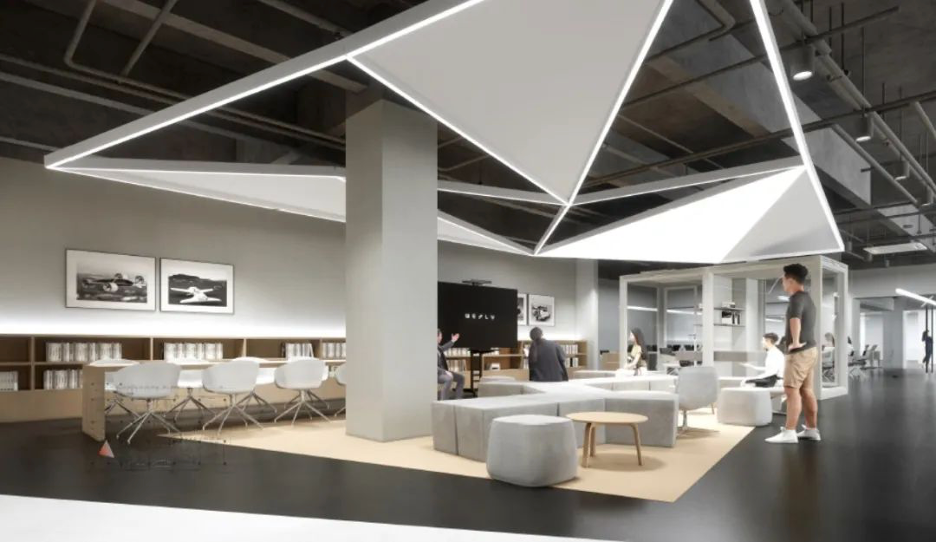
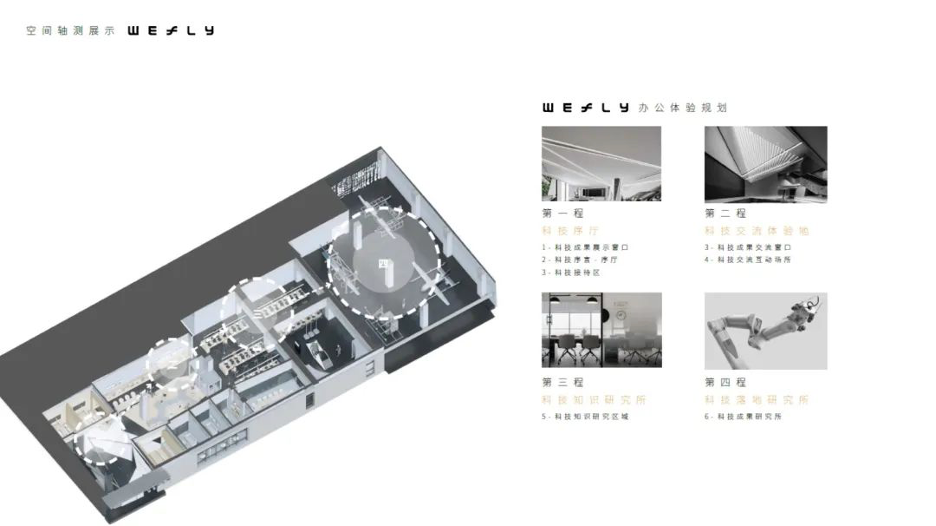
WEFLY's fluid, integrated workspace for high-tech research, exchange, testing, and integration
WEFLY WF-01 Technology Demonstrator
Based on China's distinctive urban cluster characteristics and the current state of its aviation industry, WEFLY distilled medium- to long-term typical application scenarios and corresponding top-level aircraft requirements and technical pathways. Through extensive CFD simulation, aircraft performance calculations, and multi-rotor power testing, the team concluded that in the near term, WEFLY will pursue a pure-electric compound-wing configuration combining vertical takeoff and forward flight, adopting conventional aircraft aerodynamic shapes, structural design, and automatic flight control approaches, while innovating in electrification and software-defined aircraft domains, and honing its capabilities in highly integrated complex systems and safe flight testing. WEFLY selected a 500 kg takeoff weight as the baseline metric for its first prototype (WF-01). Independently designed, with proprietary processes and deep manufacturing involvement, the aircraft has completed final assembly, iron-bird rig testing, and flight testing. The prototype is planned for later use as a testbed for the company's self-developed battery systems, flight control systems, and electric ducted fan thrust systems.
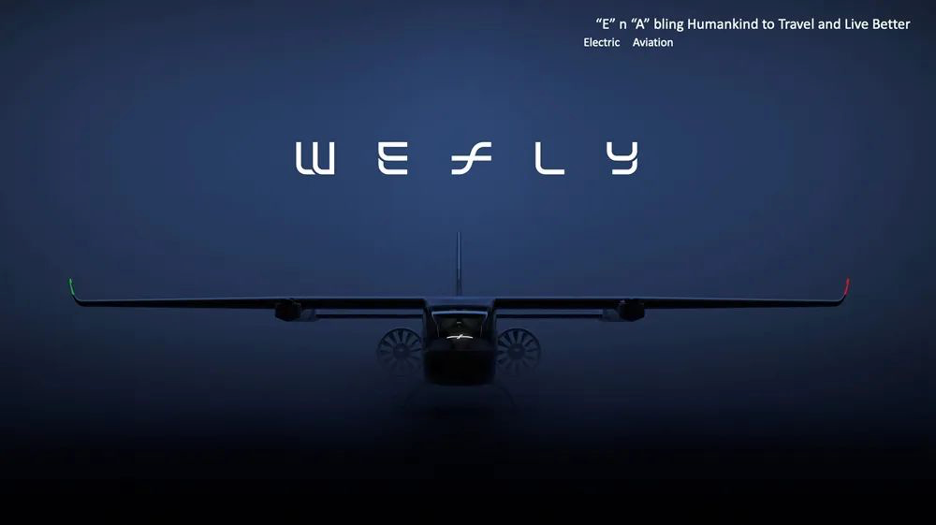
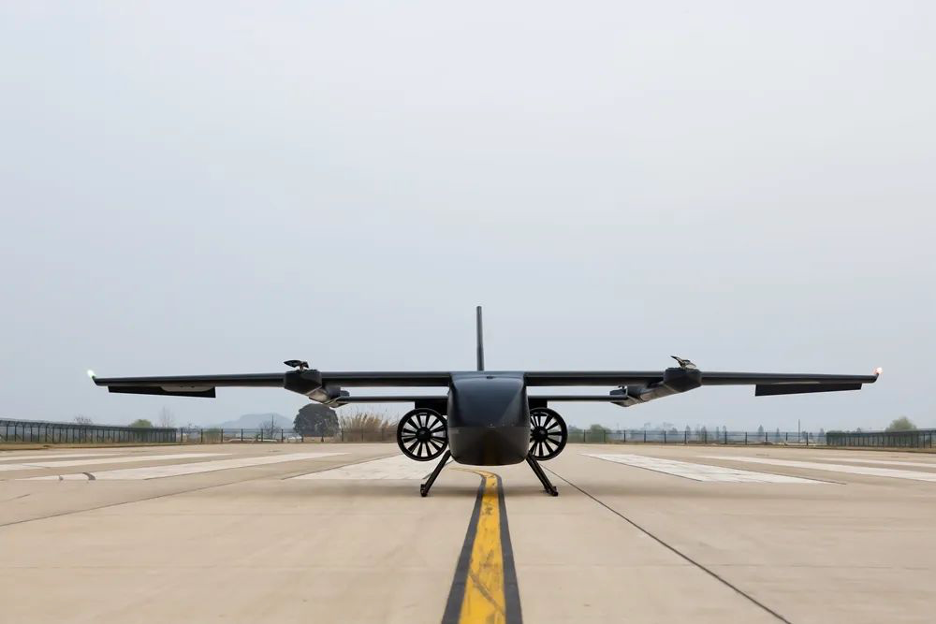
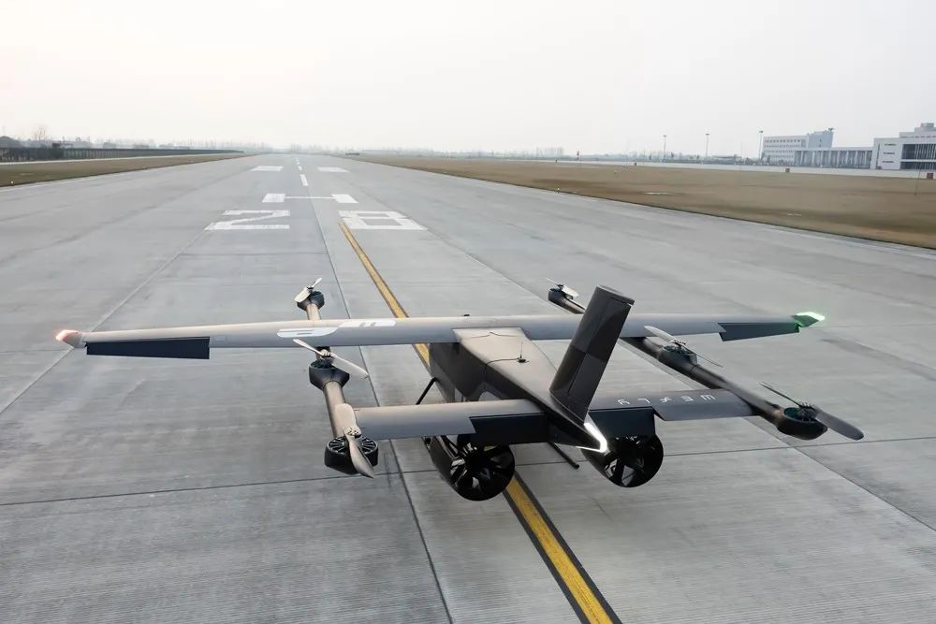
WEFLY technology demonstrator WF-01 (high thrust-to-weight ratio electric ducted fan propulsion and vertical-lift open-rotor compound wing — high-wing and conventional horizontal tail configuration — 100+ km range — 220 km/h cruise speed at 300 m cruise altitude — high-lift-to-drag airfoil and low-noise blade design)
Breakthroughs in Battery Cells and Electric Propulsion Systems
WEFLY understands that aircraft development is a vast and complex systems engineering undertaking, requiring top-level aircraft requirements to be distilled and decomposed hierarchically into major systems — overall design, aerodynamics, structures, propulsion, controls, electrical power, electronics, software — and further down to individual parts, components, electronic elements, or lines of code. Drawing on team members' prior helicopter urban operations experience, and through collaboration with renowned international and domestic transportation research institutions, WEFLY derived urban transportation operational requirements and applied traditional aviation's waterfall requirements decomposition with deep-level excavation. At each requirements level, various methods including experiments and tests are employed for verification, ensuring correctness and completeness.
WEFLY has derived or is in the process of deriving hundreds or even thousands of aviation-related system, subsystem, and component requirements around each top-level requirement, encompassing design, manufacturing, airworthiness, and future operational needs. In this derivation process, the vast majority of aircraft challenges point toward electric propulsion systems (EPS). After selecting a first-generation battery cell with high discharge rate and relatively high energy density, WEFLY conducted trial development and analysis of positive and negative electrode materials, established key technical requirements for battery electrodes, performed six months of flight-mission-related testing and mathematical simulation modeling on multiple cell types, and ultimately completed real-time SOC prediction and battery power system integration. In 2023, WEFLY signed formal cooperation agreements with the Institute of Physics at the Chinese Academy of Sciences and Tianmu Lake Institute of Advanced Energy Storage Technologies to jointly develop cells specifically for eVTOL requirements. This collaboration is progressing steadily and will provide WEFLY with the most reliable foundation for future airworthiness certification, mass production, and operations.
WEFLY has made numerous attempts in electric propulsion systems, including rotor power systems, electric ducted fan power systems, high-power motor control systems, and high-voltage power distribution systems. Many system designs and test apparatuses were independently developed, followed by global supplier assessment and hardware/software customization or even in-house development. From first to second generation system iterations, the company equipped itself with motors, propellers, duct structures, motor rectification structures, and various levels of power test rigs (from sensors to high-voltage power supplies to signal acquisition), achieving comprehensive electric propulsion testing capabilities.
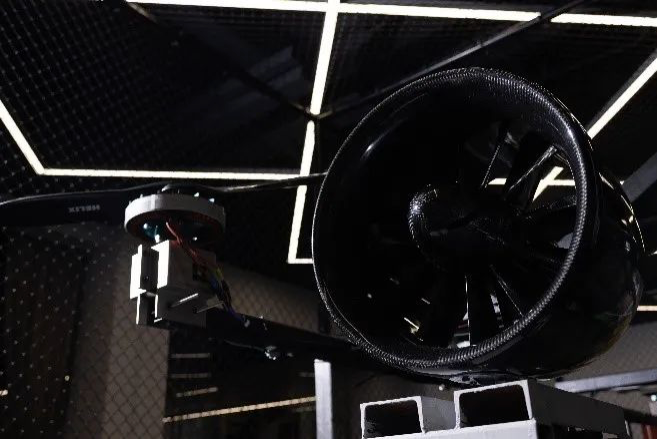
WEFLY electric ducted fan and electric propulsion test rig
Airworthiness Certification Accumulation
From the Wright Brothers' first formal powered flight, modern aviation has advanced for 120 years. Each revolution in propulsion and energy systems has reshaped and elevated the industry, and new energy applications will surely drive another transformation in aviation and airworthiness standards. Looking back, every truly valuable airworthiness standard recognized by the world has emerged from product engineering development and safe aircraft operations — built on accumulated failures and lessons, not pure theory, paper calculations, or so-called "processes." Currently in electric aviation, the FAA, EASA, and CAAC are largely at the same starting line across technical, analytical, testing, and operational phases. China has already surpassed Europe and America in power battery manufacturing and safety data, giving it advantages in electric airworthiness standards. Yet it must be recognized that airworthiness standards must be built around actual application scenarios. WEFLY believes that airworthiness truly tests deep knowledge and absolute understanding of aircraft operating conditions and every aspect of performance — not imitation of external flight functions or shapes, and certainly not rigid application of airworthiness regulations.
In this emerging industry, traditional manned aircraft R&D, flight testing, and operations experience, along with historically grounded risk management mechanisms, will be WEFLY's greatest strengths. Core team members possess firsthand FAA airworthiness experience across various aircraft categories including fixed-wing and rotorcraft (Parts 23, 25, 27, and 29), and experience building effective engineering quality systems from scratch — invaluable intangible assets. Thus from the engineering demonstrator onward, WEFLY has recognized that many key technical verification methods derive from countless system- and subsystem-level tests and accumulated actual flight hours. WEFLY has independently developed and established in Suzhou composite structure testing, high-rate battery cell testing platforms, high-power motor testing platforms, large-load aircraft-level propulsion test rigs, and complete aircraft avionics, flight control, and battery management hardware/software system integration simulation platforms, completing integration and testing from components through subsystems to aircraft level. With strong support from the Liyang municipal government in Changzhou, Jiangsu Province, WEFLY formally signed entry agreements with Tianmu Lake (Changdang Lake) General Airport, and in collaboration with Tianmu Lake Institute of Advanced Energy Storage Technologies and the Institute of Physics at the Chinese Academy of Sciences, is developing dedicated eVTOL application cells centered on the airport and leveraging Liyang's power battery industrial cluster.
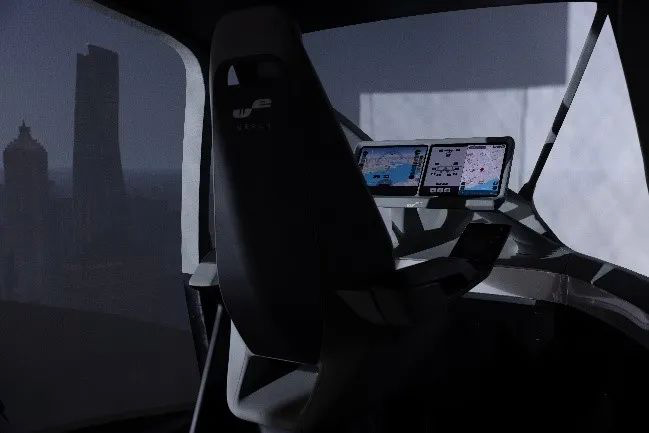
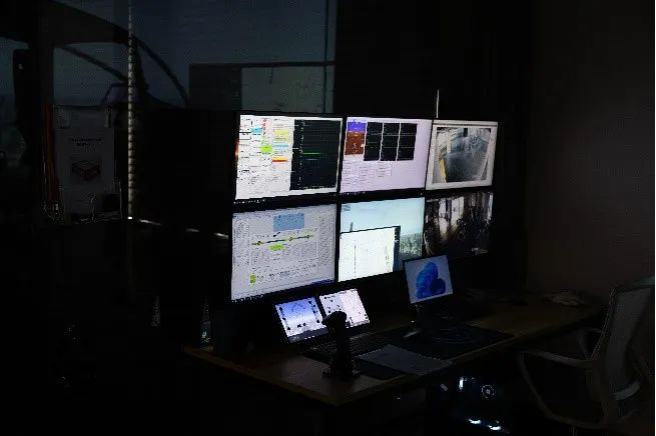
WEFLY-WELAB laboratory, system testing, and aircraft test capabilities
WEFLY Looking Ahead
As emphasized in the China Green Aviation Manufacturing Development Outline (2023-2035), green aviation requires a complete, market-application-oriented industrial chain and system; a multi-enterprise, cross-domain collaborative and efficient innovation mechanism; a multidisciplinary and cross-functional talent pool; and supporting national standards, airworthiness certification, safety supervision, and ground infrastructure systems. We must learn from the experience and lessons of how urban aviation nearly disappeared in the US during the 1970s-80s, while Blue Origin and SpaceX as private space companies flourished alongside national agencies and traditional aerospace enterprises: focus on core competencies, innovate together, strengthen cooperation, compete reasonably, and develop safely.
About WEFLY
We are a tight-knit group of aviation professionals and enthusiasts on an enduring mission to leverage the power of aviation and electrification to revolutionize the way people live their lives by building a global urban air mobility (UAM) company with Chinese roots. We design, manufacture, and operate a fleet of purposely built distributed electric propulsion vertical takeoff and landing (eVTOL) aircraft to serve this massive global trillion-dollar market. At WEFLY, our ultimate goal is to create a new urban mobility platform in the sky. We want to add one more dimension (3D) to everyone's daily mode of transportation. This will change our life fundamentally.
We are a tight knit group of aviation professionals and enthusiasts on an enduring mission to leverage the power of aviation and electrification to revolutionize the way people live their lives by building a global urban air mobility (UAM) company with Chinese roots. We design, manufacture, and operate a fleet of purposely built Distributed Electric Propulsion Vertical Takeoff and Landing (eVTOL) aircraft to serve this massive global trillion-dollar market. At WEFLY, our ultimate goal is to create a new urban mobility platform in the sky. We want to add one more dimension (3D) to everyone's daily mode of transportation. This will change our life fundamentally.
Contact: hello@wefly.ai (Images in this article are copyrighted by WEFLY)
About Linear Capital
Linear Capital is an early-stage investment firm focused on "frontier technology + industry," covering frontier technologies such as data intelligence, digital new infrastructure, next-generation robotics, and new technological transformations in traditional sectors (including biomedicine, materials, and energy), applied across vertical industries to substantially improve efficiency, address pain points, and enable industrial upgrading — achieving outsized commercial returns through significant industrial value creation. The firm currently manages ten funds with total assets under management of approximately $2 billion.
Our investment stage focuses primarily on leading angel to Series A rounds, with typical investment amounts of $3–8 million or RMB equivalent per project.
To date, we have made early-stage investments in over 120 entrepreneurial teams including Horizon Robotics, Kujiale, Sensors Data, Tezign, Rokid, Guandata, and Agile Robots. The combined valuation of Linear Capital's portfolio companies is approximately $20 billion.
In the near term, Linear Capital is working to become the premier Data Intelligence Technology Fund, and over the long term aims to build itself into the most influential Frontier Technology Application Fund.