Interview with Final Round Founder Michael: How AI Is Disrupting Traditional Recruitment | 100 Questions on AI Applications

Help users find work they truly love.
"AI Applications: 100 Questions" is an interview series launched by Linear Capital focused on the development and trends of AI applications. We invite AI application entrepreneurs — they may be founders of Linear Capital's portfolio companies, or friends of Linear Capital — to discuss current AI application topics and progress through their startup stories or personal reflections on the industry. We hope these interviews provide useful reference for more friends who care about AI applications.
For this edition, we invited Michael Guan, founder of Final Round, to share the story of founding Final Round, the process of developing an interview AI Copilot, his vision for the future of interviews, and his observations and thoughts on AI application development in Silicon Valley.
Part.01 Why you?
1. Linear Capital: Please briefly introduce yourself, what Final Round is, and what problem your product solves.
Michael: I'm Michael Guan, CEO and co-founder of Final Round. After dropping out of Yale SOM, my co-founder Jay and I started building a series of AI tools in the summer of 2023 to help job seekers find their dream jobs faster, simpler, and better with AI assistance.
Our core product is called Interview Copilot. It's like a magical teleprompter that gives users real-time talking points to help them perform better in interviews and present their best selves to interviewers.
2. Linear Capital: What was the catalyst for choosing this product?
Michael: There were several signals. First, the GPT-3 experience blew me away. The moment the first token came out, I felt this was a qualitative leap in AI that everyday consumers could actually access. My first full-time job was at a company building AI data products — Meta, for example, uses AI and ML algorithms for search ranking. But these advanced AI products are usually inaccessible to ordinary people. GPT brought that "wow moment" to many people.
The second point was the speed improvement. From GPT-3 to GPT-3.5, not only did quality jump a level, but speed increased dramatically too. In my previous AI product work, we often talked about "real-time streaming." Traditional data analytics required an ETL (Extract, Transform, and Load) process — pulling data out, cleaning it, then analyzing it, with cycles measured in weeks, months, or even quarters. But when platforms like Snowflake emerged, data analytics became real-time. Nike's sales data in Hong Kong could be pulled instantly by analysts at U.S. headquarters and shared with colleagues in Europe.
GPT-3.5 was fast enough that ordinary users couldn't perceive the latency. This kind of speed is particularly suited for scenarios requiring real-time response, and GPT-3.5's speed met that need exactly, further expanding its application scenarios.
Additionally, I saw many opportunities. At the time, everyone was focused on infrastructure, on middleware technologies — giving AI longer memory, stronger capabilities, even challenging math olympiad problems. But at hackathons, I noticed many people were more focused on practical AI application scenarios, and their enthusiasm was high. For example, we built an AI social app where everyone had an avatar, chatting online for seven days before generating a compatibility report to decide whether to proceed to real human conversation. These practical application scenarios seemed particularly interesting to me.
These interesting elements, combined with AI's "wow moment," could genuinely move many users. When the App Store first launched, everyone was scrambling to develop their own apps. The development process hadn't been systematized yet — it was an "exciting moment" phase. Later, when major companies started releasing apps en masse, it became much harder for grassroots teams to explore simple apps. However, when I saw 3-4 person teams at hackathons using AI to mine new scenarios, that passion and creativity made me want to participate too, to build something truly exciting.
The third point was the AI scenarios in Iron Man. His mask could tell Iron Man in real-time what to do next, how to interact with people, and even pull up background information on whoever he was talking to. This concept was incredibly compelling, so we tried to implement similar functionality through GPT, developing a simple product that could help users in real-time during conversations.
In fact, many powerful application scenarios have already been validated by various movies. Take online dating, for example — AI could guide users in real-time on how to communicate with their dating matches. Some teams are building similar products now, not necessarily in video form but perhaps playing a copilot role within apps like Tinder. The second scenario is work meetings — when the boss suddenly asks a question, can AI help me respond quickly and even optimize my answer? We saw potential there too and experimented with it. Sales represents another huge opportunity — Gong in the U.S. provides pre-meeting preparation and post-meeting summaries for sales teams. We wondered: could AI provide real-time conversation strategy during the meeting itself, rather than reviewing afterward? We tried developing this kind of real-time support tool and saw positive user response.
After experimentation and convergence, we settled on the recruiting scenario. One reason was our team's background included substantial interview experience; another was that user feedback gave us strong positive reinforcement, making us feel this was an exciting direction well-suited to our team.
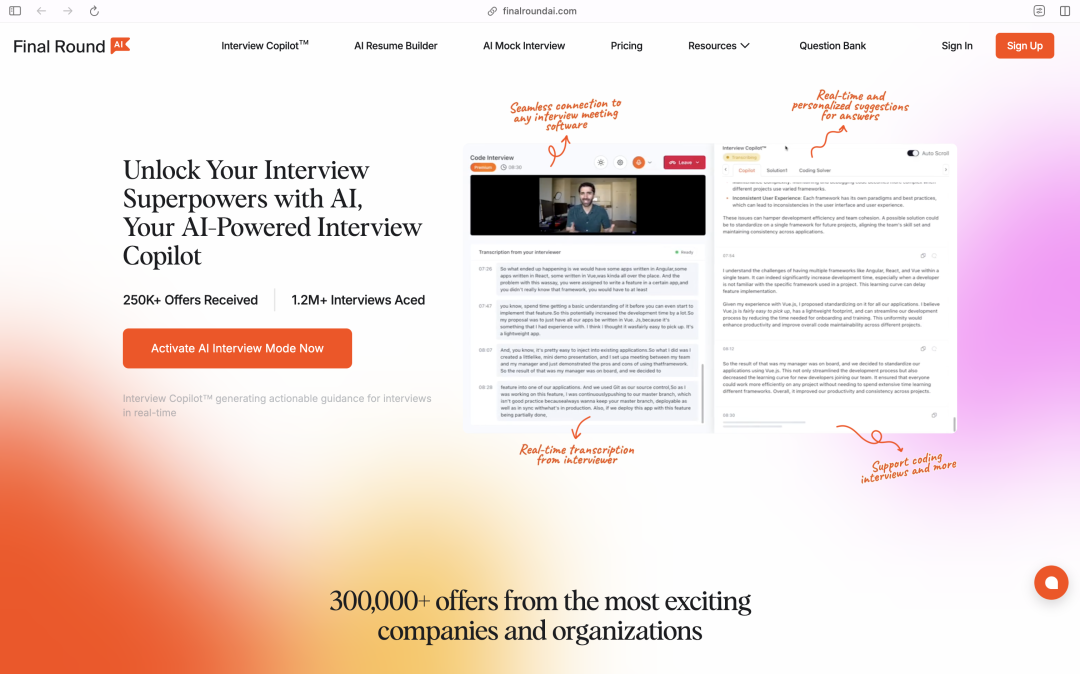 Image: Final Round official website
3. Linear Capital: What personal experiences directly relate to building a product in the recruiting domain?
Michael: Speaking from my own interview experience, when I was in business school I noticed that many classmates preparing for challenging interviews at places like McKinsey or investment banks would cover their computer screens with yellow sticky notes, writing case frameworks and talking points on them. Some who didn't want to handwrite would simply use Word documents as cheat sheets. Later we heard from one user: "Presidents and celebrities use teleprompters for speeches, so why can't ordinary people use them too?" This got us thinking about how to design an intuitive, efficient teleprompter that would feel natural and easy to use. So we kept optimizing the user experience and tried many different scenarios. Including in mock interview scenarios, where we had AI avatars interact with users. Most products on the market currently still use audio or text-only approaches. Although developing AI avatars is very costly, we still decided to do it because it provides users with a more authentic experience. This is the value we want to deliver through our product, so we had to invest substantial R&D resources to achieve it.
We released several functional applications for different scenarios and uploaded them to YouTube, gaining early attention. The interview scenario in particular received considerable attention. Traffic grew entirely organically, and users showed tremendous interest in the functionality for this scenario. This gave us direct, intuitive sense of consumer enthusiasm for this domain.
The second thing is that we communicate one-on-one with users. I set up a Google Meet link and stay online during work hours — any user can reach me through this link to give feedback. Through these conversations, I gain deeper understanding of user profiles, pain points, and needs, enabling me to iterate the product and optimize user experience more effectively.
4. Linear Capital: What major inflection points has the product gone through during its development? What happened at each?
Michael: The first inflection point was launching different business scenarios and ultimately deciding to focus on interviews. The second was deciding to start charging. Many people advised us to prioritize user growth first and worry about monetization later. But we believed charging was a way to validate market demand — especially in AI applications where costs are relatively high. Whether users are willing to pay reflects whether the product has found product-market fit. Through paying users' feedback, we could more clearly understand market size and potential. The third important inflection point was gaining the confidence to continue developing this market.
The fourth inflection point came when users shared their joy at receiving offer letters — we realized the product had created genuine value for users, and we could clearly see what future iteration directions should look like.
Mock interviews are the core direction where we've invested heavily in optimization. In earlier versions, it was just a person smiling continuously. Now our AI virtual human can actually move — not just gesticulate, but demonstrate more professional knowledge, and even interrupt users during conversation to simulate more realistic interview scenarios. Most interview simulation tools on the market are basically text plus voice, but our product achieves deeper interaction, like normal human-to-human conversation. For example, say you're preparing for an interview at Tesla — we can arrange for you to have a conversation with a virtual Elon Musk. This unprecedented experience can greatly reduce users' fear of interviews; after all, you've already "chatted" with the big boss.
But the challenges are: first, virtual human technology itself is still very new, and many companies haven't developed truly interactive AI interviewers. Second, achieving natural, fluid interaction is also a major difficulty. Most AI interview tools on the market tend to be simple question-and-answer formats. But real interviews are far more complex — interviewers may interrupt you, ask follow-up questions, or even let long silences stretch out. We have to simulate these situations through AI virtual humans, constantly "challenging" users to help them better prepare for the uncertainties in interviews.
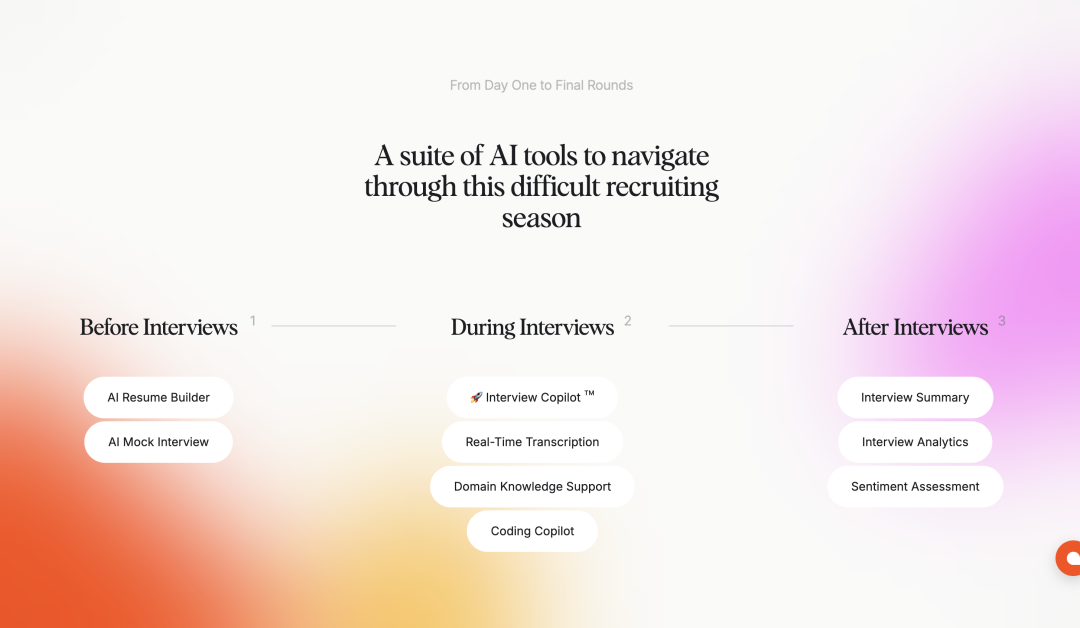
Image: Final Round product features
Part.02
Building Consumer-Facing Products
5. Linear Capital: A lot of the hiring-related products we've heard about are B2B. Why did you choose to go the consumer route? You mentioned AI avatars are expensive — did AI bring down R&D costs?
Michael: First off, it's not that AI development dramatically lowered costs. We simply want to give users the best possible experience by applying the most cutting-edge AI technology. Compared to existing products on the market that focus on text-based Q&A or simple video recording — which could also be sold to businesses — we deliberately didn't go that route. We wanted to deliver that "wow moment" of AI directly to users.
Why we chose the C-end path over B2B comes down to team DNA. As a young team, we like building products that excite us. And products that excite us tend to generate organic traffic, which helped enormously during our cold start. We did some solid promotion on LinkedIn, where people's feeds are usually pretty dull. Suddenly they see something like Final Round AI — it's interesting, and it naturally grabs attention.
Of course, the B2B opportunity is always there. Enterprise demand is clear, and the window is longer. We're actually exploring some corporate partnerships. Quite a few companies have reached out proactively after seeing our product. I think there are many angles for collaboration. In the long run, B2B will be a great complement.
6. Linear Capital: Could you briefly walk through the journey from deciding to change jobs to completing interviews — which Final Round products and features serve users at each stage?
Michael: First, from the job search phase. Compared to other regions, the North American job market is more traditional and tool-driven. People mainly find openings through various job boards. For each position, candidates need to upload tailored resumes and cover letters and apply separately on company websites. This model is completely different from how recruiting works in China, where platforms like BOSS Zhipin let you apply to multiple jobs with one resume.
What we do is use AI to help users quickly generate customized resumes and cover letters for specific positions. Cover letters have been around for ages, but plenty of people still don't know how to write a good one. Our product uses AI to complete this process in about ten seconds. What used to take an hour per application now takes maybe two minutes.
At the resume screening stage, roughly 98% of North American companies currently use ATS (Applicant Tracking Systems) for initial filtering. These systems use traditional AI and ML to analyze keywords, match scores, and so on. Less than 2% of resumes actually make it to HR. Nowadays, using AI to optimize your resume is essential if you want a real shot at being seen.
Finally, once you land the interview, we provide AI-powered mock interviews. We've invested significant resources developing our AI Avatar system, which can simulate both Behavioral Interviews and Technical Interviews. Whether you're a product manager, consultant, banker, software engineer, or in another specialized field, we have matching mock interviews.
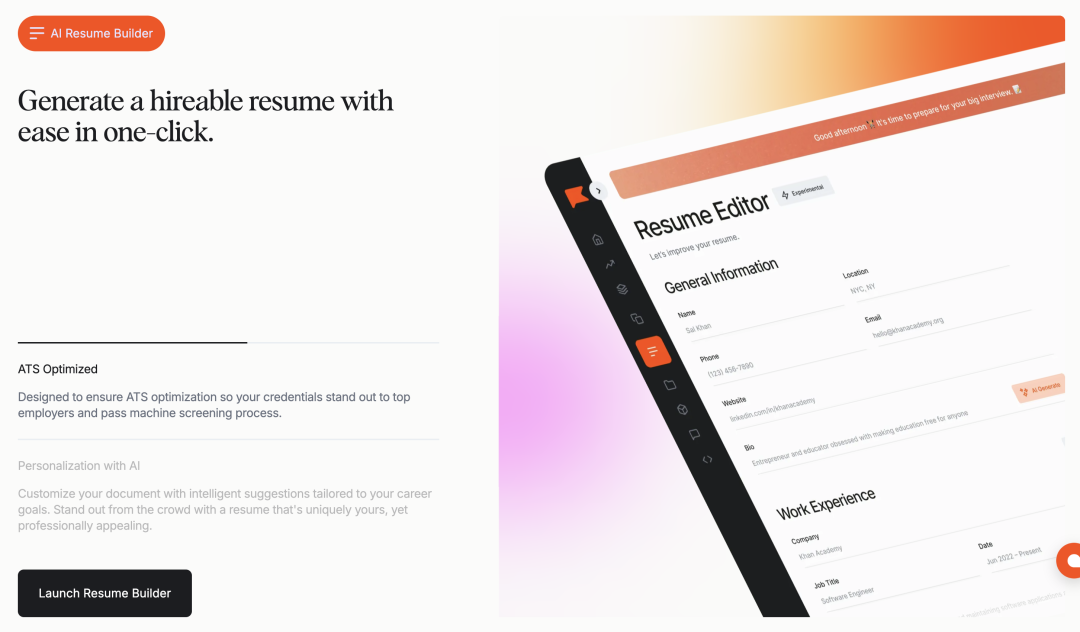 Image: Final Round product features
7. Linear Capital: Based on your data, which fields use it most? Do recruiters or headhunters mind if candidates use copilot-style products during interviews?
Michael: Currently in traditional industries — consulting, banking, product development roles in tech, common corporate functions in the US, sales positions — AI technology adoption is already quite widespread. I think AI is highly inclusive and can adapt to users from all backgrounds, helping them leverage their strengths in different domains.
For the interview itself, our Interview Copilot provides real-time bullet points to help users better recall specific experiences. This is especially valuable for excellent engineers or product managers who've been working for years but struggle to communicate effectively. Through real-time prompts, we help them organize their thoughts and present their best selves, addressing communication gaps and improving interview performance.
Right now this technology is entirely user-side; recruiters aren't directly involved. We've heard varied feedback about whether recruiters might object. I think first, AI's disruptive nature inevitably challenges the status quo. Some people are fine with AI-written emails; others find them bloated and terrible. It comes down to different understandings of the tool. Some HR folks feel using AI violates traditional norms, while many others see it as innovation that significantly boosts efficiency and helps candidates showcase their best. Some accept it, some don't. But AI is like an industrial revolution — it can't be stopped.
Part.03
User Stories
8. Linear Capital: You mentioned on a podcast that many Final Round users have 5-10 years of work experience. Why is that? What's distinctive about their needs? How do you analyze demand across different career stages, and how do you plan to expand your user base?
Michael: Mainly because existing tools don't meet their needs. Fresh graduates have schools teaching them how to write resumes, and entry-level positions typically have lower bars and less difficulty. But for someone with five to ten years of experience, finding a truly fitting role is much harder. Opportunities are relatively scarcer, and who can mentor them? Probably only people with ten-plus years in the field, more senior and more established. But that support is costly — an interview coach might charge two or three hundred dollars an hour or more. And the result is likely just hearing encouragement: "You're amazing, you've got this!" The actual help may be limited. With AI it's completely different. When writing resumes, for instance, AI can objectively and rationally analyze how your resume differs from others and where the gaps are against job requirements. It precisely pinpoints those differences and tells you how to adjust and optimize. The productivity gain is incomparable.
Early on, we organically discovered a core user base. Now our coverage is quite broad — from students still in college looking for internships to people with ten-plus years of experience seeking career advancement.
What's remarkable about AI is its adaptability. We don't need heavy customization for each industry to cover different user groups. For example, previously video editing software might have separate tools for film, animation, 3D effects. Now with AI, one simple piece of software covers all scenarios. The same applies to job platforms — you no longer need one specifically for finance, another specifically for software engineers. We're now a general-purpose job platform that works for any industry. Before, each industry had its own circles — consulting forums, finance forums, each with their own knowledge bases. Now AI can practically break down barriers between industries and penetrate deeply into most of them.
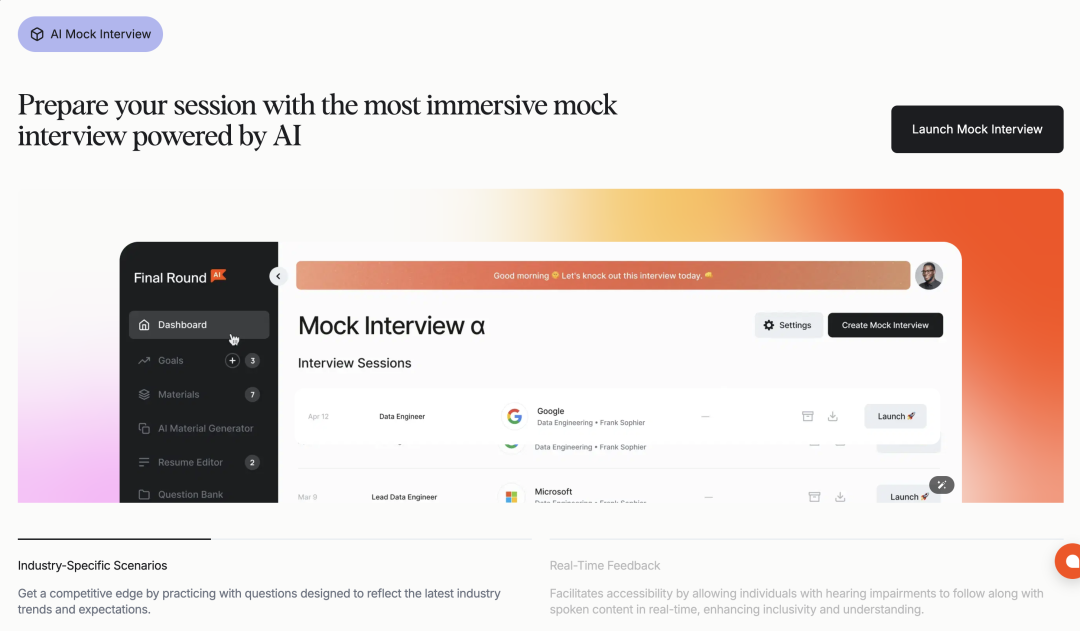
Image: Final Round product features
9. Linear Capital: Could you share some user stories? Cases where someone got good results using Final Round — any that left a particularly strong impression?
Michael: The most impressive story involves a user interviewing for a CTO position with total compensation already at $1.5 million. Using our product, he advanced through multiple rounds and landed the CTO role with a total package four to five times higher. He shared his offer letter with us — we were pretty stunned ourselves. This proves our product performs well not just in technically demanding interviews, but also in pursuing senior positions. We have many cases of users landing $200K+ annual salaries across software development, finance, consulting, and other fields.
We can quickly provide users with conversational frameworks and problem-solving approaches during interviews. Many people freeze up under pressure and struggle to express themselves. Final Round uses AI to rapidly give them direction and clear suggestions. This lets users show their best selves and respond flexibly. But this isn't about simply "reading off a script." It's more like a US president with a teleprompter — you don't feel like they're reading. They can improvise or rely on prompts, but the copilot always delivers crucial help at key moments.
Anyone without professional training will, to some degree, struggle to speak fluently due to nerves or unfamiliar settings. Most of our users are from Europe and America. Many have told us that while the US does train public speaking in schools, it doesn't mean people are actually that much better at it. Especially with new scenarios like online communication, many still find it challenging.
Part.04
The Future of Interviewing
10. Linear Capital: In your view, how will AI shape the future of interviewing?
Michael: I think in five years, we might not have interviews in the traditional sense at all. People will probably find and match with jobs through far more efficient methods. The interview will become the final step in the matching process. In two or three years, we might see AI interviewers talking directly to AI interviewees. When AGI matures, you'll just scan your background information and get matched to the most suitable job — no conversation needed. By then, everyone will likely have a much more powerful AI assistant. And in ten years, with technologies like Neuralink, people might have chips implanted in their brains. Everyone becomes equal, and human competition shifts to who has the better chip. Maybe I'm running V3 and you're on V4 — your version is more advanced, so your intelligence and capabilities outrank mine. I think this is a scenario we'll see sooner than we expect.
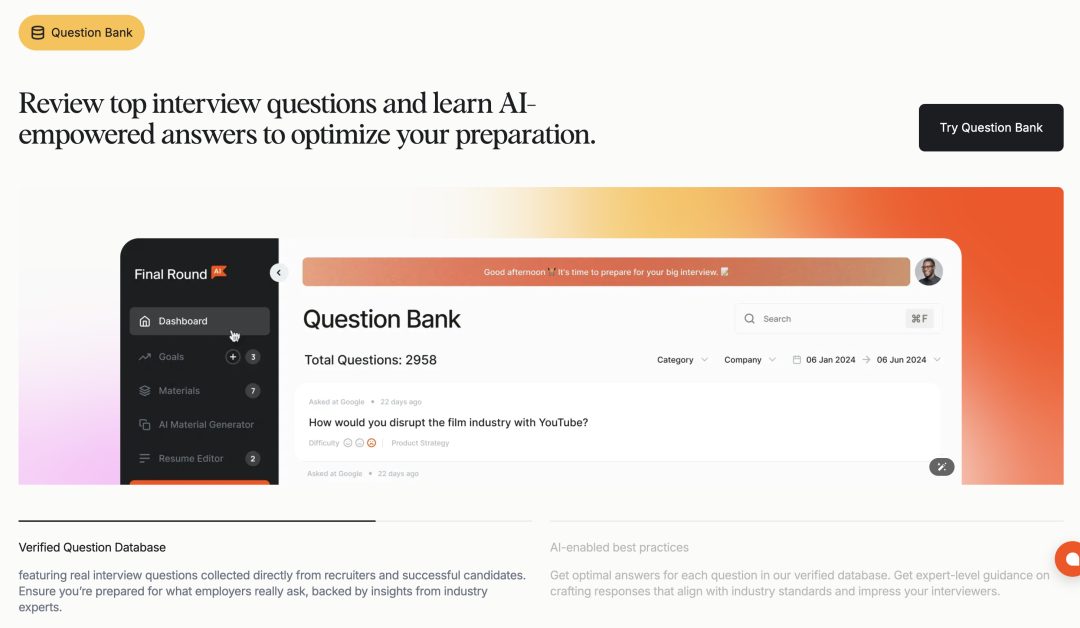 Image: Final Round product features
11. Linear Capital: Have you noticed any cutting-edge recruiting approaches in Silicon Valley that haven't caught on in China yet?
Michael: There are some really interesting new recruiting methods emerging. For example, there's a company called Mercor. Candidates do one interview on the platform, and the recruiter only watches that video — no resume, no background check. They decide whether to move forward based on that single video. It's a radical departure from the cold, one-dimensional paper resume. You're seeing the person's actual performance, which is much more holistic.
Another approach is even more interesting: skip the resume entirely and have people do projects. Companies like Telegram are typical of this. They give candidates a hackathon-style project with a deadline. Recruiters don't look at backgrounds at all. Everyone starts from the same line, and whoever performs best gets the job. This actually makes a lot of sense, because resumes can look very similar. However polished they are, they don't tell the full story. Let the project speak for itself — look at the output. That's real capability.
When we hire, we also focus heavily on this "actual output" ability. For instance, we ask candidates how they use AI in their daily work, how they use these tools to debug or brainstorm. If I have two candidates — one is a traditionally strong performer, the other has slightly weaker fundamentals but can leverage AI tools to become ten times more efficient — I'll definitely pick the latter. Because nobody writes from scratch anymore. Everyone's looking things up. What matters is who can deliver products faster. That's the hard metric.
Part.05
The Future of AI Applications
12. Linear Capital: There's a saying in the industry that people expected AI applications to explode in 2024, but the market response seems relatively muted so far. What are your observations on the current state and future prospects of AI applications?
Michael: At this point, AI applications haven't hit the expected inflection point. Personally, I don't think the timing is right yet. Many users haven't actually engaged with AI at all. A lot of people don't even know what ChatGPT is. In startup circles and Silicon Valley, everyone's talking about AI. But when you go to middle America or traditional enterprises, while many have heard of ChatGPT, they haven't actually used it, or they dismiss it. Many are still stuck in stereotypes, seeing it as just another emerging technology. They've been in their positions for a long time, their current workflow works fine, so why bother with new tools? But they haven't realized that these new tools, especially AI, could bring disruptive change.
From a market adoption perspective, AI productivity hasn't reached massive scale yet. From a product explosion perspective, I think 2025 is when the opportunity comes. Because when people talk about AI applications, many B2B areas are still in the exploratory phase — legal AI, sales AI, and so on. YC once considered exploring some B2C applications, but in their latest batch, B2B applications still accounted for over 50%. This isn't like the early internet days when there was universal consensus that every business scenario needed an app. I think true mass adoption will come after these applications mature.
Right now, many AI applications are still modifications of traditional SaaS products. Salesforce + AI, Google Docs + AI — these add AI to existing traditional products, like search features or chat functions. These aren't AI-native scenarios. In contrast, ChatGPT is a native AI scenario. Even though Perplexity has AI, it's essentially an optimized version of traditional search, just more efficient. I think AI still needs native scenarios that can seamlessly integrate into our daily lives, like WeChat.
In Silicon Valley now, there are many very promising native AI products. They're still early-stage, but they feel hopeful. For example, there's a product called SocialAI. After you log in and post something, hundreds or thousands of people comment, like, and follow you, letting everyone experience what it's like to be a superstar. This is what I consider a more AI-native product. Also, our own product is a native AI application. There are also virtual idol products, like Miquela, a virtual character who's hugely popular on Spotify and Instagram with 3 million followers, and many brands are collaborating with her. This is purely AI-created content.
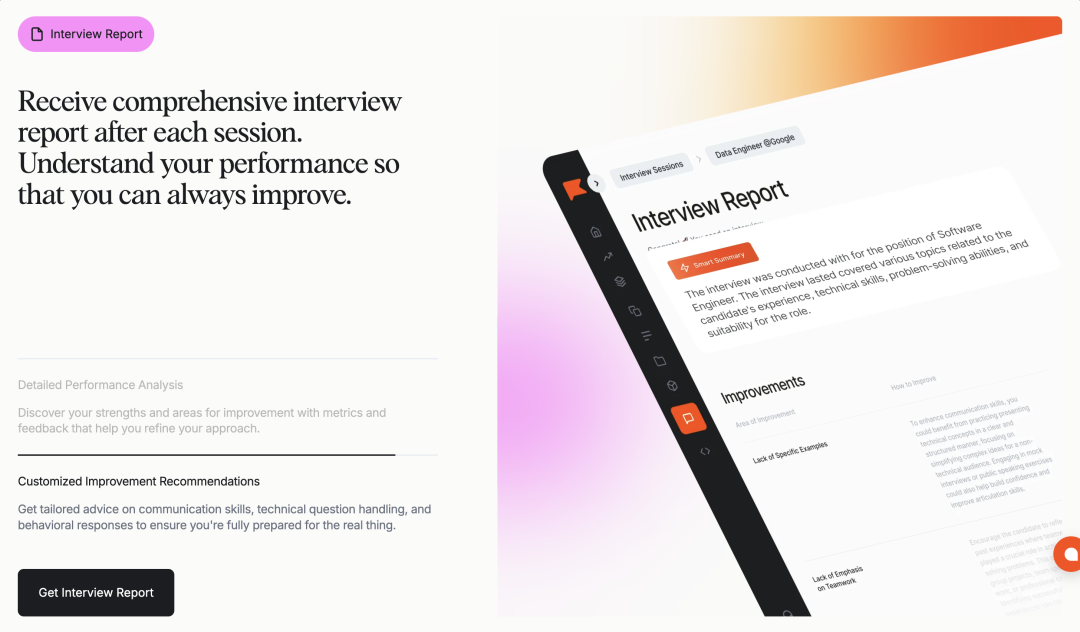
Image: Final Round product features
13. Linear Capital: Regarding AI applications, what are the entrepreneurs around you most concerned about?
Michael: The first question is when GPT-5 will be released. Whenever a new GPT version drops, the previous one accidentally gets "killed off." So people are very cautious about GPT-5's release. Especially many early AI companies — say, those adding memory or contextual association to improve GPT-3.5's performance. When GPT-4 came out, those efforts were basically rendered obsolete. So what will GPT-5 look like? Which companies will it impact, and which might it eliminate? These questions don't have clear answers yet.
The second question is customer acquisition, which is a very practical challenge. Many AI companies still use traditional methods for customer acquisition. Either they hire salespeople, or they try to create viral moments on social media, or they buy traffic and push ads. They haven't adopted truly AI-native ways to acquire customers — they still rely on traditional business development. I actually find this somewhat disappointing. Many companies call themselves AI SDR (Sales Development Representative) companies, claiming they can generate sales leads through AI, but in the end they hire thousands of sales consultants and still sell AI products the old-fashioned way. This makes me feel like the industry might still be at an inflection point.
14. Linear Capital: How has the funding landscape in Silicon Valley's AI space changed this past year?
Michael: Personally, I feel like attitudes toward AI have shifted from initially focusing on AI infrastructure, to middleware, and now more toward AI applications. People's ideology and expectations for the future keep evolving.
At the beginning, when GPT-4 was released, many people weren't optimistic about AI applications, believing true AGI was still decades away. And then it seemed like we discovered that AI applications actually matter. Although many AI applications appeared to lack strong moats, it gradually became clear that these moats aren't impossible to build. Slowly they form. For example, why can some legal AI products partner with major law firms while GPT systems can't? This shows that AI moats do exist, and many traditional domain constraints still limit these AI companies' development.
15. Linear Capital: What are your predictions for AI applications in 2025?
Michael: AI will definitely become more widespread, covering more ground, with fiercer competition and gradually lower barriers to entry. As I mentioned earlier, many ordinary Americans don't know what ChatGPT is. OpenAI hasn't run massive advertising campaigns. Walk through some average American cities, and billboards still show traditional consumer goods ads, or gaming and social platform ads — nothing about AI. Without going through these channels, AI struggles to enter ordinary people's daily lives. You wouldn't see someone pitching ChatGPT in a TV commercial. So I believe 2025 will bring a major opportunity for large-scale AI adoption and acceptance. Some middle-aged and older demographics might start using ChatGPT — maybe that will be when true popularization happens.
📮 Further Reading


Linear Bolt is Linear Capital's dedicated investment program for early-stage, global-market-facing AI applications. It upholds Linear's investment philosophy, focusing on projects where technology drives transformative change, and aims to help founders find the shortest path to their goals — whether in speed of execution or investment mechanics. Bolt's commitment is to be lighter, faster, and more flexible. In the first half of 2024, Bolt invested in seven AI application projects including Final Round, Xin Guang, Cathoven, Xbuddy, and Midreal.