From PhD to "Foreman": Building a Robot Bricklayer, Paid for by Middle Eastern Tycoons | Linear Capital Portfolio Company

One robot replaces ten skilled workers, with efficiency up 14-fold
By Li Xiaomei
Edited by Liu Hengtao
On January 20, at Dubai Marina, a massive residential tower was under construction. This is the 122-story ultra-luxury residential building planned by Six Senses Hotels, which upon completion will surpass New York's 472-meter Central Park Tower to become the world's tallest residential building.
On the construction site, robots from China's Weijian Technology were steadily applying mortar to the walls. This was the first product acceptance day for Weijian Technology. Amid the tense atmosphere of delivery, one plastering robot completed 26 square meters of plastering in just 24 minutes — the workload of a skilled worker's half-day.
When the client inspected the work, they found that wall flatness, verticality, and plastering uniformity all met or exceeded industry standards.
The successful completion of the first UAE client acceptance for the plastering robot excited everyone at Weijian Technology, meaning the company's robots had reached top-tier delivery standards for the Middle Eastern market.
In the plastering scenario, Weijian Technology's robots are far ahead of the competition. Public data shows that while China has over 850 construction robotics-related companies, Weijian Technology — with a team of just over 100 people — is the only company in the industry to successfully commercialize plastering robots.
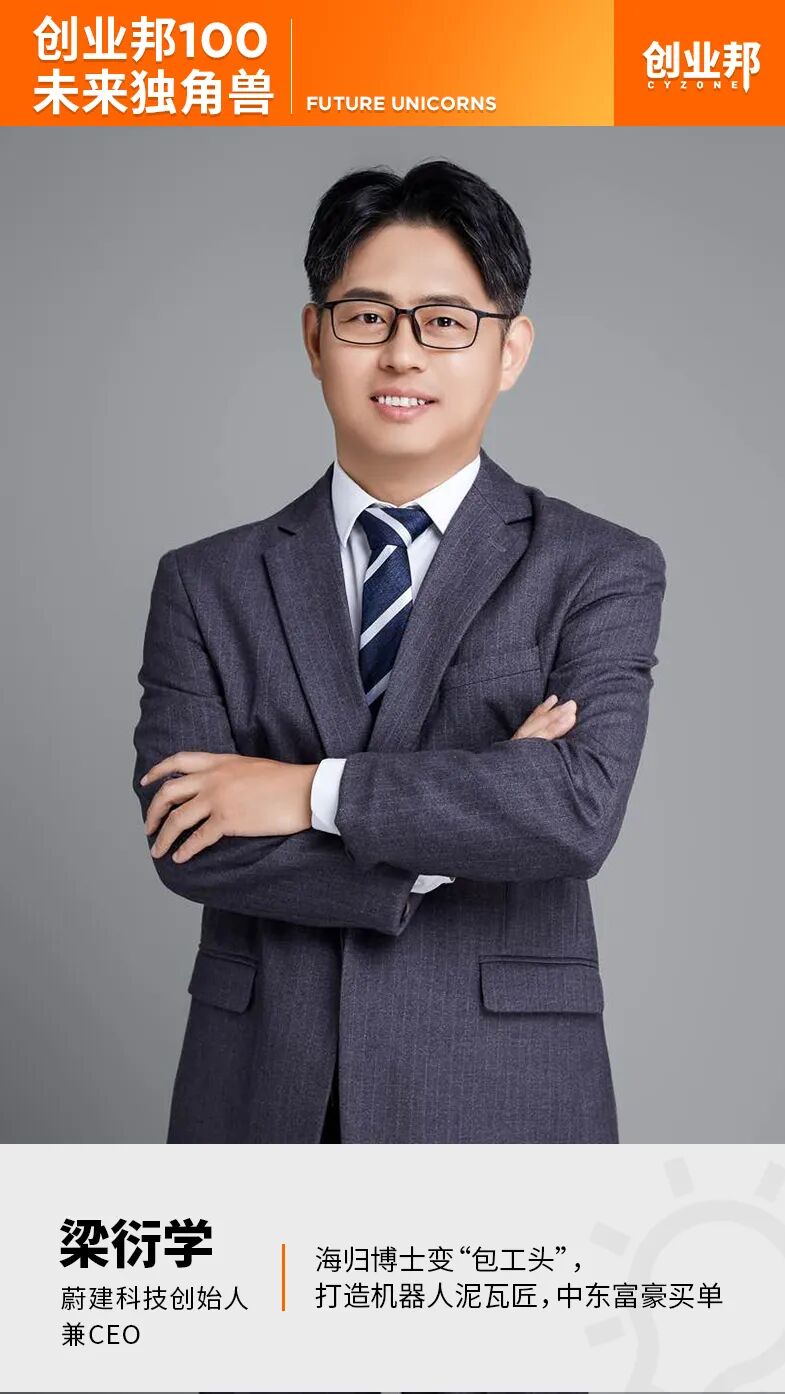
"Some industries currently in operation can be reshaped with existing technology, and construction is one of them," said Yanxue Liang, founder and CEO of Weijian Technology.

Targeting the Most Expensive Process on Site, Building Robots That "Actually Work"
Liang traces his roots to Shandong province. He earned his bachelor's and master's degrees from Shanghai Jiao Tong University's School of Mechanical Engineering, then completed his PhD at Tokyo Institute of Technology in 2006. After graduation, he joined FANUC, one of the "big four" robotics families. At FANUC, Liang became a chief researcher in just four and a half years.
During his decade at FANUC, Liang witnessed the rise and fall of industrial robots represented by robotic arms. He believed that in Japan, traditional industrial robots had entered the second half of competition, while China's robotics industry was still booming. So he chose to return home.
After returning, Liang first worked on equipment localization at CATL. In 2018, on the eve of CATL's IPO, Liang left to join the newly formed Bozhilin Robotics.
"I still wanted to do something more interesting, like robots that can actually walk and work," Liang said.
Bozhilin Robotics was a wholly-owned subsidiary of Country Garden and an early benchmark in China's construction robotics space, highly regarded by Country Garden founder Guoqiang Yang. Liang served as executive vice president of the intelligent technology research institute and was among Bozhilin's core personnel.
A year later, Liang left Bozhilin Robotics and fell into a period of uncertainty. At this point, Songyan Huang, partner at Linear Capital, reached out to Liang. Huang, who was investing in robotics at the time, believed force-controlled intelligent robots represented a technological innovation direction that could bring major transformation. Huang had originally sought out Liang to learn about the industry, but after hearing Liang discuss the development and applications of construction robots, he immediately recognized this as a massive market.
Due to population aging, using robots to fill the gap left by construction workers and improve industrial efficiency is becoming a major trend in the construction industry. This is also a blue ocean market. ABB Robotics once conducted a survey showing that as of 2021, only 55% of construction companies globally had adopted robotics technology. In the automotive and manufacturing industries, this figure was as high as 84% and 79% respectively. Compared to other industries, construction robot penetration remains very low.
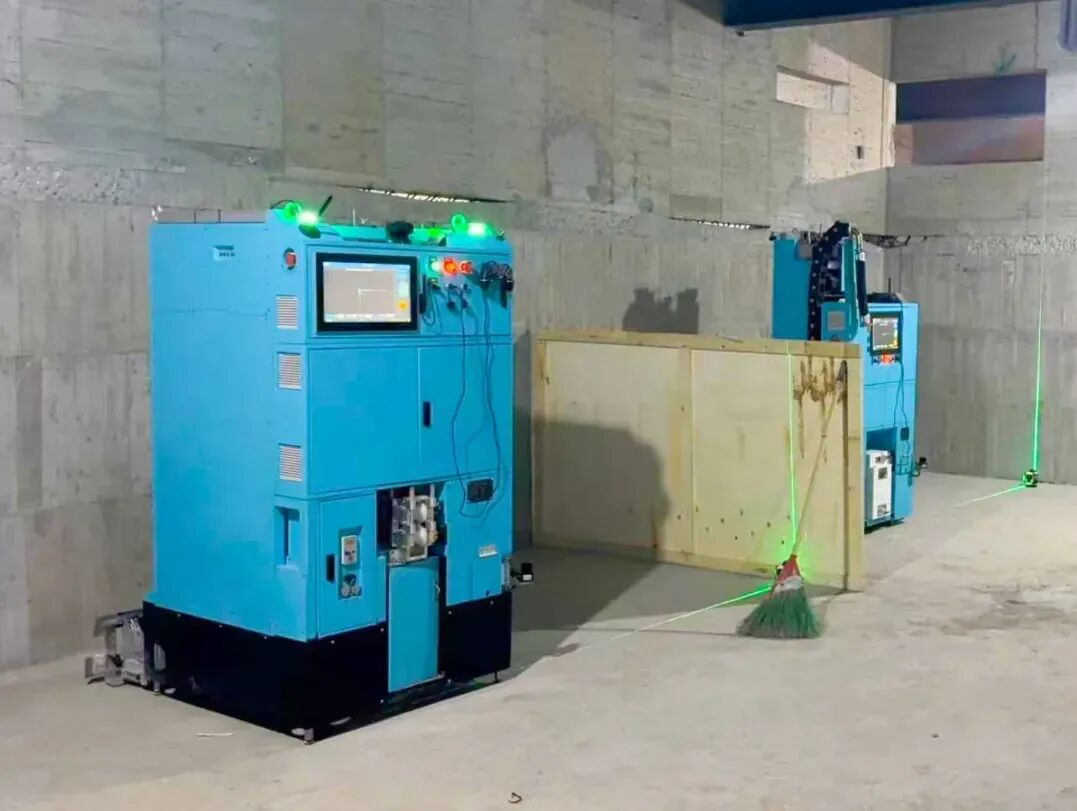
Plastering robot at work
With Huang's support and encouragement, Liang founded Weijian Technology in Shanghai's Baoshan district in 2020.
Construction robotics encompasses numerous subcategories. Divided by material processing, construction, operation and maintenance, and demolition scenarios, there are more than a dozen types including building material processing robots, plastering robots, bricklaying robots, construction monitoring robots, and demolition robots.
Which subcategory to enter first became Liang's immediate consideration.
Over a decade of deep involvement in the robotics industry had given Liang a "professional habit": viewing every process in construction through the lens of robotic substitution. Meanwhile, his FANUC experience made him realize that he had to build robots with genuine craftsmanship that "can actually work," or he would quickly enter red ocean competition.
"Robots shouldn't compete with humans for jobs. We should do what humans aren't good at. Working against gravity, physically exhausting tasks, or jobs requiring precision or craftsmanship — these are where human efficiency drops sharply. Plastering is a perfect example, and it's a process well-suited for robotic substitution," Liang said.
Construction plastering involves evenly applying cement mortar, mixed mortar, or lime mortar to wall surfaces. Mortar is heavy, and working on vertical surfaces requires overcoming gravity, demanding far more physical effort than horizontal work.
This process is also more costly. Liang explained that in the same project, one square meter of surface area might cost only 10 yuan for two or three coats of putty spraying, but 20 yuan for plastering.
Similarly, steel bar processing — one of construction's core engineering tasks — involves substantial non-value-added steps. He gave an example: among steel bar processing operations, only cutting, bending, and thread rolling are value-added, taking 10 seconds, 13 seconds, and 15 seconds respectively. All remaining time is non-value-added, with workers spending 90% of their time on tasks unrelated to value creation.
Therefore, Liang decided to focus his products on two core scenarios: interior wall finishing and steel bar processing. For interior wall finishing, he developed plastering robots, spraying robots, and modeling robots. For intelligent steel bar processing, this included ultra-high-speed thread rolling lines, flexible steel bar processing centers, and steel skeleton forming lines.

700 Square Meters of Plastering per Day, 14 Times Human Efficiency
The construction industry has massive market space, yet it is a "valley" for automation.
"We're facing a very traditional industry where division of labor rules and industry standards aren't clearly defined, making it very difficult to plan upstream and downstream processes using parameters," Liang said.
The industry standard for construction plastering is "vertical 4, flat 4, bonding strength 0.2 MPa." This means that within a 4-square-meter wall area, verticality and flatness errors must be within ±4 millimeters — roughly the thickness of two 1-yuan coins. At the same time, the plastering material must maintain 0.2 MPa bonding strength.
To achieve this standard, what should the cement mortar ratio be? What pressure should the robot apply to the wall? What speed control? There were no standard answers in the industry.
In May 2021, Weijian Technology completed a tens-of-millions-yuan angel funding round led by Linear Capital. At that time, Weijian Technology couldn't even produce a single robot drawing. Huang faced considerable internal pressure, but he held one conviction: either Weijian would build the plastering robot, or no one would for 5 to 10 years.
Liang also faced challenges. During that period, he often recalled what a FANUC leader told him over a decade earlier when he faced a career choice: "What you studied in the past doesn't matter; what you do in the future is what counts. You can't let a few years of education limit a 30-year career."
"Even if you're unclear about your own potential, believe you can do more than you imagine. As long as you have a goal in mind and work toward it, nothing is impossible," Liang said.
The key craftsmanship of plastering was held by master craftsmen, but these masters struggled to articulate their secrets. To digitize these processes, Weijian Technology sent several PhDs from the construction industry into job sites to work alongside master craftsmen, attempting to "translate" their experience into digital parameters.
Huang once visited the Weijian Technology founding team at a construction site. CTO Jiazhen Mao had transformed from a refined, cultured returnee PhD into a seasoned "foreman": heavier, tanned. Another founder was pushing a wheelbarrow, and Huang barely recognized him.
Eventually, the R&D team distilled one core technical insight: to achieve the "vertical 4, flat 4, bonding strength 0.2 MPa" requirement, robots needed to maintain approximately 30 kg of pressure during plastering.
Through continuous experimentation and practice, Weijian Technology successfully digitized the plastering process and launched its plastering robot, dramatically improving construction efficiency and quality. Data shows that each plastering robot can complete 300-400 square meters of construction area within 8 hours, with peak performance reaching 700 square meters — 14 times human efficiency. Additionally, the hollow drum rate is below 0.08%, far below the 0.7%-1.2% rate of purely manual plastering.
Liang revealed that one plastering robot roughly equals ten master craftsmen, and based on labor cost savings, payback is approximately one year.
Weijian Technology's spraying robots and intelligent steel bar processing lines have also made significant progress. The spraying robot can achieve 100 square meters of putty spraying per hour and 200 square meters of latex paint spraying, covering over 90% of home spaces including entryways and hallways. The intelligent steel bar processing line has increased productivity sixfold while reducing labor costs by 80%.
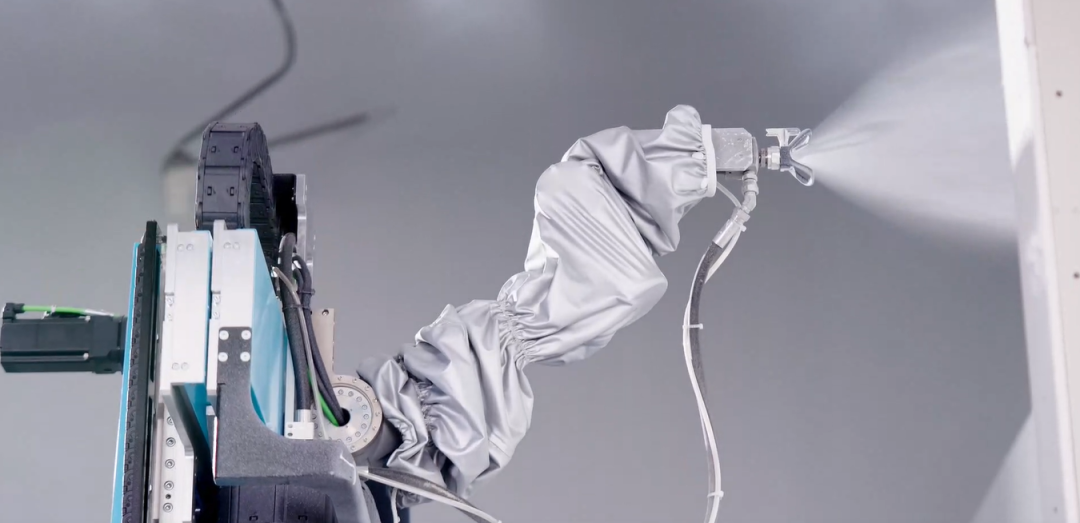
Spraying robot at work
Weijian Technology robots have completed multiple benchmark projects. These include the Lingang New Area 105 Community Financial East Nine project in deep collaboration with China Construction Eighth Engineering Division, the Wuxi Liangxi District Medical Rehabilitation Center project with Shanghai Construction Group, and the Suzhou Dushu Lake Hospital project with China Construction First Group First Company. Robot construction teams have been streamlined to 40% of traditional construction crew sizes, greatly reducing project management burdens.
To date, Weijian Technology robots have completed nearly 4 million square meters of construction work. Partners include China State Construction Engineering Corporation, China Communications Construction Company, China Railway Group, Shanghai Construction Group, Shanghai Urban Construction Group, Hebei Construction Group, Longfor, Poly, and C&D Group.

Already Shipping in Volume, Planning Global Expansion
At this stage, for Liang, the biggest challenges aren't building robots — they're talent and market education.
First, talent for operating construction robots.
"The use of construction robots can't rely on existing workers; it requires an emerging group. Only when this group grows will construction robots see rapid development," Liang said. This group consists of new-type construction workers with knowledge and technical skills who are more receptive to robots.
Weijian Technology is attempting to cultivate a batch of agents and workers capable of operating construction robots through intensive training. By their standards, these individuals must practice on actual projects until they can operate one plastering robot to complete over 250 square meters of construction area in a single day to "graduate."
Additionally, there's market education.
Construction projects have long timelines, involve numerous suppliers, and feature complex working environments. Plastering, steel bar processing, and other processes are just one link in the chain, requiring coordination with multiple parties and involving adjustments and planning of construction sequences.
"Project parties knowing robots are coming will make reasonable optimizations and compromises in construction sequences. Users willing to make reasonable construction plans for robots — that's when this can move forward," Liang explained. Construction has strong industry inertia; Weijian Technology spent two to three years before clients gradually became willing to make adjustments and cooperate on construction sequences.
"If something is hard to do, but once accomplished, it builds a moat," Liang said. Between 2024 and before Spring Festival 2025, Weijian Technology shipped dozens of plastering and spraying robots.
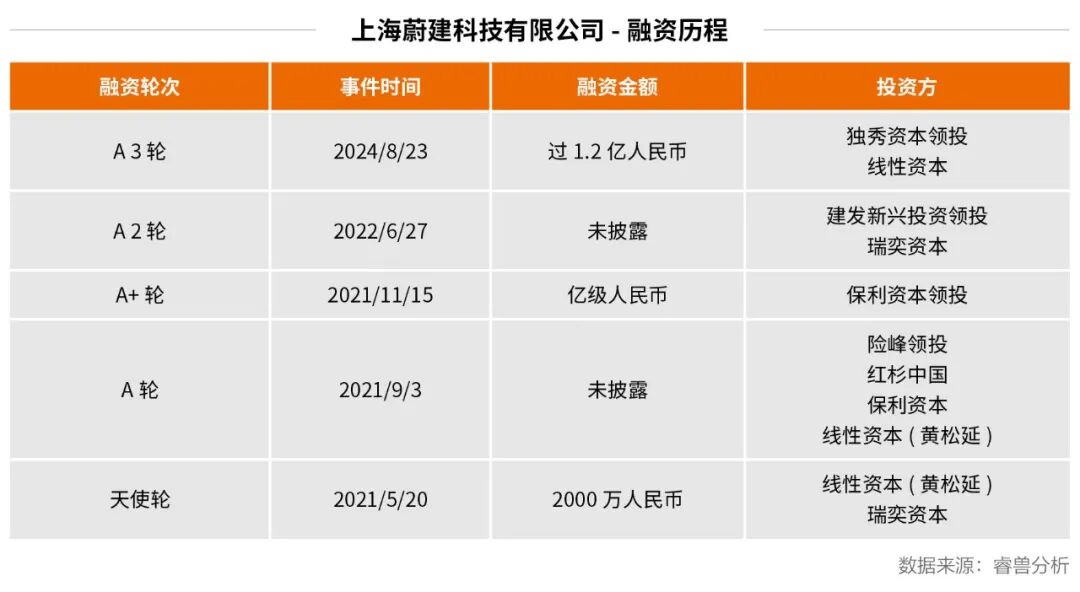
From 2021 to present, Weijian Technology has completed five funding rounds, receiving support from Linear Capital, K2VC, Poly Capital, C&D Emerging Investment, and Duxiu Capital. Among these, its A+ and A3 rounds exceeded 100 million yuan. Weijian Technology currently has branch offices in Shenzhen, Ningbo, and Xiong'an.
Huang believes the Weijian team combines top-tier robotics technical capability with deep construction craftsmanship expertise, and that core team members have worked together for many years — "the best team I've seen in this direction."
Weijian Technology is also planning overseas expansion. In April 2024, Weijian Technology launched its globalization strategy. In December, Weijian robots entered Taiwan for their construction debut. In January 2025, Weijian Technology's plastering robot successfully completed first UAE client acceptance. Weijian Technology currently has branch offices in Singapore and Hong Kong, and is already conducting business in Hong Kong, Taiwan, Singapore, Dubai, and other cities and countries.
"Domestic construction environments and building materials are overly non-standardized; overseas is more standardized, so robots can start working immediately," Liang is more confident about overseas markets. He expects overseas orders to see breakthrough progress within the next three months.
About Linear Capital
Linear Capital is an early-stage investment institution focused on "frontier technology + industry," that is, frontier technologies represented by data intelligence, digital new infrastructure, next-generation robotics technology, and new technological transformations in traditional fields (such as biomedicine, materials, energy, etc.), applied across vertical industries to substantially improve industrial efficiency, empower solutions to pain point problems, and complete industrial upgrading — achieving excess returns in commercial value through substantial increases in industrial value. It currently manages ten funds with total assets under management of approximately $2 billion.
Our investment stage focuses primarily on leading angel to Series A rounds, with investment amounts ranging from $1 million to $10 million (or RMB equivalent) per project.
To date, we have made early-stage investments in over 120 entrepreneurial teams including Horizon Robotics, Kujiale, Sensors Data, Tezign, Rokid, Guandata, and Agile Robots. The combined valuation of Linear Capital's portfolio companies is approximately $20 billion.
In the near term, Linear Capital is working to become the best "Data Intelligence Technology Fund," and in the long term, gradually build itself into the most influential "Frontier Technology Application Fund."