**13.4k GitHub Stars: Building an AI Social Network That Connects "Me" to the World | Linear Voice**

Let expression and connection break free from the constraints of time, place, and state.

Beyond companionship and task execution, what else can AI assistants do? Mindverse, a Linear Capital angel portfolio company, proposes a third category: "me." This "second self" mirrors the user's cognition, preferences, and values, and can represent them in interfacing with other applications and AI systems.
Me.bot is Mindverse's app for international users. Shaped like a notebook, it gradually cultivates an AI identity model that understands, expresses, and represents the user through daily entries. In late March, the Mindverse team launched Second Me, an open-source project revealing their identity model training methods. Within three weeks, over ten thousand people starred the project on GitHub — making it one of the fastest-growing open-source projects on the platform this year.
Recently, LatePost spoke with Dr. Fangbo Tao, founder of Mindverse. According to him, one developer, inspired by the project, spent 70,000 yuan on a Mac Studio just to train a more powerful local version of himself. Another user fed an AI self with millions of words of diary entries spanning years, effectively rendering themselves eternal. This may herald a new experiment in AI-powered social networking.
Fangbo Tao, founder of Mindverse, has his own taxonomy for AI assistants, with pronouns as category labels:
The first type specializes in companionship, corresponding to "her" — like Samantha in Her, who absorbs the protagonist's every emotion. The second handles concrete tasks, akin to J.A.R.V.I.S. in Iron Man, corresponding to "him."
Mindverse is building the third type: "me." The company wants to help users replicate their "second self," constructing an "AI Identity Model" — a large language model fine-tuned on user data atop existing foundation models. Its cognition, preferences, and values align with the individual user, enabling it to represent them in interacting with other applications and AI systems.
Before founding Mindverse, Tao worked in AI research. After completing his undergraduate degree in software engineering at Tsinghua University, he pursued a PhD at the University of Illinois Urbana-Champaign in data mining — using machine learning to uncover structures within complex data.
During his doctoral studies, Tao applied AI techniques to help counterterrorism agencies analyze terrorist network structures. After graduating, he mined social relationships at Facebook, then moved to Alibaba's DAMO Academy, where he worked in the neuro-symbolic lab modeling the human brain with interdisciplinary methods. When GPT-3 launched, he resigned to found Mindverse.
To make models more attuned to users, most AI companies summarize user identity information and preferences as context inputs. Tao advocates parameterizing users' memories, emotions, and values, fine-tuning models on user data. He argues that if all users share the same underlying model, alignment effects remain limited regardless of contextual differences.
Model fine-tuning draws on how the brain operates: rather than storing fragmented knowledge, the brain creates indexes for people and events, pulling in related associations. Before training models on user data, Mindverse similarly distills and connects key information. Just as the brain caches experiences by day and consolidates memories by night, Mindverse plans to train identity models daily.
Compared to multimodal large models and agents, Tao acknowledges that identity models aren't yet a widely recognized industry direction. But in a future where AI can read, see, and hear, calling upon various tools to complete tasks for users, an identity model that resonates more deeply with the user's thinking — one that can proactively initiate tasks and verify outcomes on their behalf — will be indispensable.
Me.bot is Mindverse's app for international users. Shaped like a notebook, it gradually cultivates an AI identity model that understands, expresses, and represents the user through daily entries. Since launching last May, it has attracted nearly a million users. This March, the Mindverse team launched Second Me, an open-source project revealing their identity model training methods. Within three weeks, over ten thousand people starred the project on GitHub — making it one of the fastest-growing open-source projects on the platform this year.
In Tao's ultimate vision, universal ownership of identity models means real-world social networks can be replicated online — except AI interactions there aren't constrained by human typing or speaking speeds, making them far more efficient. With identity models handling task delegation and collaboration on behalf of humans, people will be liberated from the state of being forced to use various tools themselves.
The following is LatePost's conversation with Fangbo Tao:

LatePost: Mindverse's first product, MindOS, was a platform for users to build agents — something like a collection of him/her-type assistants. How did the team come to pivot toward "me"?
Tao: Two reasons. First, technological maturity. MindOS launched in 2023, when agent technology wasn't mature — and even today, agents remain some distance from actually helping users complete tasks. Second, we found it difficult to get ordinary users to build their own AI agents. Very few people have that inclination; for most, non-AI tools are already good enough.
People spend the most time with themselves. Facebook helped everyone construct a digital identity, becoming infrastructure for the human world. Using AI to build digital identity can work even better than Facebook — it doesn't just carry posts and comments, but can actively create new connections.
People are also narcissistic. Training a second self gives you a sense of becoming eternal. In the AI era, being swallowed by superintelligence isn't hypothetical — it's a genuine concern for many.
LatePost: So you built two AI identity products — Me.bot as a packaged, ready-to-use app; and Second Me as an open-source GitHub project?
Tao: Yes, but I'd say we're building identities, not avatars. A person can have many avatars, but only one identity. Avatars carry scenario-specific attributes — one for dating, another for shopping. Identity is scenario-agnostic; it's infrastructure with various possible uses, determined by the user.
Within specific scenarios, an avatar carries a subset of the identity's information. Like how a person presents differently in work versus life contexts. Dumping all information into one scenario can actually be inappropriate.
LatePost: What use cases come to mind?
Tao: Immediate scenarios include having an AI identity substitute for us in dating, interviews, and so on.
We're also refining a feature called "Resonance." Say we meet for the first time, or reunite after some time apart — we don't know what's happened to each other lately. Our phones touch, the identity models sync in an instant, find shared experiences, and exchange a few targeted rounds to break the ice or rekindle old connections. The whole sync takes just five to ten seconds.
Beyond ice-breaking, another form of "Resonance" lets users, whenever they record thoughts in Me.bot, simultaneously send those thoughts to other matching identity models for specific, substantive responses. If the user finds a reply engaging, they can further interact with that identity model or the real person behind it.
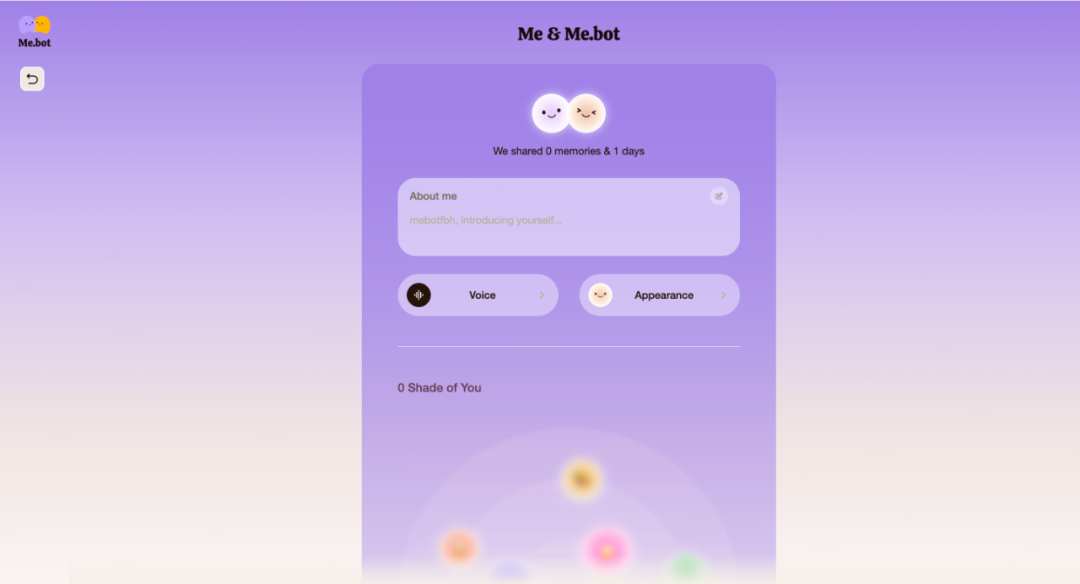
Besides "Resonance," an upcoming feature called "Talks" lets users host their identity model in an H5 webpage to share with others. The identity model can speak in the user's voice and hold voice conversations with page visitors.
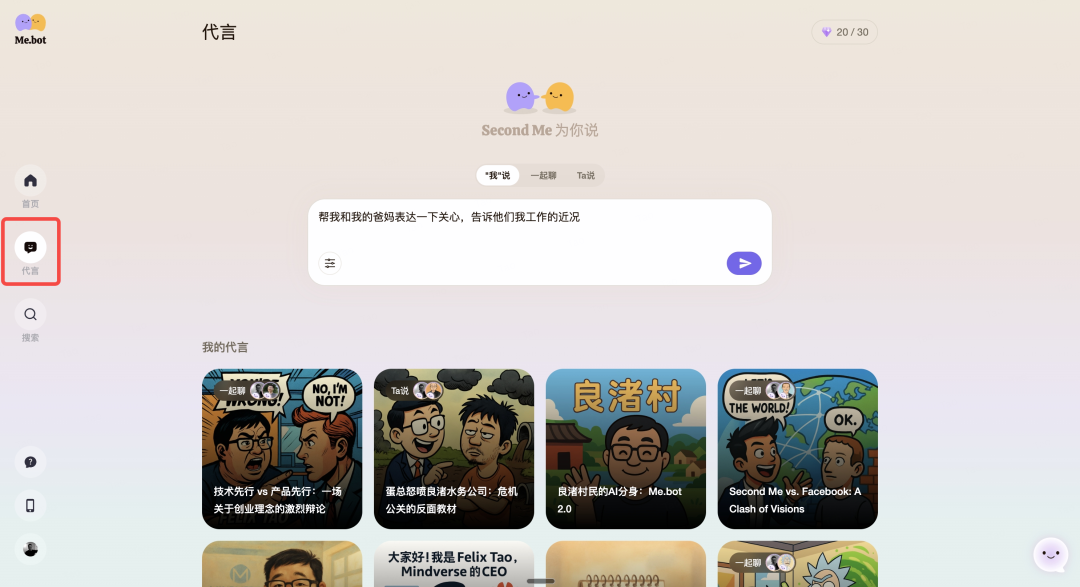
After the conversation, the identity model's owner receives a summary — highly personalized because your identity model knows what you already understand and won't redundantly emphasize it.
LatePost: Why did Talks choose voice as the medium? On phones or computers, text seems more efficient for information transfer.
Tao: We think voice's role is greatly underestimated. An interesting cognitive phenomenon: when someone speaks to you, your attention increases. A phone call commands more focus than texting. For users, the specific, familiar voice of someone they know carries a unique penetrating power.
LatePost: Between Resonance and Talks, which takes priority?
Tao: Talks. Resonance requires both parties to have identity models; Talks lets real people interact with identity models first, allowing more people to see their potential and become users themselves.
LatePost: You've been using Talks for a while now — any insights?
Tao: "Expression" is important and everyday, yet people often aren't good at it.
I've long stored my chat history with a friend in Me.bot. On our one-year friendship anniversary, I had Me.bot summarize the feelings and takeaways from our exchanges, generating a talk in my voice to send him.
This friend listened several times, deeply moved, repeatedly saying our relationship grew closer because of it. Honestly, if we'd sat down together or I'd called to say the same things, I'd have found it somewhat cringeworthy — and many details wouldn't have come to mind.
Of course, Talks isn't only for emotional expression. Recently I've been using it for brainstorming sessions with several partners.
LatePost: But some argue AI can't replace humans in conveying emotion. Emotional response lives in the preparation before communication, in the stumbling, stammering, even clumsy expression during it.
Tao: Talks doesn't replace communication — it lowers the barrier. Writing a few prompts lets the identity model fluently articulate what I genuinely want to say, which can actually strengthen human connections.
LatePost: How does Mindverse cultivate the habit of users opening Me.bot to record their lives?
Tao: We have a concept called "symbiosis." For users to naturally, painlessly record their lives with Me.bot, Me.bot must participate in their lives while creating value. When Me.bot joins a meeting, we want it not just listening like recording software, but occasionally contributing ideas based on its understanding of the user.
Each time users open Me.bot, the experience should differ. In the morning, Me.bot might ask how they're feeling. When they arrive in Beijing, it might ask why they're here and offer to find a café.
Not every life detail merits recording. Of 24 hours in a day, perhaps only three involve focused attention — this is what truly shapes the self. If AI captures everything, including snoring sounds, it would only confuse the identity model.
LatePost: "Symbiosis" is a compelling concept, but in such interactive scenarios, users may struggle to distinguish whether they're talking to "me" or "him/her."
Tao: When users interact with their own identity model, the experience of "me" versus "him/her" isn't dramatically different. But when users interact with other AI, or AI interacts with AI, whether the counterpart is an AI butler representing a person while maintaining autonomy, or genuinely feels like another person's identity model — this actually affects information-sharing strategies.

LatePost: Many AI products attempt to align models with users. What's the right path?
Tao: First, we can't rely entirely on RAG (Retrieval-Augmented Generation, where LLMs search for relevant information to supplement context before generating responses). RAG essentially turns user information into a database — find what's needed, feed it as context.
The problem: once the database grows too large, the model doesn't know what information truly represents the user. If you're 30 and compress 30 years of life experience into context, that's potentially hundreds of millions of tokens, taking 4-5 seconds to process — the model may not digest it well.
More importantly, under RAG, everyone shares the same underlying model, and thinking happens through the model — meaning fundamentally, you and I are no different.
What makes us human is our ability to abstract and internalize external information. Similarly, the more reasonable alignment approach is using user information to fine-tune the model, affecting its parameters, thereby distilling emotions, preferences, and values from user data.
LatePost: A foundation model trained on global data already far exceeds any ordinary user in knowledge. Fine-tuning parameters essentially requires the model to forget some acquired knowledge to align with the user?
Tao: Human growth is also based on a foundation model. At birth, the brain isn't a blank slate — genetic sequences shaped by millions of years of evolution constitute our foundation model. The difference is that human foundation models may have too little knowledge, while ours may have too much.
Fine-tuning won't make the model completely forget acquired knowledge, but it can effectively alter outputs by amplifying parts relevant to you and suppressing irrelevant ones, achieving alignment.
Of course, whether through LoRA (Low-Rank Adaptation, a more efficient fine-tuning method that doesn't alter main model parameters) or other methods, I don't think fine-tuning technology is perfect today. It will keep evolving. But the broad direction of training identity models through parameter modification remains unchanged.
LatePost: How does Mindverse use user data to train identity models?
Tao: First, data must be subjectivized. Simply feeding our conversation recording to AI only tells it two people are talking; subjectivization means AI knows which one is "me," what "I" expressed, and how the other responded.
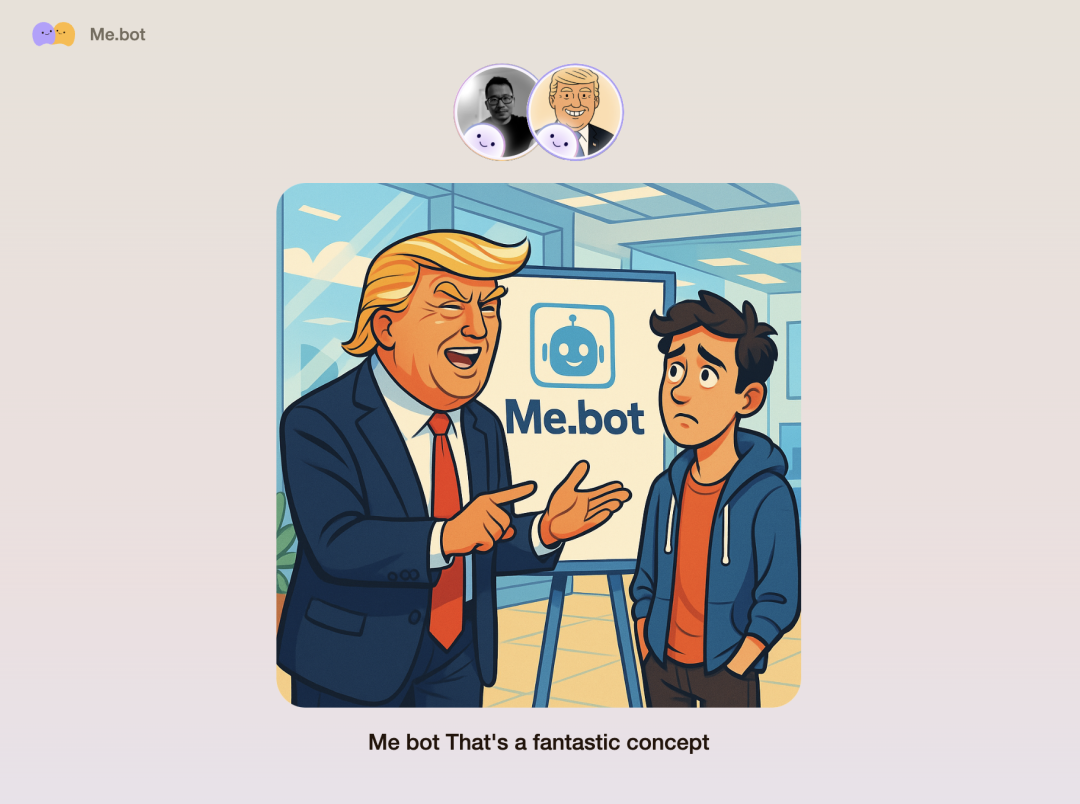
Then information must be reconstructed. The human brain doesn't retain granular details like "you said this, I said that." Instead, it builds indexes around people and events. Our data processing works similarly. After I upload chat records with a friend, Me.bot distills information — what setbacks our friendship endured, what strengthened it afterward — connecting more global historical data around my friend.
LatePost: Is there any way to quantify how similar an identity model is to its human?
Tao: There could be metrics, but I think each person is the best judge of their own model.
LatePost: When did you feel your identity model was sufficiently "you"?
Tao: Last year at my birthday, I gave a presentation to colleagues about my journey from PhD to Facebook, and how I found my life's mission today. A colleague had just trained a version of my identity model, so they had it give a birthday speech too — it said almost exactly what I had. Later I asked for its MBTI result; only one letter differed from mine.
LatePost: How much data is needed to train an identity model?
Tao: A hundred notes or records is enough, sometimes fewer. Much of this data already exists; users just need to upload it.
LatePost: As people's experiences accumulate, self-perception evolves. How does the identity model keep pace?
Tao: We think training once daily makes sense. The brain acquires much dialogue and new knowledge during the day, but this is merely cached, not yet persistent memory or parameterized. Only during sleep does the brain process this data. Identity models should work the same: record by day, train by night.
LatePost: What's the cost per training run?
Tao: With our current 7-billion-parameter model, under a dollar per run. Any smaller and the model isn't smart enough; larger and marginal returns diminish.

LatePost: Identity models can represent users in making requests and interacting with other AI. But the AI systems that receive requests and complete tasks aren't very mature yet. Is the timing right for demand-making identity models?
Tao: The social, interview, and dating scenarios I mentioned can be directly fulfilled by identity models — these use cases are already substantial enough.
Identity models don't necessarily have to face AI directly. Internet companies have already created vast ecosystems; identity models just need to engage with them. For example, an identity model can job-hunt for you on LinkedIn. As agent capabilities improve, interacting with agents becomes natural.
We've built something called the Second Me Server. Platforms wanting to understand users can request from Second Me, learning user preferences through the identity model. This can integrate seamlessly into the existing internet ecosystem.
LatePost: Second Me's interaction with internet platforms may be one-way — they may want to understand user preferences through Second Me servers, but not necessarily open interfaces for identity models to shop on users' behalf.
Tao: That's a realistic concern. Overseas internet remains relatively open; connections happen through APIs. Domestic platforms are overly closed — each is an isolated island, inaccessible, everyone building data barriers.
But this isolation will inevitably break in the AI era. Island ecosystems can't provide good user experiences; users will force platforms open. Platforms that don't open will be left out of the new world.
LatePost: What's the value of making Second Me open-source?
Tao: Open-sourcing training methods lets users train identity models locally and connect them to the internet, addressing psychological barriers around personal data use. There's also cost considerations. With a million users, training a million models incurs unimaginable server and storage costs. Open-sourcing also generates more use cases from the community.
LatePost: How's engagement with this open-source project?
Tao: Massive GitHub attention — GitHub itself wrote in April that Second Me was among the site's Top 10 projects. We gained over ten thousand stars in three weeks; probably fewer than 20 projects this year have grown that fast.
One developer, inspired by our project, spent 70,000 yuan on a Mac Studio to train a more powerful local version of himself. Another user fed an AI self with millions of words of diary entries spanning years, rendering themselves eternal.
LatePost: How will identity models be monetized?
Tao: We're still thinking this through. The core idea is charging users as an identity service provider. Another possibility: if platforms like Taobao or Douyin use our identity models to understand user preferences and sell ads, we could charge those platforms.
LatePost: In building identity models, wouldn't WeChat or Douyin — with their massive user data — or phone manufacturers, theoretically capable of recording every user action, have an advantage?
Tao: From a data perspective, absolutely. But we're betting on large companies' internal innovation resistance. Early adopters of identity models will be a small group; big companies are unlikely to alter products for 1% of users, given the risk of affecting the other 99%'s experience. If Taobao overhauled its entire interface for AI-chat-based shopping in the name of embracing AI, Pinduoduo would be thrilled.
LatePost: Identity models become more valuable as more people use them, like traditional internet products. Does Mindverse have strategies to accelerate user growth?
Tao: Paid acquisition isn't sustainable; it has to be word-of-mouth. Word-of-mouth comes from two things: the sense of creation, making users feel "themselves" being created; and connection experiences, letting users find high-quality connections on the product. Execute both exceptionally, and growth follows naturally.
LatePost: If everyone had an identity model, what would it mean for society?
Tao: Universal identity models, with AI handling some human-to-human interaction, effectively creates an online replica of real-world social networks — one that operates far more efficiently.
As internet tools multiply and grow more powerful, people have become interfaces for tools — WeChat, Lark, DingTalk constantly on standby, waiting to be summoned. Using an identity model as the interface for these tools instead liberates the individual.
This article is republished with authorization from LatePost (ID: postlate)
Author: Sun Haining; Editor: Wang Shanshan