Deep Principle Releases Its First General-Purpose Large Model, Outperforming GPT-6 Astra on Scientific Reasoning Benchmarks | Linear Portfolio

Turn advances in AI for science into actual scientific discoveries.
y'x

Recently, Deep Principle officially released Hydrogen-1.0, the company's first general-purpose large language model, simultaneously open-sourcing its model weights. The model can assist researchers in analyzing scientific problems, writing simulation programs, troubleshooting computational anomalies, and participating in reaction pathway analysis and spectrum interpretation.
Hydrogen-1.0's model weights are now available on Hugging Face and ModelScope, with future inclusion planned for Google, AWS, and Microsoft Azure's MaaS platforms. Researchers and developers can download the model to adapt and validate it for their own scientific tasks.
Linear Capital was the lead investor in Deep Principle's seed round and has continued to support the company through multiple subsequent rounds.
On November 2, Deep Principle officially released Hydrogen-1.0, the company's first general-purpose large language model, simultaneously open-sourcing its model weights. Built on GLM-5.3, Hydrogen-1.0 underwent further domain-specific training in science, incorporating knowledge from chemistry, materials science, and life sciences, along with feedback from researchers, proprietary lab records, and multi-round materials exploration processes.
Hydrogen-1.0 can assist researchers in analyzing scientific problems, writing simulation programs, troubleshooting computational anomalies, and participating in reaction pathway analysis and spectrum interpretation. Centered on specific research objectives, it can further plan experiments, breaking down protocols into concrete operational instructions, and leverage evaluation results from each round to continue searching for more suitable material candidates.

From the constancy of the speed of light to the discovery of relativity, from an abnormally growing petri dish to the discovery of penicillin — reasoning through vast knowledge in complex scenarios and data is the essence of scientific discovery. Deep Principle evaluated Hydrogen-1.0's performance in these two dimensions through FrontierScience-Research (FSR) and GPQA-Diamonds benchmarks.
FSR tests whether a model can solve unfamiliar problems in physics, chemistry, biology, and other fields requiring multi-step reasoning. Hydrogen-1.0 achieved a 38.3% success rate, surpassing GPT-6-Astra's 33.3% and improving upon the base model GLM-5.3 by 13.9 percentage points. GPQA-Diamonds consists of difficult multiple-choice science questions written by experts. Hydrogen-1.0 attained 93.0% accuracy, a 3 percentage point improvement over the base model, approaching Moonshot AI's 93.5%.
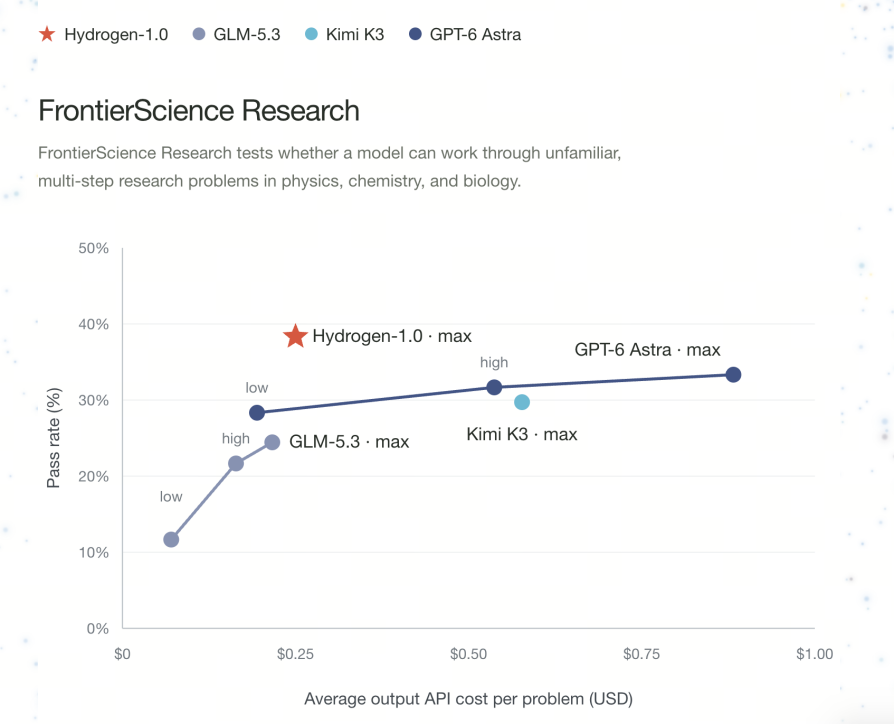
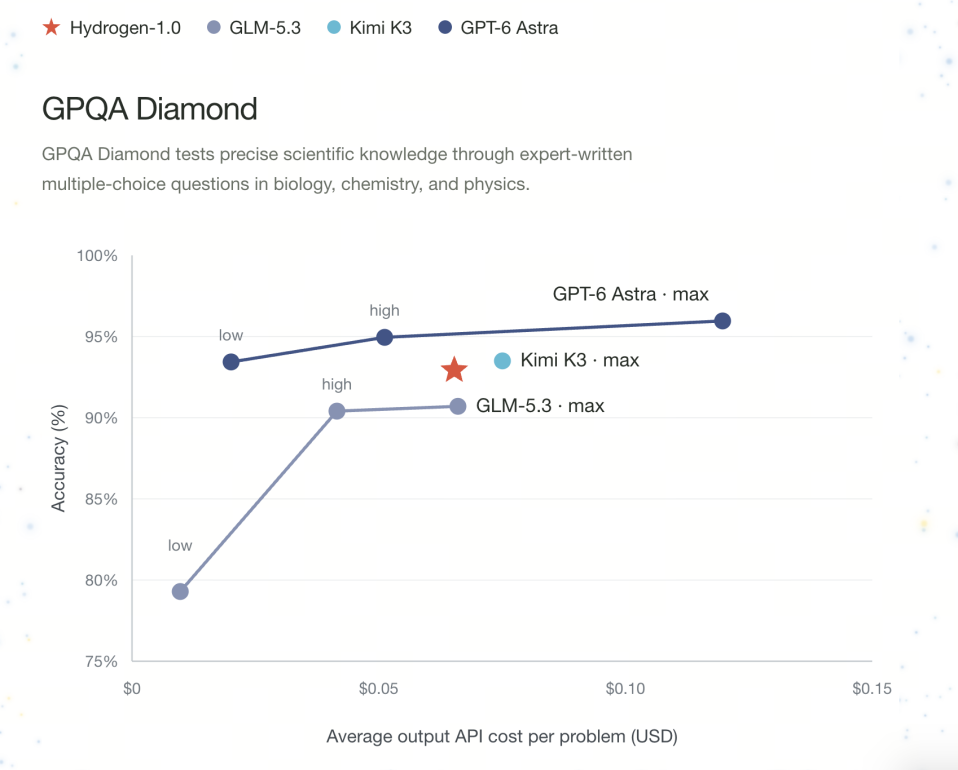
These results demonstrate that compared to the base model, Hydrogen-1.0 can apply domain knowledge more accurately and is better at solving complex scientific problems requiring multi-step reasoning.
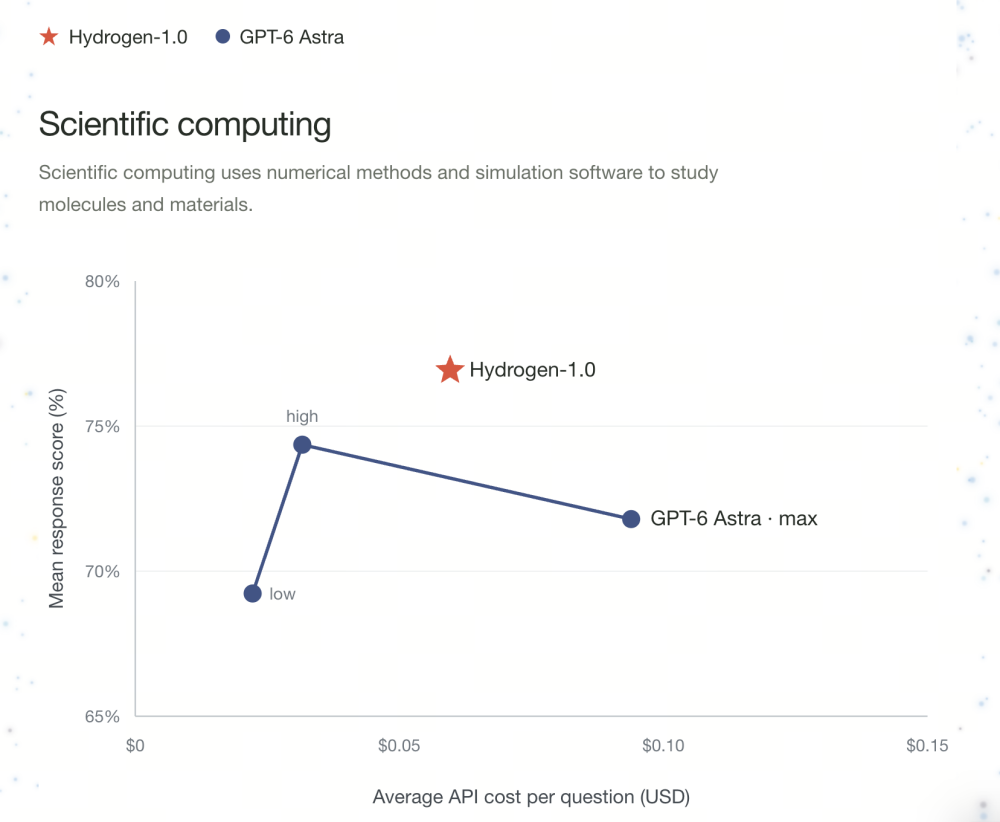
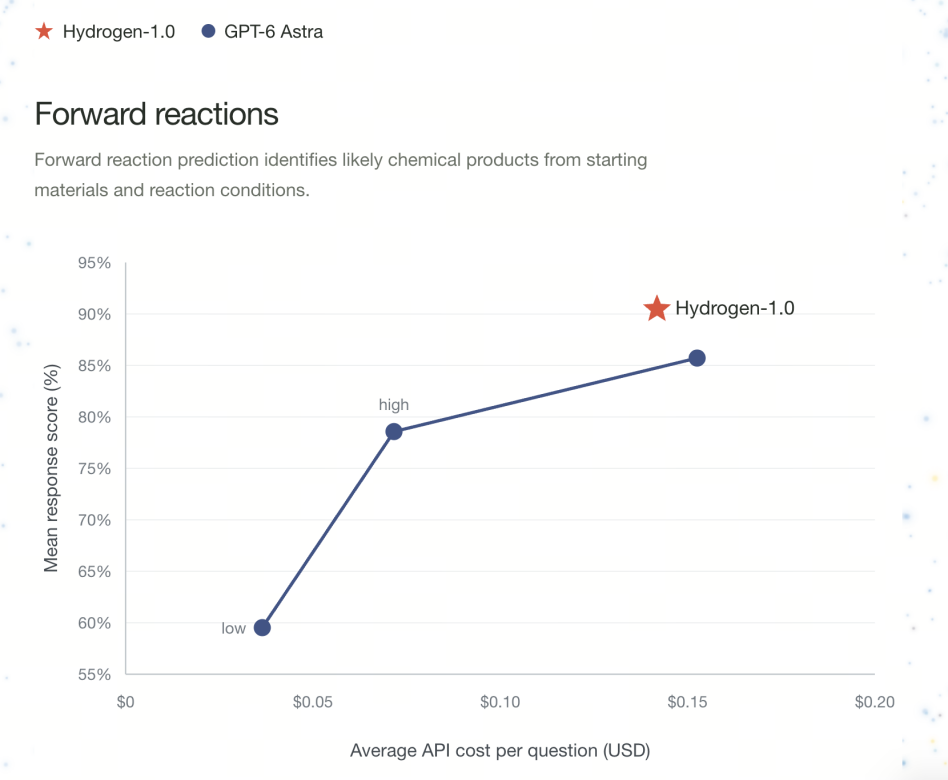
Beyond scientific knowledge and reasoning benchmarks, Deep Principle also conducted internal tests around research problems the team encounters in daily work. In scientific computing and single-step reaction prediction tasks, Hydrogen-1.0 achieved average scores of 76.92% and 90.48% respectively, outperforming GPT-6-Astra's 71.79% and 83.33%. The former assesses the model's ability to use computation and simulation to study molecules and materials; the latter evaluates whether the model can predict likely products given starting materials and reaction conditions.
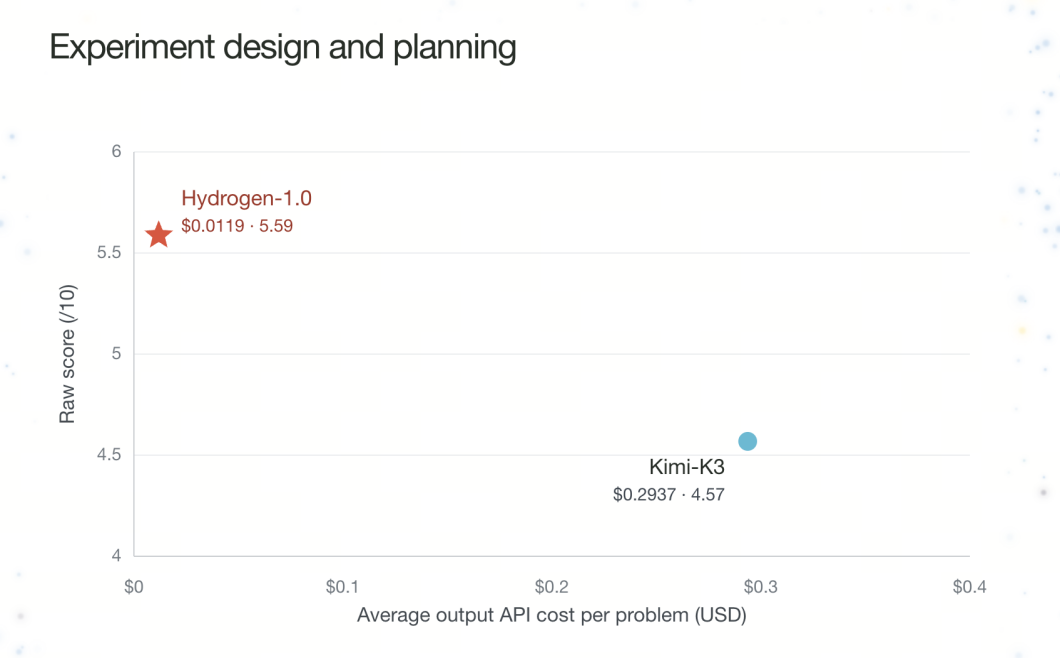
Scientific research requires not only answering questions but also designing experiments to explore the physical world. Hydrogen-1.0 can formulate experimental protocols based on research objectives, further refining operational steps.
To evaluate this capability, Deep Principle selected 117 experimental design and planning problems, scoring Hydrogen-1.0 and Moonshot AI's responses using the same criteria (opus-5.5 and gpt-6-astra refused to answer such questions too frequently for fair comparison). On a 10-point scale, Hydrogen-1.0 achieved an average score of 5.59, higher than Moonshot AI's 4.57, demonstrating its advantage in experimental design and planning tasks.
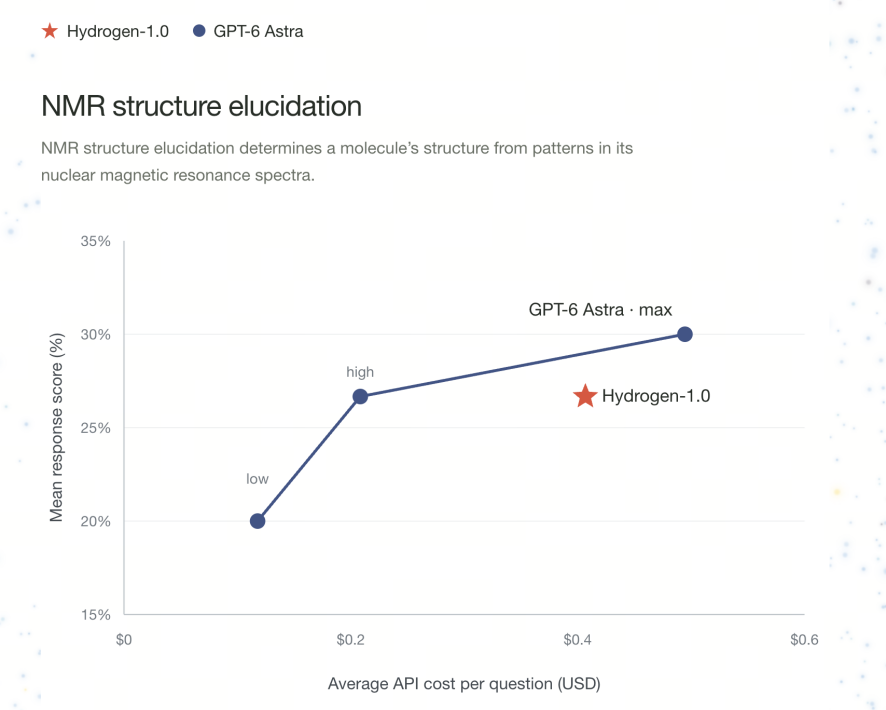
After experiments are completed, the resulting products still need to be identified. Hydrogen-1.0 can assist researchers in analyzing nuclear magnetic resonance (NMR) spectroscopy results to find clues for identifying substances. Deep Principle tested this capability with 30 related problems. Hydrogen-1.0 achieved an average score of 26.67, slightly below GPT-6-Astra's 30.00, with a difference of 3.33 points. On this specialized task, Hydrogen-1.0 achieved results close to GPT-6-Astra.

Before researchers formally begin experiments, they typically need to analyze what properties materials might possess and what reaction routes might occur, then screen for worthwhile protocols to validate. Hydrogen-1.0 can assist with these tasks, studying molecular motion and material properties through computational simulation, checking for anomalies during calculations, and comparing different reaction pathways to help researchers make more informed choices for subsequent experiments.
The following two cases intuitively demonstrate Hydrogen-1.0's predictive capabilities in the early stages of research.
Hydrogen-1.0 can help researchers study material properties computationally. For example, when researching polyethylene — commonly used in plastic bags — it can write programs, build molecular models, and calculate molecular motion and arrangement. If the calculated material density shows anomalies, it can also assist in checking the program, identifying double-counting issues, making corrections, and re-running. Researchers can leverage the model to complete similar programming, computation, and debugging work, providing references for subsequent experiments.
Automated modeling, error correction, and analysis in polyethylene molecular simulation
Hydrogen-1.0 can assist researchers in mapping out and comparing possible reaction routes. To obtain a target product, multiple reaction steps are often required, with alternative products potentially forming along the way. Hydrogen-1.0 can draw on existing computational records to analyze what steps each route requires, determine which step might be more difficult to advance, and identify alternative options. Researchers can use these analyses to prioritize protocols for validation and even gain inspiration for novel reactions.
Stepwise expansion and pathway comparison of reaction networks

With worthwhile ideas to validate, the next step is arranging specific experiments. Hydrogen-1.0 can assist researchers in developing protocols, listing concrete steps, and using virtual compilation to check for omissions or sequencing errors in operations.
In a study exploring "whether palladium catalyst loading can be reduced," Hydrogen-1.0 arranged 12 sample positions by combining three catalyst loading levels with two base loading levels, with two replicates per combination, while maintaining consistent temperature control across all samples to exclude thermal interference and more cleanly isolate the effects of varying catalyst and base loadings. It could generate precise operational steps for each individual sample. From reagent addition, liquid transfer, and stirring to post-reaction sampling and filtration, it could list each step sequentially.
After writing out the experimental plan for each sample, the equipment's ability to execute these operations still needs to be verified. Hydrogen-1.0's Lab Compile virtual compilation serves this purpose: setting up a virtual environment to check whether equipment supports corresponding actions, whether necessary preparations are complete, and whether operational sequences are correct. For example, the case below demonstrates the model intercepting the erroneous operation of "beginning liquid aspiration before the aspiration tool has been fitted with a new tip." Researchers can use such checks to identify execution issues in advance, make corrections, and then schedule actual experiments. This not only provides a training environment for further strengthening AI capabilities but also avoids safety risks in the process of "AI taking over the laboratory."
Virtual rehearsal in the laboratory — correcting operational errors and simulating proper workflows

Discovering new materials often requires repeated trial and continuous optimization. Whether a candidate's performance meets expectations influences the next round of selection. Hydrogen-1.0 can leverage existing evaluation results to continue recommending candidates, helping researchers determine which materials are worth investigating next.
Deep Principle tested the model's ability to make these selections through a "metal complex search" task. The benchmark required models to find candidates with larger values for an electronic structure metric, the "HOMO–LUMO gap." As shown in the figure, multiple models started from the same pool of initial candidates, recommending one new candidate per round, receiving evaluation results, and then deciding the next recommendation, for a total of five rounds. Each model could only see feedback for candidates it had recommended. The curves illustrate how the search progressed round by round: by the fifth round, Hydrogen-1.0's best-found metric averaged 4.318 eV, compared to 3.689 eV for GPT-6-Astra and 3.353 eV for Moonshot AI. With the same number of recommendation rounds, Hydrogen-1.0 found candidates with higher target metrics, demonstrating its ability to leverage continuous feedback to advance materials search.
Hydrogen-1.0's performance in multi-round materials search compared to other models

In training Hydrogen-1.0, Deep Principle drew on both domain knowledge from chemistry, materials science, and life sciences, as well as feedback from researchers, proprietary lab records, and complete multi-round materials exploration processes, aiming for the model to learn how researchers solve problems.
These training materials preserve the full context of research. How an approach was initially conceived, what results were actually obtained, and why it was later modified — all are documented. The model first learns how to analyze problems, develop plans, and interpret results through complete task exemplars, then refines its performance based on feedback. For materials development tasks requiring iterative screening, Deep Principle also incorporated continuous multi-round recommendation and evaluation processes into training, enabling the model to learn how to adjust subsequent choices based on previous rounds' results.
To absorb these experiences, the training system also needed to accommodate complex analytical processes. Deep Principle improved long-context training methods to preserve reasoning steps involving calculation, checking, and modification as completely as possible. During reinforcement learning training, if a longer response has not finished generating, the system can save progress to be resumed later.
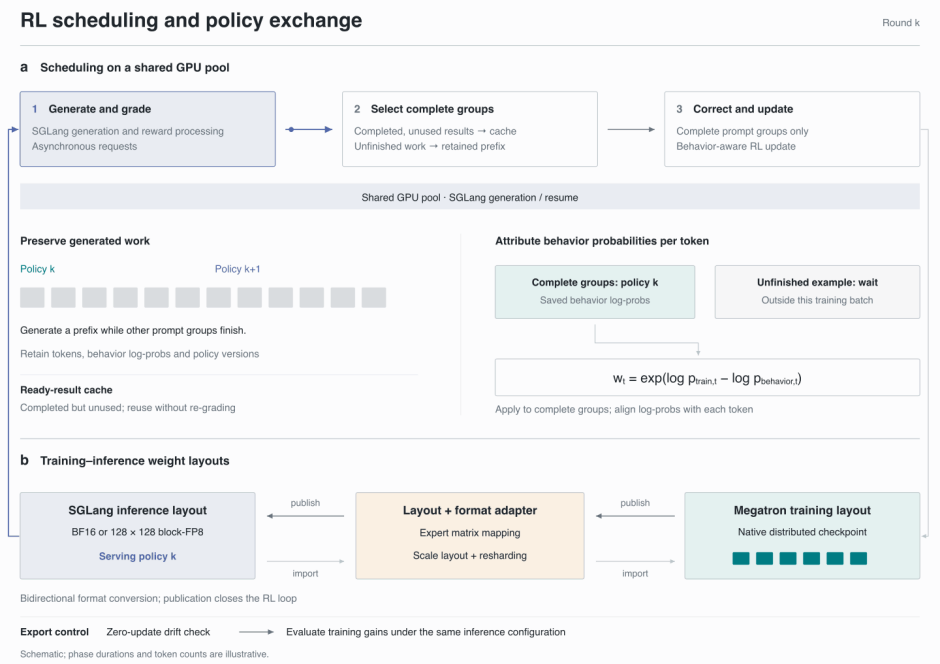
Figure: The model can first generate a response and receive a score, then adjust based on feedback, reducing redundant computation

Hydrogen-1.0's model weights are now available on Hugging Face and ModelScope, with future inclusion planned for Google, AWS, and Microsoft Azure's MaaS platforms. Researchers and developers can download the model to adapt and validate it for their own scientific tasks. Teams needing to integrate the model with existing tools can access it through the NeuroSpark API. Researchers can also directly invoke Hydrogen-1.0 through Deep Principle's AI Scientist product Mira to conduct scientific reasoning, research computation, experimental planning, and multi-round exploration.
Different research teams have their own familiar material systems, research methods, and experimental conditions. Deep Principle hopes more teams will apply Hydrogen-1.0 to actual research, testing its problem-solving capabilities across diverse scientific scenarios. This is why Deep Principle chose to open-source Hydrogen-1.0.
Chenru Duan, CTO of Deep Principle, stated: "Helping humanity discover new knowledge is Deep Principle's long-term goal in developing scientific large language models. Every attempt in scientific research, every unexpected result, and every hypothesis correction can become learning experiences for the model. We hope that by open-sourcing Hydrogen-1.0, the model can be tested in real scientific research and gradually become a reliable partner for scientists exploring the unknown."
Complete benchmark results, training methods, and application cases are now available in the Hydrogen-1.0 technical blog. Interested readers can further examine how the model handles specific tasks and how these capabilities were trained and evaluated.
Going forward, Deep Principle will continue testing the model's performance across different material systems and research tasks, and explore how to incorporate new experimental results and research experiences into subsequent training. The company looks forward to collaborating with research teams, developers, and the open-source community to translate advances in scientific AI into progress in scientific discovery.