Green Carbon Synthesis, a company developing proprietary next-generation sustainable aviation fuel technology, has raised tens of millions of RMB in an angel round led by Linear Capital.

Green Carbon Synthesis has optimized the catalyst and process pathway based on conventional Fischer-Tropsch technology, independently developing a third-generation Fischer-Tropsch synthesis process for producing SAF.
By Xue Xiaowan | Edited by Su Jianxun
36Kr Carbon has learned that Green Carbon Synthetic Energy (Shaoxing) Co., Ltd. recently completed a multimillion-yuan angel funding round, with Linear Capital as the sole investor, and Cloud Capital serving as the exclusive financial advisor. The proceeds will primarily fund the construction of a minimum viable production unit for pilot validation and team expansion. Founded in July 2023, Green Carbon Synthetic Energy develops process technologies for producing green aviation fuel and naphtha, among other green fuels and chemical feedstocks. 36Kr Carbon understands that the company has independently developed a next-generation Fischer-Tropsch synthesis process for green energy production, with products including Sustainable Aviation Fuel (SAF), biodiesel, bio-naphtha, and other high-value-added Fischer-Tropsch products.
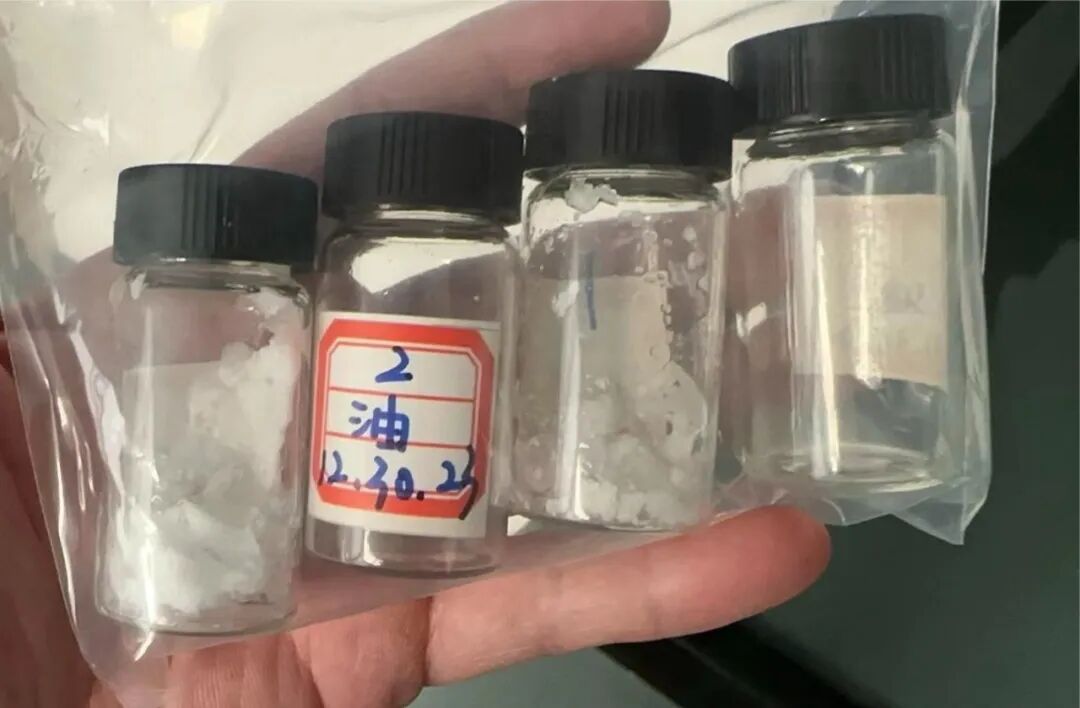
Company-provided image
Following the formal adoption of the EU's ReFuelEU Aviation regulation last year, SAF has garnered widespread global attention. Under the EU's mandatory policy requirements, the minimum SAF blending ratio will be 2% in 2025, rising to 6% by 2030, 20% by 2035... and reaching 70% by 2050.
Meanwhile, domestic policies are also encouraging the development of green aviation fuel as a substitute for conventional jet fuel. For instance, the Action Plan for Carbon Peaking Before 2030 explicitly calls for vigorously promoting advanced bio-liquid fuels and sustainable aviation fuel as replacements for traditional fuels, and improving the energy efficiency of end-use fuel products.
Driven by strong policy tailwinds both at home and abroad, major global airlines have successively announced explicit SAF usage targets. Measured against the trillion-yuan market for conventional jet fuel, SAF is poised to reach a hundred-billion-yuan scale in market demand — creating new opportunities and challenges for SAF producers and suppliers alike. Currently, SAF production encompasses multiple technological pathways, including HEFA, Fischer-Tropsch synthesis, alcohol-to-jet, and power-to-liquid.
Xiao Lifeng, founder of Green Carbon Synthetic Energy, explained that the company has independently developed an advanced Fischer-Tropsch process, dubbed "third-generation Fischer-Tropsch," which optimizes catalysts and process pathways based on the traditional approach: on one hand, it improves catalyst utilization efficiency and lifespan, making them better suited to current green aviation fuel production needs; on the other hand, it enables equipment miniaturization at lower cost, better adapting to the characteristics of the biomass market.
Looking at the upstream segment, feedstock sources are diverse — biomass (primarily crop straw), livestock waste, and municipal solid waste can all serve as raw materials for Green Carbon Synthetic Energy's SAF production. After upstream processing such as biomass and solid waste gasification, and appropriate syngas composition adjustment, a suitably proportioned synthesis gas is formed, which ultimately undergoes Fischer-Tropsch synthesis to produce SAF. Xiao Lifeng noted that the previous-generation Fischer-Tropsch catalytic process has already been validated at commercial scale at an overseas facility; by comparison, the new-generation Fischer-Tropsch process offers superior performance and cost advantages.
Regarding the choice of technological pathway, Xiao Lifeng stated that selecting Fischer-Tropsch synthesis was the result of comprehensive consideration across the upstream and downstream industry chain. Particularly important is the controllable cost of upstream processing — the company has already partnered with multiple domestic upstream process producers, achieving good integration with the Fischer-Tropsch stage through mature gasification technology. More critically, through Green Carbon Synthetic Energy's technological pathway, the volume of available feedstock sources is sufficient to meet SAF production needs, and can even further satisfy demand for green diesel and other green chemical feedstocks.
On the business model front, Xiao Lifeng told 36Kr Carbon that Green Carbon Synthetic Energy will pursue commercialization in phases. In the initial stage, the company will primarily collaborate with upstream feedstock giants to produce green aviation fuel meeting domestic and international certification requirements. The next phase will focus on advancing mass production, constructing demonstration projects, further promoting commercial sales partnerships for SAF products and technology process packages, and entering overseas markets through integrated skid-mounted equipment.
Investor Perspectives:
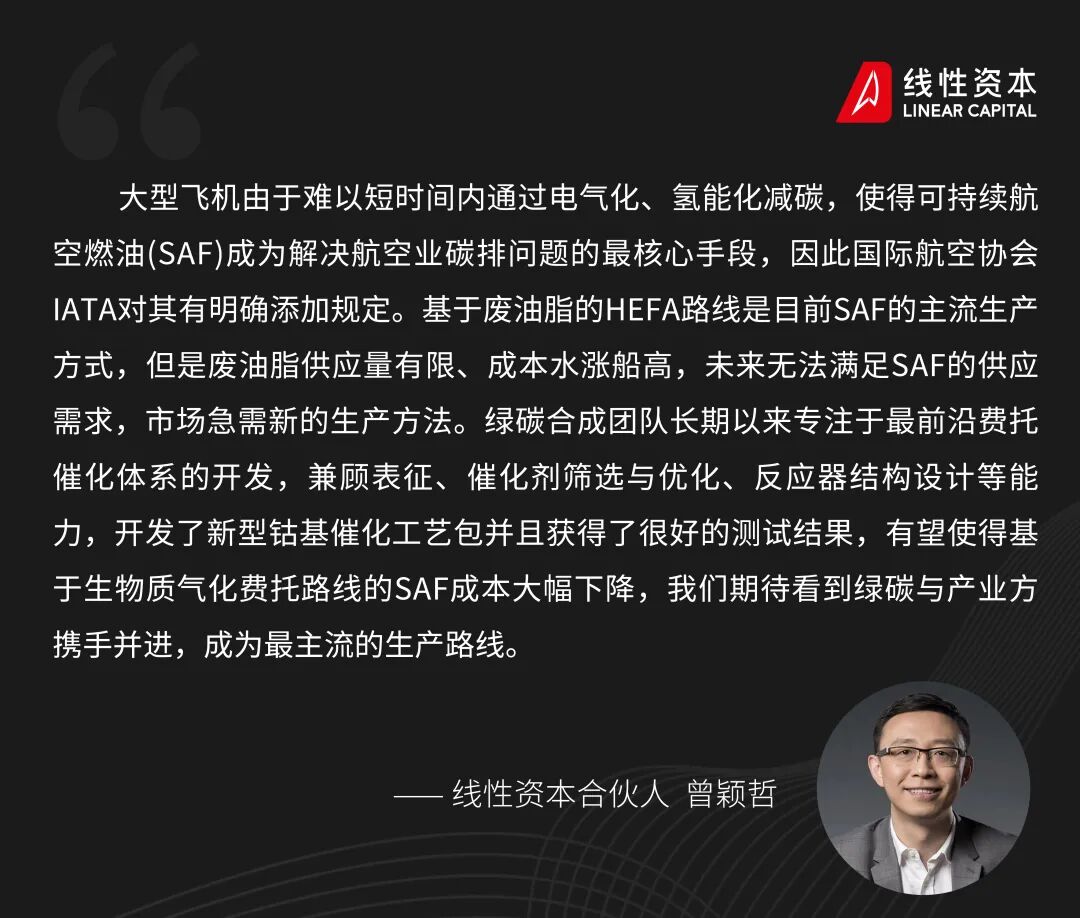
Zeng Yingzhe, Partner at Linear Capital: Large aircraft cannot be decarbonized through electrification or hydrogen in the near term, making sustainable aviation fuel (SAF) the most critical solution for addressing aviation industry emissions — which is why the International Air Transport Association (IATA) has established clear blending mandates. The waste-oil-based HEFA pathway is currently the mainstream SAF production method, but waste oil supply is limited and costs are rising steadily, making it unable to meet future SAF demand. The market urgently needs new production methods.
The Green Carbon Synthetic Energy team has long focused on developing cutting-edge Fischer-Tropsch catalytic systems, with combined capabilities in characterization, catalyst screening and optimization, and reactor structure design. They have developed a novel cobalt-based catalytic process package that has achieved promising test results, with the potential to significantly reduce costs for biomass gasification Fischer-Tropsch SAF production. We look forward to seeing Green Carbon collaborate with industry partners to become the most mainstream production pathway.
Cao Jishan, Founding Partner at Cloud Capital: Cloud Capital has long been attentive to opportunities in green energy, and sustainable aviation fuel represents a rare, systematically high-ceiling incremental opportunity in the energy sector. The waste-oil HEFA method is the most mature but faces clear cost-reduction bottlenecks. We firmly believe in the structural cost-reduction opportunities brought by core technological and engineering capabilities within this major SAF赛道. Cloud Capital wishes the Green Carbon Synthetic Energy team greater contributions in the global wave of green energy development.
| Image source: Pexels