Linear Capital Leads RVision's Angel Round; Company Secures Back-to-Back Investments from HSG and Xiaomi to Build Next-Generation HUD

Secured multiple mass-production designated projects.
By Xiao Qianping | Edited by Yuan Silai
Elsewhere has learned that AR display technology company RayViz has completed consecutive funding rounds — a Pre-A round led by HSG and an A round from Xiaomi — with cumulative financing nearing RMB 100 million. The proceeds will fund new technology R&D, lab and factory expansion, and accelerated mass production and delivery.
The RayViz team was formed in 2018 and established the company in 2021 after returning from Cambridge. It is headquartered in Nanjing, with an overseas R&D center in Cambridge, UK, and a manufacturing facility in Xingtai. Leveraging its expertise in optics and algorithms, RayViz focuses on novel AR display solutions. Its current main product is automotive HUD (Head-Up Display) systems.
HUD projects virtual images of driving and navigation information onto the windshield within the driver's line of sight, helping drivers access critical information without looking away from the road, thereby improving safety. According to research from Ping An Securities, domestic HUD shipments are expected to reach 8 million units by 2025, with the market potentially hitting RMB 10 billion — roughly 3.5x growth from 2022.
However, one persistent pain point in HUD adoption is ghosting: image distortion caused by windshield thickness. To address this, pre-installed HUDs typically require customized windshields with tapered PVB film (narrower at the bottom, wider at the top) to align reflected light and eliminate ghosting. But this wedge film significantly increases HUD costs and limits broader application scenarios. Previously, there were no mass-produced pre-installed HUD cases in the commercial vehicle or rail transit sectors.
In response, RayViz developed its proprietary Parallel Vector ghost-free technology, enabling windshield-type HUDs to work with ordinary glass — no wedge film, no ghosting. This frees HUDs from dependence on expensive custom wedge film, reducing costs for passenger vehicle HUDs by over 20%. The technology also facilitates HUD adoption in commercial vehicles and rail transit, expanding application scenarios.
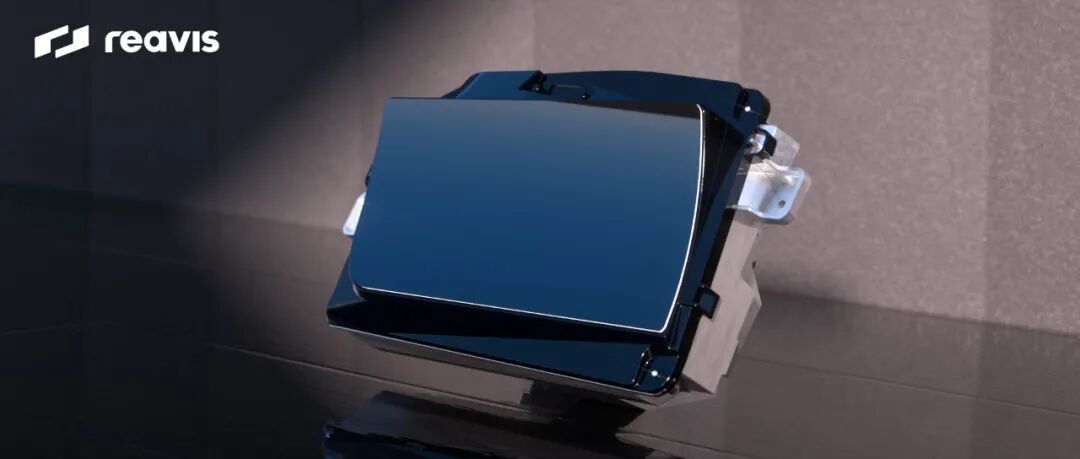
RayViz product image. Source: Company
In terms of user experience, this technology also lays groundwork for 3D multi-plane HUDs with layered depth. Previously, such 3D multi-plane HUDs typically required specially modified windshields. RayViz's Parallel Vector ghost-free technology achieves ghost-free imaging at multiple projection distances without any windshield modification. This means it can address the eye fatigue and dizziness caused by frequent focal adjustments in AR-HUDs, improving the AR experience.
Additionally, RayViz has refined numerous details for AR-HUD deployment. These include proprietary algorithms for HUD ground-anchoring effects and multi-signal processing, plus optimized optical engine convection systems and thermal designs that reduce operating temperatures while mitigating sun-loading risks.
On the commercial front, RayViz has secured multiple mass-production designated projects, with the earliest SOP delivery expected by year-end. The company is also engaged in R&D collaborations with several well-known domestic and international OEMs, spanning passenger vehicles, commercial vehicles, rail transit, and aviation.
Looking ahead, RayViz plans to expand its HUD product line based on its optical technology strengths, developing digital holographic 3D HUD technology to bring digital holography into intelligent cockpits and deliver immersive driving experiences.
The core founding team hails from the University of Cambridge and leading industry companies, with multiple senior engineers in the HUD field. CEO Dr. Yuanbo Deng completed his undergraduate studies at Zhejiang University before pursuing holography, AR, and 3D display research at Cambridge through his master's, PhD, and postdoctoral work. CTO Dr. Daoming Dong previously worked at Apple and leading holographic display company VividQ. Chief Scientist Professor Daping Chu is Director of the Cambridge Centre for Advanced Photonics and Electronics, a veteran expert in optoelectronic displays.
Investor Perspectives:
Zheng Qingsheng, Partner at HSG: Optics and algorithms are critical to delivering AR technology. RayViz's deep accumulation in underlying optical technology and spatial data fusion algorithms positions it well to expand and enrich AR application scenarios.
Xiaomi Strategic Investment: The RayViz team comes from the Cambridge Centre for Advanced Photonics and Electronics, with proprietary ghost-free PV technology and deep expertise in 3D display. We believe the team can deliver next-generation innovative experiences for the automotive display market.
Cover image source | IC photo Layout | Ye Chuqiao