A Conversation with Agile Robots' Zhaopeng Chen: Spanning Germany, China, and the United States to Build a Super Unicorn

After raising $2 billion, a technology idealist's global journey.
"Between the Lines" is an in-depth conversational video podcast produced by Linear Capital. The guest for the fourth episode is Zhaopeng Chen, founder of Agile Robots. Yesterday, Agile Robots announced a new funding round, bringing its valuation to $8.5 billion.
In 2007, Zhaopeng Chen graduated from Harbin Institute of Technology and spent ten years at the German Aerospace Center's lab. He rose to deputy director of the lab — still the highest position a Chinese person has held there. In 2017, he gave up the iron rice bowl of the lab and, together with nine former colleagues from Germany, the United Kingdom, the United States, Bolivia, and elsewhere, started a company in a borrowed office.
In 2018, Linear Capital met the Agile Robots team. Within a month, we flew to Germany to complete due diligence and made our first investment in Agile Robots. In the years since, we have continued to add to our position. Not long ago, Zhaopeng Chen flew from Munich to Shanghai to join our video podcast. Over more than five hours of recording, he recounted Agile Robots' unique growth story.
Everyone is talking about Chinese companies going global, but Zhaopeng Chen's story is different.
In 2007, Zhaopeng Chen graduated from Harbin Institute of Technology and flew alone to Munich, where he spent ten years at the German Aerospace Center's lab, rising to deputy director — still the highest position a Chinese person has held there.
In 2017, he gave up the lab's "iron rice bowl" and, together with nine former colleagues from Germany, the United Kingdom, the United States, Bolivia, and Slovakia, started a company in a borrowed office.
Today, Agile Robots is valued at nearly $10 billion, employs more than 3,000 people from over 60 countries, has delivered nearly 40,000 robots, and has doubled revenue for eight consecutive years. In smartphone supply chains and on BMW production lines, its robots run around the clock.
But what truly convinced us to invest in Agile Robots at the seed round was not the technology — it was the "texture" of Zhaopeng Chen as a person. When Agile Robots was still very small, we saw that Chen was relaxed whether meeting Masayoshi Son, Tim Cook, or Jensen Huang. Behind that ease is a confidence that flows from passion. And that passion, grown from the bone, has him flying 680,000 kilometers a year across three continents.
From Munich to China to Silicon Valley, Chen has brought robots out of the ivory tower of research institutes and into factories and onto production lines. Ultimately, he wants to bring them into the home.
He says he hopes people will eventually remember that it was Zhaopeng Chen who defined the final form of robots. That's something you can put on your tombstone.
How does one person build a vast global team and carve out a super-unicorn in robotics? How does a scientist learn to use financial tools, M&A, and organization to gradually realize his ultimate dream about robots? Welcome to this episode of "Between the Lines."
This written excerpt is about 19,000 characters. Watching the video is a better experience ↓


A Scientist Trained by Two Academicians
▍Harry Wang: Zhaopeng, you're a scientist trained by academicians in two countries. For your PhD, you chose Germany rather than the United States. What was your thinking at the time?
▍Zhaopeng Chen: I had offers from the United States too, but** I ultimately chose Germany because of my obsession with robotics.** I've loved robots since I was a child, and the German Aerospace Center's technological sophistication in robotics was something I deeply aspired to.
Another reason was my teacher — Academician Liu Hong, today vice president of Harbin Institute of Technology. He was the first teacher who brought me into robotics. When I went to Germany, Teacher Liu was still at the German Aerospace Center, but he was about to return to China as a national expert, and the lab there needed someone to manage it, so I went to Germany as his "substitute." So this should be called "an inevitable accident."
▍Harry Wang: After you got there, what made you feel you'd made the right choice?
▍Zhaopeng Chen: When I arrived in Germany in 2007 and 2008,** I saw the most complex robotic dexterous hand in the world at the time** — it gave me goosebumps. It was an extreme feat of engineering, an enormous temptation for someone like me who loves mechanical and electrical engineering. To this day, I believe the German Aerospace Center's dexterous hand technology from back then remains world-leading.
But technical extremity does not equal product extremity. Although Germany may not currently lead in AI large models or in scaling robot production, the German pursuit of technical and engineering excellence commands great respect.
▍Harry Wang: Why did Teacher Liu think you were suited to take over his work?
▍Zhaopeng Chen: To this day, he hasn't told me. I guess there are two reasons. First,** he knew I was deeply committed to robotics** and hoped someone could persistently carry this technology forward, rather than coasting for a couple of years, grabbing a degree, and leaving. Second,** the staged achievements of my undergraduate and master's work gave him confidence in my ability**. Third, he perhaps felt I was a relatively optimistic person. In a place like the German Aerospace Center, you need some spontaneous, combustible drive, or it's very hard to persevere.
▍Harry Wang: Tell us about your other mentor, Hirzinger. How do the two mentors differ?
▍Zhaopeng Chen: Although the two teachers come from different countries, their traits are very similar —** both are deeply committed to science and technology.** Teacher Liu Hong has done decades of research on space robotics. In my eyes, he is something like "the father of Chinese space robotics," and almost single-handedly set off a flourishing of space robotics in China.
Teacher Hirzinger is very similar. The entire robotics institute at the German Aerospace Center was built by him, and he believed robotics and AI should be the mainstream of the next era. Though in different countries, the two teachers, driven by the same belief, built different organizations with different schools and different students.
▍Harry Wang: Thanks to your introduction, we had the privilege of meeting Academician Hirzinger. He speaks and thinks with great rigor, but without constraint. I did indeed feel a German-style conservatism — he didn't want to give you any excessive promises.
At the time we asked him: "When can the robot Zhaopeng wants to build actually reach the market?" He said it would take at least five years. My first reaction was: should we just pack up and go home? But then I thought, we're investing in Zhaopeng, not in Teacher Hirzinger. Investing in him might get us the best technology, but investing in Zhaopeng gives us the chance to productize the technology and commercialize the product.
▍Zhaopeng Chen: We built our first product in six months.
▍Harry Wang: I spent ten years in the United States, and the American mindset is always to build something first, take it to market, then adjust the technology based on feedback.
▍Zhaopeng Chen: Germans are relatively conservative. Their usual thinking is to perfect the engineering and the product, and only give it to the customer once they feel it's OK. But that's not how products are made. Products are made by stepping out with the left foot to build the product, then stepping out with the right foot to the customer site to see feedback; bring the feedback back, step the left foot again to iterate the technology, step the right foot again —** that's how you move forward.**
▍Harry Wang: The "left foot, right foot" theory of products is quite interesting. How specifically did your two teachers influence you?
▍Zhaopeng Chen: Their pursuit of science and technology has benefited me all along. First,** whatever you do, do it purely and seriously — if you don't like it, don't do it; if you like it, you can keep doing it forever.**
Second, they both had extremely long-range views of the future development of technology, while also being able to realize them step by step on solid ground. They could see what machines should look like in ten or twenty years, so the institute should have Module One, Module Two, Module Three laid out. No one is a deity — no one can precisely judge the endgame — but this direction, and the effort toward it, should exist today.
This way of thinking also showed up in how I later structured the company: on one hand, commercial judgment has to be translated into execution; on the other, judgment about the long-term direction of technology must be clear, otherwise the organization, the technical direction, and many decisions will have nothing to stand on — you won't even be able to convince yourself.
Expanding the Boundary of the Whole Circle
▍Harry Wang: Trained by two academicians, you ultimately didn't take the academic path but chose to start a company. What's the story there?
▍Zhaopeng Chen: This too is an "inevitable accident." I'm interested in many things and have lots of ideas, but publishing papers doesn't reward having lots of ideas. A PhD's field of research is like a circle; inside the circle is the knowledge accumulated in that field over decades or even centuries. You can digest it, but digesting it is useless.** A PhD must push a little at some corner of the circle, forming a bump.**
Drilling that one point beyond everyone else, pushing that bump outward, was a bit much to ask of me.** Because I find everything in the circle interesting, and making me pick one thing to do for 20 years would be a kind of torment.**
▍Harry Wang: The reason I quit my PhD back then was exactly the same as yours — except I didn't start a company, I went to Silicon Valley. That's also why we resonated so much when we met. You spent 10 years at the German Aerospace Center and were already deputy director of the lab — the highest position a Chinese person has held there to this day. It fully qualifies as an "iron rice bowl."
But you were able to bring out nine colleagues from various countries — Brits, Germans, Americans, plus Slovaks, Bolivians. Having brothers from so many countries willing to follow you and Peter to build something is no small feat.
▍Zhaopeng Chen: As a researcher, your whole life is roughly about forming a bump at some corner of the circle — maybe you're Einstein and the bump is a bit longer, but you still haven't expanded the boundary of the whole circle.
Personally, I hope to see, in my lifetime, a state of affairs like I, Robot — hundreds of millions of robots doing everything in my life. That was my first motive for starting a company.
The second is that** I realized research alone cannot achieve this goal**. When we collaborated with research institutions like OpenAI and DeepMind, we found that even if the robot's body is brought to the extreme of the world — sensor systems, mechatronic systems, humanoid torsos, and so on — combining software and hardware still doesn't solve the fundamental problem.
The consensus in the industry at the time was that you must have enough data,** but no one knew what paradigm to use to encompass that data. What we were clear about was that you absolutely must have enough data and enough applications for robotics to extend the boundary of the circle outward by one ring.**
That's what pushed me and a group of like-minded people who share the same passion to leave and start a company. They could have gone to Google or Meta, but they were willing to stay at DLR to do this — because of passion. Everyone on the team is exceptionally skilled. Robotics is enormously complex — it demands an understanding of mechatronic systems, traditional control, software, and vision all at once. Gathered together, these people may not cover every technology, but there's a suitable person at every critical link, and everyone believes this is achievable.
▍Harry Wang: Was it hard to convince them to come out with you?
▍Zhaopeng Chen: It took a lot of time and energy. I was relatively lucky, because among this group I was the first to arrive at DLR. Apart from Peter, these folks had all more or less worked with me before — that kind of trust is different. After all, we'd fought in the same trenches.
"Pushed out" by his teacher to start a company
▍Harry Wang: I heard a story, that you once used a robot on an American woman who'd been paralyzed from the neck down for over 20 years, and through a brain-computer interface she held a cup of water on her own for the first time. Is that supposedly one of the trigger moments when you first thought about starting a company?
▍Zhaopeng Chen: I'd say it was one of the bigger highlight moments among the many projects at the time. Around 2010, we had a project in collaboration with Brown University in the United States. We did the robotics; we worked with Brown's researchers and doctors, who handled the brain-computer side, linking up the entire chain from neuroscience to brain-computer interface to the robot.
She was an elderly woman who'd been paralyzed for many years in the United States, completely unable to move anything below her neck. Brown's doctors performed a craniotomy and implanted sensors to capture EEG signals, which were then transmitted to us for processing. We used what was then a fairly traditional neural-network method to decode her brainwaves, translate them into commands the machine could understand, and control a robotic hand to carry out what she wanted to do.
She was sitting there, wanting to use her right hand to pick up a cup of water from the table and drink. The experiment lasted over a month, and throughout that time the cranial sensors stayed open the whole time. She finally succeeded — using thought alone, she got the robotic hand to lift the cup from the table and drink. She was overcome with emotion, tears in her eyes. That moment deeply moved every researcher in the room. We saw that technology can ultimately make people's lives better — and that's the ultimate goal of anyone who works in technology.
▍Harry Wang: When did you truly make up your mind to start a company? When we met you, you'd already been trying to raise money in the market for nearly a year.
▍Zhaopeng Chen: Agile Robots is actually already my second company. When I started the first one, I didn't really have any entrepreneurial ambition — it was purely because the robotic hands we made sold too well. Universities and research institutes all over the world came to DLR to buy robotic hands. The professors were delighted, but the more we sold, the more obvious the problem became: we were, after all, a research institute. We were supposed to focus on research, but instead the whole world was coming to buy our robotic hands. That clearly wasn't a long-term thing.
One day, my teacher suddenly came to me and said, "Zhaopeng, you have to go out and start a company, otherwise the institute can't function. Next week you and Peter go set up a company specifically to sell robotic hands." That company was founded in 2013, and it ran for several years on robotic hand sales alone. Revenue was decent every year, and it was self-sufficient.
By 2017–2018, from a technical, commercial, and market standpoint, building general-purpose AI robots had reached a certain feasible tipping point — it was time to take it seriously. That couldn't be done inside our previous "thrown together" company, so a new company had to be founded.
▍Harry Wang: So the first company was more like a side gig.
▍Zhaopeng Chen: Exactly — it was essentially an appendage of the institute. But even so, we learned a lot. For instance, the biggest difference between selling a product and doing research is that you have to do service** — customers don't just need to recognize that your product and technology are good; you have to make them satisfied. Later, when we did Agile Robots, this became my biggest principle: everything, everything, is about making the customer satisfied.
A cup of Starbucks, a trip to Germany
▍Harry Wang: Tell the story of how we first met. The first time we met, you described a scenario — a knife touching a fingertip, stopping on contact without drawing blood. I thought right then that I wanted to go to Germany and see it for myself, and ideally try it with my own hand. About a month after we met, I flew to Germany. How did you feel when you saw us? Did you think we had a shot?
▍Zhaopeng Chen: I'd met quite a few investors by then, but I hadn't succeeded yet, so it was hard to judge which investor would really have chemistry with you. Still, Linear left a few deep impressions on us at the time.
The first, and most important, was that one conversation with you. We sat in the Starbucks downstairs from your home, in a little corner facing the street, and talked for two hours. I couldn't tell whether this round of financing would come through, but I felt that talking with Harry was a real fit — at the very least, we could become friends.
The second was that within a month of that conversation, you flew to Germany — something that had never happened with anyone else. One chat in a café, and within a few weeks you flew that far to come see us, spent three or four days with us, talked to everyone, and watched every robot demo we had.
▍Harry Wang: You showed us the needle-popping-balloon demo too, right? I really wanted to see if I could get pricked, but it didn't happen — a bit of a shame.
▍Zhaopeng Chen: We did perform it, but the needle can't touch a person. That's when I realized Harry and Linear were unlike any investor I'd met. You really resonated with this, you were persistent, and you were willing to truly commit.
The third thing that left a deep impression was the scene of us in that beer hall in Germany, having a great time talking — I still have a photo of it on my phone to this day. You left on a Friday, arrived in Shanghai Saturday morning, and by Monday you told me you'd decided to invest.
▍Harry Wang: Looking back, I also have to thank you for giving us that opportunity. From the first investment to now, not accounting for dilution, the return is approaching 1000x.**

The ambition hidden in the name
▍Harry Wang: The company is called Siling in Chinese, Agile Robots in English. Is there a story behind that?
▍Zhaopeng Chen: Agile Robots was my idea. We understand robotics along two dimensions: thinking and acting. Agile has two meanings — one is physical agility, the other is dexterity of thought. Translated into Chinese, that's Siling — both able to think, and very dexterous.
From day one, what we wanted to build was Physical AI, even though the term didn't exist back then. Our earliest slogan was "Connect other intelligence to the physical world." A robot needs to both think and act, and ultimately complete tasks — that requires a brain, a body, and experience, which is to say data. Agile Robots has invested heavily in all three layers, with the goal of connecting body and software into a true AI flywheel. Then the emergence of intelligence is only a matter of time.
▍Harry Wang: But back then there was no such thing as large models. The Physical AI you're talking about then must be different from today's concept, right?
▍Zhaopeng Chen: We'd actually already spotted the problem. Neither deep learning nor reinforcement learning could solve the data and generalization problems. At the time there was no overall paradigm that could encompass enough data, collect it, digest it, and ultimately form conclusions. Before the Physical AI solution appeared, we had already recognized the problem — and when the solution did appear, we grasped some of its characteristics.
We already have tens of thousands of application scenarios — from consumer electronics in China to car factories in Germany to all the hyper-scale labs in San Francisco. We believe the most important thing is to do what today's pure automation can't do, and only humans can.
When you walk into BMW Plant 1, you'll find there are still a lot of people on the production line. Take the "supermarket" process before the main line — moving various parts from the warehouse to a staging area before the main line for buffering, sorting, categorization, even pre-assembly. The scenarios are highly varied, with no fixed pattern, and it's a long-horizon task. Doing this with traditional robots can't reach that level of automation. This is exactly where Physical AI can play a role.
▍Harry Wang: As the earliest investors, we often get asked: is Agile Robots a company that sells products, or one that sells solutions?
▍Zhaopeng Chen: Agile Robots is fundamentally a purely technology-driven product company. But in robotics, becoming a product company isn't easy.
▍Harry Wang: Back to a rather mundane question — how many robots has Agile Robots delivered that are actually running in the field so far?**
▍Zhaopeng Chen: Nearly 40,000 units delivered. Revenue has doubled for eight consecutive years, and this year it should double again.
▍Harry Wang: How do you view this wave of newly emerging peers?
▍Zhaopeng Chen: History is strikingly similar. Every era has a wave, and every wave eliminates a batch of people — in the end, only those who survive are the winners. And surviving ultimately comes down to real customer recognition** — that's extremely important.
▍Harry Wang: You have quite a few product lines. Is there a way of presenting them that helps people better understand your product matrix?
▍Zhaopeng Chen: We basically don't have a unified script. Essentially there are two kinds of customers. The first kind wants a product** — they don't care whether your solution is finished; what they look at is how strong the product's impact is. Whether it's an AMR, a robotic arm, or a humanoid, if the product is good enough, customers will come to you to buy.
The second kind doesn't want a product — they want you to solve their problem. At that point, talking to them about a product matrix is useless; they don't care at all what you have.
We don't even have a sales deck. It's simple: go live, and if you see a problem, we'll help you solve it. Within a week of finishing talks, the entire engineering team is on site identifying problems; within 3 to 5 weeks, a DFM (design for manufacturing) comes out; within two months the whole solution is done. Does the cost work, does the solution work — if OK, go live.
▍Harry Wang: Kind of like the Palantir model.
▍Zhaopeng Chen: Very direct. Customers really respond to that. They don't have time to waste with you, and they don't have time to listen to you talk about vision.**
Agile ONE, the culmination of humanoids
▍Harry Wang: The most complete embodiment of all this should be Agile ONE, which just came out at the end of last year. Humanoid robots started with Tesla's Optimus, and China has produced a huge batch too. Where do you see Agile ONE's differentiation?
▍Zhaopeng Chen: It's something of a culmination. A humanoid is really like a car — all four-wheeled things are cars, and anything with two arms and two legs counts as a humanoid.
I think there are three core capabilities: first, local motion, the ability to move; second, manipulation, the ability to operate; third, the degree of intelligence — the brain. Comparing on these three, where Agile ONE is strongest relative to peers is the brain and manipulation, which shows directly in how it handles complexity, precision, and generalization when doing tasks. We've rarely seen these aspects in other products.
▍Harry Wang: When and in what scenarios does Agile One have a chance to scale?
▍Zhaopeng Chen: Agile One is a series — there are bipedal versions and wheeled versions. The wheeled ones are already shipping in volume, several thousand units a year. Real bipedal applications still need to find their actual use cases.
▍Harry Wang: A lot of scenarios don't actually need legs, and bipedal efficiency isn't necessarily the highest anyway.
▍Zhaopeng Chen: For one thing, efficiency isn't that high. For another, some of the side effects of bipedal design actually reduce production efficiency on the line. Our best-selling product is not bipedal.
▍Harry Wang: I think this might be human arrogance — we want to see a robot that looks like us before we'll truly accept it. In Chinese, "机器人" (robot) has to carry the character for "person," whereas "robotics" in English doesn't have that forced attachment.
▍Zhaopeng Chen: Sometimes it's also the result of industry and capital reinforcing each other. I don't think it's necessarily wrong — the final verdict still has to come from facts.
Dexterous hands, data volume, and $30,000
▍Harry Wang: There's a saying that the biggest advantage of humanoid form is that anything a person can do, a humanoid robot can do.
▍Zhaopeng Chen: A crucial thing about humanoid form is that the body and the brain complement each other. To achieve Embodied Artificial Intelligence — to get physical AI to a "ChatGPT moment" — the data volume needs to be at the billion-hours level or above. For robots, data at that scale absolutely does not exist.
▍Harry Wang: How many hours have you accumulated so far?
▍Zhaopeng Chen: We already have several hundred million hours of data — probably the largest dataset in the world. But relative to the billion level, that's just 1%, a drop in the bucket. The only data that can reach that volume is data generated by human form — video and all kinds of other information. So humanoid form makes sense, but there will probably be several stages: the first stage is still imitating humans, but that's not necessarily the endgame. Once embodied intelligence models reach a certain level of intelligence, they'll keep learning and go beyond human form — what they ultimately look like will be decided by the agents themselves.
▍Harry Wang: Right, agents optimizing agents. You've said Agile One's hand is the most dexterous robot hand in the world — what supports that claim?
▍Zhaopeng Chen: Setting software aside, a dexterous hand needs at least three things: First, the degrees of freedom and dexterity have to be high enough, while not being too big — it has to fit in a cramped space like a human hand. Second, it needs enough sensors. A human hand's function isn't just execution — it's also sensing the world. Without the process of touch, even a child's brain would be underdeveloped in some ways. Without an adequate perception system, a dexterous hand is only 50% there. Third is product-grade stability, reliability, maintainability, and manufacturability.
Two or three years ago, nobody in the world could match us on these three points. Now many peers have caught up on degrees of freedom, but on the second and third points, I haven't yet seen anyone comparable to us.
▍Harry Wang: Beyond technology, investors care about whether this can truly scale. What's the cost situation now?
▍Zhaopeng Chen: This isn't just a dexterous hand question — it's a whole-humanoid question. Our own plan puts the mass-production threshold at around 50,000 to 100,000 units. At that volume, we estimate a final price of around $30,000.
▍Harry Wang: $30,000 — that's absolutely not expensive.
▍Zhaopeng Chen: This is backed by real numbers. A robot is essentially the same as a car or an EV — motors, reducers, controllers. You can calculate it based on the supply chain. Looking at the dexterous hand alone, it accounts for roughly 30% to 40% of the humanoid's total hardware value.
▍Harry Wang: Agile ONE started mass production in Germany earlier this year. Where does it stand now? Are customers already trialing it?
▍Zhaopeng Chen: Right now we're mainly using it in our own factories and production lines, because our own factories already have too much demand — and it's the best scenario for validating the entire technology loop from hardware to software. As for BMW's factory, we're already on site, and there may be a joint announcement soon. Next up is probably Audi, and after that possibly Mercedes-Benz.
▍Harry Wang: That would also be a big help to the German economy. I hear Germany is short on skilled technical workers, and that costs them roughly €15 billion a year in lost industrial output.
▍Zhaopeng Chen: I don't know the exact figure, but we've been through the real scenario. BMW's Regensburg plant's best-selling model is the electric X2, with planned capacity of 100,000 units. They want to expand to 200,000 but simply can't. Why? Without workers, you can't double output. And if you really did double it and next year's sales are bad, you can't just lay people off. This is a problem all of Europe faces.
▍Harry Wang: If this works, pulling back the output lost to insufficient staffing means output and tax revenue — a big help to the German and European economies.
▍Zhaopeng Chen: They're in a trough right now, so their tolerance for new technology — and for mistakes — is very high.

The 25-minute rule
▍Harry Wang: Who was Agile Robots' first customer? How did you land them?
▍Zhaopeng Chen: Our first truly large-scale customer was Foxconn. Again, an "accidental inevitability" — when our technology emerged, it happened to be exactly when the industry urgently needed change**: cost pressure, demands for faster product iteration, rising labor costs — all of it required a new way to solve customers' problems. When market demand and technological maturity hit the tipping point at the same moment, it becomes inevitable — it's just that we happened to lead it.
▍Harry Wang: Right time, right place — and you were the right people. Foxconn had hired so many people before, and their automation was already decent. Why did they pick you at that moment?
▍Zhaopeng Chen: The core was cost efficiency. They'd wanted to change for a long time — I wasn't the first to try to enter this industry. The earliest to do production-line robots was Franka. We hadn't even founded the company yet, and they'd already delivered machines to the factory, but it wasn't much use.
▍Harry Wang: Was it the technology that fell short, or the cost?
▍Zhaopeng Chen: Neither cost nor technology was mature enough, plus insufficient understanding of the application scenarios. You can't expect that just because you build something in Germany, the workers on the line can pick it up and use it directly. A single piece of equipment has tens of thousands of parts — the slightest gap in any screw or washer will keep the whole machine's yield and efficiency down. Every part that makes up the machine, and every algorithm that controls those parts, cannot make a mistake, and all of them must meet every task and final check that the customer has defined per the SOP. Any single error means the whole thing fails.
▍Harry Wang: You have to get to the front lines, into the trenches. High robustness, high precision — fully guaranteed across an extremely complex system.
▍Zhaopeng Chen: Fully guaranteed, and you have to ensure stability. Machines can't be problem-free — cars break down too — but you have to keep downtime to a minimum. All our customer service follows the "25-minute rule" — when a customer calls, an engineer has to be on the production line within 25 minutes. Not online — on the line. So we have many sites around the world.
▍Harry Wang: That's Palantir-style service mentality. But has any investor challenged you on this — that higher service costs will hurt gross margins?
▍Zhaopeng Chen: Customers don't care how beautiful your machine is or how elegant your algorithms are. What they want first is for the machine to work; second, if it doesn't work, your people had better be there. No investor has challenged me on it — maybe they've challenged the team below me.
▍Harry Wang: Your numbers are decent, your product line is fairly diversified, and some margins are very good.
The 48 hours that wore out a new pair of leather shoes
▍Harry Wang: When you make decisions, do you consult people, or are you more the dictatorial type?
▍Zhaopeng Chen: For every decision, I'll ask everyone relevant, but in the end I always follow my own judgment** — that's very important.
▍Harry Wang: Be democratic about gathering information, but hold the final judgment yourself** — because only you can be responsible for yourself. You can only carry that weight yourself. Looking back, was there ever a life-or-death moment where it seemed dangerously close but the decision turned out right?
▍Zhaopeng Chen: No. My principle is: unless you see an opportunity worth staking the entire company's future on, it's not worth staking the entire company.
▍Harry Wang: Don't go dancing on cliffs for no reason. The last person who said something similar to me was Kai Yu — he really dislikes dancing on cliff edges. But you're a bit different from him — sometimes you're willing to make big bets on new things.
▍Zhaopeng Chen: I can take the bet, but the upside of that bet has to be high enough.
▍Harry Wang: What have been some particularly big, particularly hard decisions in your history?
▍Zhaopeng Chen: Decisions about product direction are the most agonizing. I tend to stick to my own ideas — but after sticking to them, the judgment has to be accepted by every team, and then it has to be validated by facts. It's quite a torment.
For example, we've done some small acquisitions. The judgment on the technology direction was fine, but the timing was off — sometimes we bought too early, sometimes too late. Or you find that what you're thinking about — the moment for it hasn't arrived yet.
▍Harry Wang: Buy too late and it costs more; invest too early and the company runs out of steam before the wind arrives. We know this well in investing. You've also shared a concept before — "the sorrowful army wins."
▍Zhaopeng Chen: Right, it's about putting yourself and your team in a sense of urgency where "if we can't close this today, we're dead" — but not actually putting yourself in that situation.
▍Harry Wang: Always have a sense of crisis, but don't actually push yourself into crisis. And doing robotics means you have to be extremely optimistic about the future —** balancing those two means working with a pessimistic mindset while holding the most optimistic expectations.
▍Zhaopeng Chen: Right — the glass half empty. Both half full and half empty — it has to be that way.
▍Harry Wang: Half empty toward things, half full toward people.** When did you start feeling this way?
▍Zhaopeng Chen: You only get that feeling after going through several life-and-death shifts at the level of specific projects.
We once built an entire production line using the latest intelligent robots — something no robotics company in the world had ever attempted. During the process I was very confident. But a week before go-live, I flew from Germany to the factory site, took one look, and knew: this is going to fail.
There were 48 hours until go-live, and the overall first-pass yield and throughput just wouldn't come up. Maybe a screw wasn't tightened right, a washer wasn't seated properly, a piece of code wasn't tuned, a camera wasn't calibrated. Hundreds of engineers on site — it was like fighting a war, completely different from product R&D.
My approach was rather extreme — go straight to the bottom, don't sit in the office listening to reports. At the time there were nearly 150 stations, each one different, each with different problems, and it was an assembly-line setup. Every process needed first-pass yield above 99.99%, and you multiply that 150 times to get the final result. So what do you do? You go through them one by one.
I remember it vividly — that was the first time I walked a brand-new pair of leather shoes until they fell apart, start to finish. After landing I went roughly 48 hours without sleep, pacing the production line the whole time, watching every detail of every machine. The floor was total chaos. Nobody knew what to do, nobody dared take responsibility, everyone thought we were done for. It was one of the few extreme situations I've been through.
▍Harry Wang: How did it turn out?
▍Zhaopeng Chen: Right before the client walked in, the site manager was still on the phone with me saying it wasn't going to work, that today was the end. But the moment the door opened, it worked. That's the real story — all the core problems were solved.
▍Harry Wang: Sometimes it really does come down to that instant. If the client had walked in and seen problems, they'd have turned around and walked right out. Were you nervous when they came to look?
▍Zhaopeng Chen: You know me — any project I'm on, all the big names show up and they're all watching you. But by the time they arrived I wasn't nervous anymore. Before they arrived, definitely. Whether you stick your neck out or pull it in, you're getting cut either way — so what are you going to do?
Don't Dance at the Edge of the Cliff
▍Harry Wang: You've closed more than seven rounds of financing. Which one mattered most?
▍Zhaopeng Chen: To be honest — and this definitely isn't because we're friends — I genuinely think Linear's round was the most important. After that we basically never had a particularly difficult stretch. Overall it's been fairly smooth.
▍Harry Wang: Here's something interesting: in your later rounds, at least from the third round on, you still had a lot of cash sitting in the bank.
▍Zhaopeng Chen: That's what you taught me — never dance at the edge of the cliff.
▍Harry Wang: Never wait until you absolutely need money to raise. Plenty of people tell me, "Bro, I've only got six months left," and all I can say is, "You're already too late."
▍Zhaopeng Chen: Composure requires capital.
▍Harry Wang: From $10 million to nearly $10 billion — over these eight years, do you think you did something right, or were you just luckier than everyone else?
▍Zhaopeng Chen: It's not about getting one thing right — it's about trying to get it right at every single decision point to reach where we are today. I don't think we got everything right, but we made no fatal mistakes. That's another thing you taught me: never leave the card table — stay in the game. If a single decision is wrong enough that you never get to play again, that's a nonstarter. Once you accept that premise, decision-making actually gets easier.
▍Harry Wang: The robotics sector is in a big bubble right now. A lot of companies' valuations are completely disconnected from their actual products and commercialization. How do you see Siware's valuation?
▍Zhaopeng Chen: We've been through ups and downs too. As Boss Zhang always says, we've already become friends with time. Whether outsiders see us as high or low no longer has a decisive impact on how we judge our own valuation. Today's valuation is derived from logic, and I've always believed it's reasonable — definitely not low, but not high either. We're already on the road to IPO — the market will decide the final, real value.
▍Harry Wang: By current P/S multiples, that would put you close to $100 billion, wouldn't it?
▍Zhaopeng Chen: Some friends ask, "Why don't you just ask for Figma's valuation? Their revenue isn't higher than yours." Others say our P/S shouldn't be that high. So at moments like this, you have to have your own judgment about what's fair market value — that's what matters.
▍Harry Wang: I actually think Siware is undervalued. Compare it to FANUC and those 1.0-era companies — their P/S is roughly 2 to 5x. But many embodied AI companies today that basically have no revenue and carry valuations of $10–20 billion routinely trade at P/S of 60 to 100.
▍Zhaopeng Chen: Shouldn't that be infinity?
▍Harry Wang: That's a price-to-dream ratio. But sooner or later it has to come back down to earth.
Some people say that when Siware was founded, the concept of Physical AI didn't exist yet, so it doesn't count as AI Native. I tell them, before that concept existed, what Siware was pursuing was exactly "AI for the Physical World" — it just didn't use that term. After large models emerged, Siware followed up very quickly. When we invest in embodied 2.0 companies, we ultimately expect them to walk into industry, into commerce, into the home — and that still has to happen one step at a time, left foot, right foot.
If there's already a good company that has gotten both feet moving and formed a positive cycle, why force a low valuation onto it? Siware has found some balance between the two, and it can hold its head high with everyone.
▍Zhaopeng Chen: Every era's wave produces something excellent, but history has an uncanny way of repeating itself. Early on there were the AI Four Little Dragons; later the Large Model Six Little Dragons. How many can you still name today? That doesn't mean none of the good ones survived. So we rarely compare ourselves to new peers — there's no need.
We've been through all the ups and downs. The key is never to slam the table in a fit of temper at any point in time — to speak conservatively and always deliver on what we promised investors.

There's Nothing a Barbecue Can't Fix
▍Harry Wang: Siware is a pretty interesting company. Your business spans so many countries around the world — how do you reconcile these cultures: China, Germany, plus the American culture that came with the Silicon Valley office?
▍Zhaopeng Chen: Every place has its own strengths and specialties; the key is how to make up for each other's weaknesses. China's strengths are talent, supply chain, scale, and a persistence and capacity for rapid iteration that I haven't seen anywhere else in the world. Germany is far smaller, but what has sustained the country for decades is an extreme engineering culture — making one thing that the whole world recognizes as the best. America is fascinating: Americans are a lot like Chinese people — they don't get hung up on details, once they decide they just go, very practical. Their strength is a dedication to and recognition of innovation, which China and Germany relatively lack.
The core is using each side's strengths to cover the others' weaknesses — otherwise people and teams end up confronting each other instead of combining their strengths.
▍Harry Wang: Easier said than done, though, isn't it? You're one of the few companies that spans three regions and blends three cultures — any lessons learned?
▍Zhaopeng Chen: We have a saying: there's no problem a barbecue can't solve — and if it can't, then two barbecues. I believe people everywhere are the same: as long as you can sit down and talk, things can be resolved. If you can't talk, then there's nothing to be done.
▍Harry Wang: What I dread most is trying to resolve emotionally charged issues in group chats or over email.
▍Zhaopeng Chen: Exactly. People have to meet in person — you can't rely on texts and emails. Another lesson: you have to get people from different countries, different cultural backgrounds, with different strengths and weaknesses, sitting together on a regular basis.
▍Harry Wang: Did you understand that from the start?
▍Zhaopeng Chen: Because as a Chinese person at the German space agency, I was something of a maverick — I was the conflict myself. The space center is a place where every country sends people to collaborate — Americans, Brits, Dutch, French, all working together on an international space mission.
▍Harry Wang: So you'd already been through that kind of culture clash before founding the company.
▍Zhaopeng Chen: Take launch missions, for example. In Europe only France and Russia can launch rockets. I was quite close with the Russians at the time — their rockets are a bit bumpy, but they always reach the destination in the end. When I was negotiating cooperation with people from the Russian space agency, the talk was really just one part of the whole process — in the end it always came down to sitting down and drinking together. I observed people from all these different countries — European, Russian, Chinese, American — and in the end you realize that person-to-person communication is fundamentally very similar everywhere.
▍Harry Wang: I think a lot of geopolitical problems are manufactured. When it comes down to one individual facing another, people are actually quite candid. As long as you treat the other person sincerely, most problems can be solved.
"Buying" Back His Fellow Alumni
▍Harry Wang: There's another unusual thing about you — you've acquired a lot of European companies. You come from a scientist's background, yet you learned to use financial tools to expand your capabilities, your people, and your business. A lot of people can't get past that hurdle — they always want to use their own technology, products, and market to crush the competition. How did you develop that mindset?
▍Zhaopeng Chen: It has to do with what I want to do. First, robotics is an industry with a very long technology chain. Second, to define the organization and company of the next era of Physical AI, you should keep as much core technology in your own hands as possible to guarantee rapid iteration.
But the technology chain is too long — from software to hardware sensors to the application layer, it's wildly varied. It's like a shoemaker who will never know how to build a phone. So if we're not fast enough on some core technology, or we don't understand some application scenario deeply enough, M&A is the way to solve it. So far the results have been very good.
▍Harry Wang: Did you have that philosophy from the start, or did someone wise point the way? Sure, you ultimately need all these things, but that doesn't mean you have to incubate them in-house from scratch.
▍Zhaopeng Chen: Nobody told me. For a company this is really a cost question, not a matter of engineers' pride. When the whole organization has to serve a bigger goal, how much it costs to build something in-house versus how much it costs to buy a company that does it — the comparison is easy to work out. Look at us: after all these acquisitions, the core technologies are all built in-house.
▍Harry Wang: Your biggest acquisition was probably Franka. Why were you able to pull that off?
▍Zhaopeng Chen: I think it was inevitable, and the reason is simple: Siware and Franka share the same roots — we're fellow alumni, so to speak. They did control, we did robotic hands, and the two teams' cultures and technical origins are one and the same.
The difference is that in the industrial field we've gone much faster, deeper, and more steadily than Franka. Franka's application scenarios were very limited, and commercial obstacles created the situation they were in. But there's one thing Franka did very well that we hadn't done — they represented the global standard for a new generation of perception robots.
Of course, their founders had some misconceptions in their commercial judgment — they thought that once you had an advanced perception robot, manufacturers everywhere would use it, but if customers won't pay, that's simply impossible. Technological leadership creates scale effects, scale effects create brand effects, and brand effects in turn feed back into scale effects — I saw that closed loop clearly at the time.
Second, when we acquired Franka we could already see Physical AI gradually taking shape — and that shaping always comes out of the labs of major research institutions and big companies. Whoever holds that platform, in a sense holds the window into Physical AI — a bit like how NVIDIA broke into computing through graphics cards. It just so happened that they had very serious problems with commercial execution, which gave us the opportunity, and we seized it in one push to complete the acquisition.
▍Harry Wang: There's another point here that struck me — the lack of brand awareness among many technical founders. Who has the energy to figure out how brilliant your technology is or how good your product is? Industry buyers are generally lazy, and a brand dramatically lowers the cost of understanding a company. Franka had already built a brand in academic research, while Siware's brand at the time was mainly in industry. In hindsight, that deal really didn't cost much.
▍Zhaopeng Chen: Exactly. That's how it is.
Acquiring a century-old giant in exchange for trust
▍Harry Wang: The other company you acquired, thyssenkrupp, is a very established German industrial giant.
▍Zhaopeng Chen: The company itself has been around for centuries; the automation business for about 70-odd years.
▍Harry Wang: How did that acquisition opportunity come about? And what was the process like?
▍Zhaopeng Chen: A company that's been around for decades or a hundred years is far more mature than we are. From management down to every operational level, everyone is extremely professional — much less of the emotional stuff we had when we acquired Franka.
On integration: our core product R&D team and their automation team are hard to merge, but we don't need to merge on the product side — what needs merging is the application side.
What we lacked most was customer recognition. Especially in Europe and the US, getting into BMW, Mercedes-Benz, or Audi production lines takes a huge amount of time, and they've already been through that cycle a hundred times. The best engines, the 12-cylinder Rolls-Royce engines, are all built in that factory. Walk into that factory and you'll find a particular production line is theirs — so when new tech comes along, there's no barrier to integrating it.
▍Harry Wang: So the benefit it brings is brand on one hand, and generations of accumulated trust on the other?
▍Zhaopeng Chen: And technology accumulation. They have deep technical roots and deep customer trust, which means when BMW works on its next-generation technology, they'll still come to them.**
▍Harry Wang: Germans and Japanese are both pretty nostalgic.
▍Zhaopeng Chen: That's also determined by the technology itself. Every corner of a factory and logistics operation carries traces of past technology and products. Once you've used a certain vendor's tech for years, it's very hard to break away.
▍Harry Wang: After the acquisition, was integration easy?
▍Zhaopeng Chen: Definitely not easy, but it was also great training for us. Technical people all have their pride. On the day we acquired Franka I went over and got the barbecue going with my old colleagues first — after all, former comrades-in-arms, colleagues, and classmates were now going to have me walk into their office as the boss "taking over." I completely understand that feeling.
So I called each of them informally, and that afternoon we sat in the office, chatted, had coffee. The first three minutes were awkward — everyone thought they were going to report their work to me. I said no need, let's just talk about how today's work differs from when we were at DLR. The whole ice-breaking took maybe three to five minutes, and everyone realized it wasn't as complicated as they'd imagined.
▍Harry Wang: Our roots are the same — we're all brothers and sisters.
▍Zhaopeng Chen: It's just that back then we all left to start companies as young guys, and now when we meet again, we've all got gray at the temples. So first, the bonds of emotion and mutual trust exist to some degree. Second, one thing I'm very insistent on organizationally is that you must keep your promises**. When we acquired Franka, the problem to solve was one that no young robotics company today would face: big orders, but no ability to produce.
Orders always exceed your production capacity — so what do you do? I said, first let's catch up, second, you have a production problem, you can't build, and I guarantee within three months I'll get your production line running again. And in February of the following year, the whole production line was reinstalled, and within three months we produced the first machine — it was stunning. The entire Franka team was won over. Seeing that level of execution, integration just became the natural result.
Judge people by the glass half full
▍Harry Wang: You now have three main offices — Munich, Beijing, and Silicon Valley. When you select people, do you use different talent profiles for the leaders in different places?
▍Zhaopeng Chen: Not really. I meet a lot of people, and my friends are relatively reliable, so the people they introduce are also pretty reliable.
▍Harry Wang: So you already trust the people doing the initial screening.
▍Zhaopeng Chen: Absolutely, but that also takes time to build. Everyone has strengths and weaknesses. When doing things, look at the glass half empty — look at the downsides and the worst possible outcomes; when judging people, look at the glass half full — look at their strengths and put those strengths to good use**. That's very important.
▍Harry Wang: In all these years, have you ever misjudged someone?
▍Zhaopeng Chen: Of course, but I think the real issue is that I didn't put their strengths to good use.**
▍Harry Wang: How are roles divided across Germany, China, and the US?
▍Zhaopeng Chen: Siware is a global company that originated in Germany, no fundamentally different from other multinationals — same logic as BMW or NVIDIA. It has to do with the nature of robotics itself: many application scenarios and supply chain management require a lot of linkage between Europe and China. Besides the German headquarters, the biggest site is actually in China; the US is relatively small, mostly because the big customers are there. So the division is fairly clear: most core R&D is done in Germany, a lot of application work in China, and the Chinese market itself is very large, so we've put a lot of effort in there too.
▍Harry Wang: I remember you mentioned that Munich is a neutral place — East and West can both come. Is that right?
▍Zhaopeng Chen: Yes. After a few beers, everyone's the same.
▍Harry Wang: You made a very impressive hiring decision — Rory Sexton, former head of Apple's Asia supply chain. At our annual meeting last year, he flew over, did a fireside chat with me, had dinner, and flew back first thing the next morning. I said, why is your style so much like Zhaopeng's? How did you find him and persuade him to join?**
▍Zhaopeng Chen: This is a great example. In a way, he represents why Apple succeeded — extreme focus and extreme execution. When something needs to be done, he just does it, whatever the cost. We had instant chemistry the first time we met. I got to know Rory through a mutual friend — we're all in the Apple supply chain circle. I think Rory is a bit like a modern-day Bethune — he played a considerable role in the development of China's entire industrial sector, especially the smartphone industry.**
My thinking at the time was, if I want him to join, I first have to understand what kind of person he is. So I had a brief phone call with him, and he said right away we could talk in Zurich. I found that interesting — no dodging, no empty pleasantries. Peter and I drove four hours from Munich to Zurich, had dinner and talked at a restaurant across from the main train station, then walked along Lake Zurich for over an hour — basically, over that one dinner, the mutual recognition between the two of us was settled, and everything after that fell into place.
Going straight to the bottom
▍Harry Wang: When we invested, you were nine people; now you're over 3,000. Have there been fundamental changes to the organizational structure? How have you upgraded your own management bandwidth?
▍Zhaopeng Chen: Once the organization grows, I can't manage thousands of people myself — there have to be different layers of management so information can flow through such a large organization and feedback can reach the decision-making level.
To this day I still don't have my own office. What I want to achieve is that everyone can see me working at my desk, and if I shout, everyone can hear me — my voice can reach everyone, and everyone's feedback can reach me. But soon you find one building isn't enough, you need several buildings, and at that point information flow and feedback to the decision-making level starts to break down.
▍Harry Wang: There's another unusual thing about you — your team has people from over 60 countries.
▍Zhaopeng Chen: Across three time zones.
▍Harry Wang: Is this organizational management system something you figured out yourself, or did you have a guru or consulting firm behind it?
▍Zhaopeng Chen: We didn't use any consulting firm — consulting firms are what I trust least. We've done organizational innovation, but a lot of internal innovation has essentially been done before by someone else — for example, a CEO having dozens of people report directly to them.**
▍Harry Wang: How many people report directly to you?
▍Zhaopeng Chen: Everyone, if necessary — usually somewhere between a dozen and twenty-some people. Because if a problem comes up, I go straight to the bottom — not only can everyone report to me directly, I'll also proactively go find them. I ask a manager; if he doesn't know the situation, I ask the manager one level down; if that manager can't figure it out, I call the engineer directly. In the end I often end up calling the engineer in charge on the production line — otherwise you won't understand the real problem.
▍Harry Wang: That approach is like Elon Musk. But not every CEO has that patience and ability — many just hand it off to someone below and say "go figure it out for me," when only you know the priorities. The top person has to take it seriously.

Redefining "grind"
▍Harry Wang: Let's talk about one of your traits — redefining "grind." Once we were at an LP annual meeting in Chengdu, and it was 3 a.m. We were about to go back and sleep, and you said to me: "Bro, I'm going to keep eating barbecue with these guys, because I want to recruit the two of them to become the heads of the Southwest region."
▍Zhaopeng Chen: They're the heads of the Southwest region now.
▍Harry Wang: The next morning I got up around seven or eight, and saw your message from 6 a.m.: "Bro, done — both joined." You're the only person I've ever met willing to go that far. Is that state something you're born with, or something that gets drawn out of you?
▍Zhaopeng Chen: Both. By nature, I'm not the type to leave things half-done — if I've arranged to talk something through with someone tonight, then no matter how late, I'll finish it by the next morning. That's just my personality.**
A lot of the time you don't know whether this person, this thing, or this business opportunity will determine your future, so you can't let any opportunity slip — sure, you could also go back and sleep. But there's plenty of time to catch up on sleep — you can sleep in the car, sleep on the plane.
▍Harry Wang: You also draw energy from doing it. How many miles do you fly a year?
▍Zhaopeng Chen: Last year about 680,000 kilometers — top 2 in Beijing's Chaoyang district. **Later David Li from Hesai commented: "Giving you second place is because I was afraid you'd get cocky."
▍Harry Wang: What do you do on the plane?
▍Zhaopeng Chen: Mostly rest. Rest is important — if you don't rest well, nothing works.
▍Harry Wang: Besides sleep, what else do you do to stay healthy — body and mind?
▍Zhaopeng Chen: You have to have something that pulls you completely out of work. That's actually quite hard, because starting a company is already stimulating enough — it's hard to find something more stimulating than that. I quite like driving fast — that's when I really relax. And various sports, including very extreme ones like downhill mountain biking. Though now investors have started telling me not to do that. The other thing is long-duration exercise — running, swimming. When I was running most intensely, I did 10 kilometers a day. Less now — partly no time, partly my knees won't allow it. But when you get to seven or eight kilometers, you find the world consists only of your heartbeat and the road ahead — that state relaxes me a lot.
▍Harry Wang: One more thing that left an impression — you book all your own travel, itineraries, flights, and hotels. Do you have an assistant?
▍Zhaopeng Chen: No, I do everything myself — it's about efficiency. No assistant could keep up with my work pace and life pace, including the places I go. And since priorities shift constantly, I have to handle everything myself.
▍Harry Wang: I know two people like you. One is Elon Musk — he has "half an assistant" and books most of his own travel. Pinduoduo's Zheng Huang doesn't have an assistant either. Once I wanted to introduce him to a Facebook executive, and he said, "I don't have an assistant, just add me directly."
▍Zhaopeng Chen: That's how people reach me now too — just add me. And these days, AI agents have made things incredibly convenient.
Today's competitors might become your subsidiaries tomorrow
▍Harry Wang: Right now there's a wave of embodied AI companies emerging globally, and competition is fierce. Does that worry you?
▍Zhaopeng Chen: I'm not too worried. Every field, every technology, every product goes through this kind of competition when it reaches maturity — worrying won't help. What I focus on more is: are we going to be one of the companies that ultimately stays?
▍Harry Wang: Competition is a good thing — it might push you to become stronger.
▍Zhaopeng Chen: It comes back to what I said — clear goals, clear direction, never leave the table. Your competitor today may well become your subsidiary tomorrow.
▍Harry Wang: I hope your competitors eventually become your allies. Chinese embodied AI companies might be able to achieve 90% of the capability of the world's top robots at less than half the price. Is that path viable?
▍Zhaopeng Chen: Absolutely viable. There will certainly be outstanding Chinese companies that secure a place in embodied AI. Many companies have really good strategies — they're going after overseas markets, with extreme cost control and product and supply chain mastery that overseas players simply can't match.
But the weakness is not understanding overseas markets: you can't expect to finish a product in a San Francisco office and have factory workers in Asia use it. And the reverse is true too — you can't finish something in Beijing, Shanghai, Hangzhou, or Shenzhen and expect everyone around the world to love it.
▍Harry Wang: But I think the new generation of entrepreneurs can grab a bag and go to the customer's home — go into the field, be able to do technology and product, and also go to the customer's house to serve them well. I hope that company is Agile Robots.
▍Zhaopeng Chen: I hope so too.
▍Harry Wang: You've traveled around the world and met outstanding entrepreneurs in many places. What do you think characterizes Chinese entrepreneurs?
▍Zhaopeng Chen: The land shapes its people. Germany is relatively very conservative — far less open to new technology than China. Introducing any new technology comes with many concerns: extensive validation and testing, and before launch you have to consider whether it will make the unions happy. The United States, by contrast, is a combination of both but closer to China. You can see it in the pace of project deployment: a project in Germany typically takes at least 3 years to deploy; in China, 12 months; working with the US is also basically around 12 months.
▍Harry Wang: American efficiency is pretty good then.
▍Zhaopeng Chen: Very high efficiency. But we rarely see American companies truly get down to the factory floor, onto all the production lines. For them the ideal state is "I only do software, and you do all the dirty work."
▍Harry Wang: I think Americans find it hard to go from luxury to frugality, while Chinese people are still in the process of moving from hardship toward better times — people still have hope that life will get better. You could call it "easy to go from frugality to luxury."
Going head-to-head with the titans
▍Harry Wang: Let's talk about your experiences going head-to-head with top titans. Can you describe their most striking personality traits in one or two sentences? You've probably had a lot of dealings with Lei Zhang, Neil Shen, Masayoshi Son, and others.
▍Zhaopeng Chen: These guys all have very distinct characteristics. Neil Shen is a quintessential Wall Street elite — the "other family's child," an academic star all the way through, handsome, everyone likes him, and extremely sharp in everything he does.
Lei Zhang's charisma operates on another level. He's very emotional and full of personality — being the top liberal arts scorer in Henan isn't for nothing. When you talk with him, you can't help but be drawn into his emotions and values. Grand and sweeping — he's the one giving you those big narrative frameworks, and he's very funny too.
Masayoshi Son is a fascinating person. His accurate judgment of long-term goals is admirable — he always sees an interesting direction while many people are still looking at the chaos.
▍Harry Wang: Do you think he actually sees it, or does he see it because he believes it?
▍Zhaopeng Chen: It's because he believes it, not because he actually sees it. That's why he has both very typical successes like Alibaba and very atypical examples like WeWork. All his investment logic comes from describing a distant vision. Many people say they can't understand his investment logic — really it's that they don't understand what's going on in his head. He talks with you for 20 minutes and thinks, wow, I'm in — and then writes it all down on a napkin.
▍Harry Wang: Sometimes the height of a life is limited by our rationality. I've found that the projects where we made big money were actually driven by emotion in the decision-making. Rationality can only eliminate the wrong options — among the final three, the one that actually makes you big money usually comes down to emotion.
▍Zhaopeng Chen: That's why there are always these surprises that make your eyes light up and raise your ceiling.
▍Harry Wang: Rationality determines the floor, emotion determines the ceiling.
▍Zhaopeng Chen: Jensen combines Eastern and Western culture, engineer culture and entrepreneur culture. We met and talked for an hour and a half to two hours. He told me, "Zhaopeng, you have to keep your Eastern wisdom — you have to keep your Asian wisdom." Having a strong enough hand and a supple enough posture allows you to blend well across different fields and occasions — able to cooperate and compete, able to compete and cooperate.
▍Harry Wang: These titans all share one trait: they're effective unities of contradiction.
▍Zhaopeng Chen: When we talk, he often presents a theory and then overturns it himself. It's not just conflict with others — he's in conflict with himself too. I find that fascinating. Another important aspect of Asian wisdom is what's called "Bodhisattva's heart, thunderbolt's hand." These bosses are all very nice, but when it's time to do big things, they're extremely decisive.
▍Harry Wang: They have to be ruthless in decision-making.
▍Zhaopeng Chen: You ask about their common traits — I think the biggest one is that these people are all extremely sincere and pure, and of course each one is also extraordinarily smart. And it's because of that sincerity and purity that they can believe in one thing consistently from beginning to end.
Lei Zhang told me, "Zhaopeng, you're the only person I've met whose PPT, slogans, and story haven't changed from day one to now." Later I realized Jensen is the same — what he talked about years ago and what he talks about 20 or 30 years later is the same thing. When he talks about computing power today, it sounds like he's selling chips, but I don't think so. What he's talking about today is what he believes will happen in the future.
Before I'd met these people, you sometimes doubted yourself — is this thing really right? But when you discover that the titans are all like this, you know it's right. That's a very positive encouragement.
The day it truly enters the home
▍Harry Wang: From your own perspective, what does success mean? You've been through DLR's space projects, founded Agile Robots, valued at nearly $10 billion. But I know that's not what you consider true success.
▍Zhaopeng Chen: I see it on two levels. First, in daily work and life, you must keep your promises — whether the other party is an investor, a customer, or a supplier, you must deliver what you say. Second, is the core realization of long-term goals**. I just love building robots. My expectation for robots is that they can go from industry into daily life — that you can see them in every aspect of human life.
▍Harry Wang: Into every industry, into every household. You've shared the story of Professor Hirzinger talking about his mother — he couldn't care for his elderly mother living alone in Cologne, often couldn't reach her because she hadn't put the landline back properly, and she'd often kick off her blanket at night and catch cold. He hopes that one day robots can enter the home and do the caring well. How long do you think that will take?
▍Zhaopeng Chen: I think within 2 years the model side will reach a relatively mature state, but model maturity doesn't mean hardware can seamlessly integrate with software — that might take another 1 to 2 years. Then from hardware and software into real-life scenarios, another 1 to 2 years. Overall, 3 to 5 years — that's absolutely something to look forward to. By then, the value robots create won't just be checking screws in a factory for you — it will solve different problems across human life, work, production, and logistics.
▍Harry Wang: If one day Agile Robots' hardware and software breakthroughs can enter the home and care for ordinary people's physical and mental well-being, the world will be different because Agile Robots exists.
▍Zhaopeng Chen: I firmly believe Agile Robots will be one of the most important forces driving robots into the home.
▍Harry Wang: Let's talk about a ten-year promise. What kind of person do you most hope Zhaopeng Chen will be in 10 years?
▍Zhaopeng Chen: Still loving robots as much as today, and still doing this work — that's what I look forward to.
▍Harry Wang: If the you of ten years from now could say one sentence to the you of today, what would it most likely be?
▍Zhaopeng Chen: Try as hard as possible not to make fatal mistakes.
▍Harry Wang: Suppose one day you really do leave the stage of history — what do you hope people remember you for?
▍Zhaopeng Chen: What I hope people remember is that Zhaopeng Chen defined the ultimate form of robots. I think that's something I could write on my tombstone.
▍Harry Wang: Finally, a gift for you. This card has our heartfelt words.
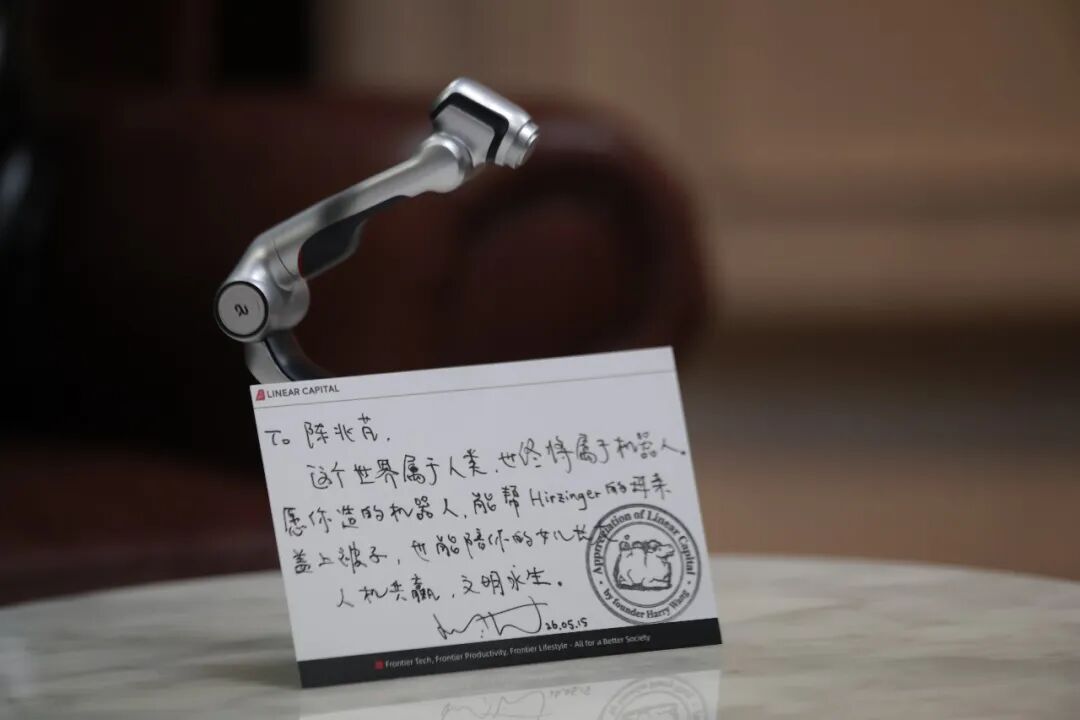
▍Zhaopeng Chen: Thank you, Harry.
▍Harry Wang: Let's verify it in ten years.
Due to space constraints, this article covers about one-third of the interview content from that day.